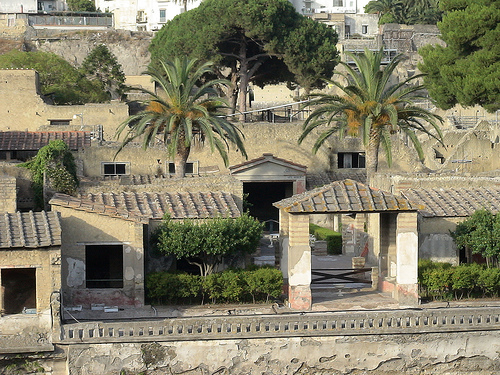
Location: Via 4 Novembre, Ercolano (Herculaneum), Campania region Map
Destroyed: August 24th, 79 AD
Open: Apr- Oct 8:30am-
5:30pm
Nov- March 8:30am- 5pm
Closed: 1 Jan, 1 May, 25 Dec
Entrance Fee: €7.5
Museo Archeologico Virtuale
Via 4
Novembre 44
Open: 9am- 5:30 Tue- Sun
Entrance Fee: €7.50
Herculaneum
or Ercolano in Italian is located in Campania region of Italy 5 miles (8km) South- East of modern Naples. Herculaneum is less famous victim of the Vesuvius that destroyed Pompeii on August 24th, 79 AD.
Beautiful Herculaneum was smaller in size and population (just 4000-
5000 citizen by modern estimation) yet people who lived here were
richer and higher in status. Their homes indicate great care and
wealth that they put into designs. Unlike its neighbor Pompeii,
Herculaneum was destroyed by a series of six volcanic avalanches of
pyroclastic flows (mixture of volcanic mud of high temperature that
reach 500°C, hot volcanic gas, pumice, rocks and hot ash) that
covered the city and instantly incinerated humans, organic matter
and other objects. Ironically solidified volcanic tuff also
preserved bones of Herculaneum residents and most importantly it
carbonized wooden objects that usually rot and disappear quickly.
This includes such fragile artifacts like tables, doors, food items,
combs and even fragments of a cradle with baby bones. It gives a
better idea of daily Roman life and ancient people.
Additionally, Herculaneum preserved oldest Christian home chapel
with a Cross mounted on the wall. As far as we know this is the
oldest example of Christian symbol anywhere in the former Roman
Empire.
Today a large part of Herculaneum have been
excavated in the volcanic rock. It gives an impression of the
magnitude of natural might that was unleashed on Herculaneum. If you
want to visit the archaeological site of Herculaneum in the summer
months don't forget to take plenty of water, get some sun block and
try to stay from the sun. It can get very hot here very quickly. The
entrance fee to the site is 7.5 Euros good for one day. If you want
to visit nearby Pompeii you can get a ticket for 20 Euros good for
three days. If you get hungry you can get food in small stores just
outside of Herculaneum Archaeological site. Don't forget to visit
MAV (Museo Archeologico Virtuale), a history museum dedicated to the
ancient Herculaneum and mementos that they left centuries ago. This
ancient site might be interesting and entertaining to both adults
and kids. Although the appearance of some of the frescoes might be
inappropriate for small children.
According to legend, Dionysius of Halicarnassus narrates that
Herculaneum was founded by Hercules, returning from Iberia with a herd
of oxen taken from Geryon, in 1243 BC, while historically there is no
certain information about its foundation due to lack of verification
elements such as finds, which do not go beyond the 2nd century BC.
Strabo claims that the city was founded by the Osci in the 12th century
BC: the hypothesis could be true as some transcriptions from the Oscan
language have been found, which would have remained in use in
Herculaneum until the Roman conquest. According to others, however, the
city was founded by the Etruscans between the 10th and 8th centuries BC,
when the whole territory came under the influence of the Italic people.
In 479 BC. Herculaneum was conquered by the Greeks, precisely by the
Pelasgians: under the influence of the Hellenic people, the urban layout
proposed by Ippodamo da Mileto was adopted, similar to the nearby
Neapolis, of which it is claimed that it was a suburb; under the Greeks
the mention of Herculaneum appears for the first time, precisely in 314,
in a writing by Theophrastus, with the Greek name of Ἡράκλεια. The city
was later expanded during the 5th century BC. after the conquest of the
Samnites; between the 4th and 3rd century BC it becomes part of the
Roman orbit: if during the second Samnite war its position is uncertain,
if deployed as an enemy of Rome together with Naples or as an ally with
Pompeii, in the third Samnite war it is against the Romans, being
subsequently defeated. It is in this period that the Romans begin to
prefer villas along the Herculaneum coast, building sumptuous
residences; during the social war, entered in the Nocerina
confederation, the city was attacked and conquered in 89 BC. by a legate
of Lucio Cornelio Silla, Tito Didio, thus ending its political
independence and becoming a municipality of Rome, administered by a
colony of veterans of the Sillano army. At the end of the republican age
it had already become an established holiday center for the Roman
aristocracy: Lucio Anneo Seneca, in his De ira, narrates that Gaius
Julius Caesar would have destroyed a villa near the coast of Herculaneum
in which the mother, avenging her. During the imperial era it
experienced its period of maximum splendor thanks to the tribune,
elected in 32 BC, and later declared patron, Marco Nonio Balbo, who
promoted the construction of new buildings, such as the Basilica and the
restoration of the walls: in the the same period was followed by the
construction of the theatre, the aqueduct and two thermal complexes.
In 62 Herculaneum was hit by an earthquake which made renovation
work necessary: an epigraph shows that Vespasian had the Basilica and a
temple restored at his own expense. The restorations had not yet been
completed when in 79, precisely on August 25, or in any case a period
after this date, it was affected by the eruption of Vesuvius: compared
to Pompeii, it did not suffer the rain of ashes and lapilli due to the
direction of the wind, despite being on the slopes of the mountain.
However during the night, following the collapse of the column of
volcanic materials, it was hit by pyroclastic flows at a speed of over
one hundred km/h at high temperatures, formed by water, mud, rock and
liquefied pumice, which covered it under a stratum varying from ten to
fifteen metres, which later reached twenty-five following other
eruptions, such as that of 1631. Over the years, this material has
solidified into pappamonte, a sort of tuff but softer, which has made it
possible to conserve materials organic materials such as wood, papyrus
and food, instantly charred by the high temperatures of the pyroclastic
flows. Herculaneum therefore ceases to exist; after the eruption there
is no recovery of an inhabited center: in 121 Hadrian orders the
reopening of the coastal road that passes through the city and goes from
Naples to Stabia and Nocera, along which some sporadic houses are built
Archaeological excavations, ☎ +39 081 8575347, pompei.info@beniculturali.it Full €11.00; Reduced €5.50. - From April 1st to October 31st: Herculaneum, Oplontis and Stabiae: 8.30 - 19.30 (last admission 18.00). From November 1st to March 31st: Herculaneum, Oplontis and Sabia: 8.30 - 17.00 (last admission 15.30).
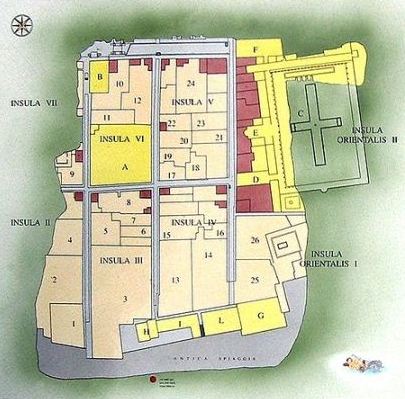
1. House of Aristide
2. H. of Argo
3. H. of the Inn
4.
H. of the Genius
5. H. of the Skeleton
6. H. of the Bronze
Herma
7. H. of the Opus Craticium
9. H. of Galba
11. H.
of the double atrium
14. H. of the Alcove
15. H. of the
Deer
17. Samnite House
18. H. of the Great Portal
20.
H. of the Carbonised Furniture
23. H. of the Corinthian
Atrium
24. H. of the Bicentary
Public buildings
A.
City Baths
C. Palestra
G. Suburban Baths
I. Sacred Area
L. Terrace of M. Balbus
Much of Herculaneum is still covered by sediment and soil. Archaeological digs continue on this site as we speak. Although it is slightly smaller site than neighbouring Pompeii it is still easy to loose yourself here. For an ease of orientation we broke up the map of Herculaneum on insulas or city blocks. Each city block has several houses with numerous families that lived and died here. According to historian Lucius Cornelius Sisenna stated that settlement of Herculaneum was encircled by small defensive city walls that were constructed in the second century BC. Military fortifications had a rectangular shape that covered over over 20 hectares of land. After Herculaneum became part of the Roman empire walls lost much of its strategic purpose. They were simply incorporated into new buildings constructed around them. The city was ruled by political heads known as duumvirs. They were re- elected annually. At the time of its destruction it had a population of approximately 4000 residents. City arteries, its roads included five cardos and tri decumanus. City blocks were known as insula or insulae. Layout of the settlement is still broken into insula for ease of orientation.
View of the Suburban District of the ancient Herculaneum. This was the sea
shore of the old town of Herculaneum before eruption didn't move the
shore line half a mile further away by depositing geological sediments
in the sea. The bottom row of arches is the boat docks where over 300
skeletons of women, men and children were discovered. On the extreme
right you can see a rectangular building of the Suburban Thermae or
Baths. Next to it is a terrace with an altar and a statue of town's
benefactor M. Nonius Balbus. On
the extreme left is the terrace that is known as The Sacred Area of Herculaneum.
Boat docks
The
ancient boat docks, or boathouses (fornici), of Herculaneum
represent one of the most poignant archaeological discoveries at the
site. Located along the former shoreline at the base of the Sacred
Area terrace, these arched stone vaults originally served as storage
sheds for small boats and harbor equipment. During the catastrophic
eruption of Mount Vesuvius in 79 AD, hundreds of residents sought
refuge here, hoping the sea would offer escape. Tragically,
pyroclastic surges overwhelmed the area, preserving nearly 300
skeletons in dramatic poses of despair. Today, resin casts of these
victims placed in situ create a haunting, immersive experience that
vividly illustrates the human cost of the disaster while showcasing
the city's bustling maritime life.
Suburban Thermae or Baths
The Suburban Thermae, or Suburban Baths, of Herculaneum are among
the best-preserved Roman bath complexes in the ancient world,
offering exceptional insight into daily hygiene and social rituals.
Situated near the ancient shoreline and likely funded as a public
gift by the prominent citizen M. Nonius Balbus, these baths feature
intact vaults, marble cladding, stucco decorations, frescoes, and
carbonized wooden elements. Divided into sections for changing
(apodyterium), cold (frigidarium), warm (tepidarium), and hot
(caldarium) rooms, they provided luxurious facilities with sea
views. Their remarkable state of preservation, thanks to protective
volcanic debris, allows visitors to imagine Roman bathers enjoying
heated pools and ornate surroundings in this elite seaside resort.
The Sacred Area
The Sacred Area in Herculaneum is a raised terrace overlooking the
ancient coastline, dedicated to religious worship and civic
reverence. This western sector of the south terrace housed two small
temples: one to Venus (with traces of frescoed landscapes and a
portico) and another to the Four Gods. Supported by heavy vaulted
substructures, it served as a spiritual focal point for merchants,
sailors, and residents near the harbor. Excavated later in the 20th
century, the area reveals how Romans integrated sacred spaces into
public life along the waterfront, blending devotion with scenic
beauty before the eruption buried it under layers of ash and mud.
Terrace of M. Nonius
Balbus
The Terrace of M. Nonius Balbus is a monumental
public space honoring one of Herculaneum’s most generous
benefactors, the Roman senator and proconsul Marcus Nonius Balbus.
Overlooking the sea and adjacent to the Suburban Baths, it features
a marble-covered funerary altar and an equestrian statue base,
erected by decree of the local senate in recognition of his
patronage and civic contributions. The terrace served as a prominent
gathering place, with honors including processions and special
theatrical seats. Its elevated position and inscriptions highlight
the profound respect for local elites in Roman society and provide a
striking visual anchor at the southeastern edge of the
archaeological park.
Theatre
The Theatre of Herculaneum, constructed during the Augustan period
in the 1st century AD, was a grand venue capable of seating around
2,500 spectators for plays, concerts, and public events. Partially
buried beneath the modern town of Ercolano, it was the first major
structure rediscovered in the 18th century through tunneling
efforts. Built with a typical Roman semicircular design, it featured
ornate decorations, including bronze statues and marble elements,
some of which are now in the Naples Archaeological Museum. Though
access is limited or via special underground pathways, the theatre
underscores Herculaneum’s vibrant cultural life as a sophisticated
resort town before Vesuvius silenced its stages forever.
Insula II is a well-excavated residential block in Herculaneum,
bordered by ancient streets like Cardo III, revealing the dense
urban layout of Roman townhouses and shops. This insula includes
several notable private residences excavated in the early 19th
century, showcasing multi-story architecture, peristyles, and
preserved wooden elements thanks to the carbonizing effects of the
eruption. It exemplifies how elite homes coexisted with more modest
structures in a compact seaside community, offering archaeologists
valuable insights into domestic life, social stratification, and
building techniques in a prosperous Campanian town.
House of Aristide and the House of Argo
The House of Aristides (also known as Casa di Aristide) and the
adjacent House of Argo (Casa d’Argo) are two prominent
early-excavated villas in Insula II, representing the luxurious
lifestyle of Herculaneum’s upper class. The House of Aristides opens
directly onto its atrium, with lower levels possibly used for
storage, though it suffered some damage from initial digs. The House
of Argo, named after a lost fresco depicting the myth of Argus
guarding Io, features a large peristyle, elegant reception rooms,
and upper-floor traces, making it one of the most beautiful houses
uncovered in the 1820s-1830s. Together, they highlight refined Roman
domestic architecture with colorful frescoes, gardens, and practical
layouts suited to a coastal elite residence.
House of the Genius
The House of the Genius (Casa del Genio), located in Insula II near
the House of Argo, derives its name from a small statue of a winged
cupid or guardian spirit (genius) discovered adorning a candlestick
within its walls. Partially excavated between the 1820s and 1850s,
this spacious residence includes a peristyle with a rectangular
basin and reflects the grandeur of Herculaneum’s noble homes. Like
its neighbors, it preserves evidence of refined living spaces that
combined functionality with artistic decoration. The find of the
genius figure adds a personal, protective spiritual dimension to the
household, typical of Roman domestic cults, offering a glimpse into
the private beliefs of its ancient inhabitants.
Insula III in ancient Herculaneum represents a densely built
residential block along Cardo IV, showcasing a mix of elite
patrician homes and more modest dwellings from the final days
before the AD 79 eruption of Vesuvius. This insula offers
visitors a fascinating cross-section of Roman urban life, with
well-preserved structures that highlight architectural
adaptations, daily routines, and the dramatic impact of the
volcanic disaster on its inhabitants.
House of the Wooden Partition
The House of the Wooden Partition (Casa del Tramezzo di Legno)
in Herculaneum's Insula III stands out for its exceptionally
rare surviving wooden sliding partition that once separated the
atrium from the tablinum. This carbonized but intact feature
allowed Roman homeowners to control privacy, light, and social
interactions in elegant living spaces. The house, originally a
spacious patrician residence that later saw parts subdivided,
provides remarkable insight into domestic architecture and the
use of perishable materials preserved by the eruption's
pyroclastic flows.
House of the
Skeleton
The House of the Skeleton in Herculaneum's Insula III
derives its evocative name from the discovery of a human
skeleton inside, a poignant reminder of the tragic fate of those
who could not escape the AD 79 Vesuvius eruption. This domus
features preserved architectural elements and offers a vivid
snapshot of everyday Roman life interrupted by catastrophe. Its
finds and layout illuminate the hurried attempts at survival
amid the chaos of falling ash and toxic gases.
House of the Inn
The House of the Inn (Casa dell'Albergo) in Herculaneum's Insula
III is a large and luxurious waterfront dwelling originally
mistaken for a hotel due to its size and private baths. Built in
the Augustan period with panoramic views over the Bay of Naples,
it features an impressive atrium with an impluvium and reflects
the wealth of its owners. The structure exemplifies elite Roman
residential design adapted to the coastal landscape of the town.
House of the Bronze Herma
The House of the Bronze Herma (Casa dell'Erma di Bronzo) in
Herculaneum's Insula III is named after a distinctive bronze
herm portrait, likely of the homeowner, discovered in the
tablinum. This elongated, older residence features beautiful
third-style frescoes and a central impluvium, highlighting the
personal and status-driven decoration typical of prosperous
Roman households. The herm serves as a powerful symbol of
self-representation in ancient domestic spaces.
House of the Opus Craticium
The House of the Opus Craticium in Herculaneum's Insula III
exemplifies economical Roman construction techniques using
timber framing (opus craticium) with rubble infill, allowing for
thinner walls and efficient use of space in later-period
apartments. Excavated in the early 20th century, this
multi-family dwelling replaced earlier structures and preserves
traces of fourth-style decoration and furniture. It provides
valuable evidence of how less affluent residents adapted to
urban density and economic realities in the final years of the
city.
Insula IV in Herculaneum features prestigious seaside properties
with stunning views of the ancient coastline, blending luxurious
residential architecture with practical urban planning along major
cardines. This block includes some of the site's most opulent homes,
showcasing advanced decorative programs, mosaics, and gardens that
reflect the high social standing of their owners before the
catastrophic burial in AD 79.
House of the Alcove
The House of the Alcove (Casa dell'Alcova) in Herculaneum's Insula
IV consists of two joined buildings connected by a stepped entrance,
creating a unique mix of rustic simplicity and ornate decoration.
Named for its distinctive alcove or apse-like feature in one of the
rooms, this dwelling offers insights into adaptive Roman housing
practices and includes well-preserved courtyards and living spaces.
Its layout highlights the blending of different architectural
traditions within a single property.
Fullonica
Fullonica or cleaning service is a small business that
survived the eruption. It is adjacent to the House of the Alcove and
many archeologists suggested that it once belonged to the owner of the
house. During archeological digs scientists discovered tanks for
cleaning. Ancient Romans used acidity of urine to wash off dirt. Ancient
Roman cities even had a job position that involved a worker walk around
the city and ask for some urine for their business. In addition to the
business part of the buildings, residential area of its workers was also
found here. Living in the place that smelled like a giant toilet was
probably pretty bad.
House of the Deer
The
House of the Deer (Casa dei Cervi) in Herculaneum's Insula IV is one of
the most luxurious seaside villas, famous for its exquisite marble
statues of deer attacked by dogs that gave the house its name.
Overlooking the Bay of Naples, this grand residence belonged to a
wealthy owner (possibly a freedman) and features rich frescoes,
still-life paintings, and a sophisticated layout with terraces and a
central courtyard. It exemplifies the pinnacle of Roman domestic luxury
and artistic patronage in the 1st century AD.
House of the Mosaic Atrium
The House of the Mosaic Atrium (Casa dell'Atrio a Mosaico) in
Herculaneum's Insula IV earns its name from the striking black-and-white
geometric mosaic pavement in its atrium, featuring intricate patterns
and floral motifs. Positioned with a southern aspect toward the sea,
this elegant domus includes a chessboard-style decoration and other
refined elements that underscore the refined tastes of its inhabitants.
The wavy pavement caused by volcanic pressures adds a dramatic testament
to the forces that preserved yet altered the structure.
Other buildings in this part of Herculaneum include:
House of the Painted Papyrus, House of the Stofa
Insula V in Pompeii's Regio V is a relatively well-preserved block of
residential buildings located in the eastern part of the ancient city,
offering valuable insights into the daily life, architecture, and social
structure of Pompeian society before the catastrophic eruption of Mount
Vesuvius in 79 AD. This insula features a mix of modest dwellings and
more elaborate homes, many of which were still under renovation or
partially damaged at the time of the disaster, reflecting the seismic
activity that preceded the final eruption. Excavated in various
campaigns, Insula V provides archaeologists with examples of Samnite-era
influences alongside later Roman modifications, including intricate
mosaics, atria, and private shrines that highlight the blending of
public and private spaces in Roman domestic life.
House of the Bicentary
(Casa del Bicentenario) is one of the most significant and largest
houses in Insula V, named after its discovery during the 1938
bicentennial celebrations of Pompeii's first systematic excavations.
This elegant residence features a grand Tuscan-style atrium with a
central impluvium, beautifully preserved frescoes in the Fourth Style,
and upper-floor rooms that suggest it belonged to a wealthy family or
possibly served commercial functions. Its well-maintained condition,
including wooden architectural elements and a private lararium
(household shrine), makes it an excellent example of upper-class
Pompeian living, complete with evidence of post-earthquake repairs.
House of the Beautiful Courtyard
(Casa del Bel Cortile) stands out for its charming and spacious internal
courtyard that gives the property its name, providing natural light and
ventilation to the surrounding rooms in typical Roman fashion. The house
displays refined wall decorations and architectural features that
indicate a comfortable middle-to-upper-class occupancy, with direct
access patterns suggesting integration into the neighborhood's social
fabric. Its courtyard design exemplifies how Pompeian homeowners
maximized limited urban space for both aesthetic pleasure and practical
household activities.
House of the Carbonised Furniture
(Casa dei Mobili Carbonizzati) is renowned for the remarkable
preservation of wooden furniture and everyday objects that were
carbonized by the hot pyroclastic flows during the eruption, offering
rare tangible insights into Roman domestic interiors. This house
features a traditional layout with an atrium and peristyle, along with
frescoed walls that retain much of their original vibrancy, allowing
visitors to imagine the daily routines of its inhabitants amid the
volcanic catastrophe.
House of the Corinthian Atrium
(Casa dell'Atrio Corinzio) is distinguished by its impressive
Corinthian-style atrium, characterized by elegant columns that reflect
Hellenistic architectural influences popular in Roman Italy. The refined
decorative scheme and spatial organization highlight the owner's
aspiration to display status and cultural sophistication, while
surviving artifacts provide clues about the household's activities and
the broader economic life of Pompeii.
House of the Great Portal
(Casa del Gran Portale) earns its name from the monumental and ornate
entrance portal that immediately impresses visitors, signaling the
prosperity of its ancient residents. Inside, the house reveals a
harmonious blend of living quarters, service areas, and decorative
elements typical of Pompeian elite dwellings, including wall paintings
that depict mythological scenes and daily life motifs.
House of the Neptune Mosaic
(Casa del Mosaico di Nettuno) features a stunning mosaic floor depicting
the sea god Neptune (Poseidon), showcasing the high level of artistic
skill and mythological reverence common in Pompeian homes. This
decorative centerpiece, combined with other architectural details,
points to a household that valued luxury and classical themes, making it
a highlight for understanding private art patronage in the Roman world.
House of the Wooden Sacellum
(Casa del Sacello di Legno) is notable for its small wooden shrine or
sacellum dedicated to household gods, a feature that underscores the
deep integration of religious practice into everyday Roman domestic
life. The preserved wooden elements and modest yet functional layout
provide a more intimate glimpse into the spiritual and practical world
of a typical Pompeian family.
Samnite House (Casa
Sannitica) represents an important example of pre-Roman Samnite
architecture within Pompeii, characterized by its austere yet solid
construction and distinctive atrium style that predates many of the more
opulent Roman modifications seen elsewhere in the city. Its survival
offers crucial evidence of the cultural transition from Samnite to Roman
dominance in the region, with simpler decorative schemes that contrast
with later Fourth Style frescoes found in neighboring properties.
Other buildings in this part of Herculaneum include:
H. of the Tailor, H. Apollo the Citharist
Insula VI in ancient Herculaneum represents a vibrant urban block
that showcases a mix of public, religious, and residential
architecture typical of a prosperous Roman town before the
catastrophic eruption of Mount Vesuvius in 79 AD.
Collegial shrine of the Augustales
The Collegial shrine of the Augustales, also known as the Sede degli
Augustali or Hall of the Augustales, served as a key civic and
religious center dedicated to the imperial cult, particularly
honoring Emperor Augustus and his successors. This building in
Insula VI featured a central hall with a shrine flanked by side
rooms, where the College of Augustales—a group of freedmen
responsible for organizing imperial worship—held meetings and
rituals; notable surviving elements include frescoes depicting
mythological scenes like Hercules and well-preserved architectural
features that highlight its importance in local social and political
life.
Central Thermae
The Central Thermae, or Central Baths, built around the 1st century
AD in Insula VI, provided essential public bathing facilities with
separate sections for men and women, including the standard sequence
of frigidarium, tepidarium, and caldarium rooms. These baths
functioned not only as hygiene centers but also as important social
and cultural hubs, featuring impressive architecture, heating
systems, and decorative elements that reflected the Roman emphasis
on communal wellness and leisure in Herculaneum.
House of the Tuscan Colonnade
The House of the Tuscan Colonnade (Casa del Colonnato Tuscanico) is
a notable private residence in Insula VI characterized by its
distinctive Tuscan-style colonnade and an unusual layout suggesting
the merger of two earlier dwellings. With entrances on different
streets, it includes well-preserved frescoes, architectural details,
and living spaces that offer insight into the daily life and tastes
of affluent Roman homeowners in Herculaneum.
House of the Double Atrium
The House of the Double Atrium (Casa dei Due Atri) stands out for
its elongated plan featuring two distinct atriums—one tetrastyle
with tall columns and another of Etruscan type complete with an
impluvium—allowing for sophisticated multi-level living and enhanced
light and ventilation. This design, along with upper-floor evidence
and decorative elements, illustrates advanced Roman domestic
architecture adapted for comfort and status in the densely built
town.
House of the Black Hall
The House of the Black Hall (Casa del Salone Nero) is renowned for
its elegant peristyle with a four-sided colonnade and a striking
large black-painted oecus (hall) that creates a dramatic,
sophisticated ambiance ideal for receptions. Featuring Fourth Style
decorations, wooden shrines, and high-status rooms, it exemplifies
the refined lifestyle of Herculaneum's elite residents.
Insula VII in Herculaneum contains a blend of public and private
structures, with only a portion excavated due to its position
beneath modern development, revealing significant insights into
the town's civic and residential fabric.
Basilica Noniana
The Basilica Noniana, also called Galleria Balbi, is a prominent
public building in Insula VII that served judicial, commercial,
and civic functions typical of Roman basilicas. Partially
excavated with entrances along Cardo III, it features
substantial architectural remains that underscore its role as a
key administrative and social center in ancient Herculaneum.
House of Galba
The House of Galba (Casa di Galba) in Insula VII derives its
name from a silver bust of Emperor Galba found nearby, though
much of the structure remains unexcavated beneath modern
overlays. This Samnite-period house includes notable features
like a kitchen with cocciopesto flooring and vivid wall
paintings, providing glimpses into elite Roman domestic life.
Villa of the Papyri in Herculaneum
The Villa of the Papyri, located just outside the main urban
area near Herculaneum, is one of the most extraordinary Roman
villas ever discovered, famous for its extensive library of
carbonized papyrus scrolls containing philosophical texts. This
luxurious seaside estate, with its peristyles, gardens,
sculptures, and sophisticated layout modeled after Greek
influences, belonged to a wealthy owner (possibly linked to the
Piso family) and offers unparalleled evidence of elite Roman
intellectual and artistic culture preserved by the volcanic
burial.
Herculaneum streets and shops. The stones on the road were designed to allow
citizens to pass the streets that were often muddy, but at the same time
it would not prohibit wheels of carts to pass. Parts of the central
street of Herculaneum, Decumanus Maximus, were closed to wagons and
carts. Apparently these parts of the road were used as a forum of a
city.
Herculaneum was built in the central area of the Gulf of Naples, at the
foot of Vesuvius, on a volcanic plateau overlooking the sea, protected
at the north and south ends by two valleys in which two streams flowed;
Lucio Cornelius Sisenna describes it thus:
«Oppidum tumulo in
excelso loco propter mare, parvis moenibus, inter duos fluvios infra
Vesuvium collocatum.»
(Lucius Cornelius Sisenna)
Strabone
instead praises the healthy air and its strategic position along the
coastal road. In its urban planning it retraces the Greek model proposed
by Ippodamo da Mileto: protected by walls, it had the shape of a regular
chessboard, divided into rectangular lots called insule, defined by two
types of road axes, namely the decumani, which in Herculaneum were three
and ran from east to west, following the coastline, and the hinges,
which were five and ran from north to south, descended from Vesuvius to
the sea; the streets were paved with volcanic or calcareous stone and
had sidewalks on the sides sometimes covered by porticoes near the
richest residences or, as in the case of the decumanus maximus, covered
along its entire length. In total Herculaneum had an extension of about
twenty hectares for a population which, at the time of the eruption, was
between 4,000 and 5,000 units: most of the people managed to get to
safety, few were found in the inside the buildings or on the streets,
while a group of about three hundred bodies were found charred dead in
the warehouses of the port, surprised in their sleep by the pyroclastic
flows.
The economy of Herculaneum was not based on manufacturing
activity but was mainly based on fishing, with the port area favored by
the two inlets at the mouth of the rivers, one larger to the east, the
other smaller to the west, and on agriculture with the cultivation of
olive trees, wheat, figs and vines and the production of wine such as
Lacrima Christi and Lympha Vesuviana. The city was equipped with a forum
and the main economic activities were given by the shops and the rental
of commercial premises and restored houses.
Having a mostly
residential function, the city enjoyed less cultural autonomy and this
favored the field of innovation, also visible in the architecture: in
fact, the Herculaneum house, compared to the Pompeian one, was smaller
but sometimes decorated more sumptuous, with the use of frescoes,
mosaics and marbles with the opus sectile technique. The most luxurious
houses were located along the edge of the hill, overlooking the sea, or
just outside the urban centre, such as the Villa dei Papiri for example:
the houses had running water but not all were equipped with a sewer.
Furthermore, compared to Pompeii, no electoral posters were found along
the walls in Herculaneum, just as the language of the graffiti appears
to be less ironic. The city was equipped with three thermal complexes
including the Suburban Baths and those of the Forum, a Palaestra, a
Theater capable of accommodating 2,500 people, several temples and
public buildings such as the Basilica and the Basilica Noniana, while
the walls, originally built for defensive purposes with large pebbles of
lava stone and pumice and in which narrow doors opened, which became
useless after the Roman conquest and were partly incorporated into the
buildings.
Between 1709 and 1710 during the construction of a well, a farmer came
across some pieces of marble: he had found the theater of ancient
Herculaneum; of the first excavations, through underground tunnels, were
conducted at the behest of Prince Emanuele Maurizio d'Elbeuf, but
interrupted shortly after by the judiciary for fear of collapse of the
buildings above. New explorations took place starting from 1738 at the
request of Roque Joaquín de Alcubierre to Charles of Bourbon, who was
joined in 1750 by Karl Jakob Weber: with the discovery of Pompeii and
the movement of vehicles and men towards the new site, the
investigations in Herculaneum they ceased definitively in 1780.
During the 19th century two short campaigns were carried out, this time
using the open-air excavation technique: the first from 1828 to 1855
commissioned by Francesco I delle Due Sicilie, the second from 1869 to
1875 led by Giuseppe Fiorelli, both suspended for few finds.
A
turning point in the investigations took place in 1924 with the
superintendent Amedeo Maiuri, followed later by Antonio De Franciscis:
after a long process of expropriations, in about twenty years of
excavation he brought to light four hectares, which correspond to the
extension of the current archaeological park, out of the total twenty of
the ancient city, which was followed by consolidation and restoration
works. Small excavation campaigns also took place during the second half
of the 20th century, when the site was mostly maintained: in 1997 the
archaeological excavations of Herculaneum, together with those of
Pompeii and Oplontis, were declared a UNESCO World Heritage Site of
humanity. The majority of the finds found in Herculaneum are kept in the
National Archaeological Museum of Naples: they are objects of daily use,
paintings, mosaics and statues. In the Herculaneum houses, thanks to the
layer of pappamonte that was formed following the eruption, it is
possible to see the remains of pieces of charred wood, furniture and
partitions and it is precisely due to the solid layer of rock that the
site over the years it is protected from looting, due to the difficulty
of digging and the considerable depth.
The ancient Herculaneum and its findings have been the subject of
several films and documentaries. In 1962 the film directed by Gianfranco
Parolini, Year 79 - The destruction of Herculaneum, the city is the
backdrop to the events of the tribune Marco Tiberio and the slave Livia
in the hours of the eruption of Vesuvius.
The documentary Gli
skeletri del Mistero, which involved the archaeologist Mario Pagano, the
volcanologist Giuseppe Mastrolorenzo and the anthropologist Pierpaolo
Petrone, dates back to 2002: the theme is that of the discovery of the
skeletons along the ancient beach of Herculaneum.
Other
documentaries are Herculaneum diaries of darkness and light, by director
Marcellino de Baggis and The secrets of Herculaneum, made by Rai in
2019. Alberto Angela has dealt with Herculaneum several times: in
particular in the documentary Stanotte a Pompei and in the last episode
of the fourth edition of Meraviglie - The peninsula of treasures, where
he focused on the theater.
By Plane
The nearest airport to Ercolano (ancient Herculaneum) is
Naples Capodichino International Airport (IATA: NAP), located
approximately 10–13 km (6–8 miles) away. This modern facility serves
numerous domestic and international flights, making it a convenient
entry point for visitors exploring the archaeological wonders of
Herculaneum, Pompeii, and the Vesuvius area.
From the airport, there
is no direct public transport to Ercolano. The most straightforward
option is to take the Alibus shuttle (about €5–7, 15–20 minutes) to
Naples Centrale / Piazza Garibaldi station, then transfer to a train
(see below). Taxis cost around €25–40 depending on traffic, while
private transfers or rideshares are also widely available and
recommended for groups or those with luggage. The drive typically takes
15–25 minutes under normal conditions.
By Train
Ercolano is
well-connected by two independent railway networks, offering flexible
options from Naples and beyond.
Trenitalia: The Portici-Ercolano
station serves the main Naples–Salerno line. This is useful for regional
connections, though it's about 1.5–2 km from the main archaeological
site. Trains run frequently; travel time from Naples is short (around
10–15 minutes).
EAV Circumvesuviana (the most popular choice for
tourists): The key stations are Ercolano-Scavi (closest to the
Herculaneum ruins, just a 5–10 minute downhill walk) and Ercolano-Miglio
d'Oro (handy for villas along the historic road). These lie on the
Naples–Sorrento and Naples–Poggiomarino lines. Trains from Napoli
Garibaldi (part of Naples Centrale) or Porta Nolana take about 15–20
minutes and cost around €2.70 one way. Services run frequently (every 30
minutes or so), though be sure to confirm you alight at Ercolano-Scavi
for the excavations.
Tip: The Circumvesuviana can get crowded
with tourists heading to Pompeii or the Amalfi Coast—watch your
belongings. For a more comfortable ride, consider the seasonal Campania
Express tourist train (March–October), which stops at Ercolano with
fewer halts.
By Bus
Ercolano enjoys good bus connections from
various operators, including local and national services. From Naples,
the EAV company operates reliable routes directly to Ercolano, with
journeys taking 20–50 minutes depending on traffic and the specific line
(e.g., bus 222 or similar services from Piazza Garibaldi).
Buses are
an affordable option (€2–5) and integrate well with the regional transit
network. Long-distance coaches from farther afield (e.g., FlixBus) may
also stop nearby. Check current timetables via the EAV app or website,
as services can vary.
By Car / Road
Ercolano is easily
accessible by car via the A3 motorway (Napoli–Salerno–Reggio Calabria).
Take the Ercolano exit and follow local signs toward the town center or
archaeological park. The distance from central Naples is only about 11
km (7 miles), making it a quick 15–25 minute drive.
Parking is
available near the site, though it can fill up during peak tourist
season (spring and summer). The area features scenic roads with views
toward Vesuvius, but note that narrow historic streets in the town
center may require careful navigation. Tolls on the A3 are modest for
this short stretch.
Additional Practical Advice
Ercolano
combines perfectly with a visit to nearby Pompeii (about 17 km away) or
a hike up Vesuvius. From Ercolano-Scavi station, the Vesuvio Express
shuttle offers convenient transfers to the volcano. Public transport in
the area is generally efficient but can be affected by strikes or summer
heat—plan ahead using apps like Citymapper or the official
EAV/Trenitalia sites. For a stress-free experience, especially with
children or mobility needs, consider a guided tour with included
transfers.
Summers in this region of Italy can be intensely hot and
humid, sometimes making outdoor exploration feel
overwhelming, especially during the peak months of July and
August when temperatures frequently climb into the high 80s
to low 100s°F (30–38°C).
Stay safe and comfortable in
the heat:
Drink plenty of water throughout the day — many
historic towns have public drinking fountains with fresh,
cool acqua potabile. Carry a reusable bottle and refill it
often.
Protect yourself from the strong Mediterranean
sun: wear a wide-brimmed hat, light-colored and
loose-fitting clothing, sunglasses, and apply a high-SPF
sunscreen.
Plan your sightseeing for the cooler morning
hours or late afternoon. Many shops and attractions close
during the traditional siesta (roughly 1–4 PM), when locals
escape the midday heat.
Security awareness:
Keep a
close eye on your belongings at all times. Tourist areas,
crowded piazzas, markets, and public transport are favorite
spots for pickpockets. Use a cross-body bag or money belt,
and avoid keeping valuables in easily accessible pockets.
Money matters:
Always carry some cash (euros) with
you. While larger cities and major tourist sites usually
accept credit cards, many small family-run shops, local
markets, street vendors, and rural villages still operate
primarily on cash. Having small denominations makes
transactions smoother and helps you avoid issues with card
readers or minimum purchase requirements.