Location: Sighişoara, Mures County Map
Constructed: 12th century
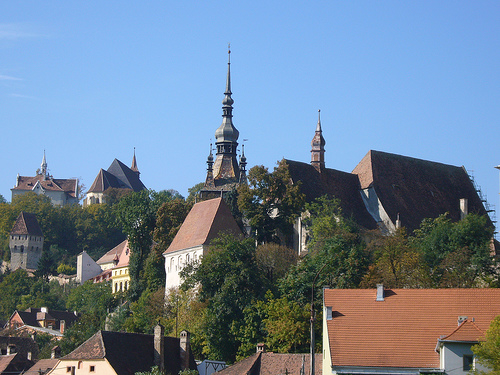
The Sighişoara Citadel, also known as the Historic Centre of Sighişoara, is a remarkably preserved medieval fortified town located in central Romania, in the historic region of Transylvania, within Mureș County. Situated on a hill overlooking the Târnava Mare River valley, it is approximately 40 miles northeast of Sibiu and 110 miles northwest of Bucharest. As one of the few inhabited medieval citadels in Europe—and the only one of its kind in Southeastern Europe—it continues to house residents while serving as a living testament to medieval urban life. In 1999, it was inscribed as a UNESCO World Heritage Site, recognized for its outstanding representation of a small fortified city that bridged Latin-oriented Central European culture and Byzantine-Orthodox Southeastern European influences. The site covers 33 hectares, with a buffer zone of 145 hectares, and draws visitors for its atmospheric cobbled streets, colorful burgher houses, ornate churches, and defensive structures that evoke the era of guilds, invasions, and craftsmanship.
Prehistory and Founding
Human habitation in the Sighişoara region
dates back millennia, with evidence of settlements from the Bronze Age
Wietenberg culture around 3500 years ago, followed by Roman Dacia
influences in later eras. The citadel itself, however, traces its
origins to the 12th century. In 1191, German settlers known as the
Transylvanian Saxons—primarily craftsmen and merchants from regions like
Flanders, Moselle, or Saxony—were invited by Hungarian King Béla IV to
colonize and defend the borders of the Hungarian Kingdom against
invasions. These settlers built the initial fortification on Citadel
Hill (also called School Hill), atop the site of a prehistoric
stronghold, to provide refuge for locals in the Târnava Mare River area.
The first written record of the settlement appears in 1280 as "Castrum
Sex" (Fort Six), likely referencing its position among other Saxon
fortifications. By this time, a small fortress and a Dominican monastery
had been established, underscoring its early importance as a defensive
and religious center.
The Saxons' arrival followed the devastating
Mongol (Tatar) invasion of 1241-1242, which had destroyed much of the
region and prompted a need for fortified settlements. Sighişoara marked
the northern boundary of the Saxon lands, alongside larger centers like
Sibiu (Hermannstadt) and Braşov (Kronstadt), and quickly grew into a
strategic outpost blending German architectural traditions with local
needs.
Medieval Development and Key Events
By the 13th
century, Sighişoara had evolved into a thriving trade and craft hub.
Inhabitants organized into guilds, with at least 15 documented by the
15th-16th centuries, including shoemakers, tailors, blacksmiths,
furriers, and goldsmiths. These guilds funded the construction of robust
defenses: fortress walls and 14 towers (nine of which survive) were
erected by the late 13th century, with expansions continuing into the
15th century to counter Ottoman threats. The city gained status as a
free royal town in the 14th century, enabling economic growth through
weekly markets and three annual fairs that attracted merchants from
across the region. Strict guild rules enforced quality, with punishments
like public shaming on a "wooden donkey" for fraud or substandard goods.
The 15th century marked a peak, with Sighişoara playing a key military
role. It withstood invasions, including those by Ottoman forces, and
served as a base for figures like John Hunyadi and Matthias Corvinus in
battles against the Turks. Notably, in 1431, Vlad II Dracul (father of
Vlad the Impaler) resided here, and his son Vlad III (Țepeș), later
infamous as the inspiration for Dracula, was born in the citadel.
However, the period from 1601 to 1676 was tumultuous, plagued by wars,
rebellions, plagues, earthquakes, and fires. In 1601, a Szekler army
treacherously occupied the citadel for a year, renaming it Nemesvar and
causing widespread damage. A 1612 siege by outlaws under Prince Báthory
was repelled by armed citizens. The most catastrophic event was the
Great Fire of April 30, 1676, which, fueled by winds, destroyed 70% of
the city, including much of the lower town and citadel, leading many to
consider abandonment before reconstruction began. Other trials included
Mongol invasions, witch trials, executions, and epidemics.
Throughout
these centuries, the citadel's defenses were continually fortified, with
walls raised from an initial 4 meters to up to 14 meters in places
between the 14th and 17th centuries to resist Turkish attacks.
Architecture and Defenses
Sighişoara's architecture is predominantly
Gothic, reflecting its Saxon roots. The citadel is encircled by a
930-meter wall, punctuated by towers named after the guilds that
maintained them, such as the Clock Tower (64 meters high, built in the
13th-14th centuries as the main gate and town hall), Tailors' Tower,
Tinsmiths' Tower (25 meters, four levels), and Shoemakers' Tower. Many
towers were rebuilt after the 1676 fire or other disasters; for
instance, the Furriers' Tower has four levels and was restored
post-fire, while the Goldsmiths' Tower was demolished in 1863 after a
lightning strike in 1809. Key structures include the Church on the Hill
(14th century, with Gothic elements) and the Monastery Church. The lower
town, rebuilt after 1676, features colorful houses and narrow streets
that have remained largely unchanged.
Cultural Significance and
Modern History
Sighişoara exemplifies the Transylvanian Saxons'
850-year culture, now preserved mainly through its monuments amid
ongoing emigration that threatens its heritage. Its strategic location
fostered a blend of Western and Eastern influences, making it a cultural
crossroads. During the Communist era, its Medieval German heritage was
remarkably preserved, unlike many other sites. By the late 19th century,
the medieval guild system declined with industrialization, transforming
Sighişoara into a "city museum."
Today, with a population of around
32,570 (2007 estimate), it hosts an annual Medieval Festival blending
arts, crafts, rock music, and stage plays, attracting tourists. Its
association with Vlad the Impaler adds a layer of intrigue, though the
citadel's true value lies in its authentic medieval fabric, which has
survived invasions, disasters, and time.
Sighişoara Citadel, located in the town of Sighişoara in Mureș
County, central Romania, is a remarkably preserved medieval fortress
built in the 12th century by Saxon (German) settlers, known as the
Transylvanian Saxons. Founded on the site of a prehistoric fortification
atop School Hill (Dealul Școlii), it served as a refuge for locals along
the Târnava Mare River and evolved into a strategic military and
commercial center. The citadel exemplifies the culture of these
settlers, blending Latin-oriented central European influences with
Byzantine-Orthodox elements from southeastern Europe. It was designated
a UNESCO World Heritage Site in 1999 for its outstanding testimony to
Saxon heritage and as an example of a small fortified border town that
has remained inhabited for centuries. The architecture primarily
reflects medieval Gothic styles from the late Middle Ages, with later
Renaissance and Baroque additions, creating a harmonious mix that has
withstood invasions, epidemics, and a devastating fire in 1676 that
destroyed 70% of the town.
The citadel occupies a hilltop plateau,
divided into the Lower Citadel (around the Citadel Square) and the Upper
Citadel (accessed via the Covered Staircase). It is enclosed by robust
defensive walls, narrow cobbled streets, and colorful burgher houses
with steep tiled roofs and ornate facades. The overall layout is compact
and organic, shaped by the terrain, with buildings clustered for defense
and community. Unlike many medieval sites, it remains a living town,
with residents inhabiting its historic structures.
Defensive
Structures: Walls and Towers
The citadel's architecture is defined by
its formidable defense system, built primarily between the 14th and 17th
centuries to counter Turkish attacks and other threats. The encircling
wall, originally about 930 meters long and 4 meters high, was later
reinforced to reach 9.3 meters on average and up to 14 meters in
vulnerable sections. Constructed from stone and brick, it featured
battlements, loopholes for archery, and five artillery bastions for
cannon fire. This wall not only provided physical protection but also
symbolized the economic prosperity of the Saxon guilds, who funded and
maintained it.
Integral to the walls are the 14 original guild
towers, each named after the craftsmen who built and occupied them as
headquarters, residences, and storage. These towers, mostly polygonal or
cylindrical in shape, were erected in the 14th-15th centuries during a
period of economic growth driven by tradesmen. Nine survive today,
showcasing Gothic elements like pointed arches, narrow windows, and
steep roofs, with some rebuilt after the 1676 fire. They vary in height
(up to 25-64 meters) and levels (2-5 floors), often with overhanging
upper stories for defensive overhangs (machicolations) to drop
projectiles on attackers. Here's a detailed list of the key towers:
Clock Tower (Turnul Ceasului): The most iconic structure, standing
64 meters tall as the main gate-tower and former town hall. Built in the
14th century with Gothic foundations, it was expanded with Renaissance
elements, including a baroque spire added in the 17th century after fire
damage. The square base transitions to an octagonal upper section,
topped by a colorful tiled roof with four small corner turrets and a
central spire. It features a mechanical clock from 1648 with a carousel
of figurines representing Roman gods (originally wooden, replaced with
metal after fires). The tower includes defensive features like arrow
slits and a balcony for panoramic views.
Tailors' Tower (Turnul
Croitorilor): A two-story gate-tower opposite the Clock Tower, rebuilt
in Renaissance style after a 1676 gunpowder explosion. It has a
hexagonal plan with thick walls and a steep roof, serving as a secondary
entrance.
Tinsmiths' Tower (Turnul Cositorilor): 25 meters high with
four levels, featuring a square base and overhanging wooden gallery for
defense. Connected to the Tanners' Tower via the Archers' Gallery, a
covered walkway for crossfire.
Butchers' Tower (Turnul Măcelarilor):
Hexagonal in shape, with multiple levels and a steep roof, rebuilt after
the 1676 fire. It exemplifies the functional yet fortified design
typical of guild towers.
Furriers' Tower (Turnul Cojocarilor): Four
levels high, destroyed in 1676 but rebuilt with Gothic windows and a
conical roof.
Blacksmiths' Tower (Turnul Fierarilor): Constructed in
1631 on the site of the older Barber's Tower, rebuilt post-1676 with a
robust, multi-level design.
Tanners' Tower (Turnul Tăbăcarilor): One
of the oldest, with a simple rectangular form and defensive slits,
guarding the Clock Tower area.
Ropemakers' Tower (Turnul
Frânghierilor): Restored in the 19th century, now a caretaker's dwelling
near the Evangelical Cemetery; it has a modest, functional design.
Cobblers' Tower (Turnul Cizmarilor): Also known as Shoemakers' Tower,
fortified in 1603 and rebuilt multiple times, with a polygonal base and
steep roof.
Lost towers include the Goldsmiths' (integrated into
a chapel), Weavers', and Fishermen's, demolished in the 19th century.
Several landmarks define the citadel's skyline and interior:
Clock
Tower (Turnul cu Ceas): The most iconic structure, this 64-meter
gate-tower houses a museum with medieval artifacts, astronomical clocks,
and wooden figurines that rotate to mark the days of the week. It offers
panoramic views from its balcony.
Vlad Dracul House: The presumed
birthplace of Vlad the Impaler, now a restaurant and small exhibition
space with Dracula-themed displays.
Church on the Hill (Biserica din
Deal): Accessed via the 175-step Covered Stairway (Scara Acoperită),
this 14th-century Gothic church features murals, a crypt with Saxon
tombs, and an organ from 1680.
Guild Towers: Including the Tailors'
Tower (opposite the Clock Tower, used for gunpowder storage until a 1676
explosion), Tinsmiths' Tower (25 meters high), and Shoemakers' Tower
(rebuilt in 1681 after fires).
Covered Stairway (Scara Şcolarilor): A
175-step wooden-roofed staircase built in 1642 to protect schoolchildren
from winter weather, leading to the Church on the Hill and Joseph
Haltrich High School.
Other highlights include the Weapons Museum
in the Clock Tower, the Torture Room exhibit, and the Evangelical
Cemetery with historic gravestones.
Culturally, Sighişoara Citadel represents the heritage of the
Transylvanian Saxons, akin to sites in Sibiu and Brașov, showcasing
medieval urban planning and guild-based society. It hosts the annual
Sighişoara Medieval Festival in July, featuring arts, crafts, rock
music, stage plays, and knight reenactments, drawing thousands of
visitors. The site's association with Dracula adds a layer of intrigue,
boosting tourism while preserving authentic history over myth.
In
recent years, conservation efforts have focused on maintaining its
UNESCO status, with minimal modern intrusions to keep it inhabited and
vibrant. Visitor information includes entry fees for key sites like the
Clock Tower (around 16 RON or €3.20 as of recent reports), and it's
accessible year-round, though summer is peak season. The citadel's charm
lies in its blend of history and liveliness—cafes, shops, and homes
coexist with ancient walls, making it a must-visit for those exploring
Transylvania's fortified towns.