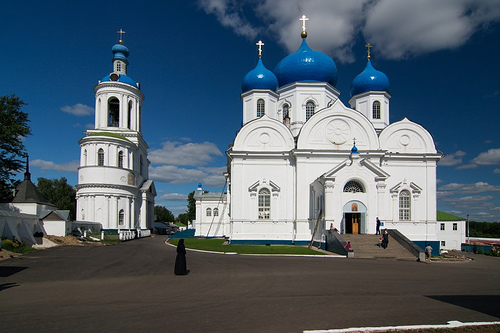
Nestled in the quaint settlement of Bogolyubovo within Russia's Vladimir Oblast, the Holy Bogolyubsky Monastery—fully named the Bogolyubsky Monastery in Honor of the Appearance of the Bogolyubsky Icon of the Mother of God (Nativity of the Virgin)—stands as a venerable Eastern Orthodox enclave. Positioned roughly 2 kilometers northeast of Vladimir city, where the Nerl River merges with the Klyazma, this site is integral to the esteemed Golden Ring circuit of historic Russian locales. The name "Bogolyubovo," meaning "beloved by God," stems from its storied beginnings involving celestial apparitions and royal piety. Originating in the 13th century atop the remnants of a 12th-century princely estate, it is enshrined as a UNESCO World Heritage Site under the "White Monuments of Vladimir and Suzdal" designation. This complex draws devotees, scholars, and sightseers alike, thanks to its fusion of archaic remnants, majestic temples, and tranquil riverside vistas, embodying the shift of authority from Kievan Rus' to the northeastern realms in medieval times.
Founding Legend and the Princely Residence (mid-12th century)
Prince Andrei Bogolyubsky, son of Yuri Dolgoruky, moved the political
center of northeastern Rus’ from Kiev northward. Around 1155–1158 he
transported the wonderworking Vladimir Icon of the Mother of God from
Vyshgorod. According to tradition (recorded in later sources such as the
early-18th-century Life of Prince Andrei Bogolyubsky and the
mid-18th-century Chronicle of the Bogolyubov Monastery by Igumen
Aristarkh), the horses carrying the icon halted near the Klyazma River.
That night the Theotokos appeared to the prince in a vision, commanding
him to leave the icon in Vladimir and to found a church and monastery on
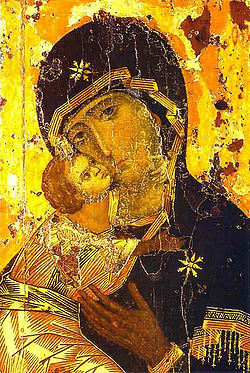
the spot. In response, Andrei commissioned the Bogolyubskaya Icon of the
Mother of God—a full-length standing image of the Virgin with arms
raised in prayer—which became the monastery’s chief relic.
Between
1158 and 1165 Andrei built a fortified white-stone residence (“grad
kamen’ Bogolyubovo”) that included:
A two-story stone palace
connected by a passage to the choir of the Cathedral of the Nativity of
the Theotokos.
A stone staircase tower.
A stone ciborium (canopy)
marking the exact site of the Theotokos’ apparition.
Defensive walls
and possibly additional towers.
European master builders
(possibly from Lombardy or southern Germany) participated, making the
complex architecturally exceptional for Rus’. The Nativity Cathedral was
richly decorated inside and out with gilded copper, frescoes (likely by
Greek painters), carved white-stone reliefs, and marble-like painted
columns. Contemporaries compared it to Solomon’s Temple.
The nearby
Church of the Intercession on the Nerl (built c. 1165, often dated
1158–1165) was commissioned by Andrei as a memorial church, possibly
linked to a victory over the Volga Bulgars or the death of his son
Izyaslav. Though not part of the monastery proper, it forms part of the
same artistic and spiritual ensemble and is one of Russia’s most iconic
medieval churches.
The Murder of Prince Andrei and Early Monastic
Life (1174–early 13th century)
On the night of 28–29 June 1174,
conspirators (boyars dissatisfied with Andrei’s centralizing policies)
murdered the prince in his own palace. The site of the killing—under the
staircase of the tower—survives to this day and remains a place of
veneration.
After Andrei’s death the residence declined. His
successors preferred Vladimir, and the palace fell into disrepair. A
monastery was likely established on the castle grounds either late in
Andrei’s reign or in the early 13th century by his successors, partly to
atone for the regicide. The first firm chronicle mention dates to
1214/15, when Bishop John of Rostov and Suzdal retired and died there;
he was buried “with the rest of the brotherhood” beside the Nativity
Cathedral, confirming an existing monastic community and cemetery.
The monastery suffered repeated devastation:
1177 – sacked by
Prince Gleb of Ryazan.
1238 – Mongol-Tatar invasion razed
fortifications.
Later raids in 1293, 1382, and 1411.
Yet it never
ceased functioning entirely.
Medieval and Early Modern Periods
(13th–17th centuries)
Information remains sparse until the late 17th
century. The monastery served as a princely and later patriarchal house
monastery. In 1687 Tsars Ivan and Peter Alekseyevich made it a
patriarchal “domovy” (house) monastery; in 1753 it became synodal. It
was later transferred to the Vladimir bishops and from 1882 was governed
by vicars of the Vladimir diocese.
18th–19th Century Rebuilding
and Expansion
The original 12th-century Nativity Cathedral collapsed
on 14 November 1722 (vaults had begun failing earlier) after ill-advised
17th–18th-century alterations that weakened its structure. A new
cathedral was erected 1751–1758 on the old foundations, repeating the
four-piered cross-domed plan but with 18th-century modifications (wooden
octagonal drums replaced by stone in 1772).
In the 18th century a
tent-roofed bell tower was added above the ancient staircase tower, and
other monastic buildings rose. The greatest 19th-century addition was
the massive Cathedral of the Bogolyubskaya Icon of the Mother of God
(1855–1866), designed by Konstantin Ton in Russo-Byzantine style—the
largest and most prominent structure in the ensemble today.
The
monastery was elevated in rank: 3rd class (1763), 2nd class (1872), 1st
class (1891). Annual cross processions carrying the Bogolyubskaya Icon
from Vladimir to the monastery (established in the 18th century)
commemorated a miraculous end to a plague.
Soviet Era and Closure
(1920s–1990s)
The monastery operated until 1923. On 3 June 1923 it
was closed; its property was nationalized and the complex turned over to
the Vladimir-Suzdal Museum-Reserve. Many buildings were repurposed or
fell into disrepair. The pre-Mongol palace remnants were considered lost
until archaeologist Nikolai Voronin rediscovered the staircase tower and
connecting passage in 1954.
Revival (1991–present)
In 1991
part of the complex was returned to the Church under
schema-archimandrite Nikodim. In January 1997 sixty nuns from the
Zadonsk Spaso-Preobrazhensky Monastery transferred here, transforming it
into a women’s convent. Restoration has been extensive: new iconostasis
(2002), workshops (sewing, icon-painting, carpentry), a holy spring with
chapel and baths, cell buildings, and outbuildings. A podvorye
(dependency) was founded in Spas-Kupalishe. Today the convent is active,
with an abbess (currently Mother Lukiana since 2026) and ongoing
veneration of its ancient relics.
The Bogolyubsky Monastery's design encapsulates a chronological
tapestry, where 12th-century vestiges are woven into subsequent
edifices, evoking a "stone symphony" that merges primordial simplicity
with the splendor of the 18th and 19th centuries. While 19th-century
constructions define its external silhouette, the true historical gem
lies in the enduring fragments of Andrei Bogolyubsky's palace—the
earliest surviving specimens of pre-Mongol secular architecture in
Russia.
Prominent architectural highlights encompass:
Nativity
Cathedral (1751): Reconstructed following the 1723 collapse of the
original 12th-century edifice during a flawed enlargement. It integrates
antique white-stone pieces into its exteriors and interiors, including
segments of the ancient palace walkway, blending Baroque aesthetics with
medieval motifs.
Helical Staircase and Arcade Tower (12th century):
Iconic survivors marking Andrei's assassination site, these feature a
constricted, coiling stone ascent and vaulted passageway, serving as a
poignant pilgrimage centerpiece.
Cathedral Honoring the Bogolyubsky
Icon of the Mother of God (1866): An imposing neo-Byzantine edifice that
commands the horizon, designed to enshrine the venerated icon and host
swelling pilgrim crowds.
Bell Tower Incorporating the Assumption
Church (1841–1842): A lofty, embellished gateway belfry functioning as
the primary ingress, housing a chapel for the Assumption of the Virgin
Mary.
Annunciation Refectory Church (1683, reconstructed 1804):
Evolving from a humble dining hall into an expansive church with
neoclassical flourishes.
Monastic Quarters, Enclosures, and Bastions
(18th–19th centuries): These circumscribe the grounds, fostering a
bastioned yet welcoming ambiance with integrated shrines and utilitarian
structures.
The pristine white limestone, potentially sourced
with input from Central European artisans, imparts a radiant sheen to
the originals. The configuration harmonizes with the terrain, preserving
traces of 12th-century earthen bulwarks and ditches in the vicinity.
Materials like local flagstone and brick, coated in subtle stucco, yield
characteristic pale yellow and pink hues, reflecting regional
adaptations in Vladimir-Suzdal architecture.
Adjacent to the monastery proper, the crowning jewel is the Church of
the Intercession on the Nerl (1165–1166), situated approximately 1.5
kilometers distant in a meadow prone to inundation. Commissioned to
honor Andrei's son Izyaslav and a heavenly epiphany, this solitary-domed
marvel rests on a man-made, stone-sheathed mound to endure seasonal
floods. Its form is exemplary: Robust basal walls with an arcaded belt
ascend to tripartite upper facades, embellished with bas-reliefs
depicting King David, lions, avians, and 20 interlaced maiden motifs
symbolizing chastity and reverence. The subtly inward-sloping walls
convey an illusion of ethereal elevation, amplified by its mirrored
image in the Nerl's waters—often hailed as Russia's most evocative
architectural poem.
Additional noteworthy aspects include:
The
Bogolyubsky Icon of the Mother of God, a sacred artifact commissioned by
Andrei, central to the site's foundational myths and venerated for
purported miracles spanning centuries.
Devotional paths retracing
Andrei's murder locale and visionary encounters.
Proximal
archaeological treasures, such as the Upper Paleolithic Sungir site
(circa 25,000 years old), infusing prehistoric layers.
Folklore of
supernatural manifestations, sustaining pilgrim influx for over seven
centuries.
Surrounding points like the Kivorium (canopy) over the
Bogolyubsky Women's Monastery spring and memorials to WWII fallen.
As of 2025, the monastery flourishes as a vibrant spiritual nucleus, sheltering about 63 nuns and monks in a balanced ascetic and communal existence, while welcoming tourism. Access is open, though schedules fluctuate (often until 6 PM weekends, earlier closures possible). Ongoing preservation, coordinated by the Vladimir-Suzdal Museum-Reserve, ensures its endurance. The enveloping Bogolyubovo township (population around 4,500) bolsters eco-tourism with facilities like contemporary libraries and cultural venues. As a Golden Ring staple, it's conveniently reachable from Vladimir via the M-7 route, offering an immersive portal into Russia's devotional and built legacy—ideal for day excursions combining history, nature, and reflection.