Location: 10 km (6 mi) Northeast of Vladimir, Vladimir Oblast Map
Hotels, motels and where to sleep
Restaurant, taverns and where to eat
Bogolyubovo (Боголюбово) is located 10 km (6 mi) Northeast of Vladimir in Vladimir Oblast in Russia. Its name means "God- loving" in Russian. It was found in the 12th century by Russian Prince Andrew Bogolyubsky on the hilly ridge along the old riverbed of Klyazma river. Bogolyubovo was designed as a royal suburb of Vladimir. Some of the best known religious complexes are found here including a Bogolyubovo Monastery and a Church of the Intercession on the Nerli. After Russian Revolution in 1917 many of the monasteries and churches were closed, others destroyed. Only after collapse of Soviet Union, the revival of Orthodox structure gained any money from a government. Reconstruction makes up for decades of neglect.
Bogolyubovo has few sights, but most of them are essential and included in the UNESCO World Heritage List
Church of the Intercession on the Nerli
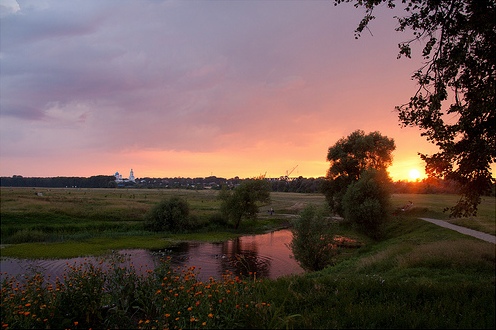
Church of the Intercession on the Nerl. This is probably the most harmonious and complete church in Russian architecture. Both the shape, the exterior decoration, and the location are perfect. The church stands in the field, on a small hill near the Nerl river, close to its confluence with the Klyazma. One has to approach the church by foot that makes the journey something like a pilgrimage. The way is very picturesque, since you can see the church in front of you and the Bogolyubovo convent behind you. In the spring, high water cuts the church off and provides a breathtaking view. To get to the church, cross the railway tracks near the Bogolyubovo train station and head south. You will find a unique, stone-paved road through the meadow, and you will likely see the church as soon as you pass through a narrow line of trees between the railway and the meadow. It takes about 15 minutes to walk (driving to the church is impossible). In the daytime, one can enter the church, but the interior is quite average and inferior to the exterior.
Bogolyubovo Monastery (Боголюбский монастырь)
Bogolyubovo convent: the convent is located in the Bogolybovo village, right on the main road. Although the convent was founded in 13th century, most of its buildings are more recent. The major reconstruction took place in 19th century and provided the present baroque–to–russian-revival style of the site. The only significant monument is the remaining part of the Prince's palace of Andrey Bogolyubsky – the so-called Staircase Tower (Лестничная башня) and the adjoining gallery from 12th century, both are now incorporated into the Church of the Nativity of the Holy Virgin (built in 18th century). You will easily recognize the old fragments due to their unusual appearance that strongly contrasts to the other buildings. These fragments are believed to trace back to 12th century and are considered as the only monument of ancient secular (and civilian) architecture in Russia. The decoration of the walls is relief and rather resembles that of St. Demetrius Cathedral in Vladimir. The church houses a small museum that shows archeological findings and a reconstruction of the ancient town of Bogolyubovo. Apart from the ancient fragments, you will find a number of more recent and bright buildings, including the Cathedral of the Bogolyubovo icon of Our Lady (1855–65, russian-revival style, the most impressive and visible building of the convent) and the Church of the Assumption of Our Lady (over the gate, built in 1841).
Cathedral of Our Lady
of Bogolyubovo Monastery (Cathedral of the Bogolyubskaya
Icon of the Mother of God): This grand Russian-Byzantine
style cathedral serves as the monastery’s main temple.
Designed by renowned architect Konstantin Ton, it was
constructed between 1855 and 1866. Its massive scale and
ornate interior make it a dominant landmark; during the
Soviet era, it was repurposed as an archive before being
returned to the Church.
Cathedral of
the Nativity of the Blessed Virgin Mary: This cathedral
replaces an earlier 12th-century white-stone church built by
Prince Andrei Bogolyubsky in 1158. The original collapsed in
1723, leading to the construction of the current building in
1751–1758. It stands on the historic site of the prince’s
palace complex and now functions partly as an exhibition
space for the Vladimir-Suzdal Museum-Reserve.
Church of Joachim and Anna: Located just outside the monastery
on Ulitsa Lenina (a short walk toward Vladimir), this
mid-19th-century classical-style church features elegant
columns and pediments. It is simpler than the monastery’s
grand cathedrals but remains a notable local landmark and
parish church.
1. International Arrival: Getting to Russia and Moscow
Fly into
Moscow: The practical entry point is one of Moscow’s major airports:
Sheremetyevo (SVO) – most international flights.
Domodedovo (DME).
Vnukovo (VKO) or Zhukovsky (ZIA).
Smaller regional airports like
Ivanovo Yuzhny (IWA) exist but have very limited flights and are not
recommended for international travelers.
From airport to Moscow city
center/train stations:
Aeroexpress high-speed train (fastest, ~45–60
min to central stations, ~500–600 RUB).
Metro + bus (cheaper but
slower).
Yandex Go taxi or Uber (~1,500–3,000 RUB, 45–90 min
depending on traffic).
Visa/entry: U.S. and most Western citizens
need a visa or electronic visa (e-visa) for Russia. Check the latest
requirements on the Russian consular website or your airline, as rules
can change. Have your passport (valid 6+ months), migration card, and
registration ready.
2. From Moscow to Vladimir (the main hub,
~180–195 km / 2–3 hours)
This is the fastest and most convenient leg.
Trains are highly recommended over buses for speed and comfort.
Fastest & Best Option: Train (1.5–3 hours, multiple daily)
High-speed trains (Strizh, Lastochka, or similar): 1h 40m–2 hours. Very
comfortable, with Wi-Fi and food options.
Regular trains: 2.5–3
hours.
Departure stations (check exact train on RZD.ru or the RZD
app):
Moscow Kursky Station (Курский вокзал) – most high-speed trains
to Nizhny Novgorod direction.
Moscow Vostochny Station (Восточный
вокзал) or Yaroslavsky (Ярославский вокзал) – some services.
Cost: 1,100–3,000+ RUB one-way (cheaper in advance; business class
higher).
Frequency: Dozens of trains daily; easy day-trip possible.
Arrival: Vladimir Passenger Station (Владимир-Пассажирский) – right next
to the bus station and central area.
Buy tickets: Online via official
Russian Railways (RZD) website/app (eng.rzd.ru), Tutu.ru, or RealRussia.
Buy in advance for best prices and seats. Foreign cards may need a
workaround (use a Russian intermediary or cash at station).
Alternative: Bus (3–4 hours)
From Moscow Central Bus Station (or
Shelkovskaya) to Vladimir Bus Station.
Hourly services via
Avtovokzaly.ru or similar.
Cost: ~1,400–2,300 RUB.
Less
comfortable than train but cheaper and no station changes needed.
Driving or Taxi (2.5–3 hours)
~195 km via M7 Volga highway (or
the parallel old Moscow–Nizhny Novgorod road).
Cost: Fuel
~1,500–2,000 RUB + tolls; full taxi/private transfer ~20,000–30,000 RUB
one-way.
Easy with international GPS (Yandex Navigator app works
great).
3. From Vladimir to Bogolyubovo (10–13 km / 15–25
minutes)
Once in Vladimir, options are frequent and cheap.
Easiest
& Recommended: City Bus (15 minutes, very frequent)
Buses #18,
#103, #126, #152 (and possibly others) run through Bogolyubovo.
Where
to catch: Any stop on Moskovsky Prospekt (main road), Cathedral Square
(Соборная площадь), near the Golden Gate, or historical center. Just ask
locals or use Yandex Maps/Go app (“Bogolyubovo” or “Боголюбово”).
Frequency: Every 15–20 minutes most of the day.
Fare: ~30–50 RUB (pay
with card or cash to driver).
Get off: When you see the large
Bogolyubsky Monastery (white bell tower + blue domes) on your right. The
stop is right in front.
The monastery is the main landmark; from
there, the road right after leads down to Bogolyubovo station and the
path to the Church on the Nerl.
Local Train (Elektrichka, 13–18
minutes)
From Vladimir station, take any train toward Nizhny Novgorod
(Kovrov, Vyazniki, Gorokhovets direction).
Stops at Bogolyubovo
station (right at the village).
Runs ~8 times/day, but schedule has a
big afternoon gap (roughly 08:30–15:30). Not ideal unless it fits
perfectly.
Cost: Very cheap (~100–200 RUB). Check schedule on RZD
app.
Taxi or Ride-Share (15–20 minutes)
Yandex Go app
(Russia’s Uber) – easiest, reliable, English interface available.
Cost: 300–600 RUB.
Ask for “Боголюбово, Боголюбский монастырь” or
“Bogolyubovo Monastery.”
Driving
From Vladimir, head east on
the old road toward Nizhny Novgorod (parallel to the railway or join M7
briefly). Bogolyubovo is the first settlement you reach.
Parking:
Limited. Free near the monastery or paid/toll lot near the railway
station.
4. Other Routes
From Suzdal (common Golden Ring
combo): Bus to Vladimir (~50 min, every 30 min), then transfer to
Bogolyubovo bus/taxi. Or direct taxi (~30–45 min, ~1,000–2,000 RUB).
From Nizhny Novgorod: Train or bus west (stops at Bogolyubovo or
Vladimir).
From St. Petersburg: Overnight train to Vladimir or
Moscow, then onward.
5. Practical Tips for a Smooth Trip
Apps
you need:
Yandex Go → taxis, local buses, maps (works offline too).
RZD or Tutu.ru → trains.
Google Translate (with offline Russian pack)
or Yandex Translate.
2GIS or Yandex Maps for local navigation.
Language: English is limited outside Moscow. Signs are in
Cyrillic—learn basic phrases or use apps.
Money & payments: Cash
(RUB) is useful for buses/taxis. International cards work less reliably;
Mir cards or cash apps are better. ATMs are everywhere in Vladimir.
Best time: Summer for the meadows and church walk (can be muddy/flooded
in spring). Weekdays avoid crowds.
Once in Bogolyubovo:
Monastery/convent is right by the bus stop.
Church of the
Intercession: Walk ~1–2 km south from the railway station across the
meadow (stone path). Beautiful but isolated—wear good shoes.
Safety & comfort: Russia is generally safe for tourists. Trains/buses
are clean and punctual. Vladimir has hotels/cafes if you overnight.
Total typical time from Moscow center: 3–4 hours door-to-door by
train + bus. From a Moscow airport: add 1–2 hours.
There are no commercial accommodations. However, it is usually possible to spend the night in the convent. You will not have to pay, but you will have to work for the convent instead (note that this option is relevant for Russian-speaking travellers only, others are unlikely to get to the convent at all). Most travellers stay in Vladimir that is only half an hour away and offers numerous hotels of different comfort and price.
In Bogolyubovo, you can find two roadside cafes only. More
satisfying food is readily available in Vladimir.
Picnic
(Кафе), ул. Ленина, 14а.
Pleasure (Кафе), ул. Ленина, 52.
Drink
If you want to have a drink, you can join locals buying
alcohol in one of the round-the-clock shops. However, this is not
recommended. The choice of bars and nightclubs is available in
Vladimir.
There are grocery stores along Lenina
street (ulitsa Lenina) where you can buy food and a minimum of
household goods. For better choice, you have to go to Vladimir.
During the summer, souvenirs are sold along the road to the Church
of the Intercession.
Stay safe
Despite its great history
and tourist importance, Bogolyubovo is a rather unpleasant place
with respect to the safety. In general, it is not recommended to
stay there during the night (in fact, there is nothing to do in the
evening anyway). In the daytime, Bogolybovo is visited by numerous
tourist groups and should be quite safe. The only problem may come
from the beggars who are very annoying and sometimes even
aggressive. If you do not plan to support these people, do not
hesitate to send them off.
Pre-Founding and Early Settlement (9th–11th Centuries)
Archaeological evidence shows a possible fortified Merya
(Finno-Ugric) settlement existed here as early as the 9th–10th
centuries. The strategic riverine location—controlling trade routes
along the Klyazma (part of the Volga basin)—made it attractive for
later Slavic princely development. However, Bogolyubovo as a named
town only emerges in the mid-12th century.
Founding as
Princely Residence (1158–1165)
In 1157–1158, after moving the
capital of the Vladimir-Suzdal Principality from Suzdal to Vladimir,
Prince Andrey Bogolyubsky (son of Yuri Dolgoruky) established his
personal residence here, initially called Bogolyubov or Bogolyubovo.
Construction of the palace-fortress complex lasted until around
1164–1165.
Legend of the Founding (widely accepted in Russian
Orthodox tradition and chronicles): While transporting the revered
Vladimir Icon of the Mother of God from Kiev toward Rostov, Prince
Andrey’s horses stopped inexplicably about 10 km from Vladimir. That
night, the Theotokos (Virgin Mary) appeared to him in a vision,
commanding him to build a church and monastery on the spot and to
leave the icon in Vladimir. He named the place “Bogolyubovo” in her
honor and commissioned the Bogolyubskaya Icon of the Mother of God
(a 12th-century icon depicting the apparition).
The residence was
an impressive dvor (court) and zamok (castle-like complex):
white-stone walls (perimeter ~1.5 km), earth ramparts and moats
(outer perimeter ~2.9 km), towers, and a central Cathedral of the
Nativity of the Holy Virgin (1158–1165). The cathedral featured
carved limestone reliefs, frescoes, gilded copper details, ceramic
floors, stained-glass windows, and marble-like columns. A two-tiered
staircase tower (with a unique spiral staircase) connected the
living quarters to the cathedral and fortress walls—the only major
pre-Mongol secular Russian building to survive in recognizable form.
Under Andrey, Bogolyubovo functioned as a full-fledged city with a
permanent population, posad (trading quarter), crafts, militia, and
self-government. Some sources describe it as the actual
administrative and symbolic center of North-Eastern Rus’, even more
than Vladimir itself. Andrey lived here for about 17 years, building
other landmarks including the nearby Church of the Intercession on
the Nerl (1165), Russia’s first church dedicated to the Intercession
feast.
Andrey’s Assassination and Immediate Aftermath
(1174–1177)
On the night of 28–29 June 1174, a boyar conspiracy
assassinated Prince Andrey in the staircase tower of his own palace.
The murder marked the beginning of the end of Bogolyubovo’s golden
age. In 1177, Prince Gleb of Ryazan sacked and looted the town
during inter-princely wars.
Mongol Invasion and Decline (1238
Onward)
The Mongol invasion of 1238 devastated the fortifications
and town. Bogolyubovo never regained its political or urban
prominence; it shrank into a settlement around the former princely
complex.
The Bogolyubsky Monastery (13th–20th Centuries)
No later than the 13th century, a male monastery dedicated to the
Nativity of the Virgin was founded directly on the site of the
ruined palace. The original cathedral’s basement survived and was
incorporated into later structures.
Major building phases:
17th–19th centuries: Intensive monastic construction in Baroque and
Neo-Russian styles, including the tiered Church of the Nativity
(1751, built over 12th-century foundations), refectory, bell tower,
walls with towers, and the grand Cathedral of the Bogolyubskaya Icon
of the Mother of God (1866, designed by Konstantin Ton and
consecrated by St. Theophan the Recluse).
The monastery became a
major pilgrimage center thanks to the Bogolyubskaya Icon and
legends.
After the 1917 Revolution, the monastery was closed.
It was revived in 1992 as a male monastery and, since 1997, has
operated as both male and female communities side by side.
Modern History and Status
1945–1965: Administrative center of
Vladimir District.
1960–2006: Urban-type settlement.
Since
2006: Rural settlement and administrative center of Bogolyubovskoye
rural settlement.
Today it forms part of the “Golden Ring”
tourist route. The monastery and palace ruins are managed by the
Vladimir-Suzdal Museum-Reserve, with ongoing archaeological study
(notably by N.N. Voronin and later researchers).
Location and Coordinates
Bogolyubovo lies approximately 10 km
(6.2 mi) northeast of Vladimir, the oblast's administrative center
(some sources note effective distances of 2–13 km depending on
measurement points along the urban fringe). Its precise coordinates
are around 56°11′N 40°32′E (56.183°N 40.533°E), with a central
elevation of 131 m (430 ft) above sea level. It sits within the
broader Central Federal District, roughly 190 km east of Moscow.
The settlement occupies the high (left) bank of the Nerl River,
several kilometers upstream from its confluence with the larger
Klyazma River. The iconic Church of the Intercession on the Nerl (a
UNESCO World Heritage site) stands about 1–1.5 km away in the
adjacent low-lying floodplain/meadow at or near this confluence.
Topography and Terrain
Bogolyubovo lies in the gently
undulating low plain of the East European (Russian) Plain,
specifically within the Klyazma River basin. Vladimir Oblast
features modest relief: average elevations around 132 m, with local
minima near 68 m and maxima up to 269 m across the oblast. The area
around Bogolyubovo consists of ancient river terraces and broad
valleys.
The settlement itself is on elevated ground (the
"high bank"), providing natural defensibility historically.
South
of the village, the terrain drops to the foot of the hill where the
Moscow–Nizhny Novgorod railway runs.
Beyond the railway stretches
a broad water-meadow (floodplain) with the Church of the
Intercession on a small artificial hill/spit.
This floodplain
is part of the Nerl-Klyazma confluence zone, characterized by flat,
meandering river channels, broad valleys, and low-gradient terrain
typical of the region’s rivers.
The Klyazma River divides the
oblast into more elevated northern areas and the lower, swampier
Meshchyora Lowland to the south; Bogolyubovo sits in the
transitional northern section.
Hydrology and Rivers
The
defining geographical feature is the confluence of the Nerl and
Klyazma rivers (part of the Volga River basin via the Oka).
Nerl River (Нерль): A left tributary of the Klyazma, ~284 km long,
draining a basin of ~6,780 km². It has slow, meandering flow with
broad floodplains.
Klyazma River (Клязьма): A major tributary of
the Oka (and thus Volga), ~686 km long, basin ~42,500 km². It flows
through the oblast, historically important for trade and navigation.
Rivers in the region exhibit:
Flat currents and meandering
channels.
Pronounced spring high water (snowmelt floods) from
April–May, often inundating the meadows and cutting off access to
the church (creating the famous "floating church" visual).
Low
water in summer–autumn, with occasional rain-induced flooding.
Ice cover from November/December to April.
The Nerl-Klyazma
junction was historically a strategic trade gateway. Sand beaches
along the rivers near the church allow swimming in warmer months.
The oblast has hundreds of rivers and streams totaling thousands of
kilometers, plus lakes and swamps (especially southward).
Climate
Bogolyubovo shares Vladimir Oblast’s humid continental
climate (Dfb Köppen classification), moderated slightly by its
riverine position but with continental extremes.
Temperatures: Cold, snowy winters (January average around −8°C to
−11°C) and warm, humid summers (July average ~18–20°C). Significant
diurnal temperature swings in summer can trigger thunderstorms.
Annual average temperature is approximately 5.5°C.
Precipitation:
600–700 mm annually, with a summer maximum. Snow cover persists
through winter.
Other: Frequent summer thunderstorms; stable low
winter levels in rivers after freeze-up.
The climate supports
distinct seasons, with transitional spring/autumn periods and high
spring runoff contributing to the floodplain dynamics.
Vegetation, Soils, and Environment
The region lies in the
mixed-forest zone of central Russia. Vegetation includes spruce,
pine, birch, oak, and other deciduous species, though much original
forest has been cleared for agriculture and settlement. Floodplain
areas feature meadows, wetlands, and riparian vegetation, with
protected status for the Bogolyubovsky Meadow around the church.
Soils are predominantly gray forest and soddy-podzolic (typical of
the non-chernozem zone), supporting both forests and limited
agriculture. The broader landscape includes some swamps southward in
the Meshchyora Lowland.