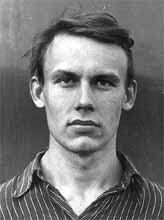
Yuri Doroshenko was one of the nine hikers who perished in the Dyatlov Pass Incident in February 1959, a tragic and mysterious event in the Ural Mountains that continues to captivate researchers and enthusiasts. A young, athletic, and charismatic member of Igor Dyatlov’s expedition team, Doroshenko was known for his strength, humor, and close bonds with his fellow hikers.
Background and Early Life
Yuri Georgiyevich Doroshenko was born on January 29, 1938, in the
Soviet Union, likely in the Sverdlovsk Oblast or a nearby region, though
exact details about his birthplace are scarce. Growing up in the
post-World War II era, Doroshenko was part of a generation shaped by
Soviet ideals of collectivism, physical fitness, and resilience. His
family background is not well-documented, but like many of his peers, he
likely came from a working-class or middle-class household, navigating
the challenges of a recovering nation.
Doroshenko enrolled at the
Ural Polytechnical Institute in Sverdlovsk (now Yekaterinburg), where he
studied engineering, possibly in a field related to electrical or
mechanical systems, given the institute’s technical focus. By 1959, he
was in his early 20s, likely in his third or fourth year of studies, and
was an active member of the institute’s hiking and skiing club. His
involvement in outdoor activities reflected the Soviet emphasis on
sports and exploration, as well as his personal passion for adventure.
Doroshenko was an experienced hiker and skier, having participated
in several treks in the Ural Mountains and other regions. His physical
prowess and enthusiasm made him a natural fit for the challenging
Category III expedition to Otorten Mountain, organized by Igor Dyatlov
in January–February 1959. At the time of the expedition, Doroshenko was
21 years old, in peak physical condition, and eager to prove himself on
one of the most demanding routes of his career.
Personality and Relationships
Yuri Doroshenko was described by friends and fellow hikers as
outgoing, confident, and full of life. He had a magnetic personality,
often serving as the group’s jokester, with a knack for lifting spirits
through humor and playful antics. Diaries and accounts from the
expedition highlight his role in fostering camaraderie, whether through
singing, storytelling, or lighthearted debates. His nickname, “Yura,”
was used affectionately by the group, reflecting their close bond.
Physically, Doroshenko was tall, strong, and athletic, with a rugged
handsomeness that made him stand out. Photos from the expedition show
him smiling broadly, often posing with confidence or engaging in
physical tasks like skiing or chopping wood. His strength was a valuable
asset, as he likely carried heavy loads and assisted with
labor-intensive tasks like setting up camp.
Doroshenko had close
relationships with several group members, particularly Igor Dyatlov,
whom he respected as a leader, and Georgy Krivonischenko, with whom he
shared a similar lively spirit. He was also romantically linked to
Zinaida Kolmogorova, one of the two women in the group. Their
relationship, though not officially confirmed, is suggested by
expedition diaries and photos, which capture moments of affection and
closeness between them. Doroshenko’s warmth extended to the entire
group, including the older Semyon Zolotaryov and the quieter members
like Alexander Kolevatov, making him a unifying figure.
Role in the 1959 Expedition
Doroshenko was one of ten members of the Dyatlov group’s expedition,
which began on January 25, 1959, with the goal of skiing approximately
300 kilometers (186 miles) to Otorten Mountain in the northern Ural
Mountains. The team included eight men (Igor Dyatlov, Yuri Yudin, Yuri
Doroshenko, Alexander Kolevatov, Georgy Krivonischenko, Rustem Slobodin,
Nicolai Thibeaux-Brignolle, and Semyon Zolotaryov) and two women
(Zinaida Kolmogorova and Lyudmila Dubinina). Yuri Yudin turned back on
January 28 due to illness, leaving nine hikers to continue.
Doroshenko’s role in the expedition was that of a strong and reliable
team member. His physical fitness made him essential for tasks like
breaking trails through deep snow, carrying supplies, and setting up the
tent. He likely contributed to group morale, keeping spirits high during
the grueling journey. Photos show him actively participating in camp
activities, such as cooking or preparing equipment, and his presence is
noted in the group’s diaries, which describe lively discussions and
songs.
On February 1, 1959, the group set up camp on the slopes
of Kholat Syakhl (“Dead Mountain”), a location exposed to harsh winds
and potential snow hazards. Doroshenko, as a key member, would have
helped secure the tent, a task the group performed with precision, as
evidenced by its condition when found. That night, an unknown
catastrophe struck, leading to the deaths of all nine hikers.
Circumstances of His Death
When the group failed to send a scheduled telegram by mid-February
1959, a search and rescue operation was launched. On February 26,
rescuers found the tent, torn open from the inside, with most of the
hikers’ belongings, including shoes and warm clothing, left behind.
Footprints led 1.5 kilometers to a cedar tree, where the bodies of Yuri
Doroshenko and Georgy Krivonischenko were discovered, partially clothed
and near a small fire.
Doroshenko was found lying on his back,
with his head toward the tent and his legs toward the cedar tree. He was
dressed only in a vest, short-sleeved shirt, shorts, and one sock,
despite temperatures below -30°C (-22°F). His body showed signs of
hypothermia, the official cause of death, but also had minor injuries:
abrasions on his face and hands, burns on his right foot and ankle
(likely from the fire), and singed hair. Nearby, a branch broken at 5
meters suggested he or Krivonischenko climbed the tree, possibly to
gather wood or look for the tent. The fire, which had burned out,
indicated they attempted to survive but succumbed to the cold.
The discovery of Doroshenko and Krivonischenko, known as the “cedar tree
group,” was pivotal in shaping the mystery. Their lack of clothing
suggested a panicked flight from the tent, a phenomenon later linked to
paradoxical undressing, where hypothermic individuals remove clothing
due to a false sense of warmth. The burns and minor injuries raised
questions about their final hours, with some speculating they
encountered an external threat or struggled to stay warm.
The
official Soviet investigation concluded that the hikers died due to a
“compelling natural force,” but the vague explanation fueled
speculation. Doroshenko’s condition, particularly his proximity to the
fire and minimal clothing, has been central to theories about the
incident. A 2021 study supporting the avalanche theory suggests a small
slab avalanche caused the group to flee, with Doroshenko and
Krivonischenko attempting to survive by the cedar tree before freezing.
However, the absence of avalanche debris in 1959 and the group’s
experience in avoiding such risks have kept alternative theories alive.
Theories and Speculation
Doroshenko’s death, as part of the cedar tree group, is a key piece
of the Dyatlov Pass puzzle. His condition and location have informed
several hypotheses:
Avalanche: The 2020 Russian investigation and
2021 studies propose a slab avalanche forced the group to cut open the
tent and flee. Doroshenko and Krivonischenko, reaching the cedar tree,
tried to build a fire but died of hypothermia. Critics note the slope’s
low angle (15–20 degrees) and lack of debris, as well as the group’s
ability to avoid avalanche-prone areas.
Hypothermia and Paradoxical
Undressing: Doroshenko’s minimal clothing aligns with paradoxical
undressing, a common hypothermia symptom. The burns suggest he got too
close to the fire in a disoriented state, though this doesn’t explain
why the group fled the tent.
Military Involvement: Some theorize a
military test, such as a sonic boom or chemical exposure, caused panic.
Doroshenko’s burns and singed hair have been cited as evidence of an
explosion or radiation, though no conclusive proof exists. Trace
radiation on some clothing (not necessarily his) adds intrigue.
Infrasound or Panic: Infrasound from wind patterns may have induced
disorientation, prompting a chaotic escape. Doroshenko’s injuries and
position suggest he fought to survive, but this theory struggles to
explain the group’s collective behavior.
Foul Play or Paranormal:
Speculative theories of an attack by locals, Soviet agents, or
supernatural forces point to Doroshenko’s burns and the broken branches
as signs of struggle. These lack credible evidence but persist in
popular narratives.
Doroshenko’s role in climbing the tree (inferred
from the broken branch) suggests he was among the last to die in his
subgroup, fighting to stay alive. His burns, initially seen as
mysterious, are now often attributed to accidental contact with the
fire, though they remain a point of fascination.
Legacy and Impact
Yuri Doroshenko is remembered as a vibrant, strong, and beloved
member of the Dyatlov group, whose life was cut short in a tragedy that
defies explanation. His role as the group’s morale-booster and his
possible romance with Zinaida Kolmogorova add a human dimension to the
mystery. Photos of Doroshenko, smiling and skiing through the snow, are
among the most poignant artifacts of the expedition, preserved by the
Dyatlov Foundation, established by survivors’ families and the Ural
Polytechnical Institute.
Doroshenko’s death by the cedar tree,
alongside Krivonischenko, has shaped the narrative of the Dyatlov Pass
Incident, highlighting the group’s desperate struggle to survive. His
condition has been studied extensively, contributing to theories about
hypothermia, avalanches, and external forces. The 2019 Russian reopening
of the case, which concluded in 2020 with an avalanche explanation, has
not fully resolved questions about Doroshenko’s final moments, keeping
his story alive in books, documentaries, and podcasts.
Doroshenko’s legacy is tied to the enduring fascination with the
incident. His youth, strength, and charisma make his loss particularly
poignant, a reminder of the potential snuffed out on Kholat Syakhl. The
Dyatlov Pass, named after the group’s leader, serves as a memorial to
Doroshenko and his companions, and his story continues to inspire
research and debate.
Personal Details and Anecdotes
Athleticism: Doroshenko’s strength was evident in photos of him
skiing and carrying heavy loads. His physicality likely made him a key
contributor to labor-intensive tasks.
Romance with Zina: Diaries and
photos suggest a close bond with Zinaida Kolmogorova, with moments of
tenderness captured on film. Their relationship, if romantic, adds a
tragic layer to their shared fate.
Humor and Energy: Expedition
accounts describe Doroshenko leading songs and joking about love and
adventure, reflecting his role as the group’s cheerleader.
Burns and
Tree-Climbing: The burns on his foot and singed hair, combined with the
broken cedar branch, paint a picture of Doroshenko’s final struggle,
possibly climbing to gather wood or signal for help.