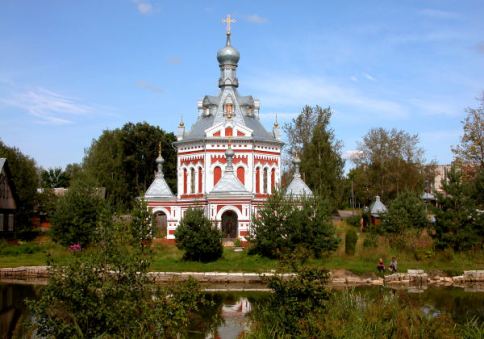
The Chapel of Saint Martyr Varvara, also known as the Chapel of Saint Barbara (Капелла святой Варвары in Russian), is a modest yet elegant religious structure located in the town of Gus-Khrustalny, in Russia's Vladimir Oblast. This late 19th-century chapel serves as a fine example of provincial Russian Orthodox architecture from that era, reflecting the town's industrial heritage and spiritual life. Below is an in-depth description, drawing on its history, architecture, location, and cultural significance.
Gus-Khrustalny, often translated as "Crystal Goose,"
was founded in 1756 as a settlement centered around glass and crystal
production, initiated by the merchant Akim Maltsov. The Maltsov family,
who were noble entrepreneurs, expanded the glassworks into a major
industry, attracting workers and fostering the growth of the village
(originally called Gus-Maltsovsky). By the 19th century, the town had
become one of Russia's premier centers for crystal manufacturing, with
factories producing high-quality glassware, including items for the
imperial court.
The Chapel of Saint Barbara was constructed in the
1880s during a period of industrial and urban expansion under the
Maltsovs' influence. This timing aligns with the town's peak prosperity,
when new infrastructure—such as factories, hospitals, schools, and
trading rows—was being built. The chapel has been preserved as a
historical site, surviving the Soviet era and post-Soviet transitions,
when many religious buildings were repurposed or neglected. Its
dedication to Saint Barbara, the patron saint of miners, artisans, and
those in hazardous professions (including protection against sudden
death, fire, and explosions), is particularly fitting for a town built
on glassmaking—a craft involving intense heat, furnaces, and potential
dangers akin to mining. While Gus-Khrustalny's economy was rooted in
glass rather than mining, the saint's protective role likely resonated
with the factory workers and craftsmen.
The chapel's history is
intertwined with the broader development of Gus-Khrustalny, which
evolved from a small village in the bend of the Gus River into a city by
the early 20th century. It stands as a testament to the Maltsovs'
patronage of both industry and faith, complementing other religious
sites in the area. Today, it remains a quiet symbol of the town's past,
often visited by tourists exploring the Golden Ring region or the nearby
Meshchera National Park.
Architecturally, the Chapel of Saint Barbara
exemplifies late 19th-century Russian ecclesiastical style, blending
traditional Orthodox elements with ornate decorative flourishes typical
of the period. It is described as a "large chapel," suggesting it is
more substantial than a simple wayside shrine but smaller than a full
church or cathedral. Key features include:
Ornate Detailing: The
exterior boasts intricate architectural embellishments, such as carved
stonework, moldings, and possibly filigree elements common in Russian
churches of the era. These details provide a sense of grandeur despite
the chapel's modest scale, reflecting the influence of revivalist trends
in Russian architecture during the late Imperial period.
Structure
and Form: As a chapel, it likely follows a compact, cross-shaped or
rectangular plan with a central dome or cupola, typical of Orthodox
designs. The architecture emphasizes verticality and symmetry, with
elements like arched windows, decorative cornices, and possibly colorful
accents (e.g., white walls with gold or blue highlights, as seen in many
Russian churches). Inside, one might expect simple iconography, an altar
dedicated to Saint Barbara, and perhaps frescoes or icons depicting her
martyrdom (she was a 3rd-century Christian saint executed by her father
for her faith).
Setting and Integration: The chapel is set within an
attractive park-like environment, enhancing its picturesque quality.
This green space provides a serene contrast to the industrial heritage
nearby, allowing for contemplative visits. Its design harmonizes with
other late 19th-century structures in Gus-Khrustalny, such as the
monumental Church of St. George (now housing the Crystal Museum), which
was built slightly later (1892–1904) in a similar ornate style.
The chapel's preservation highlights its durability, with no major
reconstructions noted in available records. It avoids the elaborate
onion domes of larger Russian cathedrals but captures the essence of
provincial religious architecture—functional, symbolic, and
aesthetically pleasing.
The chapel is situated on the southern outskirts of
Gus-Khrustalny, in the older southern half of the town. This area was
the original heart of the settlement, located in the bend of the Gus
River, which was dammed in the 18th century to create an artificial
lake. The lake divides the town into northern and southern sections,
giving Gus-Khrustalny a unique, scenic flavor with water views and
bridges.
Proximity to Key Sites: It is near the historic crystal
factory (now the Maltsov Crystal Factory), spinning and weaving mills, a
workers' hospital, pharmacy, and a school for craftsmen’s children. The
trading rows—a 19th-century shopping arcade with columns, galleries, and
balconies—are also nearby. The chapel is close to the town center and
the Holy Trinity Temple (formerly the Church of SS Joachim and Anna),
making it part of a walkable cluster of attractions.
How to Reach It:
Gus-Khrustalny is about 63 km (39 miles) southeast of Vladimir and 250
km (155 miles) east of Moscow, accessible by train, bus, or car via the
M7 highway. From the town center, the chapel is a short walk or drive
south, often included in local tours focusing on the town's glass
heritage. The surrounding park makes it ideal for a peaceful stroll,
especially in summer.
Though not as famous as Gus-Khrustalny's Crystal
Museum or St. George Church, the Chapel of Saint Barbara adds depth to
the town's narrative as a blend of industrial innovation and spiritual
tradition. It symbolizes the protection sought by workers in the glass
industry, where furnaces and molten materials posed daily risks. In a
broader context, it represents the Maltsovs' legacy of philanthropy, as
they funded many community buildings, including religious ones.
Visitors often note its tranquil atmosphere, making it a spot for
reflection amid the town's busier sites. As part of the Vladimir
region's tourism offerings, it contributes to the area's appeal for
those interested in Russian history, Orthodox architecture, and
off-the-beaten-path gems. If you're planning a visit, combine it with
the nearby Meshchera National Park for nature or the Crystal Museum for
insights into the town's glassy artistry.
Overall, while the chapel
may not boast the scale of Russia's grand cathedrals, its ornate charm,
historical ties to the glass industry, and serene location make it a
worthwhile stop for an in-depth exploration of Gus-Khrustalny's layered
past.