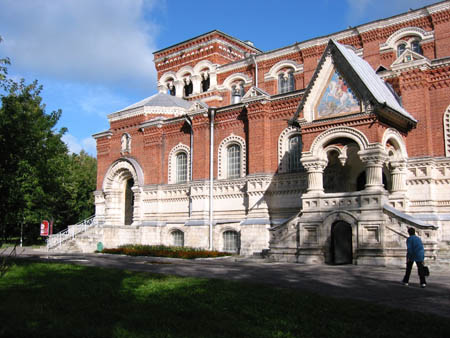
The Museum of the Maltsevi Family, more commonly known as the Maltsovs Crystal Museum (Музей хрусталя имени Мальцовых), is a premier cultural institution in Gus-Khrustalny, a town in Russia's Vladimir Oblast renowned as the cradle of Russian crystal production. This museum celebrates the legacy of the Maltsev (often transliterated as Maltsov or Maltsevi) family, who pioneered and elevated the local glass and crystal industry from the 18th century onward, transforming a modest village into an industrial and artistic hub. Housed in a striking historical building, it showcases over 2,000 unique artifacts that span centuries of craftsmanship, blending industrial history, artistic innovation, and architectural grandeur.
The story of the museum is inextricably linked to the
Maltsev family, whose entrepreneurial vision laid the foundation for
Gus-Khrustalny's identity as the "Crystal Goose" (a playful translation
of the town's name, reflecting its origins along the Gus River). In
1756, merchant Akim Maltsev established the first glass factory in the
area by decree of Empress Catherine the Great, addressing Russia's
reliance on imported glassware such as mirrors, spectacles, and window
panes. The location was ideal: abundant local sand for silica, plentiful
water and wood for production, and proximity to trade routes connecting
Golden Ring towns like Vladimir and Suzdal. Starting with simple items
like glasses and tumblers, the factory grew rapidly, and Akim was
granted nobility in 1775 for his contributions.
Akim's grandson, Ivan
Maltsev, dramatically advanced the enterprise in the 1830s. As a
diplomat, Ivan survived a deadly 1829 attack on the Russian embassy in
Persia (where poet Alexander Griboyedov perished), earning duty-free
trade rights from the Shah that facilitated exports. In 1835, during a
trip to Bohemia with Emperor Nicholas I, Ivan acquired the secret
formula for lead crystal (containing 24% lead oxide for superior clarity
and malleability) and recruited skilled artisans, enabling production
that rivaled Bohemian quality but at more affordable prices for
Russians. Inspired by French factories, Ivan and his descendants
invested in worker welfare, constructing around 425 red-brick
"Manchester-style" houses between 1860 and 1880—each divided for two
families with amenities like individual heating and yards. These homes,
of which 247 survive as cultural heritage sites on streets like
Oktyabrskaya, offered unprecedented living conditions for laborers,
though evictions were common when workers were no longer needed. The
family also built pharmacies, a hospital, schools, and even a
paper-spinning mill, fostering a self-sustaining community.
Post-1917
Revolution, the factory was nationalized, and the town—renamed
Gus-Khrustalny in 1926 and granted city status in 1931—shifted to mass
production, including the iconic faceted glasses designed by sculptor
Vera Mukhina. The plant won international acclaim but declined after the
Soviet Union's collapse, closing briefly before reviving in 2013 as
multiple glass-processing facilities. Today, it employs about 100
specialists in handmade crystal, using techniques like high-temperature
blowing (1,250°C), molding, firing, polishing, and tinting with elements
such as cobalt (blue), manganese (purple), selenium (red), neodymium
(lilac), and expensive erbium (pink). Products range from series items
to custom orders, with the factory offering tours to observe these
labor-intensive processes.
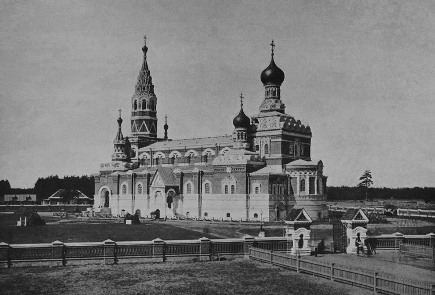
The museum occupies the former St. George's Cathedral
at Kalinina Street, 2a, a structure that exemplifies the Maltsevs'
patronage of the arts. Commissioned by factory owner Yuri
Nechaev-Maltsov and built from 1892 to 1903, it was designed by
architect Leonty Benois in a neo-Russian style blending European
basilica elements with traditional Russian features, such as a bell
tower and ornate chambers. The interior boasts 10 massive black
labradorite columns contrasting with snow-white vaults, creating a
majestic atmosphere. Key artistic highlights include Viktor Vasnetsov's
massive canvas "The Last Judgment" and Vladimir Frolov's enormous mosaic
"In Thee Rejoice, Full of Grace…," both surviving from the original
cathedral. One of the 12 original crystal chandeliers, crafted at the
factory, also remains.
In the 1920s, Bolshevik authorities repurposed
the building as a cinema, removing domes, the bell tower, altar, and
religious symbols. It was converted into the crystal museum in 1983 when
the factory's internal display space proved inadequate. Now under the
operational management of the Vladimir-Suzdal Museum-Reserve, the
building seamlessly integrates its ecclesiastical past with its role as
a "temple of crystal."
As one of Russia's finest museums of decorative glass, the Maltsovs Crystal Museum features an extensive collection that traces the evolution of the craft from the 18th century to the present. Highlights include vases exported to Persia under Ivan Maltsev's trade privileges, "agit crystal" from the Soviet era etched with Bolshevik slogans, and whimsical modern pieces like a sow with 15 piglets, a cow in a sarafan, or kokoshnik headdresses. The exhibits demonstrate diverse techniques: untinted clear crystal, colored varieties achieved through chemical additives, engraved designs, and intricate faceting. Many items reflect historical contexts, such as imperial-era decorative objects sent abroad and post-revolutionary mass-produced tableware. The collection also includes curiosities from the factory's on-site museum, emphasizing individual craftsmanship over serial production. Due to the building's spacious layout, displays are arranged thematically, allowing visitors to appreciate the optical brilliance and artistic versatility of crystal in a setting that enhances its ethereal quality.
Visitors consistently praise the museum for its
stunning architecture, well-curated exhibits, and the way it
encapsulates Gus-Khrustalny's heritage, earning a 4.7/5 rating on
platforms like Tripadvisor based on over 138 reviews. It's ranked as the
top attraction in the town and holds a Travelers’ Choice award for its
excellence. A typical visit lasts 1-2 hours, making it ideal for day
trips from nearby Vladimir (about 63 km away). As of late 2025,
operating hours are listed as 10:00 AM to 5:00 PM on Sundays, though the
museum may be temporarily closed or have varying schedules—advance
checks via the Vladimir-Suzdal Museum-Reserve website are recommended.
Admission fees are not explicitly detailed in recent sources but are
generally modest for Russian state museums, often around 200-500 rubles
(approximately $2-5 USD) for adults, with discounts for students,
seniors, and children.
The museum complements broader "crystal
tourism" in Gus-Khrustalny, where visitors can tour the active factory,
shop at the official store for authentic handmade pieces (distinguished
by quality and price—e.g., basic glass from 2,000 rubles, or about $35),
or explore the nearby glass market featuring products from local and
international producers. The preserved Maltsev worker houses and
mid-19th-century town center with elegant columns and balconies add to
the immersive experience, highlighting how the family's legacy endures
in the town's fabric. For those interested in Russian industrial history
or decorative arts, this museum offers a profound, multifaceted insight
into a craft that originated as an English invention but flourished
uniquely in Russia through the Maltsevs' ingenuity.