Millionnaya Ulitsa 5
Tel. 312- 9196
595- 4248
Closed: Tues
Metro: Nevsky Prospekt
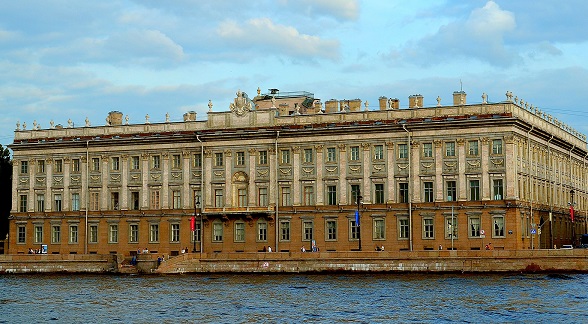
Marble Palace or Constantine Palace was constructed in 1768- 85 upon orders of Empress Catherine II the Great. She intended to give it as a present for her favourite (lover) Count Grigory Orlov, thus she chose one of the most distinguished architects in the Russian Empire Russian- Italian Antonio Rinaldi. However Orlov died in 1783 before he could get a chance to move into new residence. Catherine presented Marble Palace to her grandson Grand Duke Constantine Pavlovich, thus a second name for Marble Palace is Constantine Palace after its first permanent owner.
The Marble Palace (Мраморный дворец) stands on the First
Admiralteysky Island in central Saint Petersburg. It occupies a historic
quarter bordered by the Palace Embankment (Dvortsovaya Naberezhnaya),
Suvorov Square, Millionnaya Street, and Marble Lane (Mramorny Pereulok).
Its grand northern facade faces the Palace Embankment directly, offering
sweeping views over the wide Neva River. Across the water rises the
iconic Peter and Paul Fortress — the city's historic birthplace, with
its golden spire and bastions clearly visible, especially beautiful at
sunset or during the famous White Nights.
The eastern section of the
same city block is occupied by the service wing of the palace, which now
houses the Northwestern State Correspondence Technical University (or a
related technical educational institution). In 1994–1995, a striking
equestrian monument to Emperor Alexander III by the sculptor Paolo
(Pavel) Trubetskoy was installed in the courtyard between the main
palace and this wing. The massive bronze statue, known for its realistic
and somewhat caricatured depiction of the stout tsar, had previously
stood on Znamenskaya Square (now Vosstaniya Square) before being
dismantled; it spent time in storage in the Russian Museum vaults before
finding its current home.
To the east, beyond the university wing,
Suvorov Square features a monument to the legendary military commander
Alexander Vasilyevich Suvorov, created by sculptor Mikhail Kozlovsky.
Nearby stands the elegant Trinity Bridge (Troitsky Most), one of the
city's key crossings over the Neva, connecting the historic center to
the Petrograd Side.
South of the Marble Palace lie the former
barracks of the Pavlovsky Life Guards Regiment — an elite imperial unit
known for its tall soldiers (many over 180 cm) and distinguished service
history.
On the opposite side of the western facade, you will find
the building of the Russian Maritime Register of Shipping. Across
Suvorov Square stands the Institute of Culture, adding to the area's
rich educational and cultural atmosphere.
Additional Context for
Visitors
The Marble Palace, built in the late 18th century by
architect Antonio Rinaldi for Grigory Orlov (and later owned by the
Romanov family), is famous for its luxurious marble interiors and now
serves as a branch of the Russian Museum. Its location makes it a
perfect stop during a walk along the Neva embankments, near the Field of
Mars and the Summer Garden. The surrounding ensemble blends imperial
grandeur, military history, and modern cultural institutions, offering
excellent photo opportunities and a deep sense of St. Petersburg's
layered past.
During the reign of Peter the Great, the site of the present-day
Marble Palace was occupied by the Post Office Yard (Pochtovyy Dvor),
complete with a pier constructed in 1714 along the Neva River
embankment. This location served as a key hub for postal services and
arrivals in the young capital. On March 24, 1716, the renowned Italian
architect Francesco Rastrelli (father) and his son Bartolomeo Rastrelli
arrived here from Italy. Nearby, since 1714, stood the Animal Court
(Zverovyy Dvor), which housed the first elephant in St. Petersburg — a
magnificent gift to Peter I from the Persian Shah Sultan Husayn.
Tragically, the elephant died on May 23, 1717. Its remains were
preserved as a stuffed exhibit for the Kunstkamera, while the "elephant
barn" later accommodated the famous Gottorp Globe until 1726, when it
too was moved to the Kunstkamera.
A devastating fire in 1737
completely destroyed the Post Office Yard and the adjacent Elephant
House. The charred site was cleared and renamed "Upper Embankment
Square." For many years, this open area — forming a natural extension of
the Field of Mars (Marsovo Pole) — remained largely empty, used
occasionally for military parades and public gatherings.
In 1768, by
decree of Empress Catherine the Great, construction began on a grand
palace intended as a lavish gift to her favorite, Count Grigory
Grigoryevich Orlov. Orlov had played a pivotal role in the 1762 coup
that brought Catherine to power. The empress even planned to adorn the
facade with gilded letters proclaiming "The Building of Gratitude"
(Zadanie Blagodarnosti), though this inscription was never ultimately
installed.
The palace was designed by the Italian architect Antonio
Rinaldi and built between 1768 and 1785 (with foundation stone laid on
October 10, 1769). It became one of the first Neoclassical structures in
St. Petersburg and earned its name from the extensive use of over 30
different varieties of marble in its lavish interior and exterior
decoration.
Grigory Orlov passed away in 1783, before construction
was fully completed. That same year, Catherine II purchased the
unfinished palace from his heirs for the state treasury. In 1796, she
granted it to her grandson, Grand Duke Konstantin Pavlovich, on the
occasion of his marriage. Between 1797 and 1798, the last King of
Poland, Stanisław August Poniatowski (another former favorite of
Catherine), resided in the palace and died there suddenly in 1798.
After Konstantin Pavlovich’s death in 1831, Emperor Nicholas I
transferred the palace to his second son, Grand Duke Konstantin
Nikolayevich — a prominent admiral, statesman, and one of the key
organizers of the 1861 peasant reform that abolished serfdom. By then,
the building was in poor condition, so it underwent a major restoration
and redesign in the 1840s under architect Alexander Bryullov.
Following Konstantin Nikolayevich’s death, the palace passed to his
widow, Grand Duchess Alexandra Iosifovna. In 1911, it was inherited by
their son, Grand Duke Konstantin Konstantinovich (a poet who published
under the name "K.R."). After him, it belonged to his son, Prince Ioann
(John) Konstantinovich. Ioann’s brother, Prince Gabriel Konstantinovich,
later authored the memoir In the Marble Palace, providing vivid insights
into Romanov family life there.
Soviet Era and Modern Times
After the February Revolution of 1917, the palace was transferred to the
Provisional Government and housed the Ministry of Labor. Following the
October Revolution, it served from 1919 to 1936 as the home of the
Academy of the History of Material Culture. Later, it became a branch of
the Central Lenin Museum. To accommodate the new exhibitions, architects
N.E. Lansere and D.A. Vasiliev carried out significant interior
redesigns.
From the 1950s until the late 1980s, a famous
Austin-Putilovets armored car stood on a pedestal in front of the palace
(with a brief period indoors in the 1970s). It commemorated Vladimir
Lenin’s arrival in Petrograd on April 3 (16), 1917, when he delivered a
speech from a similar vehicle. The armored car was eventually moved to
the Artillery Museum. In 1994, the freed pedestal received Paolo
Trubetskoy’s equestrian monument to Emperor Alexander III.
In 1992,
the Marble Palace was transferred to the State Russian Museum. Today, it
hosts a permanent exhibition titled "Foreign Artists in Russia in the
18th – First Half of the 19th Century", along with regular temporary
exhibitions featuring both contemporary Russian and international
artists. The palace also serves as a prestigious venue for congresses,
conferences, and cultural events.
Its elegant Neoclassical facade
overlooking the Neva River and its rich, marble-clad interiors continue
to attract visitors, offering a fascinating window into the imperial
history, political intrigues, and cultural life of St. Petersburg.
Perfect for travelers exploring the historic heart of the city near the
Field of Mars and Summer Garden.
The Marble Palace (Мраморный дворец) stands as a true masterpiece
of early Catherine-era classicism in Saint Petersburg. Constructed
between 1768 and 1785, it was designed by the talented Italian
architect Antonio Rinaldi as a lavish gift from Empress Catherine
the Great to her favorite, Count Grigory Orlov, for his pivotal role
in the 1762 coup that brought her to power.
For a long time,
until the late 19th century, the palace was mistakenly attributed to
Giacomo Quarenghi. It was not until 1885 that the true architect was
confirmed: protodeacon V. Orlov of the palace church discovered
Rinaldi’s original drawings for the grand staircase, finally
crediting the Italian master.
A Pioneer in Stone Facades
The Marble Palace earned its name as the first building in St.
Petersburg to feature facades entirely clad in natural stone rather
than traditional plaster. Builders used durable granite for the
ground floor and a rich variety of marbles for the upper levels—up
to 32 different types sourced from Russia, Italy, Greece, and
elsewhere. This created the original Russian name “Marble House”
(Мраморный дом).
The palace feels like the most Italian structure
in the city. It evokes the noble spirit of Florentine Renaissance
palazzos and echoes the grand Palace of Caserta near Naples, where
Rinaldi had previously worked under Luigi Vanvitelli before arriving
in Russia.
Architectural Influences and Composition
According to art historian V. G. Vlasov, the Marble Palace
represents not only a creatively reinterpreted Italian palazzo but
also “a generalized image of classic palaces from all of Western
European architecture.” Rinaldi drew inspiration from masterpieces
such as:
Palazzo Valmarana in Vicenza (Andrea Palladio, 1565)
The Royal Palace in Madrid (Filippo Juvarra, 1735)
Palazzo
Chigi-Odescalchi in Rome (Gian Lorenzo Bernini, 1664–1666)
Schönbrunn Palace in Vienna (Johann Bernhard Fischer von Erlach,
project 1693)
and many others.
Rinaldi acted as a true
“painter in architecture,” using colored marbles like a rich palette
instead of pigments. The robust granite base contrasts beautifully
with the upper two floors (each about 12.5 meters high, within a
total building height of around 22 meters). These levels are unified
by a majestic Corinthian order featuring pilasters of delicate
pinkish Tivdi marble from Karelia and bluish-gray Ruskeala marble
from Finnish quarries. The subtle mother-of-pearl tones shimmer on
sunny days and take on deeper, saturated hues when wet with rain,
standing out dramatically against the gray St. Petersburg skies and
the leaden waters of the Neva.
Elegant Details and Stylistic
Blend
Light, harmonious tones are accented by sparing gilded
elements: balcony balusters on the southern facade, ornate
wrought-iron fencing around the “own garden” on the eastern side,
stucco garlands, and decorative flowerpots atop the roof parapets.
These touches hint at Rococo playfulness. Yet the overall layout
follows a “French scheme”—a closed rectangular volume enclosing an
inner courtyard (cour d’honneur) on the eastern side.
Although
Catherine II disliked the exuberant Rastrelli Baroque of the prior
era, the palace retains subtle Baroque features in its protruding
risalits, the raised attic, and the clock tower on the eastern
facade. The central section of this facade features a slight
projection of the entablature and attic, framed by semi-columns.
Sculptor F.I. Shubin created two statues for the attic and military
armor compositions. Along the entire roof parapet stand 86 elegant
flowerpots carved from light dolomite limestone.
Unique
Character
The “Italianisms” blend with an intimate, chamber-like
atmosphere unusual for grand palace architecture. Researchers note
that the interiors embody Rococo principles, where “each group of
rooms existed as if closed off” — continuing Rastrelli’s idea of
dynamic, flowing spatial organization. The trapezoidal plan gives
each of the four facades a distinct yet symmetrical character.
Today, the Marble Palace serves as a branch of the Russian Museum,
housing excellent collections of sculpture, painting, and temporary
exhibitions. In the courtyard you can admire the monumental
equestrian statue of Emperor Alexander III by Paolo Trubetskoy
(previously located near the Moscow Railway Station). From 1937 to
1992, Lenin’s armored car was also displayed here.
The Grand Staircase and Sculptural Decor of the Marble Palace
The
main staircase of St. Petersburg’s Marble Palace impresses visitors with
its elegant bluish-silvery marble cladding. It features cylindrical
vaults and soaring arches adorned with delicately carved wreaths,
garlands, and round lucarnes (small windows or openings) that allow soft
light to filter through.
The rich sculptural decoration, created by
the outstanding Russian classicist sculptor Fedot Ivanovich Shubin,
celebrates the military feats of Count Grigory Grigoryevich Orlov in
allegorical form. Eagles clutching laurel wreaths in their beaks perch
on column capitals and pilasters, while palm branches and oak leaves
symbolize victory and strength in the grand “Marble Hall” on the second
floor.
A notable detail is the bas-relief in the front lobby
depicting a profile portrait of the palace’s architect, Antonio Rinaldi,
also by Shubin — essentially the master’s “sculptural signature.” Niches
along the staircase house allegorical statues representing the times of
day (“Night,” “Morning,” “Day,” “Evening”) and seasons (“Autumn” and
“Spring Equinox”). These figures symbolize the stages of human life:
childhood, youth, maturity, and old age. The high artistic quality of
the bas-reliefs and sculptures, along with their thoughtful placement,
shows that Rinaldi collaborated closely with the sculptors, personally
reviewing plaster models before they were carved in marble.
The
Marble (Orlovsky) Hall — A Masterpiece of Russian Classicism
One of
the finest examples of Russian classicist architecture is the two-story
front Marble (Orlovsky) Hall, situated on the second floor in the
northeastern risalit. Measuring approximately 15.65 x 10.70 meters with
a height of 11.5 meters, this grand space once served as the starting
point for the palace’s enfilade of ceremonial rooms.
The walls are
clad in an extraordinary variety of marbles — seven types with over
thirty shades sourced from the Urals, Karelia, Greece, Italy, and even
Baikal lapis lazuli. Pink marble pilasters with white veins, topped with
gilded Corinthian capitals and bases, add luxurious accents. Allegorical
bas-reliefs evoking ancient Roman history (clearly alluding to Orlov’s
battlefield triumphs) were crafted by prominent sculptors Mikhail
Ivanovich Kozlovsky and Fedot Shubin. The ensemble of 14 bas-reliefs and
dessus-de-portes (1780–1782) includes majestic eagles with garlands and
wreaths, along with Rinaldi’s signature motif — the “Rinaldi flower,” an
intertwined oak and palm branch design that became the architect’s
personal emblem.
The hall’s picturesque plafond, “The Wedding of
Cupid and Psyche” (1775), painted by the Italian master Stefano Torelli
(sometimes referred to in documents as “The Triumph of Venus”), crowns
the space. Talented craftsmen including modellers I. Foght and A.
Bernaskoni, miniaturist F. Danilov, and carpenter A. Meyer contributed
to the exquisite interior design.
Later Reconstructions and
Restorations
In 1843–1851, architect Alexander Pavlovich Bryullov
oversaw a major reconstruction. He added another tier, transforming the
Marble Hall into a true double-height space with towering walls and
two-story windows. The upper level received artificial marble (stucco)
finishes. Today, only the main staircase and the first tier of the
Marble Hall’s walls preserve their original 18th-century decoration.
Between 1803 and 1811, architect Andrey Voronikhin redesigned the living
quarters. Extensive scientific restorations of the facades and select
interiors took place in 1952–1955, 1963–1965, and 2009–2010, helping
return the palace to its historic splendor.
Courtyard, Lattice,
and Service Building
The main southern courtyard, facing the Neva
River, is enclosed by an elegant forged iron lattice mounted on pink
granite pillars topped with marble flowerpots. This fence links the
palace to the adjacent service building, originally constructed by
architect Pyotr Yegorov in 1780–1787.
Bryullov later rebuilt this
structure (1844–1847), adding a third floor and adorning the facades
with pilasters to harmonize it with the main palace. The garden-facing
facade features a striking continuous frieze ribbon (about two meters
high) with four bas-reliefs on the theme “Serving the Horse to Man” by
the renowned sculptor Peter Klodt. Klodt also created the bas-relief
compositions for the two side pediments.
Until 2011, the former
service building housed the North-Western State Correspondence Technical
University.
Historical Context and Modern Significance
Built
between 1769 and 1785 by Antonio Rinaldi as a gift from Empress
Catherine II to her favorite, Count Grigory Orlov, the palace earned its
name from the extensive use of natural marble — over 30 varieties from
various regions. Catherine closely supervised the project, and a
foundation coin was even placed in the basement.
In 2015, the Bank of
Russia issued a commemorative coin dedicated to the Marble Palace as
part of the “Architectural Masterpieces of Russia” series. Today, the
palace forms part of the Russian Museum complex, hosting exhibitions of
Russian and foreign art, including the Ludwig Museum collection of
contemporary works.
The northern facade of the Marble Palace faces the picturesque Palace
Embankment (Dvortsovaya Naberezhnaya) directly along the Neva River.
Across the wide river lies the historic Peter and Paul Fortress — the
very birthplace of Saint Petersburg, with its golden spire of the Peter
and Paul Cathedral clearly visible from the palace windows. This
riverside position offers stunning panoramic views, especially at white
nights or during the famous Neva River bridges opening.
To the east
of the palace, beyond the adjacent Northwestern Territory (part of the
former service buildings and courtyards), stands the majestic monument
to Alexander Vasilyevich Suvorov on Suvorovskaya Square. Created by the
outstanding Russian sculptor Mikhail Ivanovich Kozlovsky and unveiled in
1801, the monument depicts the legendary field marshal as the god of war
Mars in classical Roman attire — one of the finest examples of Russian
Empire-style sculpture. Nearby you will also find the elegant Troitsky
Bridge (Trinity Bridge), one of the city’s main crossings, and the main
building of the St. Petersburg State Institute of Cinematography
(SPbGIK), a key center for Russian film education.
To the south of
the Marble Palace stretch the historic barracks of the Pavlovsky Life
Guards Regiment. Built in the early 19th century, these imposing
red-brick buildings once housed one of the most elite units of the
Russian Imperial Guard, known for their tall soldiers and strict
discipline. Today the complex is part of the protected architectural
ensemble of central Saint Petersburg.
Opposite the western facade
stands the building of the Russian Maritime Register of Shipping — an
important institution responsible for maritime safety standards and ship
classification in Russia.
In front of the eastern facade, in the
palace’s own courtyard (accessible from Millionnaya Street), visitors
can admire the famous equestrian monument to Emperor Alexander III by
sculptor Pavel Petrovich Trubetskoy. This powerful, expressive bronze
sculpture was originally installed on Znamenskaya (now Vosstaniya)
Square in 1909 and stood there until 1937. In 1994 it was relocated to
its current prominent position in front of the Marble Palace, where it
has become one of the most photographed landmarks in the area. The
monument is renowned for its realistic portrayal of the emperor and the
massive, sturdy horse — a striking example of Russian realist sculpture
of the late 19th century.
This central location places the Marble
Palace in the very heart of historic Saint Petersburg, within easy
walking distance of the Hermitage, Summer Garden, Field of Mars, and
other major attractions, making it a perfect stop for anyone exploring
the city’s imperial heritage.