Reki Moiki Naberezhnaya 94
Tel. 314- 9883,
314- 8893
Open: 11am- 5pm daily
Bus: 3, 10, 22, 27
The Yusupov Palace, commonly referred to as the Moika Palace, stands as a magnificent historic estate along the scenic Moika River in the heart of Saint Petersburg, Russia. Positioned close to iconic landmarks like the Mariinsky Theatre, this grand mansion represents one of the rare surviving aristocratic homes from the 18th and 19th centuries, with its extravagant interiors remarkably well-preserved despite the passage of time. Constructed initially in the 1770s, it became the cherished principal residence of the illustrious Yusupov family—among Russia's most affluent nobility—from 1830 through the tumultuous Bolshevik Revolution of 1917. In modern times, it operates as a vibrant museum and cultural venue, drawing crowds not only for its architectural splendor and extensive art holdings but also for its dark association with the dramatic killing of the enigmatic mystic Grigory Rasputin. Additional historical layers reveal that the Yusupovs, descendants of the Nogai Horde rulers, amassed a fortune surpassing even the Romanovs, owning 57 estates across Russia, including a Crimean palace, which underscores their unparalleled status in imperial society.
The property's origins trace back to the early 1700s, when it
featured a modest wooden structure belonging to Tsarevna Praskovia
Ivanovna, a relative of Peter the Great. By the mid-18th century,
ownership shifted to Count Peter Shuvalov, and in 1770, his successor
Andrei Shuvalov enlisted the renowned French architect Jean-Baptiste
Vallin de la Mothe—famed for projects such as the Small Hermitage and
the expansive Gostiny Dvor shopping arcade—to erect a more substantial
stone edifice. Completed around 1776, this formed the foundational
layout of the palace, blending French neoclassical elegance with
emerging Russian tastes. Over subsequent years, the estate passed
through several owners, undergoing expansions and stylistic updates by
architects like Andrei Alexeievich Mikhailov in the 1830s and Italian
sculptor Emilio Sala, incorporating neoclassical, baroque, rococo, and
even eclectic elements to create a richly layered design.
The palace
entered its golden age in 1830 when Prince Nikolai Borisovich Yusupov
purchased it for 250,000 rubles from the treasury. The Yusupovs, whose
lineage stemmed from Tatar princes and who had integrated into Russian
high society under Ivan the Terrible, were rewarded with vast lands and
titles for their loyalty. Their wealth ballooned through strategic
marriages, such as the union with the wealthy widow Katerina Sumarokova.
Under their stewardship, the palace was lavishly renovated by Mikhailov,
who refined its neoclassical exterior while enhancing the interiors to
reflect the family's opulent lifestyle and philanthropic spirit. They
curated an astonishing collection exceeding 40,000 artworks, featuring
masterpieces by Rembrandt, exquisite jewelry (including the legendary
pearl La Peregrina, valued at over a million dollars and later hidden
but never recovered), sculptures, and rare artifacts. The Yusupovs also
added practical amenities like a family chapel dedicated to the
Protection of the Mother of God, horse stables, and a private garden.
This era of grandeur persisted until the 1917 Revolution, when the
Bolsheviks seized the property in November, forcing the family to flee
to Crimea. Much of the art was redistributed to institutions like the
Hermitage Museum, but the palace escaped demolition or repurposing into
mundane offices or housing. Instead, in 1925, it was designated as the
"Palace of Culture for Educators" under the Education Commissariat,
preserving its second-floor state rooms and the infamous Rasputin site
as a public museum. During World War II, it temporarily served as a
hospital, and postwar, it earned status as a national historical
monument.
The palace's outward appearance harmoniously fuses various architectural influences from its phased developments, predominantly neoclassical with subtle baroque and rococo accents. Vallin de la Mothe's original design established a three-story structure with a restrained yet sophisticated facade painted in bright yellow stucco, accented by crisp white columns, pediments, and pilasters—hallmarks of 18th-century French-Russian fusion. The building includes a central pavilion flanked by symmetrical wings, enclosing a gated courtyard that opens to the street. Mikhailov's 1830s interventions added Italianate flourishes, while a baroque wing was incorporated for the theater. Though lacking sprawling formal gardens, the compact courtyard—where Rasputin famously attempted his escape—now whimsically hosts a kindergarten playground, contrasting its storied past. The palace's location on the Moika embankment enhances its picturesque setting, making it a standout in Saint Petersburg's urban landscape.
Venturing inside, the Yusupov Palace unveils a world of unparalleled
luxury, boasting over 100 rooms adorned with gilded moldings, sparkling
crystal chandeliers, sumptuous silk wall coverings, and elaborate inlaid
parquet flooring, crafted by master European artisans. These spaces,
restored to evoke pre-Revolutionary splendor, offer an authentic glimpse
into aristocratic living, feeling "lived-in" rather than sterile.
Standout areas include:
Grand Marble Staircase: This ceremonial
entryway features majestic marble steps, flanked by sculptures and
vibrant frescoes, epitomizing the Yusupovs' affluence and serving as a
gateway to the upper floors.
Moorish Drawing Room: Evoking the
family's Tatar roots, this exotic chamber boasts intricate
Islamic-inspired tiles, arched alcoves, colorful mosaics, and ornate
oriental patterns, creating a vibrant contrast to the palace's European
dominance.
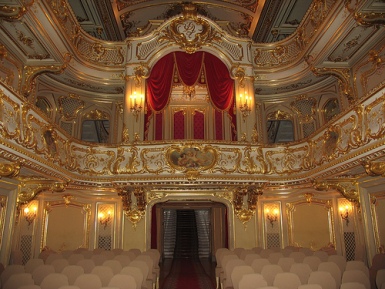
Private Home Theater: A rococo gem seating approximately
180 guests, this intimate venue mimics a scaled-down Mariinsky Theatre,
complete with a hand-painted curtain and ceiling by Ernst Friedrich von
Liphart, the Hermitage's curator. It retains functional stage mechanisms
and continues to stage concerts, ballets, and theatrical productions,
highlighting the family's passion for the arts.
Art Gallery and
Library: These refined spaces showcase surviving elements of the Yusupov
collection, such as Jacques-Louis David's "Sappho and Phaon," alongside
sculptures, rare volumes, and polished wood paneling that once housed
thousands of treasures.
White-Column Hall: A spacious neoclassical
ballroom supported by soaring white columns, renowned for its superior
acoustics and used for grand receptions, dances, and modern events.
Carved Oak Dining Room and Family Living Room: Intimate yet lavish, the
dining room features intricate wood carvings, while the living room
displays family portraits, including one of Princess Zinaida Yusupova,
adding a personal touch to the grandeur.
Prince's Study and Quarters:
Rooms like Felix Yusupov's oak-paneled study and bachelor's apartment on
the ground and semi-basement levels provide insights into daily noble
routines, with period furnishings and artifacts intact.
The less
ornate basement includes the historic cellar, now part of thematic
displays.
The palace's global fame stems from being the venue for Grigory
Rasputin's brutal murder on the night of December 16-17, 1916 (Old
Style: December 29-30). Prince Felix Yusupov—known for his
eccentricities, including cross-dressing in women's attire and jewelry,
influenced by his mother's desire for a daughter—collaborated with
Vladimir Purishkevich, Grand Duke Dmitri Pavlovich, and others to
eliminate Rasputin, a Siberian peasant turned "holy elder" who wielded
immense influence over Tsar Nicholas II and Empress Alexandra. Rasputin,
credited with healing the hemophiliac heir Alexei through hypnosis or
faith healing, was vilified by nobles for his alleged corrupting role in
court politics and rumored affair with the empress.
The conspirators
enticed Rasputin to Felix's bachelor's apartment in the palace's
semi-basement, offering him cyanide-laced cakes (possibly neutralized by
sugar) and tainted Madeira wine. When the poison failed, Yusupov shot
him in the heart with a Browning pistol. Astonishingly, Rasputin
survived, attempting to strangle Yusupov in a fit of agony before
fleeing to the courtyard. Purishkevich fired additional shots into his
back on the doorstep, followed by a fatal close-range bullet to the
forehead. The body was wrapped in cloth, bound with chains, and
discarded into the icy Malaya Nevka (or Neva) River, where autopsy
revealed he survived underwater for about seven minutes before drowning.
The cellar room and courtyard are meticulously preserved in a dedicated
exhibit, featuring wax figures of Yusupov and Rasputin, photographs,
documents, and recreations of the scene. Some tour guides report eerie
phenomena, like nocturnal footsteps, fueling legends of Rasputin's
mystical powers.
Post-nationalization, the Yusupov Palace has been diligently restored and functions as a museum emphasizing aristocratic heritage, with the state rooms, living quarters, and Rasputin exposition accessible to the public. It hosts temporary exhibitions, cultural performances in the theater, conferences, and diplomatic gatherings, maintaining its relevance as a federal protected site. Visitors can explore via self-guided tours with English audio guides for the main floors or join guided sessions (often in Russian, with advance booking recommended) for the Rasputin areas. The site attracts history buffs and tourists eager to immerse in its blend of beauty, intrigue, and spectral lore.