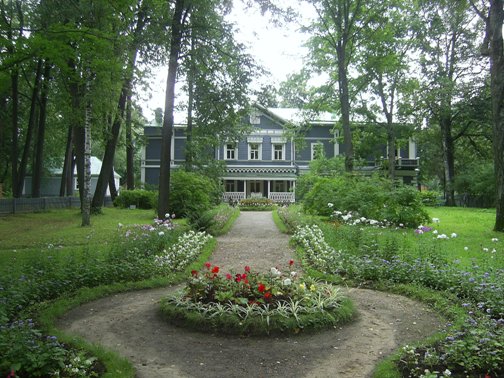
Location: Klin, Ulitsa Tchaikovskaya 48, 90 km (55 mi) Northwest of Moscow
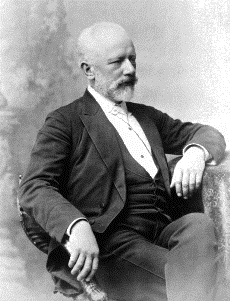
The Tchaikovsky House Museum, officially known as the State Memorial Musical Museum-Reserve of P. I. Tchaikovsky, is a historic site in Klin, Russia, about 85 kilometers northwest of Moscow. It preserves the final residence of the renowned Russian composer Pyotr Ilyich Tchaikovsky, where he lived from May 1892 until his death in November 1893. This period marked the pinnacle of his creative output, during which he composed some of his most celebrated works, including the ballet The Nutcracker, the 18 Pieces for Piano (Op. 72), and his Sixth Symphony (Pathétique). The museum, established in 1894 by Tchaikovsky's brother Modest, is the oldest memorial musical museum in Russia and attracts music enthusiasts, historians, and tourists worldwide for its authentic glimpse into the composer's personal life and artistic environment.
Tchaikovsky first sought refuge in the Klin area in 1885, renting
various properties to escape the demands of urban life in Moscow and
St. Petersburg. He initially stayed in the nearby village of
Maidanovo, where he composed major works like the ballets Swan Lake
and Sleeping Beauty, the operas The Queen of Spades and Iolanta, and
his Fifth Symphony. By 1892, at age 52, he rented the upper floor of
a house owned by the Sakharov family on the outskirts of Klin, drawn
to its serene location along the train line between Moscow and St.
Petersburg, surrounded by forests and gardens. This home provided
the tranquility he craved for composition, reading, entertaining
guests, and nature walks. Tragically, his stay was short-lived; he
died of cholera in St. Petersburg in 1893 after just over a year in
the house.
Following his death, Modest Tchaikovsky, along with
the composer's nephew Vladimir Davydov, worked to preserve the space
exactly as it was, founding the museum in 1894. Modest purchased the
property from Aleksei Sofronov (who had occupied the ground floor
and assisted in preparations) and bequeathed it to the state upon
his own death in 1916. The museum faced challenges, including a
brief occupation by an anarchist in the early 20th century and
severe damage during World War II when Nazi forces used it as
barracks from 1941 to 1942, storing motorcycles downstairs and
ransacking the upper floors. Artifacts were evacuated to
Tchaikovsky's birthplace in Votkinsk for safekeeping, and the museum
was restored in the 1940s, reopening in 1945 with a new concert hall
added nearby. Today, it holds around 200,000 items related to
Tchaikovsky's life and work, serving as a repository for his
archives and a venue for musical events.
The house is a two-story wooden structure built in the 1870s by the Sakharov family, exemplifying typical Russian country estate architecture of the era with its simple, functional design. Tchaikovsky occupied the upper floor, which features wood-paneled rooms that evoke a cozy, intimate atmosphere. The exterior is modest yet charming, with a front facade overlooking gardens and a lateral view revealing its integration into the natural landscape. An attached barn from the 1870s adds to the rustic feel. The property spans extensive grounds, including a forested area with winding paths leading to a gazebo. Post-war restorations maintained the original layout, with additions like the concert hall blending seamlessly without altering the historic core.
The museum's interiors are meticulously preserved to reflect
Tchaikovsky's daily life, creating an immersive 19th-century
ambiance enhanced by background playback of his music. The ground
floor houses exhibitions on the composer's biography, including
displays related to the Sofronov family and introductory materials
about his works. Visitors ascend to the upper floor via stairs
leading to the living room, the heart of the home. This spacious
reception area contains a Becker grand piano—played only twice a
year (on Tchaikovsky's birth and death anniversaries) by winners of
the International Tchaikovsky Competition—along with his desk,
bookcases filled with leather-bound volumes of Russian and foreign
literature, and photographs of family, friends, and inspirations
like Beethoven and Anton Rubinstein (his teacher at the St.
Petersburg Conservatory).
Adjacent rooms include Tchaikovsky's
bedroom, where he composed at a desk overlooking the garden;
Modest's bedroom; a guest bedroom; the dining room; and Vladimir
Davydov's study. His own wood-paneled study is particularly
striking, paneled in warm tones and filled with personal effects.
Exhibits throughout feature gifts from concert tours, musical
manuscripts, drafts, correspondence, a death mask, cabinet
photographs, and everyday items like his slippers by the bed. The
collection highlights Tchaikovsky's multilingual prowess (fluent in
French, German, and others) and his relationships, including with
student and friend Sergey Taneyev. A nearby cottage on the grounds
hosts the Demyanovo Estate Museum, displaying artifacts from the
Taneyev family estate, including Taneyev's archive and library
transferred in 1918.
The lush gardens were a source of inspiration for Tchaikovsky, who strolled them daily for mushroom gathering, relaxation, and creative reflection, regardless of weather. They feature alleys of birches and lilacs, some planted by visiting musicians, and hundreds of lilies added by Modest after the composer's death. A notable statue depicts Tchaikovsky seated on a bench with a book, inviting visitors to pose alongside. The grounds include a park with monuments, a gazebo at the end of a forested path, and remnants of nearby estates like Frolovskoye and Maydanovo. An annual tradition sees competition winners planting oak trees, symbolizing the enduring legacy of his music. The serene, well-maintained landscape evokes a sense of timeless peace, though some areas may feel uninhabited or under renovation.
Located at 48 Ulitsa Chaikovskogo in Klin, the museum is open from 10:00 to 19:00, closed Wednesdays, Thursdays, and the last Monday of each month. Admission is approximately 550 RUB, with an additional 200 RUB for photography permits. Audio guides (150-200 RUB) are recommended for non-Russian speakers, as English signage is limited; guided tours by knowledgeable staff provide engaging stories. Allow 2-3 hours for a full visit, including the gardens—best on pleasant days. From Moscow, take a suburban train from Leningradsky Station (1-1.5 hours, ~180 RUB) to Klin, then marshrutka bus 5 or a taxi to the site. By car, it's a 1.5-2 hour drive via the Leningrad highway (taxis ~2,200-3,200 RUB one way). Book tickets in advance during peak times or events like festivals and concerts in the on-site hall. The official website offers more details, though primarily in Russian.
Beyond preservation, the museum honors Tchaikovsky's legacy as a prolific composer who produced seven symphonies, 11 operas, three ballets, and over 100 songs and piano pieces. It subtly touches on his personal life, including his failed marriage and close bonds (e.g., with Taneyev), though some aspects remain understated due to historical contexts. Visitors often describe a profound, heartwarming experience, feeling the "genius loci" in the preserved spaces.