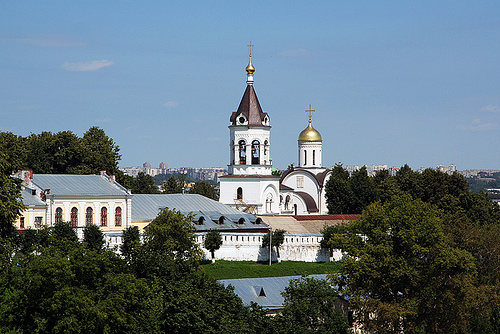
Bogorodice Rozhdenstvensky Monastery is a medieval Russian Orthodox monastery that date back to the 12th century. Its name is translated as a Birth of Mother of God Monastery.
History
In 1191, the Grand Duke Vsevolod Yuryevich, having
chosen a place in Vladimir (in the middle Kremlin city) to the east
side, in the talus near the Ivanovskiye Gates, laid the foundation
for a men's monastery.
The annals indicate the time of
foundation under the summer of 6699 (1191/1192): “the same summer,
the Grand Duke Vsevolod laid the stone church in the city of
Volodymeri. Our Lady of August on the 22nd day under Bishop John. "
When the church was laid, the Grand Duke himself and his entire
court were present. At the same time, a hostel was established in
the monastery and many villages and estates were granted from the
Grand Duke for maintenance. The leadership of the Nativity Monastery
was carried out by abbots (until 1230), despite the fact that abbots
Simon and Mitrofan, one after the other, were bishops in Vladimir.
Archimandrites began to rule the monastery in 1230. The
Christmas monastery began to be called the great archimandry and
until the time of Tsar John Vasilyevich was listed as the first
among Russian monasteries. From the middle of the XIII century to
the beginning of the XIV century, the All-Russian metropolitans, who
transferred the first bishop's see from Kiev to Vladimir, had a stay
in the Nativity monastery, which was considered their cathedral.
XIII-XV centuries
In 1214, Yuri Vsevolodovich elected the
Christmas hegumen Simon as bishop in Suzdal. On March 14, 1227, in
the place of Simon, by the election of the same prince, Abbot
Mitrofan was consecrated to the Bishop of Suzdal by Metropolitan
Kirill, who was then in Vladimir.
In 1230, according to the
election of Yuri Vsevolodovich's nephews, Rozhdestvensky, the first
Archimandrite Kirill was consecrated bishop of Rostov.
In
1237, during Batu's invasion of Vladimir, the abbot of the
monastery, Archimandrite Pakhomiy, was killed by the Tatars, and
with him all the brethren of the monastery were beaten, and the
monastery itself was plundered and devastated.
On November
23, 1263, Grand Duke Alexander Yaroslavich Nevsky was buried in the
Church of the Nativity Monastery, who died on November 14 in
Gorodets, on his way back from the Horde. When the Grand Duke's
throne was transferred from Vladimir to Moscow, the Grand Dukes, out
of respect for their ancestor, Prince Alexander Nevsky, made
significant contributions to the Nativity Monastery. So, Ioann
Danilovich Kalita in 1328 in his spiritual testament wrote: “And
what is I bought a small village on Kirzhach from Prokopye from the
abbot, another Leontievskoe, the third Sharapovskoe, and then I give
St. Alexander himself in memory "; John Ioannovich wrote in the
spiritual year of 1356: “The village of Pavlovskoe was given to St.
Alexander is good for his memory "; his son Dmitry Ioannovich in the
first spiritual year of 1371 confirms: "but that my father, the
great prince, gave the village of Pavlovskoye to St. Alexander that
cannot be moved." In his own spiritual letter of 1379 it is said:
"And from my silver vessels they will give to the Holy Mother of God
in Volodymyr a great silver dish from the ring."
In 1388,
Archimandrite Pavel of the Nativity was consecrated by Metropolitan
Pimen as Bishop of Kolomna to replace Bishop Gerasim.
XVI-XVII centuries
In 1517, by the council's election and the
permission of the Grand Duke, Archimandrite Gennady was made Bishop
of Suzdal.
In 1566, Archimandrite Joachim took part in a
Moscow church council and was the bail of Prince Mikhail Vorotynsky,
and was also at the council in 1580 (about not taking patrimonies
from monasteries and not buying new ones from the peasants). In
1584, Archimandrite German was at the cathedral about the
abandonment of estates at the monasteries. In 1598, Archimandrite
Varlaam was in Moscow at a cathedral and signed a letter of
coronation of Boris Godunov.
Modern musicologists consider
Archimandrite Isaiah (in the world Ivan Timofeevich Lukoshko) one of
the greatest masters of znamenny singing, a representative of her
“Usolsk” school. In 1613, the archimandrite was at the election of
Mikhail Fedorovich to the throne and was the first after the bishops
to sign the electoral letter. In 1605, Archimandrite Isaiah became
the confessor of False Dmitry I. On June 22 (July 2), 1619, he was
appointed to the patriarchal throne of the Rostov Metropolitan
Philaret. On September 28 (October 8), 1645, Archimandrite Jonah was
present at the wedding ceremony for the reign of Alexei
Mikhailovich.
In 1667, the Greek patriarchs traveling to the
Great Moscow Cathedral - Paisius of Alexandria and Macarius of
Antioch, when they were in Vladimir and respecting his antiquity and
celebrity, upon arrival in Moscow, with the permission of Tsar
Alexei Mikhailovich and on the advice of Patriarch Joasaph, granted
Archimandrite of the Nativity Monastery Philip the right to wear
tablets on the mantle and use the bishop's staff in the ministry,
for which they were given a letter; from that time on, Archimandrite
Philaret began to be called the most reverend. In the same year,
Filaret was at the Moscow cathedral about the correction of the book
and about various church rituals, and on November 30 of this year he
was ordered to present a letter to Patriarch Nikon about his arrival
from the Resurrection Monastery to Moscow, and on December 1 he was
among the soborians when Nikon was deposed.
In 1672,
Archimandrite Vincent corrected the life of Saint Alexander Nevsky,
compiled by the order of the Tsar and Grand Duke John Vasilyevich by
Hieromonk Michael.
XVIII century
On July 14 (25), 1723, Archimandrite Sergius received the
Imperial Decree of Emperor Peter I on the transfer of the relics of
St. Prince Alexander Nevsky, who were open since 1381, in the Church
of the Nativity of the Blessed Virgin Mary. The last archimandrites
of the Nativity Monastery, Pavel and Platon Petrunkevich, were
members of the Holy Synod.
Back in 1561, by the will of Tsar
John Vasilyevich and by the letter of the All-Russian Metropolitan
Macarius, the Trinity Monastery of St. in terms of its antiquity and
the advantages that were given to its abbots, it was always in the
direct jurisdiction of the All-Russian metropolitans, then the
patriarchs, and finally, depending on the most holy synod, among the
stauropegic ones.
At the beginning of the 18th century, as
can be seen from the census books of the city of Vladimir, compiled
in 1715 by the Landrat Prince Artemy Ukhtomsky, there were 64
monastics in the Rozhdestvensky Monastery, including two
archimandrites, six hieromonks and five hierodeacons. From the
surviving census book of the same time, according to the census of
the chief inspector Semyon Nikiforovich Korovin, the chief commander
Andrei Fedorovich Borkov and the commandant Andrei Mikhailovich
Veshnyakov, in the village of Makarovka, near the posad, there are
13 yards and 5 yards of servants of the Spassky Zlatovratsky
Monastery assigned to the Nativity Monastery.
On July 16
(27), 1744, by decree of Empress Elizabeth Petrovna, it was decided
to establish the Vladimir diocese from the synodal region and
convert the stauropegic Nativity monastery into an episcopal house
for the then newly appointed Bishop Platon to Vladimir, since until
now the bishops had their residence in the city of Suzdal. Before
the establishment of the states in 1764, the monastery had 7899
peasant souls and the most bishop's house was supported by its
income. In 1789, after the union of the Vladimir diocese with
Suzdal, Bishop Victor moved to stay in Suzdal, and the Vladimir
Bishops' House entered the civil department and governor-general
Zaborovsky was housed in it. In 1797, Bishop Victor, reporting to
the Holy Synod that the Vladimir bishop's house, after the departure
of the governor-general from it, remained idle, presented his
opinion on the transfer of the second-class Tsar-Konstantinov
monastery here - but in 1798, before the journey of Emperor Paul I
to Kazan, a decree was issued from the Holy Synod on the bishop's
stay in Vladimir as before, and Bishop Victor moved from Suzdal,
occupying the Nativity monastery in Vladimir. Since that time, the
Vladimir bishops have a permanent residence at the monastery.
The Rozhdestvensky Monastery, where the episcopal see was
located, stands near the cathedral in a most beautiful, high place
on the banks of the Klyazma River; the hall in it is the most
charming, avenue. However, the buildings in that monastery are few
and the circumference is not great; the stone fence is small and we
did not notice the tower. We were surprised that the monastery was
one of the first, and there are not many buildings in it.
- Plato
(Levshin), 1792
XIX — XXI centuries
On August 24
(September 5), 1858, Emperor Alexander II examined the Church of the
Nativity of the Most Holy Theotokos in the monastery and ordered to
restore it in its ancient form. For the restoration of the temple,
the emperor donated 40 thousand rubles, the same amount was given by
private individuals, 10 thousand rubles - by the Holy Synod. In
1859, the architect-restorer Nikolai Artleben, together with D.
Koritsky, ordered to demolish the pre-Mongol temple and, under the
guise of restoration, built a new one in its place. The ancient
temple was demolished by 1861.
P. D. Baranovsky welcomed
Artleben's project as the first example of scientific restoration of
an architectural monument in Russia. In 1924, he specially came to
Vladimir to prevent the demolition of the temple.
From July
1918 to 1991, departments of the Cheka (OGPU, NKVD, KGB) and a
pre-trial detention center were located on the territory of the
monastery. "The cathedral and the bell tower were dismantled on the
initiative of the head of the Vladimirsky office of the OGPU,
despite the protests of the specialist of Glavnauki N. Levinson, in
June - July 1930" During the Stalinist repressions, burials of the
repressed were carried out on the territory of the monastery garden,
as evidenced by a memorial plaque installed on the wall of the
monastery along Bolshaya Moskovskaya Street.
In 1991, during
the celebration of the 800th anniversary of the founding of the
monastery, the beginning of its revival was laid. The monastery
cathedral and bell tower were built in new, simplified forms.