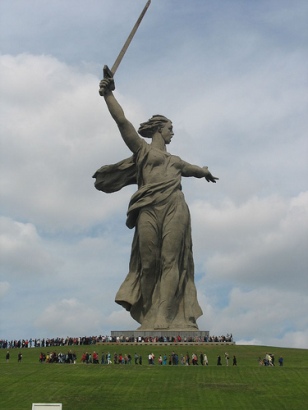
Mamayev Kurgan, often referred to as Mamayev Hill or Height 102.0 on military maps, is a commanding elevation rising approximately 102 meters above the Volga River in Volgograd, Russia (formerly known as Stalingrad). This site is etched into history as a central battleground during the Battle of Stalingrad, one of the bloodiest and most decisive confrontations of World War II, spanning from July 23, 1942, to February 2, 1943. The hill's name originates from the Tatar word "kurgan," meaning tumulus or mound, and is linked to the 14th-century Golden Horde commander Mamai, though archaeological evidence suggests prehistoric burial mounds in the area. Its modern prominence stems from the ferocious fighting that took place there, where control shifted hands up to 15 times, resulting in staggering losses—estimates indicate that the soil still holds 500 to 1,250 fragments of metal and bone per square meter, a grim testament to the intensity of the combat. Today, it hosts an expansive memorial complex spanning about 26 hectares, dedicated to the heroes of the Battle of Stalingrad, embodying themes of Soviet resilience, maternal sacrifice, and the triumph over fascism. Recognized for its cultural and historical value, it has been on UNESCO's tentative list for World Heritage status since 2014, symbolizing global acknowledgment of its role in commemorating one of history's greatest battles.
The Battle of Stalingrad was a pivotal turning point on the Eastern
Front, where the Soviet Union halted the Nazi advance into the USSR.
Mamayev Kurgan was strategically crucial due to its elevated position,
offering panoramic views over the city, the Volga River crossings, and
key industrial districts, allowing for effective artillery observation
and fire control. On September 13, 1942, the German Sixth Army launched
a massive assault, capturing the hill after brutal close-quarters
combat, only for the Soviets to counterattack. The freshly arrived 13th
Guards Rifle Division, commanded by General Alexander Rodimtsev, crossed
the Volga under heavy fire and recaptured the summit on September 16,
but at a horrific cost—nearly all 10,000 men were killed or wounded
within days. The hill saw repeated assaults; by late September, Germans
held the northern slopes while Soviets clung to the southern ones. Key
units like the 284th Rifle Division, including legendary sniper Vasily
Zaytsev (famous for his duels with German marksmen), defended positions
until relieved in January 1943 during Operation Uranus, the Soviet
encirclement that trapped and defeated the German forces. The fighting
was so intense that the landscape was obliterated—trenches filled with
bodies, craters from incessant shelling, and the earth turned black from
fires and explosions, preventing grass growth for years postwar. Total
Soviet casualties in the battle exceeded 1.1 million, with over 34,500
soldiers buried in mass graves on the hill alone, including notable
figures like Marshal Vasily Chuikov (commander of the 62nd Army, the
only Marshal buried outside Moscow) and Zaytsev (reburied here in 2006).
The German surrender on February 2, 1943, marked the end, but the hill's
scars remain, with unexploded ordnance and human remains occasionally
unearthed even today.
Postwar, the site was designated for
memorialization to honor the "Great Patriotic War." Construction began
in May 1959 under sculptor Yevgeny Vuchetich and engineer Nikolai
Nikitin (known for the Ostankino Tower), facing engineering challenges
like unstable soil from wartime damage and groundwater erosion. The
complex was completed and unveiled on October 15, 1967, during the
Soviet era's emphasis on war heroism, costing millions of rubles and
involving innovative prestressed concrete techniques to stabilize
structures on the shifting terrain.
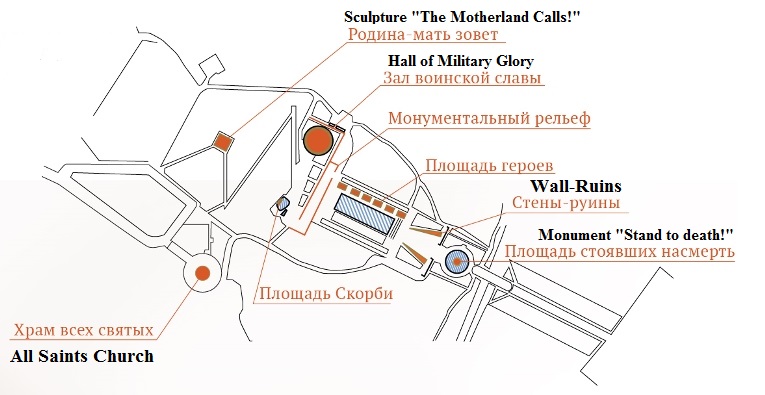
Designed as a symbolic pilgrimage, the complex guides visitors on an
ascending path from the base to the summit, representing the progression
from despair and battle to victory and eternal remembrance. The layout
integrates architecture, sculpture, and landscape in a socialist realist
style, with granite pathways, reflective pools, and inscriptions drawn
from real soldiers' letters and oaths. Entry begins at the southern foot
via the Avenue of Poplars, lined with trees symbolizing renewal.
The
introductory "Memory of Generations" is a 17-meter bas-relief showing a
diverse procession—soldiers, civilians, and children—carrying wreaths
and banners, evoking communal mourning and tribute across eras.
Ascending, visitors reach the "Stand to the Death!" sculpture: a
colossal, muscular soldier bursting from rocky ruins, armed with a
submachine gun and grenade, inscribed with "...And not a step back!"—a
reference to Stalin's Order No. 227, emphasizing unbreakable Soviet
resolve amid encirclement.
Next is the Square of Those Who Fought to
the Death, flanked by "Ruined Walls" etched with battle scenes,
closed-eyed soldier faces (symbolizing the fallen), and authentic
wartime graffiti like pleas for vengeance. Audio elements recreate
gunfire and shouts, immersing visitors in the chaos.
The Square of
Heroes features a large reflective pool and six heroic sculptures:
depictions of unyielding defenders, nurses aiding the wounded, sailors
in combat, officers rallying troops, a banner-bearer saving the flag,
and victors over defeated enemies, all underscoring collective heroism.
Inscriptions here, such as "With an iron wind blowing straight into
their faces, they were still marching forward," highlight superhuman
endurance.
At the core lies the Hall of Military Glory, a circular
pantheon opened in 1963 for the battle's 20th anniversary. Its exterior
boasts reliefs of celebrating soldiers; inside, an Eternal Flame burns
in a massive hand-shaped torch, encircled by walls listing 7,200 names
of the fallen in golden mosaic. A perpetual honor guard changes hourly,
and solemn music (like Shostakovich's works) plays softly; visitors
maintain silence as a mark of respect. The ceiling bears: "Yes, we were
mere mortals, and few of us survived, but we all fulfilled our patriotic
duty to our sacred Motherland!"
Higher up, the Square of Sorrow
presents a heart-wrenching sculpture of a mother cradling her dying son
in a pool of "tears," capturing personal grief amid national tragedy.
The pinnacle is "The Motherland Calls!"—an 85-meter-tall (including
the 27-meter sword) concrete colossus weighing 8,000 tons, depicting a
woman summoning her people to defend the homeland. Inspired by the
Winged Victory of Samothrace, its dynamic pose and billowing robes
convey urgency; the sword, originally titanium but replaced with
stainless steel in 1972 to reduce wind noise, points defiantly.
Engineering feats include a thin shell (18-32 cm thick) reinforced by
steel cables, though tilting issues (up to 20 cm by 2003) prompted
restorations in the 2010s, including foundation reinforcements and LED
lighting. At its base lie mass graves and a church added in 2005,
blending secular and spiritual remembrance.
Mamayev Kurgan transcends a mere monument; it's a sacred site in Russian culture, attracting over 2 million visitors annually for reflection, education, and ceremonies like Victory Day on May 9. It influences art, literature, and film—featured in works like Enemy at the Gates (depicting Zaytsev) and Soviet propaganda—and stands as a "dark tourism" destination, highlighting war's horrors. Symbolically, it represents motherhood calling for sacrifice, immortalizing the Soviet spirit against invasion. Recent efforts include pushes for UNESCO inscription, with discussions in 2025 emphasizing its two original peaks (one now under the Church of All Saints). Open 24/7 and free, it's best visited at dawn or dusk for atmospheric views, though visitors must respect rules like staying off the grass and maintaining silence in sacred areas. As a beacon of memory, it ensures the lessons of Stalingrad endure, warning against the costs of conflict while celebrating human fortitude.