If you want to find a museum that tells everything about the
Arctic, from the production of ice cream to a story about the
properties of ice, then you definitely need to visit the Museum of
Artistic Exploration of the Arctic named after A. A. Borisov. The
development here means a slightly different plan: in an artistic
sense, that is, the creation of paintings that described the life of
the North, because the main exhibition of the museum is "The Artist
of eternal Ice". The main material for this exhibition was a
collection of works by Alexander Borisov, who created about 400
works.
The museum itself is located in an 1897 building. The
main feature is that this monument is two floors higher than one of
the main buildings of the city, and in those days the construction
of such buildings was prohibited. The mystery will remain for
centuries — how exactly a resident of Arkhangelsk, E. K. Plotnikova,
was able to obtain permission to build such a house.
Already at
the end of the 20th century, the building was transferred to the
Museum of Fine Arts, but for quite a long time it was in a preserved
state, as it needed to be restored. Restoration work is still
underway, despite the fact that the Museum of the Artistic
Development of the Arctic named after A. A. Borisov currently has a
variety of exhibitions.
Already at the end of the 20th
century, the building was transferred to the Museum of Fine Arts,
but for quite a long time it was in a preserved state, as it needed
to be restored. Restoration work is still underway, despite the fact
that the Museum of the Artistic Development of the Arctic named
after A. A. Borisov currently has a variety of exhibitions.
And the expositions here, I must say, are wonderful: the work of the
first artist, who is rightfully considered responsible for the
artistic development of the Arctic, he created images depicting the
snows of the Far North. Five more halls complement the paintings:
the first one deals with Arctic exploration, polar expeditions — the
artist also participated in one of them. Maps of polar routes,
photos and videos, as well as navigation devices — everything that
was connected with the development of the North. I must say that
Borisov's work is not the only one here: his neighbor was the oldest
artist of the North, Ilya Konstantinovich Bylk, the second painter
who visited the Far North with brushes and paints. Temporary
exhibitions are held in the fourth and fifth halls.
Tours of
the museum are not limited to this. There is a workshop at the
museum where you can do paper plastics, learn how to knit sea knots
and try yourself as a researcher of the Far North. And for kids, a
master class is regularly held in the museum premises, where
everyone can make ice cream.
Opening hours: 10:00 — 17:00,
day off is Tuesday. The website.
The Museum of Artistic Exploration of the Arctic named after A.A.
Borisov (also referred to as the Museum of Artistic Development of the
Arctic) in Arkhangelsk, Russia, is a unique institution dedicated to the
artistic representation and exploration of the Arctic region. It serves
as a branch of the State Museum Association "Artistic Culture of the
Russian North," which oversees several cultural sites in the area. The
museum's history is deeply intertwined with the life and legacy of its
namesake artist, Alexander Alexeyevich Borisov, and reflects broader
efforts to preserve and promote the cultural heritage of the Russian
North.
The Legacy of Alexander Alexeyevich Borisov: Foundation
for the Museum's Focus
To understand the museum's origins, it is
essential to begin with Borisov himself, as the institution was
established to honor his pioneering contributions to Arctic art. Born on
November 2 (14), 1866, into a peasant family in a small village along
the Northern Dvina River in the Arkhangelsk governorate, Borisov
overcame early hardships to become the first professional artist to
depict the Arctic landscapes en plein air. At age ten, he suffered a
severe injury when logs fell on his legs, temporarily paralyzing him.
His parents vowed to send him to the Solovetsky Monastery if he
recovered, and upon healing in 1881, the 15-year-old Borisov spent a
year there working with a fishing crew. This experience ignited his
fascination with the White Sea's beauty, ice formations, white nights,
and the Pomors' tales of Arctic voyages in traditional wooden vessels
known as kochi.
Borisov returned home but soon rejoined the monastery
as an apprentice in its icon-painting studio. In 1886, he moved to St.
Petersburg, enrolling in a painting school run by the Society for the
Encouragement of the Arts, where he completed a three-year program in
just one year. By 1888, he had entered the Imperial Academy of Arts as a
non-matriculated student, earning several silver medals for his work
between 1888 and 1892. He studied under renowned landscape painters Ivan
Shishkin (from 1893) and Arkhip Kuindzhi (1894–1897), who instilled in
him precision in drawing and a sensitivity to color and light—skills
that would define his Arctic depictions.
Borisov's breakthrough came
in 1896 when he joined an Academy of Sciences expedition to the Murman
Coast, Kola Peninsula, and Novaya Zemlya to observe a solar eclipse.
This marked his first direct encounter with the High Arctic, inspiring
paintings such as “Midnight Sun on the Arctic Ocean” and “An Arctic
Night in Spring” (both 1897), which were acquired by Pavel Tretyakov for
his gallery in Moscow. Tretyakov ultimately purchased 65 of Borisov's
works, recognizing his role in pioneering the Arctic as a subject in
Russian visual art. Borisov earned epithets like “painter of eternal
ice,” “Russian Nansen,” and “poet of the North,” and he named
geographical features in Novaya Zemlya after his mentors and patrons,
including Cape Shishkin, Cape Kuindzhi, and the Tretyakov Glacier.
His expeditions intensified in 1898 with a sledge journey across the
Bolshezemelskaya tundra to Vaygach Island, where he sketched under
midnight sun conditions and documented Samoyed (Nenets) culture, later
publishing the book “Visiting the Samoyed People” (1907). A more
ambitious venture followed in 1900: Borisov organized an expedition to
Novaya Zemlya, building a house-studio and a sailing boat named “The
Dream.” The group became icebound near Matochkin Strait, forcing them to
abandon the vessel and endure harrowing escapes on foot and by lifeboat,
losing supplies and facing near-death from cold and swells. Rescued by
Nenets hunters, Borisov and zoologist T. Timofeev continued exploring
northward in 1901 via sledge for 106 days. These experiences informed
his 1909 book “In the Land of Cold and Death,” which poetically
described the Arctic's mysteries and beauty amid perils.
Borisov's
works gained international acclaim through exhibitions in Europe
(Vienna, Prague, Berlin, Paris) and the United States (New York, 1908),
earning him France's Legion of Honour, Norway's Order of St. Olav
(recommended by Fridtjof Nansen), and audiences with figures like
President Theodore Roosevelt. In Russia, he lectured publicly with magic
lantern slides to democratize knowledge of the North. Beyond art,
Borisov contributed to regional development by building an Art Nouveau
house near Krasnoborsk (now a museum-cultural center), advocating for a
northern railway, and founding the Solonikha spa in 1922, which he
managed until his death on August 17, 1934. His legacy endures in
collections worldwide, including over 60 works at the Tretyakov Gallery,
and in named sites like streets in Arkhangelsk and a peninsula in Novaya
Zemlya.
Establishment and Building History
The museum itself
emerged from efforts to preserve Borisov's Arctic-focused oeuvre within
the broader context of northern Russian art. It is housed in the "Trade
Building with a Coach House," a two-story brick structure built in 1897
as part of the Shingarev-Plotnikov City Merchant Estate on Pomorskaya
Street in Arkhangelsk. At the time, the building was controversially two
floors taller than most city structures, violating height restrictions;
the means by which owner E.K. Plotnikova obtained permission remain a
historical mystery. This architectural monument from the late 19th
century adds to the museum's cultural significance.
In 1994, amid
post-Soviet cultural reorganization, Arkhangelsk city authorities
transferred the building to the Arkhangelsk Museum of Fine Arts, which
had been established in 1960 as a regional art repository (later
evolving into the State Museum Association "Artistic Culture of the
Russian North" in 1994). The structure was initially mothballed due to
disrepair, but restoration efforts began in 1997 and have continued
intermittently to the present day, reflecting ongoing preservation
challenges in the harsh northern climate.
Key Developments and
Opening
The museum's formal development accelerated in the early
2000s. In 2002, despite ongoing renovations, the first permanent
exhibition, "The Artist of Eternal Ice" (alternatively translated as
"The Artist of the Polar Ice"), opened in the restored spaces. This
marked the museum's public debut, showcasing Borisov's works and
establishing it as Russia's first and only museum dedicated to an
artistic perspective on the Arctic.
A significant milestone occurred
in 2008 when the institution was officially renamed the Museum of
Artistic Exploration of the Arctic named after A.A. Borisov. This
rebranding emphasized its focus on the broader history of Arctic
artistic development, beyond just Borisov's contributions. The
exhibition design was handled by the Moscow-based company
"Museum-Design," with artistic direction by Alexander Nikitich Konov
(Honored Artist of the Russian Federation), project management by M.V.
Mitkevich (Director of the Museum Association), and scientific oversight
by E.I. Ruzhnikova (Deputy Director for Scientific Work). Since 2013,
the museum has pursued ongoing artistic redesigns of its exhibitions to
enhance visitor immersion.
Collections, Exhibitions, and
Educational Programs
The museum's core collection comprises
approximately 400 original works by Borisov, including paintings,
sketches, and artifacts from his expeditions, emphasizing themes of
eternal ice, midnight suns, and northern landscapes. Dedicated halls
explore Arctic exploration history, featuring maps of polar routes,
photographs, videos, navigation instruments, ship models, and expedition
memorabilia—many tied to Borisov's travels and those of other explorers.
One hall focuses on Borisov's international trips, while another
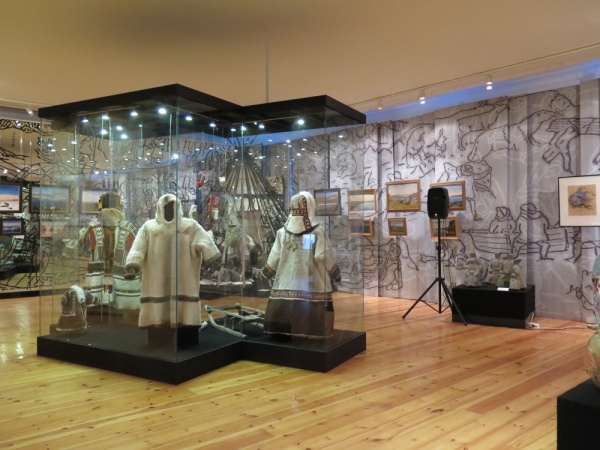
highlights Nenets decorative and applied arts, showcasing the indigenous
culture of the region.
Additional spaces are devoted to other
northern artists, such as Ilya Konstantinovich Vylka (also known as Tyko
Vylka, one of the earliest Nenets artists to depict the Far North) and
Stepan Pisakhov (1879–1960), whose iconic White Sea pine landscapes are
compared to Isaac Levitan's birches. Several halls host temporary
exhibitions, allowing for rotating displays on Arctic themes.
The
museum emphasizes education and interactivity, operating as a Center for
Social Innovation in Culture. It includes a workshop for hands-on
activities like paper crafts, knot-tying, and role-playing as Arctic
researchers. Regular master classes for children, such as making "ice
cream" (a playful nod to the frozen theme), engage younger visitors. A
satellite workshop in Krasnoborsk, supported by Severalmaz OJSC, extends
its reach.
Current Status and Significance
As of 2025, the
museum remains open year-round at Pomorskaya Street 3, Arkhangelsk,
continuing to attract visitors interested in Arctic art and history. It
stands as a testament to Borisov's vision of revealing the North's
enigmatic beauty, bridging art, exploration, and indigenous culture.
While restoration persists, the institution has evolved into a vibrant
cultural hub, contributing to Arkhangelsk's identity as a gateway to the
Russian Arctic. Its unique focus has inspired related projects, such as
the multidisciplinary "Explorer and Artist" initiative backed by
Nornickel, which ties into ongoing scientific expeditions in the region.
Building
The museum is located in a trading house built in 1897, which is part
of the architectural complex "Shingarev-Plotnikov City Merchant Estate".
The museum building is a two-story brick building with a carriage
house attached to it.
Funds and exposition
Since 2013, work has been underway on the artistic design of the
exhibition.
To date, the following halls are functioning:
"Borisov's foreign trips", the hall is dedicated to the exploration of
the Arctic, polar expeditions, of which Alexander Alekseevich Borisov
was a participant. The hall presents maps of polar routes, models of
ships, photographic materials, navigation devices and other exhibits
related to the Arctic theme.
Workshop in Krasnoborsk (thanks to
the financial support of Severalmaz OJSC)
"Nenets decorative and
Applied Art", dedicated to the culture and art of the Nenets people.
The hall is dedicated to the work of one of the oldest artists of
the North — Ilya Konstantinovich Vylka.
Several halls are
reserved for temporary exhibitions.
The museum also houses a
Center for Social Innovation in the field of culture.