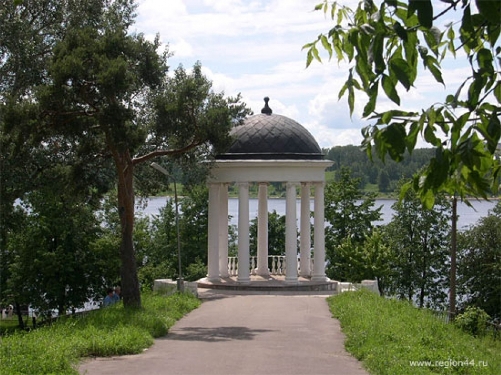
Location: Centralny Park (Central Park), Ulitsa 1 Maya
The Ostrovsky Arbour, also known as Ostrovsky's Pavilion or Gazebo (Беседка Островского in Russian), is a charming and iconic landmark in Kostroma, Russia, perched on a high embankment overlooking the Volga River. This small, elegant structure serves as a popular viewpoint and a symbol of the city's rich cultural heritage, blending historical reverence with scenic beauty. Located in the Central Park area along Ulitsa 1 Maya, it sits on the remnants of the ancient Kostroma Kremlin ramparts, near the river station, offering panoramic vistas of the river valley, the city's skyline, and the surrounding landscape. Its elevated position—high above the water on a bulk shaft—provides an unusually captivating outlook, making it a favored spot for locals and tourists alike to relax, reflect, and capture photographs.
The arbour's history is tied to both the site's ancient roots and
mid-20th-century reconstruction efforts. The location itself draws from
the remnants of the Kostroma Kremlin, a fortress that dates back to the
city's early days in the 12th century, when Kostroma was founded amid
the struggles between Rus principalities and neighboring powers like the
Volga Bulgars. The embankment preserves earthworks from this old
defensive structure, adding a layer of historical depth to the site.
The modern pavilion was constructed in 1956 as part of a broader
initiative to restore and enhance Kostroma's scenic and cultural
attractions after the destructions of earlier eras, including the Soviet
period's dismantling of many historical buildings. Designed by architect
Gennady Ivanovich Zosimov of the Kostroma Special Scientific Restoration
Production Workshop, it was built slightly inland from the original
riverbank edge, at the end of a boulevard on the Kremlin rampart. The
structure evokes the architectural style of traditional garden and park
arbours found in 18th- and 19th-century Russian estates, using white
stone to achieve a noble, classical appearance.
It is named after
Alexander Nikolayevich Ostrovsky (1823–1886), one of Russia's greatest
playwrights, whose works like "The Snow Maiden" and "The Dowry" captured
the essence of Russian life and folklore. Ostrovsky had deep ties to the
Kostroma region: his father was born and raised there, and the
playwright himself owned the nearby estate of Shchelykovo (now a museum
dedicated to him). According to local legend, Ostrovsky frequently
visited this spot during his trips to Kostroma, sitting on the hill to
admire the Volga's expansive views and draw inspiration for his writing.
Although the current arbour postdates Ostrovsky by decades, the name
"stuck" as a tribute to this connection, immortalizing his affinity for
the location.
Architecturally, the Ostrovsky Arbour is a simple yet graceful
rotunda, featuring a circular or polygonal base supported by seven to
eight slender columns (accounts vary slightly between sources, with some
describing seven and others eight). These columns uphold a domed or
conical roof, creating an open-air pavilion that blends seamlessly with
its natural surroundings. The use of white stone gives it a light,
ethereal quality, reminiscent of neoclassical garden follies in historic
Russian manors. Measuring modestly in size—more of a gazebo than a grand
edifice—it accommodates small groups comfortably, with benches or
seating inside for visitors to linger. The design prioritizes
functionality as a viewpoint, with its open sides framing the sweeping
scenery: the wide Volga River below, dotted with boats in summer; the
opposite bank's lush greenery; and distant glimpses of Kostroma's
historic architecture, including spires and domes that evoke the city's
Golden Ring status.
In terms of aesthetics, it harmonizes with
Kostroma's overall classical and provincial Russian charm, where
19th-century influences from architects like P. Fursov (known for the
nearby Fire Tower) are evident in the region's landmarks. The arbour is
classified as a cultural heritage monument, protected for its
architectural and historical value.
Beyond its scenic appeal, the Ostrovsky Arbour holds substantial
cultural weight. It embodies Kostroma's literary legacy, as the city and
region inspired much of Ostrovsky's work—Shchelykovo, for instance, is
depicted as the enchanted "Berendey's Kingdom" in "The Snow Maiden." The
pavilion's name honors this, linking it to the broader narrative of
Russian drama and folklore.
Its fame skyrocketed in 1984 with the
release of the Soviet film "Cruel Romance" (Жестокий романс), directed
by Eldar Ryazanov and based on Ostrovsky's play "The Dowry." Key scenes
were filmed at the arbour, capturing its romantic, melancholic
atmosphere against the Volga backdrop. This cinematic association turned
it into a nationwide icon, drawing film enthusiasts and romantics who
recreate moments from the movie. Today, it's often featured in tours of
Kostroma's attractions, alongside sites like the Ipatiev Monastery,
Susaninskaya Square, and the Ostrovsky Drama Theater (named in his honor
since 1923).
As a symbol of Kostroma, the arbour represents the
city's blend of history, nature, and art. It's part of the Golden Ring
route, appealing to those exploring Russia's provincial treasures, and
reflects the region's cultivation of artistic traditions over centuries.
The arbour is easily accessible on foot from central Kostroma, often
reached via a pleasant stroll along the embankment or through the park.
It's open daily from approximately 9:00 AM to 10:00 PM, though as an
outdoor site, it's available year-round (weather permitting). Entrance
is free, making it an ideal stop for budget travelers. Visitors rave
about the "beautiful view of the Volga," describing it as a peaceful
retreat with a sense of timeless romance. Reviews highlight its
photogenic qualities, especially at sunset, but note that it can get
crowded during peak tourist seasons (summer and holidays). Tips include
combining a visit with nearby attractions like the Resurrection Church
on the Debra or the Lenin Monument, and wearing comfortable shoes for
the slight incline. In winter, the snow-covered views add a fairy-tale
element, tying back to Ostrovsky's folklore-inspired tales.
Overall,
the Ostrovsky Arbour encapsulates Kostroma's soul: a quiet testament to
literary genius, historical resilience, and natural splendor, inviting
deep contemplation amid one of Russia's most picturesque riverside
settings.