Location: Yaroslavl Oblast Map
Mologa, a once-thriving town in Russia's Yaroslavl Oblast, stands as a poignant symbol of Soviet-era industrialization and human displacement. Founded in the 12th century at the confluence of the Mologa and Volga rivers, it flourished as a key trade hub before being deliberately submerged between 1941 and 1946 to create the massive Rybinsk Reservoir, earning it the moniker "Russian Atlantis." This flooding, ordered by Joseph Stalin, erased a settlement with deep historical roots, displacing thousands and submerging centuries of architecture and culture under what became one of the world's largest artificial lakes.
Mologa's origins trace back to at least 1149, when it was first
referenced in Russian chronicles as a fishing village supplying premium
catches like sturgeon and sterlet to the tsar's court. By the late 14th
to early 16th centuries, it hosted one of Russia's largest fairs,
drawing merchants from Europe and Asia to trade goods along the vital
Volga route. In 1777, Empress Catherine the Great elevated it to
district center status, spurring growth amid St. Petersburg's expansion
and the bustling river traffic—hundreds of ships annually docked for
loading, repairs, and services.
At its peak in the early 20th
century, Mologa boasted a population of over 6,000 residents in 1940,
housed in around 900 buildings, including 100 stone structures and a
vibrant market square with 200 shops. The town was economically robust,
with 11 factories producing wine, bricks, glue, berry extracts, and
other commodities. Architecturally, it blended medieval and classical
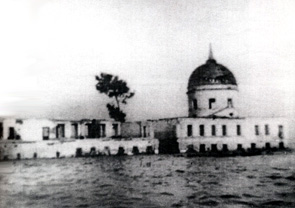
styles, featuring landmarks like the 15th-century St. Athanasius Convent
(with four churches by the late 19th century) and the grand Epiphany
Cathedral, constructed in 1882 in Russian Byzantine fashion. Notably, a
stone fire station with a watchtower was designed by Andrey Dostoevsky,
brother of the famed novelist Fyodor Dostoevsky. Life in Mologa was
idyllic for many, with residents recalling happy childhoods filled with
music, gardening, and community events amid fertile lands and river
abundance.
The town's fate was sealed in the 1930s as part of Stalin's ambitious
"Great Plan for the Transformation of Nature," which prioritized
hydroelectric power and improved navigation on the Volga. Initially,
plans spared Mologa by envisioning it as an island enclave, but
revisions raised the reservoir's water level by several meters to boost
the Rybinsk Hydroelectric Station's capacity, ultimately dooming the
town. Construction began in 1935, and flooding progressed gradually over
six years, submerging not just Mologa but approximately 700 villages, 50
churches, three monasteries, and vast estates with gardens and parks in
the surrounding area.
Evacuation efforts relocated about 150,000
people from the flood zone, with wooden homes dismantled and floated
downriver to Rybinsk, often rebuilt using Gulag prisoner labor. Stone
buildings were compensated financially or demolished by explosions,
including the Epiphany Cathedral and other structures. The final
residents departed on April 14, 1941, as waters encroached. However,
resistance was stark: A disputed NKVD report claims 294 individuals
refused evacuation, chaining themselves to objects and perishing in the
flood, though historians question this due to the slow rise of waters,
leaving their exact fate uncertain. Many families faced additional
hardships, such as deportations under the "kulak" label—wealthy peasants
targeted in Stalin's purges—with survivors like Maria Ivanova recalling
her father's exile to Arkhangelsk and the erasure of Mologa from
official records.
Today, Mologa lies beneath the Rybinsk Reservoir, its remnants
largely eroded after nearly 80 years underwater—only foundations, paved
streets, and scattered debris survive, as Bolshevik demolitions and
water damage claimed the rest. The reservoir, spanning vast areas,
occasionally recedes during dry periods, exposing ruins every few years
and drawing descendants and historians. Notable emergences, like in
2014, revealed church domes and foundations, sparking media interest and
viral photos. Survivors and relatives gather annually by boat for
commemorations, collecting artifacts like bricks or nails from the site,
which Google Maps still marks 22 km from Rybinsk.
Personal
testimonies underscore the trauma: Vassily Kovalkov preserves a "birth
brick" and knows his mother's flooded grave; Nikolai Novotelnov, now in
his 90s, lives in a relocated Mologa house, reminiscing about pre-flood
joys while mourning his father's imprisonment in Magadan. In the 1990s,
a museum in Rybinsk was established to honor the lost towns, housing
artifacts and stories.
Mologa has evolved into a cult symbol of Stalinist repression, embodying lost heritage and forced modernization. An 1881 prophecy by Mother Superior Taisiya foretold the submergence and hinted at eventual reemergence, fueling hope among some that the lands might dry again. Today, it serves as a reminder of the human cost of progress, with annual pilgrimages and online discussions keeping its memory alive.


Afanasyevsky Convent Bogoyavlensky Cathedral