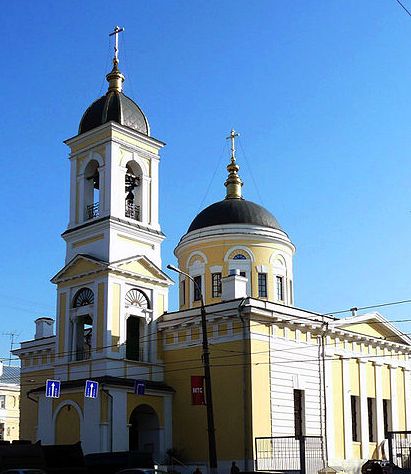
Location: Ulitsa Sovetskaya 26
Cathedral of the Ascension is a Russian Orthodox Church in the historic center of Tver dedicated to Ascension of Jesus Christ on the 40th day after his death on the Cross from the Mount Olive in Jerusalem. It was originally constructed as a wooden church in the late 16th century. However it was burned down in the late 17th century by Polish- Lithuanian invasion and Civil War that became known in Russian history as the Troubled Times. New church of the Ascension and Church of Epiphany was built here shortly thereafter. In 1725 both churches were destroyed by a fire. Current Baroque Cathedral was erected in 1760- 1768. Bell Tower was added in 1805.
Early History: Wooden Churches (Early 17th Century to Mid-18th
Century)
The site’s religious significance predates the current stone
structure. By at least 1612 (and likely earlier), two small wooden
parish churches stood here: one dedicated to the Ascension of the Lord
(the “cold” or summer church) and one to the Epiphany (the “warm” or
winter church). These modest wooden buildings served the local community
in what was then a developing part of Tver.
During the Time of
Troubles (Smuta, early 17th century), the Polish-Lithuanian intervention
devastated Tver, and both churches burned down. They were rebuilt by
1624, with an Epiphany side chapel added to the Ascension church. Fires
continued to plague the structures: the Epiphany church burned again
around 1725 and was not immediately rebuilt, while the wooden Ascension
church (with its attached Epiphany altar) suffered another major fire
later. Parishioners eventually petitioned for a permanent stone
replacement, receiving official permission (a khramozdatel’naya
gramota).
Construction of the Stone Cathedral (1749–1768)
Work
on the stone church began in 1749. The Epiphany side chapel was
completed and consecrated first, in 1751. The main Ascension altar
followed and was consecrated in 1760. This created a unified stone
temple on the historic site.
Just three years later, on May 19, 1763,
a devastating city-wide fire severely damaged the new building. The
Epiphany chapel was restored and reconsecrated within months (by
September 1763), allowing services to resume there quickly. Full
restoration of the main church, including interior decoration, was
completed by 1768. In 1805, the original bell tower—which had obscured
light and muffled sound—was dismantled, and a new one was erected on the
western side.
19th-Century Reconstruction and Classicism
Flourishing (1826–1836)
By the early 19th century, parishioners
sought a grander, larger cathedral. Although a full demolition and
rebuild was discussed as early as 1818, it was not immediately carried
out. Instead, a comprehensive reconstruction took place from 1826 to
1836, funded by local merchants I.F. Tatarintsev and F.N. Bobrov. The
provincial architect Ivan Fyodorovich Lvov designed the project in the
late Russian Classicism style.
Key additions included:
The
northern side chapel dedicated to Saints Anthony and Theodosius of the
Pechersk, completed and consecrated in 1831 (funded by merchant I.D.
Podsyponin).
The main Ascension altar was reconsecrated in 1833
during the feast of the Ascension.
The Epiphany altar received its
final consecration in 1836.
The rebuilt cathedral became a city
landmark. Its facade facing the main street (now Sovetskaya) features a
monumental portico with columns, steps, and a podium (originally
intended for statues). The building was painted ochre with white
decorative elements (columns, cornices, base, and steps made of white
stone). Inside and out, it featured elaborate paintings, including
grisaille techniques imitating three-dimensional reliefs in the portico.
The dome, crosses, and cupola were gilded; the roof used tinned iron;
and wrought-iron grilles adorned windows and doors (toned to resemble
aged oak). The bell tower was later heightened with a third tier in
1902–1903. A two-story parish house (built in the 1760s) stood nearby.
For much of the 19th and early 20th centuries, the cathedral housed the
venerated miraculous icon of the Theotokos “Tuchnaya Gora”
(“Fat/Abundant Mountain” or “Fertile Mountain”), associated with
healings and dating back roughly 250–300 years to a Tver-area monastery
(a copy remains today after the original was lost).
Soviet Era
and World War II (1920s–1980s)
After the 1917 Revolution, the
cathedral faced severe challenges:
In 1922, a state commission
confiscated church valuables and icons.
It was closed in 1935.
In
1936, it was repurposed as an exhibition space for the Tver (then
Kalinin) Regional Local History Museum.
A brief revival occurred
during the German occupation of Tver (then Kalinin) in late October
1941. Bishop Vasily (Ratmirov) of Kalinin reopened it for services with
the assistance of the occupation-appointed mayor (burgomaster) Valery
Yasinsky. Services lasted only until December 1941, when Soviet forces
retook the city and the cathedral was closed again.
In 1972, the
building was transferred to the Regional Industrial Exhibition Hall.
Significant alterations were made for secular use: inter-floor ceilings
were installed, the heating system was replaced, and a ramp was added on
the eastern side. These changes adapted the historic structure for
exhibitions but compromised some original features.
Post-Soviet
Revival (1990s–Present)
Believers’ efforts in the early 1990s led to
the cathedral’s return to the Russian Orthodox Church in 1991. Divine
services resumed on January 7, 1993 (the feast of the Nativity of
Christ). Restoration work followed in the 1990s, addressing Soviet-era
modifications.
Notable developments include:
In 1994, the
tradition of the cross procession with the Tikhvin Icon of the Theotokos
was revived (starting at the Resurrection Cathedral of the
Christ-Rozhdestvensky Monastery and ending at the Ascension Cathedral).
The relics of Hieromartyr Thaddeus (Uspensky), Archbishop of Tver and
Kashin (reposed December 31, 1937, after arrests and exile), were
transferred to the cathedral in 1994. Discovered in 1993, these relics
are among its most revered shrines. Thaddeus, known for his holiness,
gift of foresight, and modesty, is venerated as a saint who endured
Soviet persecution.
Today, the Ascension Cathedral remains an
active church within the Tver Eparchy (1st Tver Deanery). It serves as
the archpastoral residence. The current rector is Metropolitan Savva
(Mikheev) of Tver and Kashin (as of available records). It continues to
host services, processions, and veneration of its icons and relics,
including the copy of the “Tuchnaya Gora” icon. As an object of federal
cultural heritage (registered No. 6900101000), it stands as both a
spiritual center and a architectural gem of Tver’s historic core.
Historical Evolution of the Architecture
The site has deep roots.
Wooden churches dedicated to the Ascension of Christ and the Epiphany
(Theophany) existed here from the early 17th century but were destroyed
during the Time of Troubles (Polish-Lithuanian intervention in 1612) and
subsequent fires. A stone replacement was built between 1749/1751 and
1760 by local merchant Dmitry Svetogorov: the Epiphany side chapel was
completed and consecrated in 1751, with the main Ascension altar
following in 1760.
This first stone church followed Elizabethan
Baroque (developed Baroque of the mid-18th century). It was relatively
small-scale and compact, featuring octagonal volumes (vos’meriki) rising
from square bases, topped with cupola and pyramidal (shatrovaya) roofs
crowned by small domes. Facades were ornate in the Baroque manner, with
dynamic forms similar to other Tver churches of the era, such as the
Nikolo-Kapustinsky Church. A bell tower initially adjoined the north
wall but obstructed light and sound, leading to its relocation westward.
The 1763 city fire severely damaged the structure, but it was quickly
restored (Epiphany chapel by late 1763; full interior by 1768),
preserving its Baroque character for several decades.
A separate bell
tower was erected in 1805. By the 1820s, the aging Baroque building no
longer suited the parish’s needs or Tver’s post-Catherine II regular
urban planning (which emphasized harmonious stone facades along straight
streets). In 1826, the old church was largely dismantled, and a complete
reconstruction began under provincial architect Ivan Fyodorovich Lvov
(И.Ф. Львов). The new cathedral was completed in phases: the side chapel
of Saints Anthony and Theodosius of the Pechersk was consecrated in
1831, the main church (with a new gilded iconostasis) in 1833, and the
Epiphany chapel in 1836. Materials from the old structure (brick, iron)
were partially reused. Some planned elements—such as sculptural groups
on the staircases, a relief frieze over the northern portal, internal
dome coffers, and a southern staircase—were never executed due to
funding and other constraints.
The 1830s reconstruction produced the
cathedral’s current neoclassical form, aligning it with Tver’s growing
central district of two-story stone buildings. A third tier was later
added to the bell tower around 1902–1903 per architect V.I. Nazarin’s
design. The cathedral was closed in 1935, repurposed as a museum and
exhibition hall (with major internal modifications like added floors and
a ramp in 1972), briefly reopened during the 1941 Nazi occupation, and
returned to the Russian Orthodox Church in 1991–1993. It is now an
active archiereal podvorye (episcopal residence church) and a federal
cultural heritage site.
Exterior Architecture: Late Russian
Classicism
The rebuilt cathedral is a monumental yet proportionate
neoclassical structure, emphasizing symmetry, clean lines, harmonic
proportions, and architectural orders (columns, entablatures,
pediments). Its overall plan is roughly rectangular, approximately 13.5
sazhens long by 12.5 sazhens wide (about 28.7 m × 26.6 m), with a
central dome on a drum and integrated side chapels.
Northern
(main/parade) facade on Sovetskaya Street: This is the most elaborate
and visually dominant side, designed to harmonize with the continuous
street frontage. It features a prominent six-column portico
(шестиколонный портик) on a high podium with broad steps, creating a
grand, solemn entrance. Flanking wall sections enhance balance and
street integration. The portico includes sophisticated grisaille
(monochrome) painting that simulates three-dimensional volumetric
reliefs and sculptural compositions—an illusionistic technique adding
Baroque-like depth to the otherwise restrained Classicist design.
Western facade on Tverskoy Prospekt: More austere and laconic, it gains
vertical emphasis from the attached bell tower.
Materials and
finishes: White stone (likely local limestone) was used extensively and
prominently for columns, cornices/entablature, plinth/base, and all
steps of the temple and bell tower. Walls are painted ochre (a warm
yellowish-brown hue), with white accents on decorative details. The roof
and central dome are covered in tinned (luzhenoe) iron. The main
cupola/cross and bell-tower spire cross are gilded. Wrought-iron grilles
protect windows and doors; frames and doors are toned to resemble aged
oak. Everything reflects meticulous attention to detail typical of early
19th-century provincial Classicism.
The three-tiered bell tower
(with possible octagonal influences echoing the earlier Baroque phase)
provides a strong vertical accent, complementing the horizontal mass of
the main volume and dominating the intersection skyline.
Interior
Architecture and Decoration
The interior conveys monumentality and
spiritual elevation through its high, light-filled space under the
central dome. It originally featured extensive wall paintings (murals)
both inside and (to a limited extent) outside, including apostles and
evangelists on pillars and angels higher up. The focal point is the
richly carved, gilded wooden iconostasis (installed during the 1830s
reconstruction), with a concave central section supported by columns and
simpler side sections. A raised wooden solea (stepped platform) fronts
the iconostasis. Post-Soviet restorations have refreshed paintings,
added marble finishes to the iconostasis and reliquary (housing relics
of Hieromartyr Thaddeus/Ussr), installed new chandeliers and sconces,
and introduced autonomous heating with decorative grilles. The side
chapels integrate seamlessly into the unified interior volume.
Overall Character and Significance
The Cathedral of the Ascension
embodies Tver’s architectural evolution: from intimate Elizabethan
Baroque (small, ornate, octagonal forms) to grand, street-oriented late
Classicism that prioritizes civic harmony and solemnity. Its parade
northern facade, white-stone accents against ochre walls, gilded dome,
and integrated bell tower make it a visually striking yet restrained
monument. As one of the last pre-revolutionary churches built in Tver
and the sole survivor of 1930s demolitions in the center, it remains a
key spiritual and architectural anchor in the Upper Volga region.
Beyond its religious function, the Cathedral of the Ascension plays a
vital city-forming role in Tver. In the pre-revolutionary era, it helped
structure the central district's development, and during the Soviet
period, it was one of the few surviving temples, maintaining a subtle
presence amid the destruction of other religious sites. Today, it stands
as a symbol of cultural continuity in the Upper Volga region, attracting
visitors for its historical value and architectural beauty.
As of
2025, the cathedral remains fully operational, with regular divine
services and pilgrimages. It is led by the rector, Metropolitan Savva of
Tver and Kashin, and serves the local Orthodox community. Visitors can
explore it as part of Tver's sightseeing, though it is an active place
of worship—modest attire and respectful behavior are expected. For more
details, the official website is vosnesenie.ru.