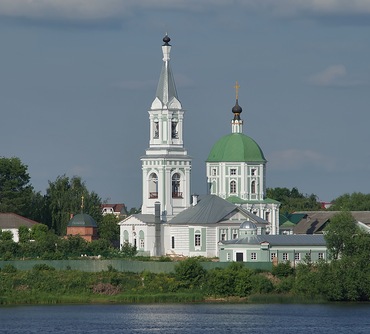
Saint Catherine's Monastery, also known as the Holy Catherine
Women's Monastery (Svyato-Ekaterininsky Zhensky Monastyr), is an
active Orthodox women's convent located in the Zatverechye
microdistrict of Tver, Russia. Situated on the left bank of the
Volga River near its confluence with the Tvertsa River, at Ulitsa
Kropotkina, 19/2, it offers a serene setting with picturesque views
of the river, making it a peaceful retreat for spiritual reflection
and a notable site for those interested in Russian Orthodox history
and architecture. The monastery is part of the Tver Eparchy of the
Russian Orthodox Church and serves as a spiritual center, housing
around 25 to 33 residents, including nuns, novices, and workers,
many of whom are elderly. Its grounds are meticulously maintained,
featuring a beautiful garden that replaced former garages and
outbuildings, providing both aesthetic appeal and practical
resources for the community.
The monastery is renowned for its
tranquil atmosphere, often described as one of the quietest places
in Tver, ideal for photography, picnics, or quiet contemplation.
Visitors appreciate its accessibility—just a half-hour walk from the
city center—and its role in preserving religious traditions amid a
scenic riverside backdrop.
Early History of the Site (1620s–1780s): Wooden Churches and the
Rise of the Stone Cathedral
The monastery's spiritual roots trace
to the 1620s, when Tver census (Pistsovye) books first record a
wooden church dedicated to the Great Martyr Saint Catherine of
Alexandria in Zatverechye. Adjacent to it stood another wooden
church honoring Saint Nicholas the Wonderworker. The Catherine
church was “cold” (unheated, used mainly in summer), while the
Nicholas church served winter needs. By 1684, the Nicholas church
had fallen into disrepair; a warm Nicholas side chapel was therefore
attached to the Catherine church.
In 1732 the original wooden
Catherine church burned down but was quickly rebuilt. By the 1770s
the wooden structures were aging, and on 27 August 1773 the clergy
and parishioners petitioned for permission to erect a stone church.
Construction, funded entirely by local donations, finished in 1786.
The new stone Cathedral of Saint Catherine was consecrated with its
main altar dedicated to the Great Martyr Catherine and the northern
chapel retained for Saint Nicholas. This building survives today as
the monastery’s central cathedral.
The design is typical
late-18th-century Russian Baroque (“Elizabethan Baroque”
transitioning toward classicism): an octagon-on-quadrangle plan with
a high rounded dome, reflecting the fashionable architectural style
of the era while echoing earlier pre-Petrine Orthodox forms. Further
expansions followed:
1800 – stone fence enclosing the church
grounds.
1806–1813 – right-side chapel of the Nativity of Saint
John the Baptist (later rededicated in 1824 to the Finding of the
Head of John the Baptist after a bishop’s blessing).
1835 – new
vestibule.
1852 – rebuilt bell tower.
1880 – new stone
perimeter wall.
1906 – chapel to Saint Seraphim of Sarov
installed inside one of the fence towers.
The church served
not only Zatverechye residents but also nearby villages, becoming a
local spiritual center.
20th Century: Soviet Repression and
Near-Destruction (1917–1989)
After the 1917 Revolution, the
church shared the fate of thousands of Russian Orthodox sites. It
was gradually stripped of its possessions and closed. The last
Divine Liturgy occurred in 1932. The final rector, Archpriest
Nikolai Vologodsky, was arrested; he died in Tver prison on 4
December 1932 and was secretly buried by authorities at the German
cemetery. Relatives later placed soil from the grave at the church’s
altar wall; a granite memorial with his photograph now stands
nearby.
During World War II the bell tower suffered damage and
was fully demolished in the 1960s. The building stood empty and
decaying for decades.
Revival and Monastic Foundation
(1989–Present)
The turning point came with the late-Soviet
religious thaw. On 7 December 1989 (the feast of Saint Catherine)
the first service in decades was held in the John-the-Baptist
chapel. In 1993 the church became a podvorye (dependency/metochion)
of the Ascension Orshina Women’s Monastery.
On 15 June 1996—the
feast day of the blessed Princess Juliana of Novotorzhsk—Archbishop
Victor (now Metropolitan) of Tver and Kashin signed a decree
transforming the podvorye into the independent Saint Catherine’s
Women’s Monastery. Nun Juliana (Ritoniemi Kirsi Marita), who had
previously been abbess of Orshina Monastery, was appointed superior
(later elevated to igumenia). She remains abbess to this day.
Key milestones in the monastery’s young life:
2001 –
restoration of the bell tower.
7 June 2007 – formal consecration
of the monastery by Archbishop Victor.
Post-2007 – construction
of the monastic enclosure (eastern and partial southern walls
completed); restoration of the Seraphim of Sarov chapel (finished
2010); erection of chapels to Saints Juliana and Eupraxia of Moscow
and to Saint Tryphon of Pechenga (by 2012).
Ongoing restoration
of cell buildings and grounds; a garden now occupies the site of
former garages and sheds.
The monastery also oversees three
attached (pripisnye) churches outside the walls:
Church of Saint
Sergius of Radonezh (with chapels to Prophet Elijah and Saint
Alexis, Man of God).
Church of the Holy Martyrs Mina, Victor, and
Vincent (first mentioned 1628).
Church of the Great Martyr
Nikita.
Spiritual, Educational, and Community Life Today
The community numbers roughly 25–33 (igumenia, nuns, novices, and
lay workers), many elderly. Daily services, especially at the
Tryphon chapel, continue. Educational work is prominent: a Sunday
school for children, four-year Orthodox Theological Courses
(operating since 1996, enrolling up to 100 adults), libraries for
sisters and laity, and catechetical programs in local schools,
colleges, gymnasiums, and even with military units. An almshouse for
the elderly operates on site. Pilgrims are welcomed to work in
exchange for spiritual guidance.
Historical Context Shaping the Architecture
The site's religious
use dates back to the early 17th century (with possible earlier wooden
structures), when two wooden churches stood here—one dedicated to St.
Catherine and one to St. Nicholas. A "warm" (heated) St. Nicholas side
chapel was added in 1684. The wooden Catherine church burned in 1732 and
was rebuilt, but after the great Tver fire of 1763, locals and Empress
Catherine II funded a new stone church completed in 1775–1786 (some
sources cite 1786 as the dedication year). This became the core of the
current monastery. In Soviet times, the church closed (1929/1930s),
served as a garage, warehouse, and workshop, and suffered damage (upper
bell-tower tiers destroyed in WWII; lower tiers later dismantled).
Frescoes from the 19th century were lost. It reopened as a convent in
1996, with major restorations (including the bell tower in 2001)
continuing into the 2010s. The monastery now includes assigned churches
and chapels outside the main grounds.
Main Cathedral: Church of
Saint Catherine the Great Martyr
The Cathedral Church of Saint
Catherine the Great Martyr (with a northern chapel to St. Nicholas the
Wonderworker) forms the architectural centerpiece. It exemplifies
late-18th-century Tver temple architecture: a synthesis of traditional
pre-Petrine Russian Orthodox forms and the Baroque style popular in the
17th–18th centuries, with later classical (classicism) additions and
annexes.
Key structural features include:
Plan and massing:
Classic "octagon on quadrangle" (восьмерик на четверике) layout. The
lower part is a square (четверик) base; above rises an octagonal
(восьмерик) drum/tier. This tiered, upward-thrusting form is typical of
Russian Baroque churches, creating a dynamic vertical emphasis. It is a
two-light (двусветный) structure with two rows of windows for
illumination.
East end (altar): A five-sided (pentagonal/faceted)
apse projects outward, a practical and decorative element common in
Russian Orthodox design for the sanctuary.
West end: A wide refectory
(трапезная) hall adjoins the main volume. This was later expanded
southward (1806–1813, possibly by architect A.A. Trofimov) with a side
chapel (originally for the Nativity of John the Baptist, later
rededicated).
Dome and roof: A high, rounded dome rises over the
octagonal light drum (световой барабан), echoing its eight-sided shape
for visual harmony. It is topped by an elegant small cupola
(главка/onion dome) with a cross. The overall silhouette blends Baroque
curvature with traditional Russian onion-dome motifs.
Façade
decoration: Rich Baroque ornamentation includes rustication (rustovka),
elaborate window surrounds (nalichniki), pilasters, and molded details
typical of the era. Later classical elements (e.g., from 19th-century
renovations) add restraint and symmetry in places, such as simpler
portico-like features or proportions. The building is constructed of
stone/brick, traditionally whitewashed with green or metallic roofing
accents on the dome.
The church measures as a compact yet imposing
parish-scale temple, not a vast cathedral, but its riverside prominence
makes it a local landmark. Interiors no longer retain original
19th-century frescoes or full iconostases from before the Soviet period,
though modern restorations have returned it to active liturgical use.
Relics (including those of St. Catherine) and icons are venerated
inside.
Bell Tower
The three-tiered tent-roofed (шатровая)
bell tower attaches to the refectory or west side, a hallmark of Russian
church ensembles. It originally dated to the 19th century (rebuilt 1852)
but was severely damaged in WWII; the upper tiers were lost, and the
base survived until full reconstruction in 2001 (architects V.V.
Kurochkin and A.V. Prokhorov). The tower features arched openings for
bells on multiple levels, decorative cornices, and culminates in a tall
spire-like tent roof topped by another elegant cupola and cross. It
integrates seamlessly with the church's Baroque-classicist aesthetic
while evoking earlier Russian tented-tower traditions.
Monastery
Ensemble and Layout
The grounds form a roughly rectangular enclosed
territory. A massive stone/brick fence (built originally in the 19th
century; eastern and southern sections rebuilt post-1996) with small
towers (башенки) surrounds it; some towers historically housed chapels
(e.g., one dedicated to St. Seraphim of Sarov in 1906). Not the full
perimeter is complete, but it defines the sacred space.
Other
structures include:
Sisterhood (kелейный) corps — Long, low
residential buildings for nuns (one preserved in relatively good
condition even in Soviet times).
Clergy house and
utility/outbuildings — Converted or rebuilt; former garages/sheds
replaced by a garden and orchard serving as both ornament and
subsistence farm.
Additional chapels on grounds — Including restored
St. Seraphim of Sarov (by 2010) and newer ones to Saints Juliana and
Eupraxia of Moscow, and St. Tryphon of Pechenga (by 2012). These are
modest, often integrated into walls or freestanding.
The complex
remains compact and functional, with ongoing maintenance emphasizing
whitewashed walls, clean lines, and Orthodox symmetry rather than grand
scale.
Affiliated churches (outside the main fence) include St.
Sergius of Radonezh (under restoration) and others like those to Martyrs
Mina, Victor, and Vincent, or Great Martyr Nikita.
Overall Style
and Significance
The architecture reflects Tver's 18th-century
rebuilding after the 1763 fire—provincial Baroque adapted to Russian
Orthodox needs, blending dynamic forms, rich decoration, and traditional
elements (octagon-on-square, tent roofs, onion domes) with emerging
classical restraint. It is not a fortress-monastery like the ancient
Sinai St. Catherine's but a harmonious parish-turned-convent ensemble
emphasizing verticality, river integration, and intimate scale.
Restorations have preserved its historical character while adapting for
modern monastic life (e.g., theological courses, school). Today, it
stands as a peaceful, active spiritual site with strong visual appeal
from the Volga.
As a relatively modern monastery with deep historical roots, Saint
Catherine's holds importance for its resilience through Soviet
suppression and its revival as a center for Orthodox spirituality. It
houses revered relics and icons, including particles from saints like
Catherine, the Kiev-Pechersk and Optina Elders, Tver and Novgorod
saints, and icons such as the Vilnius and Kazan Icons of the Mother of
God, "Do Not Weep for Me, O Mother," and the Tikhvin Icon. Unique
features include the icon "Don’t Cry for Me, Mother" in the temple.
The monastery emphasizes education and community outreach, running a
Sunday school for children, four-year Orthodox theological courses for
adults (attended by up to 100 people), and libraries for sisters and
parishioners. It conducts catechetical programs in local colleges,
lyceums, gymnasiums, and with military personnel, while also operating
an almshouse for the elderly. Daily services are held at the chapel of
Saint Tryphon, and the site welcomes pilgrims for labor in exchange for
spiritual support, with ongoing needs for donations to care for infirm
residents. Under Abbess Igumenia Juliana (Ritoniemi), it continues
restoration and expansion, symbolizing a living testament to faith in
contemporary Russia.
Reviews highlight the monastery's beauty and calm, with a Google rating of 4.7/5 from 210 reviews and a Tripadvisor score of 4.5/5 from 39. Visitors praise its well-kept grounds for reflection, the stunning Volga views, and its spiritual ambiance, though some note limited facilities like no on-site food options and changes to the original interior. Tips include visiting early mornings or weekdays to avoid crowds, and appreciating the unique icons during services. Overall, it's seen as an enriching destination for history, architecture, and peace, accessible by tram or minibus to the "Fire Square" stop.