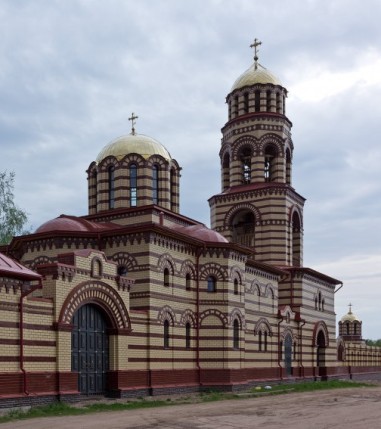
The Nikolaevsky Malitsky Monastery (Николаевский Малицкий монастырь), also commonly referred to as the Nikolo-Malitsky Monastery or simply Nikolo-Malitsa, is a Russian Orthodox male monastery dedicated to Saint Nicholas the Wonderworker. Located in the village of Nikolo-Malitsa in the Kalininsky District of Tver Oblast, Russia, it sits approximately 6 km from the city of Tver along the highway to Saint Petersburg. The monastery is positioned on the banks of the Malitsa River, which flows into the Mezhurka River, a tributary of the Volga, and is surrounded by pine forests that evoke a sense of ancient asceticism. Founded in the late 16th century, it has endured fires, wars, and Soviet-era suppression before its revival in the 21st century. Today, it operates as an active monastery under the Tver Eparchy of the Russian Orthodox Church, adhering strictly to the Athonite (Holy Mountain) monastic rule, which emphasizes rigorous ascetic practices inspired by Mount Athos traditions. Unlike traditional Athonite monasteries, it allows women visitors as an exception. The current abbot is Igumen Boris (Tulupov), appointed in 2008.
Founding and Early History (Late 16th–Early 17th Century)
The
monastery was established between 1584 and 1595 during the reign of Tsar
Fedor Ivanovich (son of Ivan the Terrible) on the wasteland known as
Shevyakova (or Shevyakovo). Tsar Fedor granted the monks the wastelands
of Shevyakovo, Mishurovo, and Zelentsovo. It began as a modest wooden
complex with minimal resources and a small brotherhood.
The Time of
Troubles (Smuta, 1604–1613) brought devastation: Polish forces ravaged
the area, and a severe famine struck in 1601–1603. Recovery came in 1613
under Tsar Mikhail Romanov, the first Romanov ruler. He assigned lands
from the ruined Tver Vozdvizhensky Monastery and the destroyed Mytitsky
Monastery to Malitsky, elevating its abbots to the rank of igumen
(hegumenos). A settlement (Malitskaya Sloboda) soon grew beside the
monastery. Its location near the busy Great Moscow–Novgorod Road drew
merchants and travelers who venerated Saint Nicholas (patron of
travelers) and offered donations, gradually expanding the monastery’s
holdings. By the 1620s–1680s, records in Tver land books show it had
acquired additional lands from other ruined monasteries.
1675
Fire and 17th-Century Reconstruction
A catastrophic fire in 1675
destroyed nearly the entire wooden complex overnight. Legend holds that
the icon of Saint Nicholas survived unscathed—its face untouched while
the back was scorched—becoming the monastery’s chief wonderworking relic
(an early 17th-century belt portrait, about 24.5 × 20 cm, with Saints
Boris and Gleb on the sides). A related miracle story tells of Saint
Nicholas appearing to the abbot in a dream, rebuking the monks for
extinguishing the eternal lamps before his icons out of fear of fire,
and promising divine protection if they were kept lit. The lamps were
restored, and the monastery reportedly never burned again.
Generous
donations enabled rapid rebuilding. In 1676, Tver nobleman and tsarist
cupbearer Grigory Dmitrievich Ovtsyn funded a new five-domed stone
cathedral dedicated to the All-Merciful Savior (Spas Vsemilostivy), with
two warm side chapels—one to Saint Nicholas and one to the Mother of God
Hodegetria (the Guide). Wooden cells, walls, and outbuildings were also
restored. Ovtsyn died in 1683 and was buried in the cathedral near the
Hodegetria chapel, per his will.
18th-Century Golden Age and
Shuvalov Patronage
The 18th century brought the monastery’s most
significant transformation. In April 1742, during coronation festivities
for Empress Elizabeth Petrovna, Countess Mavra Egorovna Shuvalova (wife
of powerful statesman Pyotr Ivanovich Shuvalov) fell gravely ill while
pregnant and stopped at Malitskaya Sloboda. She prayed before the
wonderworking icon of Saint Nicholas and vowed to rebuild the monastery
in stone if healed. She recovered, gave birth to a son named Nikolai,
and—together with her husband—became the monastery’s greatest
benefactors.
Reconstruction began around 1751–1753 in the “Petrine
Baroque” style. The territory was enclosed by a stone quadrangular wall
(about 138.5 m × 85 m) with four corner towers (originally topped with
wooden domes and spires). The central Savior Cathedral was rebuilt as a
Greek-cross plan with side chapels to Saint Nicholas and Saints
Zachariah and Elizabeth. A two-tier bell tower rose over the holy gates,
flanked by churches to the Protection of the Theotokos and Saint Peter
of Athos (the latter once housing a mosaic icon by Mikhail Lomonosov).
The Shuvalovs donated bells (including massive ones from 1743 and later
1891), family relics, a golden crucifix-reliquary containing a particle
of Christ’s robe, ancient Mother of God icons, and Lomonosov’s first
mosaic of the Savior Not-Made-by-Hands. Countess Mavra died in 1759 and
was buried in the cathedral crypt; her husband followed in 1762. Their
patronage turned the monastery into a prosperous architectural ensemble
with gardens and orderly life.
19th–Early 20th Century:
Prosperity and Popular Veneration
By the mid-19th century the
monastery thrived economically. It operated as an unstaffed, “cell-type”
(особножительное) community. It owned extensive lands (over 520
desyatins of fields, meadows, and forests), a mill on the Malitsa River,
and various outbuildings. In 1860–1861, prayers before the Nicholas icon
were credited with delivering Tver from a cholera epidemic and fires. In
1862–1863 an annual cross procession was instituted: the icon was
carried to Tver (initially to Znamenskaya Church, later Nikulskaya) on
May 9 (Old Style) and returned June 1 amid great public celebration.
A church-parish school opened in 1886 (expanded 1901) serving local
children. By 1910, 16 dachas for Tver residents stood outside the walls.
The monastery remained a popular pilgrimage site thanks to its shrines,
liturgy, and location.
Soviet Era, Closure, and Destruction
(1920s–1990s)
World War I (1915–1917) saw the monastery house Russian
army personnel. In the 1920s, Soviet authorities closed it, plundered
its valuables, and repurposed or demolished buildings. The last
documentary mention dates to May 12, 1929; regular services ended
completely by 1939. The Baroque cathedral and much of the 18th-century
ensemble were lost. The area saw fighting during the 1941 Battle of Tver
against German forces.
Revival in the 21st Century: “Tver Athos”
Revival began informally in 2002 when the parish of Saint Xenia of
Petersburg set up a chapel to Saint Nicholas in the ruined brotherly
corps and resumed prayers. Monastic life returned in 2005 with the
arrival of Hieromonk Boris (Tulupov), now igumen and abbot. On June 23,
2008, the Holy Synod officially restored the monastery under the Tver
Eparchy.
New construction followed the Neo-Byzantine style and the
Athonite (Holy Mountain) rule: the Church of the Protection of the
Theotokos (2008–2010) and the Domestic Church of All Holy Fathers of
Mount Athos (2017–2019, part of the brotherly corps). Services feature
distinctive Byzantine chanting (the monastery’s choir has recorded
albums). It is often called “Tver Athos” for its strict communal life,
all-night vigils, and Athonite traditions. The wonderworking icon of
Saint Nicholas was returned in 2010 from Tver’s White Trinity Church.
Relics of Saint Arseny of Tver (a key local monastic founder) are also
venerated. Healings attributed to the Nicholas icon continue to be
reported.
Today the monastery operates a Sunday school and
icon-painting workshop. It remains a living center of Orthodox
spirituality, cultural heritage (listed as a protected monument), and
pilgrimage, blending deep historical roots with a vibrant contemporary
monastic revival.
Historical Architecture (16th–18th centuries – largely lost)
The
monastery was founded between 1584 and 1595 on the wooded Shevyakova
wilderness. The first structures were wooden. A devastating fire in 1675
destroyed almost everything, but a small miraculous icon of St. Nicholas
survived, which later drove major donations.
In 1676, a five-domed
stone Spassky (All-Merciful Savior) Cathedral replaced the wooden
church. It featured two warm side chapels (St. Nicholas the Wonderworker
and the Hodegetria icon of the Mother of God). This was one of the
earliest stone buildings in the Tver region outside the city itself.
The decisive transformation came in 1751–1760s under the patronage of
Countess Mavra Egorovna Shuvalova (who had vowed to rebuild the
monastery after a miraculous healing). Architect P.Ya. Plyuskov (a pupil
of the famous Baroque master D.V. Ukhtomsky) completely redesigned the
complex in the Petrine/Elizabethan Baroque style — one of the first such
provincial Baroque ensembles outside Moscow and St. Petersburg. The
design drew inspiration from the Primorskaya Pustyn’ hermitage near St.
Petersburg and elements of the Smolny Monastery.
Key features of
the Baroque ensemble:
Overall layout: A strict quadrangle measuring
138.5 m × 85 m, enclosed by a stone wall with four corner towers topped
by octagonal wooden domes and spires (later iron-covered).
Central
cathedral: The rebuilt Spassky Cathedral was an elongated Greek-cross
plan with additional chapels (St. Nicholas, Zechariah and Elizabeth) and
a sacristy.
Supporting buildings: Eastern brotherhood (monastic)
corps; southern abbot’s quarters; two-tier bell tower over the Holy
Gates; flanking churches — Pokrov (Protection of the Theotokos) and St.
Peter of Athos (the latter once contained a rare mosaic icon by M.V.
Lomonosov).
Style: Rich Baroque plasticity, characteristic
18th-century window surrounds, cornices, and proportions typical of
mid-18th-century Russian provincial Baroque.
By the early 20th
century the monastery was a modest non-communal (za-shtatny) house with
8–10 monks, extensive outbuildings, a mill, and over 520 dessiatinas of
land. The entire Baroque complex was almost completely destroyed: closed
in the 1920s–1930s, used as barracks and storage, and largely
obliterated by bombing in 1941 and subsequent Soviet demolitions (the
last Pokrovsky church was dynamited in 1954). Only fragments of the
18th-century brotherhood corps survived.
Current Architecture
(2008–present) – Neo-Byzantine / Athonite Revival
When the monastery
was officially revived by the Holy Synod on 23 June 2008, the decision
was deliberately made not to reconstruct the lost Baroque ensemble
(plans and exact measurements were incomplete, and the original
buildings had mixed 17th–20th-century styles). Instead, the new complex
was built in a unified Neo-Byzantine (Athonite/Greek) style to match the
monastery’s adoption of the strict Mount Athos monastic rule and
Byzantine liturgical chant. Architect Mikhail Budkin (who also served as
an altar server at the monastery) led the main designs.
Overall
layout and enclosure
The monastery retains the historic quadrangular
plan but with a more modest, fortress-like appearance. A new stone wall
with four corner towers was completed around 2010. The towers are capped
with octagonal wooden domes and spires, echoing the 18th-century
silhouette while using two-tone “Byzantine brickwork” (alternating light
yellow and reddish-brown bricks that form decorative patterns). This
polychrome masonry is the unifying visual motif of the entire modern
ensemble and gives the buildings their characteristic warm, “Athonite”
look.
Main church – Pokrovsky (Intercession of the Most Holy
Theotokos) Temple (2008–2012)
This is the cathedral (katholikon) and
the architectural centerpiece.
Built directly on the footprint of
the historic Pokrovskaya church.
Explicitly modeled after the Church
of the Holy Belt of the Theotokos in Vatopedi Monastery on Mount Athos.
Single-domed brick structure with a compact, centralized plan typical of
late-Byzantine and Athonite churches.
Exterior: restrained
Neo-Byzantine forms, arched windows and portals, polychrome brick
patterns, and a single large dome on a high drum. The architecture
deliberately avoids the vertical emphasis of Russian Baroque in favor of
the horizontal, inward-focused harmony of Athonite churches.
Interior highlights (Athonite character)
Stasidia (high-backed wooden
seats with armrests) line the walls — the classic Athonite arrangement
that allows monks to stand or sit during the long services.
Fresco
program: Executed by Romanian iconographer Ruslan Gebya. The murals copy
16th-century Athonite prototypes (especially Dionysiat and Stavronikita
monasteries) in the style of Theophanes the Cretan. Unusually, the
frescoes were painted on large linen canvases in a workshop using a
Venetian technique (originally developed for the Doge’s Palace); the
canvases were then glued to the walls with a special
cottage-cheese-based adhesive. This allows the walls to “breathe” while
speeding up construction.
Iconostasis: Low, two-tiered, resembling a
Byzantine templon rather than the tall Russian icon screen.
Unique
liturgical feature: A large gilded khoros (circular chandelier with
icons) suspended in the center of the nave. During services the khoros
is gently swung, creating a dynamic, almost theatrical movement that
symbolizes the unity of heaven and earth and enhances the acoustics for
Byzantine chant.
The acoustics and spatial organization emphasize
communal participation — clergy and laity are not sharply separated as
in later basilica-style churches, but gathered around the central space.
Other structures
Brotherhood (monastic) corps (restored and
expanded): Contains cells, refectory with gallery, and the small
domestic Church of All Saints of Athos (built 2017–2019, also
Neo-Byzantine).
House church of St. Nicholas the Wonderworker
(consecrated 2005) inside the restored 18th-century corps fragment.
Bell tower (completed 2010) with 15 bells cast in Bezhetsk.
One-story
refectory and various service buildings, all executed in the same
Byzantine brickwork.
The monastery is fully operational, with a small brotherhood living
according to the Athonite устав, similar to practices at the Serbian
Hilandar and Russian St. Panteleimon Monasteries on Mount Athos.
Services are conducted in the Byzantine rite, with Byzantine chanting as
a highlight—performed by the "Aksion Estin" choir, which gave a concert
at the Moscow House of Music on October 15, 2025. Daily schedule
includes evening services at 17:00, midnight office and matins at 6:00
on weekdays, hours and liturgy at 8:00, molebens with akathists on
Thursdays and feasts at 14:00, all-night vigils on Saturdays at 16:00,
and Sunday akathists at 11:30. Liturgies occur every Saturday in the
house church.
Activities emphasize spiritual and communal work: An
icon-painting workshop revives canonical iconography, creating
iconostases and restoring icons. A Sunday school (named after
Archimandrite Daniel Chizhov, active since September 20, 2015) teaches
Orthodox principles, singing, and crafts to children on Sundays at
12:00. Adult catechetical courses run since October 20, 2015. The
monastery publishes spiritual and historical books and runs the
"Trezvichi" movement (since January 2014) promoting sobriety through
prayers and anti-addiction initiatives. Agricultural labor, such as
harvest collection (completed September 8, 2025), underscores
self-sufficiency and divine providence. It holds cultural heritage
status (OKN number 6931209000). Recent residents include the retired
Bishop Adrian (Ulyanov), tonsured here on March 20, 2025.
Miraculous Icon of Saint Nicholas: The 17th-century icon (24.5 x 20
cm, on canvas glued to board, with Saints Boris and Gleb) has been
central to the monastery's identity, surviving the 1675 fire and
credited with healings from burns, injuries, vision loss, cancer,
pregnancy issues, and infertility—even in modern times. Annual feasts
include May 9/22 (Translation of Relics), December 6/19 (Repose), and
July 29/August 11.
Relics: Particles of the relics of Saint Arseny of
Tver (patron of Tver monks, feasts March 2/15 and June 29/July 12); a
1763 cross with 42 holy particles; a gold cross with a fragment of the
Lord's robe; and Lomonosov's mosaic icon.
Other Highlights: The
swinging khoros in services; no holy springs mentioned, but the site's
WWII history as a battlefield adds a layer of remembrance. Patronal
feasts include October 1/14 (Protection) and events at dependencies,
like November 8, 2025, at Dimitrievsky Skete.
Address: Shkolnaya Street 17, Nikolo-Malitsa, Kalininsky District, Tver Oblast, 170508, Russia. Phone: +7 (980) 635-07-58; Email: nik-mal-mom@yandex.ru; Website: https://nikola-malica.ru/. Accessible by bus No. 233 from Tver (Emmaus-Nikolo-Malitsa route). Visitors are welcome for services and tours; the monastery seeks volunteers for restoration (e.g., at Otmitsky Courtyard) and accepts donations. Dress modestly, and note the emphasis on peaceful, prayerful atmosphere.