Athanasius Nikitin, also known as Afanasy Nikitin, was a pioneering
Russian merchant and explorer born in Tver around the mid-15th
century. He is renowned for his extensive travels from 1466 to 1472,
during which he journeyed through the Caucasus, Persia (modern-day
Iran), and India, becoming one of the first Europeans to document a
visit to the Indian subcontinent—preceding Vasco da Gama's arrival
by several decades. His voyage began as a trading expedition down
the Volga River, but after facing bandit attacks and shipwrecks, he
adapted and continued southward. Nikitin's account, titled A Journey
Beyond the Three Seas (referring to the Caspian Sea, the Arabian
Sea/Indian Ocean, and the Black Sea), provides invaluable historical
insights into the cultures, economies, and religions of the regions
he visited, including detailed observations on Hindu and Muslim
customs in India. Written in a mix of Russian, Persian, and Arabic
words, his manuscript was discovered in a monastery after his death
around 1475 and remains a key source for medieval Eurasian history.
Nikitin's legacy as a symbol of exploration and cross-cultural
exchange has been honored in various ways, including trains named
after him and stamps featuring his image. However, the most
prominent tribute in his hometown is the Athanasius Nikitin Monument
in Tver, which serves as a lasting memorial to his adventures and
contributions to Russian history.
The monument is situated on the left bank of the Volga River in Tver, Russia, specifically along the Afanasy Nikitin Embankment (Naberezhnaya Afanasia Nikitina) at address 38A. This scenic location overlooks the river, which played a central role in Nikitin's life and travels, as he began his journey sailing down the Volga. The site is part of Tver's historic district, near other landmarks like churches and pedestrian paths, making it a popular spot for locals and tourists. Its riverside position enhances its symbolic value, evoking the exploratory spirit of Nikitin's voyages. The embankment itself is named in his honor, further embedding the monument into the city's cultural landscape.
Creation and Erection (1955)
The monument was erected in 1955
during the Soviet era, when Tver was known as Kalinin. It was
designed by architect G. A. Zakharov, with sculptors S. M. Orlov
(Sergei Orlov) and A. P. Zavalov (sometimes spelled Zavalo or
similar in sources). The work was completed rapidly that year.
It
stands on the left bank of the Volga River on the Afanasy Nikitin
Embankment (formerly the First of May Embankment) in the Zavolzhsky
District, directly facing the historic Church of the Three
Confessors (Church of the Resurrection of Christ), which combines
Baroque, Classicism, and Empire styles. The location symbolizes
Nikitin’s departure from Tver along the Volga and his enduring
connection to his hometown.
Exact opening date: May 31, 1955
(some sources note June). The ceremony included the Indian
Ambassador to the USSR, K. P. Sh. Menon (or K.P.S. Menon), who
praised Nikitin as “one of the greatest travelers, one of the
discoverers of new lands,” noting that India was largely unknown in
Europe at the time.
The timing aligned with warming Soviet-Indian
diplomatic relations in the mid-1950s, including high-level visits
by leaders like Nikita Khrushchev and Nikolai Bulganin to India
(November–December 1955) and Nehru’s earlier engagements with the
USSR.
Design and Physical Description
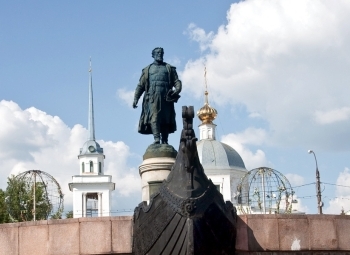
The monument
consists of:
A 4-meter (about 13 feet; one source specifies ~4.06
m) bronze statue of Nikitin standing upright in idealized Russian
merchant/traveler attire (folk-style clothing, cloak, boots).
A
granite pedestal roughly 4 meters tall.
A round cast-iron
platform shaped like the deck of a medieval Russian boat (lad’ya or
rook), with a distinctive horse-head prow at the front—symbolizing
the vessels Nikitin used on the Volga and his sea voyages.
Nikitin is depicted holding a scroll (representing a protective
charter or trade document from Tver’s Grand Prince Mikhail
Borisovich) in one hand, with a money pouch (kalita) at his belt.
His gaze is directed toward the nearby church, emphasizing his ties
to Russian Orthodox culture and homeland. A bronze plaque on the
pedestal reads (in Russian): “To the brave Russian traveler Afanasy
Nikitin in memory of his visit to India in 1469–1472 for friendly
purposes.”
Popular Legend of Its Origin
A widely
circulated folk legend claims the monument was built urgently due to
Nikita Khrushchev. During a 1955 visit to India, Khrushchev
allegedly told Prime Minister Jawaharlal Nehru that a statue of
Nikitin already existed in Russia. When Nehru asked about honoring
the first Russian visitor to India, Khrushchev—unwilling to be
caught in a lie—supposedly phoned Moscow and demanded immediate
construction before Nehru’s reciprocal visit.
Variations of the
story sometimes mention the commission originally being for a statue
of the legendary merchant Sadko (from Russian folklore), which was
hastily repurposed. While colorful and often repeated in popular
accounts, the legend is considered apocryphal or folkloric. The
monument opened in May 1955, before Khrushchev’s late-1955 India
trip, and planning likely predated any such incident. It nonetheless
reflects the era’s emphasis on Soviet-Indian friendship and Nikitin
as a symbol of early Russo-Indian ties.
Cultural Significance
and Later History
Heritage status: It is a federally protected
object of cultural heritage of the peoples of the Russian Federation
(registered accordingly).
Symbolism: The monument forms part of a
“symbolic ring” with two others dedicated to Nikitin—one in Revdanda
(near Chaul, Maharashtra, India, unveiled 2003) and one in Feodosia,
Crimea (2008)—tracing his journey.
Commemorations: Featured on a
Russian postage stamp in 2005 (550th anniversary of Nikitin’s
journey and Tver Oblast anniversary) and referenced in other
cultural works, coins, and expeditions retracing his route.
The
embankment and monument remain popular with locals and tourists,
serving as a focal point for Tver’s historical identity as the
birthplace of this pioneering traveler.
No major renovations
are prominently documented in historical records up to recent years,
though as a heritage site it has been maintained. The monument
continues to embody Tver’s pride in Nikitin as a brave explorer who
bridged cultures centuries before Vasco da Gama’s famous voyage.
The monument features a four-meter-tall bronze statue of Nikitin
mounted on a tall granite pedestal, creating an imposing yet
approachable figure that towers over visitors. Nikitin is depicted
as a resolute traveler in period attire: a long, flowing coat or
kaftan, sturdy boots, and a beard, evoking the image of a
15th-century Russian merchant. In one hand, he holds a scroll—likely
representing his travel journal—while his other hand gestures
forward, symbolizing determination and the call to adventure. His
gaze is directed outward, perhaps toward the horizon or the river,
capturing a sense of exploration and introspection.
The base of
the pedestal is particularly noteworthy, adorned with intricate
bronze reliefs depicting stylized boats and ship prows, referencing
the vessels Nikitin used during his journeys and the maritime perils
he faced. The pedestal itself is cylindrical and sturdy, with a
plaque inscribed in Russian that reads a dedication to Nikitin,
highlighting his travels "beyond the three seas." The overall design
blends classical sculpture with Soviet-era monumentalism, using
durable materials to withstand the riverside elements. In the
background, views often include nearby historical buildings, such as
a white church with a tall spire, adding to the picturesque setting.
Beyond its artistic value, the Athanasius Nikitin Monument holds
deep cultural and symbolic significance. It represents Tver's pride
in its native son, who exemplified curiosity, resilience, and
international outreach during a time of limited global connectivity.
Nikitin's travels fostered early Russo-Indian relations, and the
monument has become a site for diplomatic events, such as joint
Russian-Indian commemorations. Locally, it's a favorite location for
newlyweds to pose for photos, symbolizing new beginnings and
journeys in life—much like Nikitin's own epic voyage.
The site
attracts tourists interested in Russian history, exploration, or
literary travelogues, and it's often included in walking tours of
Tver's Volga embankment. In broader terms, the monument underscores
themes of cultural exchange, as Nikitin's writings reflect tolerance
and adaptation amid diverse societies. It stands as a reminder of
how individual journeys can bridge worlds, making it not just a
statue, but a beacon of historical inspiration.