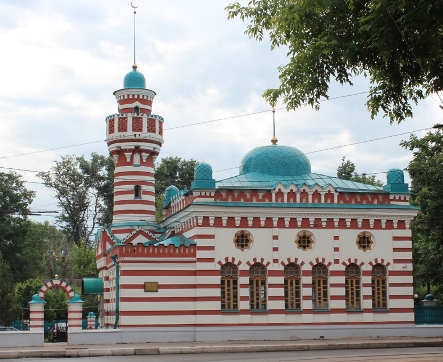
Tver Mosque (Тверская Соборная Мечеть) was built in 1905 under supervision of local imam (Muslim spiritual leader) Sayyid Burhan Hussain. It was designed for a small Muslim community of Tver that numbered about 300 people at the time. The opening ceremony of the mosque was held on October 27 which coincided with the holy month of Ramadan. Government officials presented contractually telegram from Russian Emperor Nicholas II along with a hefty sum as a donation for the Muslim community of Tver. After atheists came to power Tver Mosque along with other religious buildings in the city was closed. It was used for various purposes including warehouse, restaurant and etc. Only after break up of Soviet Union Muslim community got their house of prayer back. It underwent restoration to its original appearance.
Background: The Muslim Community in Early 20th-Century
Tver
By the early 1900s, Tver (then part of the Russian Empire) had a
small but growing Muslim population, estimated at around 250–300 people.
This included soldiers from the 8th Grenadier and 1st Dragoon regiments
(about 73 individuals) and workers at local factories and manufactories,
such as the Tver and Rozhdestvenskaya plants owned by the Konyaev
brothers and Ivan Zalogin's factory (up to 150 people). Most were
Tatars, drawn by industrial and military opportunities.
The community
lacked a dedicated prayer space, relying on private homes or informal
gatherings. In 1905, local Muslims decided to build a mosque. The
driving force was Imam Khusain Seid-Burhan (Husain Seyid-Burhan,
1876–1933), also known as the first imam-khatib. He compiled data on the
Muslim population to justify the need. Fatih Ibrahimovich Alyshev (F.I.
Alyshev), a merchant and trusted representative of the community (who
owned buffets at Nikolaev Railway stations), took charge of
documentation, permissions, and major funding.
The Tver
Congregational Mosque (Тверская соборная мечеть, also known as Tver
Cathedral Mosque or Tverskaya Sobornaya Mechet) is a historic mosque in
Tver, Russia, located at 66 Sovetskaya Street (formerly Millionnaya
Street). It is the city's only mosque and one of its notable
architectural landmarks. Built in 1906 as a Juma (Friday congregational)
mosque, it serves the local Muslim community—primarily Tatars—and stands
as a symbol of early 20th-century Islamic presence in a predominantly
Orthodox Christian region. It is recognized as a regional cultural
heritage site and exemplifies Neo-Moorish architecture.
Background:
The Muslim Community in Early 20th-Century Tver
By the early 1900s,
Tver (then part of the Russian Empire) had a small but growing Muslim
population, estimated at around 250–300 people. This included soldiers
from the 8th Grenadier and 1st Dragoon regiments (about 73 individuals)
and workers at local factories and manufactories, such as the Tver and
Rozhdestvenskaya plants owned by the Konyaev brothers and Ivan Zalogin's
factory (up to 150 people). Most were Tatars, drawn by industrial and
military opportunities.
The community lacked a dedicated prayer
space, relying on private homes or informal gatherings. In 1905, local
Muslims decided to build a mosque. The driving force was Imam Khusain
Seid-Burhan (Husain Seyid-Burhan, 1876–1933), also known as the first
imam-khatib. He compiled data on the Muslim population to justify the
need. Fatih Ibrahimovich Alyshev (F.I. Alyshev), a merchant and trusted
representative of the community (who owned buffets at Nikolaev Railway
stations), took charge of documentation, permissions, and major funding.
Construction and Opening (1905–1906)
Site allocation: On August
12, 1905, the city council granted a plot of about 150 square sazhens
(roughly 315 m²) opposite the Zemskaya Hospital at the end of
Millionnaya Street.
Permissions: Alyshev submitted a petition on
April 17, 1906. Approvals came from provincial authorities, with final
review on July 11, 1906.
Design and architecture: The project
followed a standard 1844 model in the Neo-Moorish (new-Moorish) style by
architect B.G. Polyak (Б.Г. Поляк). The building is compact (about 12
meters long) with a cube-like main structure, horseshoe arches over six
windows, star-shaped eight-pointed windows to lighten the mass, and a
cornice blending local elements. The roof features small corner domes
connected by a scalloped ridge. A 16.3-meter cylindrical minaret with a
dome and spire rises from the north side. Distinctive red-and-white
horizontal striped rustication (alternating bands) gives it a striking,
lighthouse-like appearance, reminiscent of mosques in Vladikavkaz or
Potsdam. Inside, the prayer hall includes a second-floor gallery and
choir accessed by a staircase. Total cost: around 15,000 rubles for
construction plus 2,000 for furnishings.
Construction began in
late April 1906 (stone walls) and finished rapidly by October 3,
1906—under seven months. Funding came from community subscriptions
(about 2,500 rubles from Tver and other cities) with Alyshev covering
the bulk. Emperor Nicholas II sent a telegram donating 2,000 rubles upon
opening.
Official opening: On October 27, 1906 (during Ramadan),
a solemn service marked the inauguration. Imam Seid-Burhan led prayers,
and the event highlighted interfaith harmony. A stone fence with metal
sections was added around the mosque in 1913.
The mosque quickly
became a spiritual and cultural center for Tver's Muslims, with
preserved metric books (1905–1918) in Old Tatar, later translated and
published.
Soviet Era: Closure and Adaptation (1930s–1990s)
Like many religious sites in the USSR, the mosque faced repression. It
was officially closed in July 1935 (some sources note 1932). The
building was repurposed for secular uses, including various institutions
and, for decades, the Eastern-style restaurant "Vostok" (from around the
1960s to 1992). The five-domed roof was altered to a simpler four-slope
design during this period.
Despite this, the Muslim community
persisted unofficially, guided by informal mullahs. The mosque's
survival as a physical structure (unlike many destroyed buildings)
preserved its potential for revival.
Post-Soviet Revival and
Restoration (1992–Present)
In 1992, the building was returned to the
Muslim community amid the post-Soviet religious revival. Ismail
Fayzrahmanov became the first official imam. Subsequent imams included
Fanis Bilyalov (1998–2003) and R.M. Musin (from 2003). Since 2010,
Imam-Khatib Tair Abdulbarievich Sayfutdinov (born 1959) has led the
congregation and serves as chairman of the local religious organization.
Major restorations followed:
2008: Federal funding (over 4
million rubles) supported repairs, foundation strengthening, and
regilding of crescents and spires.
Early 2000s: Original domes were
restored on the roof.
2020: A major capital restoration, supported by
the Akhmat Kadyrov Foundation, preserved the historic appearance after
114 years. It included facade and interior work; the mosque reopened on
October 5, 2020.
The 100th anniversary in 2006 was celebrated
with Mufti Ravil Gaynutdin and regional officials, underscoring its role
in interfaith dialogue.
Current Status and Cultural Significance
Today, the Tver Mosque operates as a full congregational mosque under
the Spiritual Administration of Muslims of the Tver Region. It hosts
daily prayers, Friday Juma services, Ramadan iftars and tarawih, Eid
celebrations (sometimes outdoors due to attendance), charity (zakat,
sadaqah), and community events like majlis gatherings. It maintains
Muslim cemeteries and collaborates with Tatar cultural groups. The
community adapts to modern challenges (e.g., online prayers during
COVID-19 per Russian Muftis Council guidance).
Architecturally, its
bright stripes, minaret, and turquoise or colorful domes make it a
photogenic landmark amid Tver's historic center. It represents the
resilience of Russia's Muslim minorities and Tatar heritage in the
region. The mosque continues to foster "spiritual friendship" between
Muslims and Orthodox Christians, as noted at its original opening.
Architectural Style and Historical Context
The mosque was
constructed in 1906 (construction ran from late April to early October)
by architect/engineer B. G. Polyak (Б. Г. Поляк), using a standardized
“model project” from 1844 that was widely applied to mosques across the
Russian Empire. This places it firmly in the neo-Moorish style, which
draws inspiration from Moorish (Islamic Iberian and North African)
architecture—horseshoe arches, decorative brick patterns, domes, and
minarets—while adapting to local Russian building traditions and
materials (primarily brick). The design deliberately evokes “Eastern”
motifs popular in late imperial Russia, similar to the mosque in
Vladikavkaz and even the one in Potsdam, Germany.
It was built as a
Juma (congregational) mosque for the local Muslim community (primarily
Tatars serving in regiments and working in factories), funded by
donations and prominent merchant F. I. Alyshev. The building measures
approximately 12 meters in length and occupies a modest plot of about
315 m². It is a single main volume (essentially cube-like/rectangular)
with a northern porch (притвор) and an attached minaret.
Exterior
Features and Decoration
The most distinctive element is the
horizontal striped rustication (alternating bands of white and
reddish-brown/red brick), which covers the entire facade and gives the
building its nickname “Striped Mosque” or “Полосатая мечеть.” This
polychrome effect creates a bright, rhythmic visual pattern that
contrasts sharply with typical Russian Orthodox churches nearby and
makes the mosque instantly recognizable.
Key facade details
include:
Horseshoe-shaped arches (подковообразные арки) on the six
main window openings along the long side, emphasizing the building’s
length and Moorish influence.
Star-shaped eight-pointed windows
(звездчатые 8-конечные окна) positioned above the arches. These lighter,
decorative openings help visually reduce the building’s mass and add an
intricate, geometric Islamic motif.
Stucco molding (лепнина) framing
the windows (some elements were lost during Soviet times and have been
partially restored).
A cornice incorporating local Russian
architectural elements for subtle blending with the surrounding urban
fabric.
On the northern volume (porch area), additional Eastern-style
brick patterns (кирпичный узор в восточном стиле) enhance the decorative
richness.
The roof features:
Small domes at the four corners,
topped with gilded crescents (полумесяцы) and spires.
A continuous
scalloped or jagged crest/parapet (зубчатый гребешок / зубчатый гребень)
running along the entire perimeter, connecting the corner domes and
adding a crenellated, fortress-like silhouette typical of Moorish
architecture.
The main roof is finished in green or turquoise tones,
with a restored large hemispherical dome over the two-light (двусветный)
prayer hall (the original dome was removed in the Soviet period and
later reinstated).
The Minaret
Rising above the northern
entrance/porch is a cylindrical minaret approximately 16.3 meters tall
(plus a 4.5-meter spire). It echoes the building’s striped pattern, has
its own small dome, and is topped with a spire and crescent. Its
slender, vertical form and banded decoration have led some observers to
compare its silhouette to a lighthouse. The minaret includes a
balcony/platform (traditionally for the call to prayer) with a parapet.
Interior Layout
The interior is modest in scale but functional
for a small community. The main prayer hall is two-storied (двусветный),
with spacious galleries and choirs (балконы/хоры) on the second floor,
accessed by a straight-flight staircase (маршевая лестница). These upper
levels provided additional space for worshippers. The hall features
standard mosque elements such as a mihrab (prayer niche indicating the
direction of Mecca), a minbar (pulpit), and carpeted flooring. During
the 2020 restoration (funded in part by the Akhmat Kadyrov Foundation),
the interior decoration was carefully preserved or recreated to match
the original appearance. Specific ornamental details inside are not
extensively documented publicly but align with the neo-Moorish
exterior—geometric patterns, calligraphy, and restrained Islamic
ornamentation.
Later History and Preservation
Closed in 1935
and repurposed (including as the “Vostok” Eastern-style restaurant), the
building was returned to the Muslim community in 1992 and reopened.
Major restorations in 2008 and especially 2020 preserved its historic
appearance, including the striped facade, domes, and minaret. It is now
a regional cultural heritage site (Объект культурного наследия
регионального значения) and remains an active mosque.
Location and How to Get There
Address: Smolensky Lane (Смоленский
переулок), 28 (or nearby Sovetskaya Street, 63/66), Tver. It sits near
the Volga River embankment (Naberezhnaya Stepana Razina), in the
historic center.
Coordinates: Approx. 56.85694, 35.92778.
Accessibility: Easy to reach on foot from central attractions like the
Saltykov-Shchedrin Museum (about 5 minutes). From the train or bus
station, take buses 1, 27, or 106 (around 20 minutes). Trolleybus stops
and walking paths along Sovetskaya Street make it convenient. Pair it
with a stroll along the Volga embankment or nearby sites like the
Imperial Palace or Tryokhsvyatskaya Street.
Visiting Tips
Best
Time to Visit: Weekdays between prayer times for a quieter, more
respectful experience. Mornings or late afternoons often work well.
Avoid Fridays (especially around midday Jumu'ah prayer) and major
Islamic holidays (Eid al-Fitr, Eid al-Adha) when it gets busy with
worshippers.
Hours: Generally open from around 8:00 AM to 10:00 PM,
but as an active mosque, access depends on prayers and community
activities. It may close during services. Check the official site or
call ahead.
Prayer Times: These vary daily with sunrise/sunset. Use
apps like "Ислам в Твери" (official for Tver Muslims) or general ones.
Non-Muslims should avoid entering shortly before, during, or right after
prayers (typically 15–30+ minutes each).
Contact: +7 (4822)
34-52-16; website: mechet69.tilda.ws; VK group for updates.
Etiquette and Practical Advice (Essential for Respectful Visit)
Mosques in Russia, like those elsewhere, expect modesty and respect:
Dress Code — Cover shoulders and knees. Women should wear a headscarf
(hijab); bring one or ask if available at the entrance. Men: No shorts
or sleeveless tops. Modest, loose clothing is ideal.
Shoes — Remove
them before entering the prayer hall (common in all mosques). Use
provided bags if available; carry them with you.
Behavior — Speak
quietly, silence phones, avoid photography of people praying, and do not
eat, drink, chew gum, or run inside. If a prayer starts while you're
there, move to the side/back and wait quietly.
Non-Muslims — Welcome
outside prayer times, but confirm if interior access is possible (some
reviews note it being closed for maintenance or services). Be polite; a
local guide or prior call helps.
Other — Photography of the exterior
and empty interior is usually fine, but ask permission inside. Donations
are appreciated but not required.
Additional Tips
Duration:
15–30 minutes for a quick visit; longer if combining with a walk.
Nearby: Excellent for a combined itinerary — Volga views, observation
deck in Smolensky Lane, or other Tver sights. It’s photogenic from
multiple angles, especially with the stripes contrasting the
surroundings.
Seasonal Notes: Spring/summer offers nicer light and
weather for exterior photos; winter visits are still feasible but colder
(dress warmly).
Accessibility: Compact site; check for steps at
entrances.