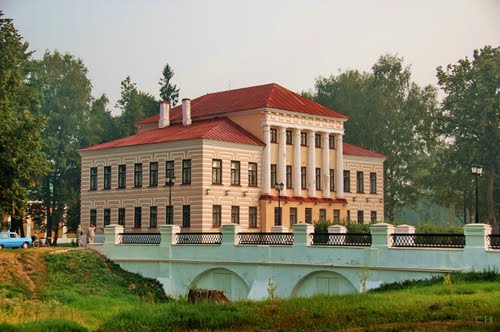
The Former City Duma (Здание бывшей Городской Думы), also known as the City Council Building or Mayor’s House, stands as one of the key historic structures in the Uglich Kremlin in Uglich, Yaroslavl Oblast, Russia. Built in 1813–1815, it exemplifies provincial Classicism and completed the formation of the Kremlin’s architectural ensemble during the early 19th century. It occupies a prominent position in the south-western part of the Kremlin, at the corner of the former earthen rampart, facing the central square on one side and the Epiphany (Bogoyavlensky) Cathedral on the other. Its two identical facades—one oriented north toward the cathedral and park greenery, the other south toward the historic trading square—create a striking visual effect depending on the viewing angle, often resembling a small palace when seen from the Filippovsky Bridge or the square.
Uglich’s administrative functions date back centuries, but early
facilities were scattered and wooden. Sixteenth-century records
(including the 1591 investigation into Tsarevich Dmitry’s death)
mention a Razryadnaya Izba and Dyachya Izba inside the fortress. By
the 1670s, cadastral books (piskovye knigi) list a Syezzhaya Izba
near the Nikolsky gates, a Gubnaya Izba with prison on Drovyanaya
Square, and various izbы (offices) for customs, merchants, and local
self-government (Zemskaya Izba) on the trading square or near the
Volga.
Late-18th-century descriptions note wooden structures for
the provincial magistrat, courts, archives, treasury, and a
narodnoye uchilishche (public school founded 1787), many in poor
condition—cold, decaying, and fire-prone. The 1784 regular city plan
(part of Catherine the Great’s urban reforms) and later plans
proposed stone “prisutstvennyye mesta” (public offices) in the
southern Kremlin, but construction was repeatedly delayed due to
fires, unsuitable sites, merchant petitions for shops, and funding
issues. By the early 1800s, administrations still occupied
dilapidated wooden buildings that clashed with the neoclassical
urban plan.
Decision and Construction (1812–1817)
The push
for a permanent stone building came in the early 1810s. On 24 May
1812, Uglich’s merchants (kuptsy) and townspeople (meshchane), led
by Gradsky Glava (mayor) Dmitry Kozhevnikov, approved the project in
a general assembly. Governor Mikhail Nikolaevich Golitsyn had urged
it since 1811, citing the old wooden house’s decay. The chosen site
lay beyond the stone bridge to the cathedral, on the right side of
the rampart (marked “E” on plans), facing the square.
The
two-story stone building (with iron roof, mezzanine, and Tuscan
portico) was designed to house the City Duma, Gorodovoy Magistrat,
courts (Sirotsky and Slovessny), Guild Council (Tsekhovaya Uprava),
city starosta, archives, public bank, small school, and a hall for
public assemblies. A new stone bridge over Troitsky Brook was also
planned. Funding came primarily from a ¼% levy on merchants’
capital, supplemented by city revenues (total budgeted at 24,680
rubles 26 kopecks).
Work began in 1813 “хозспособом” (by local
forces) after the governor approved a standard (“exemplary”) facade
project by the renowned architect Luigi Rusca (L. Rusca). Materials
were sourced locally and from nearby provinces:
Hundreds of
thousands of bricks from Uglich suppliers (Konovalov, Gnidin,
Omyachkin families).
White stone and lime from Staritsa (Tver
Governorate).
Timber, iron sheets, and nails from Tver and
Kostroma regions.
Artels of masons, carpenters, plasterers, and
glaziers (many peasants from Nizhny Novgorod, Kostroma, and Tver
areas).
Detailed accounts show rapid progress despite the
1812 Patriotic War: foundations and walls rose in 1813; floors,
ceilings, roofing, stoves, windows, and plastering continued through
1814–1815; final facade plastering, painting, and minor adjustments
occurred in 1817. The total cost came in under budget at
approximately 21,758 rubles. By mid-1814 the structure was already
largely complete.
Architecture and Features
The building
follows provincial Classicism: symmetrical facades, a prominent
six-column Tuscan portico on each side, rusticated ground floor,
modest stucco cornices, vaulted ceilings in some rooms, wrought-iron
grilles, and simple interiors typical of Alexander I-era state
buildings. The iron roof and white (or pale) walls contrast
beautifully with the Kremlin’s green slopes and the nearby stream.
Its dual-façade design was intentional for its central urban role.
Historical Uses (1815–Early 20th Century)
For over a century,
it served as Uglich’s administrative heart. It housed the City Duma
and magistrate, courts, guild council, public bank, archives,
district and parish schools, and a large hall for public meetings
and assemblies. In the Soviet era, the hall became a venue for
political gatherings and assertions of authority. It remained the
seat of city administration until the mid-20th century.
Current Use and Museum Status
Today the building belongs to the
Uglich State Historical, Architectural and Art Museum (at ul. Kreml,
d. 1). It houses the permanent exhibition “ЗаБЫТое искусство: вещь и
шедевр” (“Forgotten Art: Thing and Masterpiece”), featuring everyday
objects elevated to folk-art status—carved spinning wheels, painted
chests, black-glazed kumgany (pitchers), bronze vessels, silver
charki (goblets), bone combs, and 18th–20th-century peasant and
urban costumes, mostly donated by local residents. Temporary
exhibitions rotate in the halls.
The elegant “Krasnaya Gostinaya”
(Red Living Room), styled after 19th-century drawing rooms and once
the council meeting hall, now hosts concerts, poetry evenings,
conferences, presentations, and the “Museum Living Room” project
(intimate evening viewings of single artifacts for small groups).
The room accommodates about 50 people and includes a Yamaha piano
and modern AV equipment.
The former Uglich City Duma (City Council) building, also known as
the Building of the Former City Duma or “Дом городской управы/Думы,”
stands as a prominent historic structure within the Uglich Kremlin
ensemble in Uglich, Yaroslavl Oblast, Russia. Constructed in 1813–1815
(with finishing touches extending to 1817), it exemplifies provincial
neoclassicism from the Alexander I era and serves as a key
administrative monument of the early 19th century.
This two-story
building with a mezzanine occupies a strategic corner position on the
southern earthen rampart of the Kremlin, near Soborny Bridge and
overlooking the Kamenny (Stone) Stream and trading square. It forms one
of the main compositional dominants in the Kremlin’s regular
late-18th/early-19th-century layout, symmetrically balancing the
historic ensemble alongside churches and princely chambers. For over a
century, it housed the City Duma, Magistrate, Orphan’s and Verbal
Courts, guild board, public school, archives, treasury, and bank —
embodying the shift from medieval wooden izbas to centralized imperial
administration.
Architectural Style and Influences
The design
draws directly from Sample Facade No. 57 in Part II of the official
“Collection of Facades… for Private Buildings in Cities of the Russian
Empire” (published 1809–1812). The St. Petersburg architect of Swiss
origin, Luigi Rusca (Luigidji Rusca), created the original model. Local
builders adapted it for provincial Uglich with simplifications typical
of Russian classicism in small towns: no sculptural groups, attic, or
elaborate decoration; a schematic Doric entablature; and slightly
distorted proportions. Art historians (notably B.M. Kirikov) classify it
as a fine example of provincial neoclassicism with Tuscan and Doric
orders, reflecting the Empire style’s emphasis on symmetry,
monumentality, and civic dignity.
Exterior and Facade Design
The rectangular brick building measures approximately 11 window axes
wide and features two nearly identical symmetrical main facades — a rare
and striking trait that makes it appear palace-like from different
angles (one faces Sobornaya Square and the Kremlin park; the other
overlooks the city square and stream).
A central risalit (projecting
pavilion) dominates each main facade, crowned by a six-column
Tuscan-order portico. The columns (made of specially molded “column
bricks”) rise from a simple base, span the second-floor windows, and
connect visually to the mezzanine level. Above sits a simplified Doric
entablature with schematic triglyphs, metopes, and mutules. Flanking
sections display rustication (imitated in plaster or board cladding with
wide joints for a stone-block effect).
Limestone details from
Staritsa quarries add refinement: profiled plinth blocks, window sills
and belts, cornice inserts, column bases, and capitals. The roof
consists of sheet iron (originally 702 sheets, later painted), giving a
crisp, metallic silhouette against the Kremlin greenery. Side facades
are plainer, with original wooden tambours (one with a four-column
pedimented portico) later replaced by simple iron canopies on pillars.
Provincial “roughness” appears in narrowed column tops and omitted fine
details, yet the overall effect remains harmonious and imposing.
Materials and Construction Techniques
Builders used local Uglich
brick factories (over 335,000 bricks total, including special column
bricks). Rubble fill came from 1,820 wagonloads of wild stone; lime
mortar and alabaster ensured durability. Ironwork (sheet and strip iron,
nails) formed the roof and structural ties. Skilled local contractors
handled masonry (e.g., Egor Katyshev’s crew), woodworking, plastering,
and stove-making. Total cost stayed under budget at ~21,758 rubles by
1815. The structure rests on a solid rubble foundation; upper floors
feature wooden beam ceilings (“nakaty”), while archive rooms have brick
vaults for fire safety.
Interior Layout and Features
The
functional, austere interior followed imperial administrative standards.
Ground floor included central entrance halls (“seni”), corridors,
courtrooms, and vaulted archive chambers. The first floor housed meeting
halls with corner Dutch stoves and simple stucco cornices. A straight
wooden staircase (later replaced by concrete with cast-iron balusters)
led upward. The second floor featured the grand public assembly hall
(now the “Red Living Room” or Красная гостиная) and offices for the Duma
and courts. The mezzanine remained partially unfinished into the 1830s.
Later 19th–20th-century modifications added apartments and unified the
entrance into a two-light vestibule. Rooms remain undecorated except for
practical stoves, grilles, and forged doors — typical of Alexander-era
official buildings.
Current Use and Cultural Significance
Today the building forms part of the Uglich State Historical,
Architectural and Art Museum. The former Duma hall hosts concerts,
conferences, and ceremonies in the elegantly restored Red Living Room.
It retains its role as a civic landmark and contributes to the
UNESCO-tentative Golden Ring heritage of Uglich’s Kremlin ensemble.