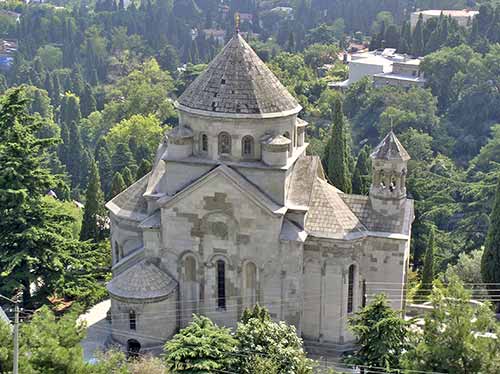
The Armenian Church in Yalta, formally known as the Saint Hripsime Church (Armenian: Սուրբ Հռիփսիմե եկեղեցի, Surp Hripsime Yekeghetsi; Russian: Армянская Церковь Святой Рипсиме), is a striking early 20th-century edifice that embodies the enduring legacy of Armenian Apostolic architecture and spirituality. Situated in the picturesque resort city of Yalta on Crimea's southern coast, this church was constructed as a faithful replica of the 7th-century Saint Hripsime Church in Vagharshapat (Etchmiadzin), Armenia—a UNESCO World Heritage site renowned for its pioneering dome design and geometric harmony. Beyond its role as an active worship site for the local Armenian community, it serves as a cultural beacon, attracting visitors with its blend of historical reverence, artistic mastery, and serene ambiance. The church's creation reflects the deep-rooted presence of Armenians in Crimea, a region with Armenian settlements dating back to the medieval era, when the peninsula was even referred to as "Armenia Maritima" due to the significant Armenian population in cities like Kaffa (modern Feodosiya). Waves of Armenian migrations, driven by historical events such as the fall of Ani in the 11th century and later exiles under Ottoman rule, brought artisans, merchants, and clergy to Crimea, where they built churches, schools, and communities that preserved their heritage amid shifting empires. In the post-Soviet era, the Armenian community in Crimea, numbering several thousand, has continued to thrive, with the Yalta church standing as a symbol of resilience and cultural continuity.
The church is dedicated to Saint Hripsime, a revered 3rd- or 4th-century Christian martyr whose story is integral to Armenia's early adoption of Christianity in 301 AD, making it the first nation to do so officially. According to legend, Hripsime was a beautiful Roman noblewoman who, along with her companions including Abbess Gayane, lived as devout nuns in a monastery near Rome, having consecrated their lives to Christ and virginity. Fleeing the advances of Emperor Diocletian, they sought refuge in Armenia, only to face similar pursuit from King Tiridates III (Trdat). When they refused his demands, the king ordered their brutal martyrdom—Hripsime was stoned to death, and her companions were executed. Miraculously, Tiridates was afflicted with lycanthropy (turning into a wild boar-like beast), and was only cured after his sister Khosrovidukht convinced him to release Gregory the Illuminator from prison, leading to the king's conversion and the Christianization of Armenia. Saint Hripsime's tale symbolizes unwavering faith, chastity, and the triumph of Christianity, and she remains one of the most venerated saints in the Armenian Apostolic Church, with her story also honored in Ethiopian traditions.
Nestled on a hillside in Yalta, part of the Crimean Peninsula (administratively under Ukraine but with complex geopolitical status), the church overlooks the Black Sea, though mature cypress and pine trees now partially veil what were once unobstructed panoramic views of the coastline and city below. Its precise location is on Zagorodnaya Street, about a 10-15 minute uphill walk from the bustling Naberezhnaya Lenina promenade, making it a rewarding detour for those exploring Yalta's historic sites like the Livadia Palace or the Chekhov House-Museum. The elevated position not only enhances its majestic presence but also integrates it into the natural landscape, surrounded by lush greenery that provides a tranquil escape from the resort town's lively atmosphere.
Initiated in 1909 and completed in 1917 amid the turbulence of World War I and the Russian Revolution, the church was consecrated the same year it finished. It was commissioned and funded by Poghos (Pogos) Gukasov, a wealthy Armenian oil magnate from Baku (also transliterated as P. Ter-Ghukasyan in some sources), as a poignant memorial to his prematurely deceased daughter, infusing the project with personal grief and devotion. Architect Gabriel Ter-Mikelyan (sometimes spelled Ter-Mikelov) meticulously designed it, incorporating a symbolic stone from the original Etchmiadzin church into its foundation to link the new structure spiritually and materially to its ancient predecessor. The renowned Armenian painter Vardges Surenyants was tasked with the interior frescoes, but he managed to complete only the dome's artwork before passing away in 1921; fittingly, he is interred on the nearby hillside, adding a layer of artistic legacy to the site. Despite Soviet-era suppressions of religion, where many churches were repurposed or closed, this one endured, reopening fully after the USSR's dissolution and continuing to serve the Armenian diaspora in Crimea. As of 2025, no major recent updates or restorations have been widely reported, though it remains well-maintained as an active parish.
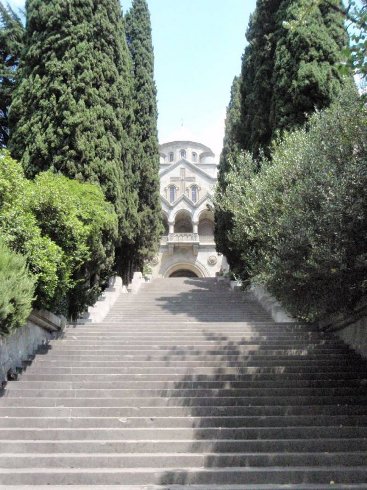
Drawing directly from classical Armenian principles, the church features a cross-domed basilica plan with precise geometric proportions, a hallmark of 7th-century innovations that influenced subsequent ecclesiastical designs across the region. Built from durable volcanic tuff stone in a warm, honey-colored hue that weathers gracefully in Crimea's subtropical climate, the exterior showcases intricate openwork carvings, symbolic motifs, and arched niches that exemplify Armenian craftsmanship. A distinctive conical dome crowns the structure, supported by a drum with twelve narrow windows that allow light to permeate the interior, while the single main entrance—formatted as a deceptive niche— is approached via a grand stone staircase that ascends the slope, creating a dramatic pilgrimage-like ascent. The facade balances austere simplicity with elaborate detailing, including geometric patterns and cross motifs, evoking a sense of eternal stability and spiritual elevation.
The interior captivates with its harmonious blend of light, color, and symbolism, centered on a cruciform layout that directs focus toward the altar. Vardges Surenyants' vibrant frescoes adorn the walls and dome, depicting biblical scenes with emotional depth and Armenian iconographic style—though only the dome was finished by him, the rest were completed by others in a complementary manner. Natural light streams through the dome's twelve arched windows, casting a soft, ethereal glow that enhances the artwork and fosters a meditative atmosphere. Graceful arches frame the space, while simple yet elegant icons and an altar emphasize spiritual purity over opulence. Nearby, a traditional khachkar (carved cross-stone) stands as a cultural emblem, and the overall design incorporates complex yet subtle elements like "Armenian hollows" (niches) that add architectural depth.
As a diaspora replica of one of Armenia's most iconic monuments, the Yalta church bridges ancient heritage with modern Armenian identity, symbolizing cultural persistence amid historical upheavals like migrations and genocides. It highlights the "life-loving" spirit of Armenian culture through its fine carvings and paintings, earning respect from Russian Orthodox communities who acknowledge Armenia's early Christian roots. Officially protected as an Immovable Monument of Local Significance in Ukraine (No. 4883-АР), it has transcended religious functions to become a venue for chamber music concerts and a backdrop for notable films, blending sacred and secular roles. For the local Armenian population, it remains a vital hub for preserving traditions, language, and faith in a multicultural region.
As of 2025, the Saint Hripsime Church operates fully as an Armenian Apostolic parish, hosting regular liturgies, baptisms, and community events while welcoming tourists. Entry is free, with typical hours from morning to early evening, though visitors should check for services or concerts to avoid interruptions. Etiquette includes modest dress, no flash photography during worship, and maintaining silence; engaging with knowledgeable staff or local guides can provide deeper insights into its history. Traveler reviews rave about its "breathtaking" architecture, "intricate details," and "serene vibe," with high ratings of 4.9/5 on Google (from 72 reviews) and 4.7/5 on Tripadvisor (from 57 reviews), often suggesting weekday or early morning visits to evade crowds and enjoy the peaceful setting in optimal weather like late spring. Despite regional tensions, it endures as one of Yalta's underrated gems, offering a profound encounter with Armenian heritage.