Location: Pushkin Boulevard
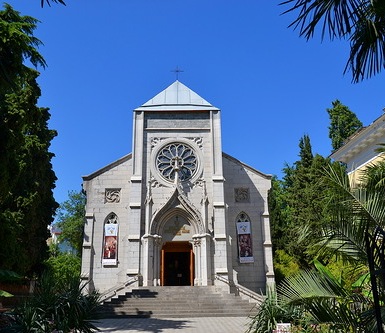
The Roman Catholic Church of the Immaculate Conception of the Virgin Mary, commonly known as the Immaculate Conception Cathedral or Organ Hall, is a striking Neo-Gothic landmark situated on Pushkin Boulevard in the heart of Yalta, Crimea. Built at the turn of the 20th century, this church stands as a testament to the region's diverse cultural heritage, serving not only as an active Roman Catholic parish but also as a renowned venue for organ and chamber music concerts. Its photogenic exterior, framed by subtropical palm trees and set against the backdrop of the Crimean Mountains, draws visitors for its architectural elegance, historical resilience, and serene ambiance that blends spirituality with artistic performances. As one of only five surviving Catholic churches in Crimea—alongside those in Sevastopol, Kerch, Kolchugino, and Alexandrov—it represents a rare preserve of Western European religious architecture in a predominantly Orthodox area.
The roots of Catholicism in Crimea trace back to
the 13th century, introduced by Genoese merchants who established
colonies along the Black Sea coast. By the mid-19th century, Yalta's
Catholic population had grown significantly, exceeding 500 members
and including Poles, Germans, Italians, and other Europeans who had
settled in the area for its mild climate and economic opportunities.
This community initially worshiped in a modest house chapel on
Pochtovaya Street, but as numbers swelled, it became inadequate. In
1855, prominent figures such as Colonel M. Malinovsky, a local
verger, and Dr. Byalokur spearheaded efforts to build a new temple,
petitioning provincial authorities for permission. They selected a
prime plot on Pushkin Boulevard, purchasing it from landowner
Maslovskaya despite its steep price. Bureaucratic hurdles delayed
progress for over a decade, with initial designs by architect
Mikhail Komarnitsky lost amid prolonged fundraising. Finally, in
1898, construction approval was granted, and Nikolai Petrovich
Krasnov—Yalta's chief architect, famed for projects like the Livadia
Palace and the Church of St. George the Victorious in
Serbia—redesigned the structure as a three-nave Neo-Gothic church.
The main building was completed in 1906, though financial
constraints prevented the addition of a planned bell tower and
organ. It was consecrated in 1911 by Bishop Joseph Kessler of
Saratov and dedicated to the Immaculate Conception, quickly becoming
a vital spiritual center for locals and tourists alike.
The
church's fortunes shifted dramatically under Soviet rule. Closed in
1928, it was repurposed for secular functions, including as offices
for various organizations and later a branch of the Yalta Historical
Museum. This era saw the destruction of most Catholic temples in
Crimea, with only a handful enduring. In 1988, during perestroika,
the building was converted into a concert hall: an organ was
installed, the interior renovated with custom furniture, and it
began hosting organ and chamber music events. Following the Soviet
Union's dissolution, the church was returned to the Catholic
community in 1991, with the first Mass held that year and a full
reconsecration in 1993. Restoration efforts preserved its sacred
elements while retaining its cultural role, symbolizing resilience
amid political upheaval.
Embodying the Neo-Gothic style popular in late
19th-century Europe, the church features a traditional three-nave
basilica layout with pointed arches, ribbed vaults, and a slender spire
that punctuates Yalta's skyline, offering a stark contrast to the golden
domes of nearby Orthodox churches. The front facade is the most ornate,
adorned with intricate stone carvings, a prominent Gothic rose window
composed of a dozen petal-like segments (though some sources note it
lacks original stained glass), and tall lancet windows with arrow-like
tracery set in pointed arches. Above the symmetrical portal, a
traditional Gothic gable bears the Latin inscription "DEO ET IMMACULATAE
DEIGENITRICI MARIAE SACRUM" ("Sacred to God and the Immaculate Mother of
God Mary"). The side and rear facades are more restrained, emphasizing
clean lines and light-colored stone that gleams against the blue sky and
surrounding greenery. The absence of the intended bell tower, which was
to be topped with a high steeple, lends the structure a unique, somewhat
truncated silhouette that enhances its photogenic appeal.
The
interior exudes tranquility, with high vaulted ceilings supported by
white colonnades featuring ornate capitals, creating an airy and
reflective space. Stained-glass windows—particularly those filtering
delicate hues of light—enhance the atmosphere, though the rose window's
simplicity is noted in some descriptions. Statues of saints line the
walls, chandeliers dangle from the arches, and the altar is adorned with
religious icons, fresh flowers, and a central crucifix. The checkered
tile floor and wooden pews accommodate both worshipers and concertgoers,
while the excellent acoustics amplify the space's dual purpose. The
organ, installed in 1988 during the concert hall conversion, occupies a
prominent position at the front, framed by Gothic elements and religious
artwork, though specific details like its make or number of stops remain
undocumented in public sources.
Under the Odessa-Simferopol diocese, the church ministers to a diverse parish of approximately 200 members from various nationalities, hosting regular Roman Catholic Masses. It also accommodates services for the Greek Catholic Church, which lacks a dedicated temple in Yalta, fostering ecumenical ties. As an organ hall, it offers year-round concerts featuring classical works, such as Vivaldi's "Four Seasons," performed by professional ensembles in an intimate setting that reviewers describe as "marvelous" and "stunning," allowing for deep immersion and rejuvenation far surpassing similar experiences elsewhere. This multifunctional role underscores its cultural importance, attracting history buffs, architecture enthusiasts, and music lovers to Yalta.
Located centrally on Pushkin Boulevard, the church is easily accessible and free to enter for worship or casual visits, though concert tickets are required for performances (prices vary; check local listings). Opening hours typically align with standard church schedules, but visitors should confirm via local sources, as they may vary for services (e.g., Masses on Sundays) and events. Tips from reviewers emphasize its photogenic qualities—ideal for photography amid the greenery—and the relaxing atmosphere, perfect for a brief escape. Respectful attire is advised, and while the space is small, it enhances the personal feel of concerts. As a hidden gem in Yalta, it pairs well with nearby attractions like the Livadia Palace or seaside promenades, offering a blend of spiritual reflection and artistic delight.