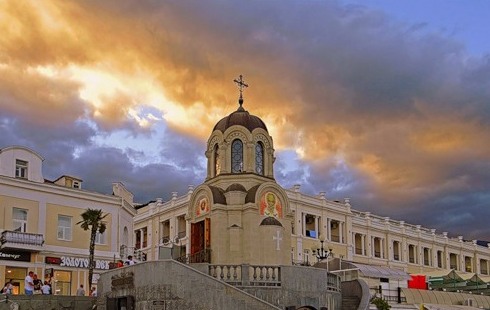
The Chapel of New Martyrs and Russian Confessors, formally known as the Chapel in Honor of the New Martyrs and Confessors of Russia, is a poignant Orthodox Christian memorial nestled on the vibrant Lenin Embankment (commonly called the Yalta Promenade) in Yalta, Crimea. This scenic Black Sea resort town, renowned for its subtropical climate, palm-lined walkways, and historic significance as a retreat for Russian royalty and Soviet leaders, provides a fitting backdrop for the chapel. Positioned near berths No. 8 and 9, it stands as a striking landmark along the bustling seafront, easily spotted from various points on the promenade and often used as a rendezvous spot for locals and tourists alike. Amid the lively atmosphere of street performers, cafes, and souvenir stalls, the chapel offers a tranquil oasis for reflection, embodying themes of faith, remembrance, and resilience in the face of historical turmoil.
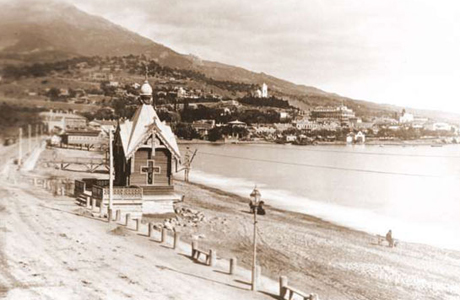
The chapel's story is deeply intertwined with Russia's imperial and
Soviet past. Its predecessor was a modest wooden chapel constructed in
1881 to commemorate Emperor Alexander II, known as the "Tsar Liberator"
for his landmark reforms, including the emancipation of serfs in 1861
and his role in the Russo-Turkish War of 1877–1878. Alexander II's
assassination by revolutionaries from the Narodnaya Volya group on March
13, 1881, in St. Petersburg—via a bomb attack that also injured
bystanders—sparked widespread mourning and the erection of memorials
across the empire, including this one on Yalta's embankment. (Note: Some
sources mistakenly reference Alexander III, his son and successor, who
died naturally in 1894; however, the context of assassination aligns
unequivocally with Alexander II.) This original structure served as a
site of imperial reverence for over 50 years until 1932, when it was
demolished during the Soviet regime's militant atheism campaign, part of
a broader effort under Joseph Stalin to suppress religion, close
churches, and repurpose sacred sites for secular uses.
The location
remained vacant for decades amid the Soviet era's persecution of
Orthodox believers, which saw millions imprisoned, executed, or exiled
for their faith—a period that produced the "New Martyrs and Confessors"
honored today. Revival efforts gained momentum in the post-Soviet 1990s
and early 2000s, coinciding with the Russian Orthodox Church's
canonization of over 1,700 New Martyrs in 2000, including Tsar Nicholas
II and his family, executed in 1918. On July 17, 2006—the feast day of
the Holy Royal Martyrs—a consecration ceremony marked the site's
preparation for rebuilding. Financed solely through voluntary donations
from Yalta residents and other supporters, the new chapel was completed
and inaugurated between 2008 and 2009. Its dedication honors the New
Martyrs and Confessors—Orthodox Christians who endured persecution from
1917 to 1991, encompassing clergy, monks, nuns, and laity who were
arrested, tortured, or killed in gulags, prisons, or during
anti-religious purges. Additionally, it memorializes local tragedies,
such as the 1941 sinking of the motor ship Armenia, torpedoed by German
Luftwaffe planes off Yalta's coast during World War II while carrying
evacuees, wounded soldiers, and medical staff. The disaster claimed
between 5,000 and 8,000 lives in mere minutes, ranking among history's
worst maritime losses and symbolizing the broader suffering of Crimean
civilians during the war. In this way, the chapel stands as a beacon of
post-Soviet spiritual renewal, bridging imperial nostalgia with
remembrance of 20th-century atrocities.
Designed in the Neo-Byzantine (or New Byzantine) style, the chapel
draws inspiration from ancient Byzantine architecture while
incorporating modern elements for a timeless yet accessible aesthetic.
This style features characteristic domes, arches, and ornamental motifs
reminiscent of early Christian basilicas in Constantinople (modern
Istanbul), adapted here on a smaller scale to fit the promenade setting.
The structure is compact—a single-domed edifice painted predominantly
white with golden accents on the cross and dome, creating a luminous
contrast against the azure Black Sea and the rugged Crimean Mountains.
Arched windows punctuate the facade, allowing soft sunlight to
illuminate the interior, while the overall design emphasizes simplicity
and elegance, avoiding the grandeur of larger cathedrals to maintain an
intimate, approachable feel.
Internally, the chapel is a serene space
designed for personal prayer and contemplation, with harmonious
decorations that foster a sense of peace and reverence. Walls and
surfaces feature icons of the New Martyrs, including depictions of the
royal family (Tsar Nicholas II, Tsarina Alexandra, and their children)
and other canonized figures like bishops and priests who resisted Soviet
oppression. Candle stands invite visitors to light votives in memory of
the departed, a traditional Orthodox ritual symbolizing eternal light
and intercession. The use of light colors and subtle
ornamentation—possibly including engraved motifs from ancient Russian
church traditions—enhances the airy, uplifting atmosphere, making it
feel spacious despite its modest size. No elaborate altars or vast
frescoes dominate; instead, the focus is on quiet devotion. The chapel
operates without an entrance fee and is typically open during daylight
hours, aligning with Orthodox liturgical schedules, though it may close
for private services or maintenance.
While the chapel primarily functions as a site for individual prayer, it hosts occasional Orthodox services and commemorative events tied to the Russian Church calendar. Key dates include July 17, marking the martyrdom of the royal family, and the broader Synaxis of the New Martyrs and Confessors on the Sunday closest to February 7 (or January 25 in the Julian calendar), when special liturgies or molebens (prayer services) may be held to honor the persecuted faithful. Additionally, November 7 commemorates the Armenia disaster, with prayers for the victims. These gatherings, though not large-scale due to the chapel's size, draw locals and pilgrims, fostering community remembrance. In broader contexts, the site aligns with regional Orthodox festivals in Yalta, such as those at nearby churches like the Alexander Nevsky Cathedral.
Rated 4.6 out of 5 on Tripadvisor with over 40 reviews and a
Travelers' Choice award, the chapel is praised for its "pretty,"
"clean," and "elegant" ambiance, serving as a "holy place" that
resonates emotionally with visitors. Many appreciate its accessibility
during promenade strolls, noting how it provides a momentary escape from
the tourist hustle. Reviewers advise respecting Orthodox etiquette:
women should cover their heads with a scarf (often available nearby),
and all should dress modestly (no shorts or revealing clothing) to enter
respectfully. Photography inside is generally discouraged during
prayers, emphasizing the site's sacred nature.
Beyond tourism, the
chapel symbolizes Crimea's cultural and spiritual revival, attracting
history buffs, Orthodox pilgrims, and those interested in Soviet-era
narratives. It pairs well with nearby attractions like the Chekhov
House-Museum, the Swallow's Nest castle, or cable car rides to Ai-Petri
Peak, offering a multifaceted Yalta experience. In an era of ongoing
geopolitical discussions about Crimea, it remains a quiet testament to
faith's endurance.