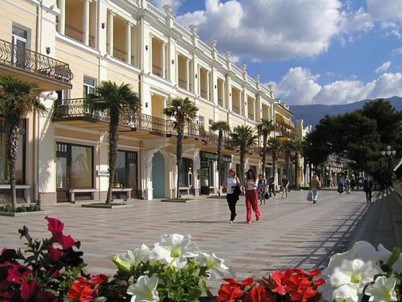
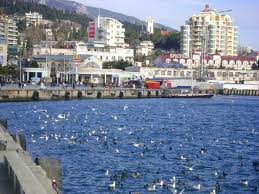
The Yalta Embankment, formally named Naberezhnaya imeni Lenina (Lenin Embankment), stands as the pulsating core of Yalta, a renowned resort city nestled along Crimea's Black Sea coast in Russia. This iconic waterfront promenade, often referred to as the Central Promenade, extends over a kilometer along the sheltered Yalta Bay, where a bustling harbor accommodates yachts, passenger ships, and pleasure boats. Established in the 19th century as a seaside boulevard for Russian aristocracy, it has transformed into a car-free haven that seamlessly merges natural splendor with urban vitality. Lined with subtropical palm trees, vibrant flower beds, and ornate street lamps that cast a warm glow at dusk, the embankment offers breathtaking panoramic views of the azure Black Sea, the dramatic Crimean Mountains, and the city's terraced hillsides. It's a magnet for tourists and locals alike, drawing crowds for its relaxed daytime ambiance and electric evening energy, where the air fills with the sounds of waves, laughter, and live performances. As one of Yalta's oldest streets, it embodies the city's evolution from a tsarist-era retreat to a Soviet resort and modern vacation hotspot, making it an essential destination for those exploring Crimea's cultural and scenic treasures.
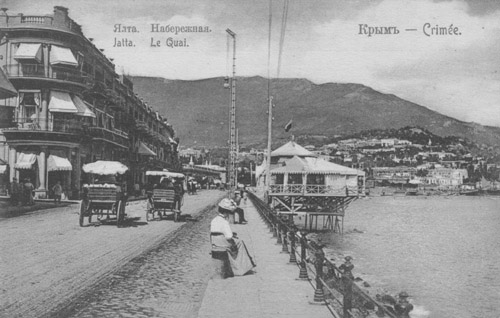
The origins of the Yalta Embankment trace back to the mid-19th century, when Yalta began emerging as a fashionable resort for the Russian elite. Initial construction occurred between 1842 and 1844 under the guidance of architect K.I. Gonyaev, creating a basic seaside path. A major reinforcement in 1886 by engineers A.L. Berthier-Delagarde and N.M. Shevtsov involved stone blocks and metal railings to combat erosion from Black Sea storms. The promenade saw further enhancements in 1961 with a two-tiered base for improved durability. During the Soviet era, it was renamed in honor of Vladimir Lenin, whose bronze statue—unveiled in 1954 and designed by sculptor Pavel Bondarenko on a granite pedestal—remains a prominent feature near the central square. The area has deep literary and cultural ties: a 500-year-old plane tree near the western end, by the Uchan-Su River, is famed as the rendezvous spot for poet Sergei Esenin and dancer Isadora Duncan. Anton Chekhov's 1899 story "The Lady with the Dog" immortalized a romantic encounter here, inspiring a dedicated sculpture group. The embankment also appeared in the 1987 Soviet film "Assa," capturing its bohemian spirit. Historically, it reflects Yalta's shift from an imperial playground—frequented by nobility—to a Soviet-era public space, with mid-20th-century additions like Soviet Square showcasing Stalinist neoclassicism through symmetrical designs and grand administrative buildings. In recent years, as of 2025, ongoing modernization efforts by the city administration have enhanced its appeal, addressing outdated elements while preserving its heritage.
The embankment's design features a two-level layout: the upper tier is a broad, paved walkway shaded by towering palms and umbrella-like canopies, perfect for unhurried strolls, while the lower level descends to pebble beaches for sunbathing, swimming, or simply gazing at the sea. Spanning about 1 kilometer, its winding path feels even more expansive due to open plazas and scenic overlooks. The atmosphere is a captivating blend of serenity and excitement—the constant Black Sea breeze carries hints of salt, pine, and blooming flowers, while the backdrop of rugged mountains adds a dramatic flair. By day, it's a peaceful spot for families and couples to enjoy the views or relax on shaded benches; come evening, it bursts into life as a social epicenter. Street musicians play folk melodies, jazz, and contemporary tunes, poets perform for attentive crowds, and vendors hawk local crafts and snacks. However, peak tourist seasons bring heavy foot traffic, and smoking is common, though daily cleanings keep the area pristine. The promenade's architecture evokes Yalta's golden age, with ornate 19th- and 20th-century facades in pastel hues, blending imperial elegance with Soviet grandeur. It connects seamlessly to Primorsky Park, a lush coastal green space established in the early 20th century, featuring exotic plants like cypresses, magnolias, and pines, along with fountains, sculptures, and panoramic terraces.
The embankment is rich with landmarks that weave together history,
art, and recreation:
Yalta Harbor: A historic bay that grew in
the 19th century, now a marina with yachts, a lighthouse, and ticket
booths for boat excursions to nearby coves or landmarks like Swallow's
Nest.
Cable Car Station: Centrally located, this funicular climbs 110
meters to Darsan Hill, offering sweeping vistas of the bay, city, and
mountains—though the ride involves quaint, older cabins.
Hotel Tauris
(Tavrida): Erected in 1875 at Naberezhnaya 13, this opulent building was
Yalta's premier hotel, hosting figures like poets Nikolai Nekrasov and
Vladimir Mayakovsky, composer Modest Mussorgsky, and writer Anton
Chekhov.
Monuments and Sculptures: The Vladimir Lenin statue anchors
the central square; nearby is the "Lady with the Dog" ensemble,
depicting Chekhov gazing at a woman and her pet, inspired by his story;
other tributes include actor Mikhail Pugovkin and whimsical items near
the Jubilee Concert Hall, such as Alexander Shirvindt's pipe and Joseph
Kobzon's microphone. A bronze sculpture of Chekhov with a seagull adds a
literary touch.
Chapel of the New Martyrs and Confessors of Russia:
This small, ornate chapel, consecrated in 2009 after construction began
in 2007, honors Orthodox martyrs and serves as a recognizable symbol of
the resort.
Roffe Baths: Built in 1897, these historic public baths
highlight Yalta's spa traditions.
Additional Sites: The Pushkin
Theater for cultural performances; small art pavilions for exhibitions;
the "Apelsin" restaurant styled as an ancient Greek ship; the General
Post Office; and the International Maritime Club. Soviet Square, with
its wide pavings and flowerbeds, hosts events and reflects
mid-20th-century design.
A visit to the embankment offers diverse activities: leisurely walks along the seafront, people-watching from cafés serving Crimean Tatar dishes, fresh seafood, and international cuisine, or embarking on maritime cruises for coastal exploration. Evening entertainment thrives with live music, street performers, and poetry readings, creating a bohemian vibe suitable for all ages—though some reviews note it's less ideal for young children due to occasional rowdiness. Adventure options include the cable car for hilltop hikes or boat trips, while shoppers can browse boutiques, souvenir stalls, and artisanal markets. Summer brings open-air concerts, festivals, and nightlife; off-season provides quieter reflection with year-round mountain views like Ay-Petri. Allocate 1-2 hours for a full stroll, wearing comfortable shoes for uneven paths and bringing sunscreen for beach areas. English signage is sparse, but multilingual staff at major spots assist. Accessibility is fair, with some steps posing challenges for mobility-impaired visitors. Pay toilets and shaded benches enhance comfort.
Visitor reviews praise the embankment's beauty, cleanliness, and
variety of dining options, like the Panoramic Restaurant Chaika, while
highlighting its romantic sea and mountain vistas. Criticisms include
high prices, outdated kiosks, uneven paving, and occasional disturbances
from crowds or homeless individuals, making it feel average compared to
other Crimean promenades. As of 2025, city efforts have led to
noticeable improvements, with reviews noting daily enhancements to
combat obsolescence. Recent X posts capture its enduring appeal, from
October 2025 photos of the promenade to mentions of nearby
constructions, such as embankment reinforcements at the former state
dacha "Glicinia" and potential developments at the town port by Russian
oligarchs, which may impact future access. Geopolitical references in
discussions underscore its symbolic role, but for travelers, it remains
a timeless blend of leisure and legacy.
In essence, the Yalta
Embankment encapsulates Crimea's resort allure—a harmonious mix of
historical depth, natural beauty, and vibrant activities that continues
to enchant visitors year-round.