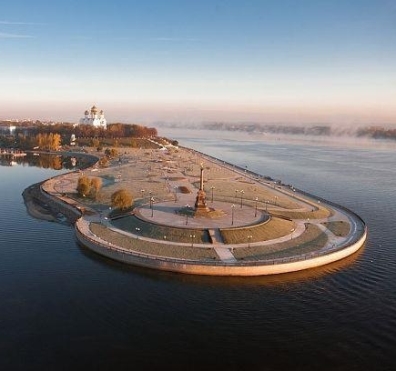
Situated in Yaroslavl, Russia, the Strelka—translated as "Arrow" due to its distinctive triangular, pointed configuration—serves as a striking natural landmark at the junction where the Kotorosl River merges with the mighty Volga River. This compact cape protrudes on the eastern (left) bank of the Volga within the southern segment of the city's ancient core, encircled by the flowing waters and the structured layout of 18th- and 19th-century streets, which together formed a strategically elevated and fortified position with precipitous embankments that deterred potential aggressors throughout history. The site encompasses dual terraces: an upper plateau rising prominently above the water for expansive scenic outlooks, and a lower expanse nearer the shoreline, now transformed into manicured gardens and leisure areas teeming with floral arrangements that bloom vibrantly from spring through fall. As an integral component of the expansive Volga River ecosystem—a cornerstone of Russia's hydrological network—the Strelka historically functioned as a pivotal node in prehistoric commerce pathways linking Nordic territories, Slavic heartlands, and distant eastern realms, facilitating cultural and economic exchanges. The area is enriched with aquatic features, including the rivers themselves, melodious fountains along broad walkways, and subtle irrigation sprays that generate colorful rainbows under sunlight, enhancing its picturesque allure.
The Strelka stands as the foundational epicenter of Yaroslavl, with
archaeological traces of habitation extending to the Neolithic period
(roughly 5th to 3rd millennium BCE). By the 9th century, it hosted a
Finno-Ugric community of the Merya tribe, who established a ritualistic
enclave dubbed "Bear Corner" (Medvezhy Ugol), presumably tied to ursine
veneration rituals. Nearby excavations, such as those at Timerevo, have
yielded relics fusing Viking and Slavic motifs, affirming its status in
early Volga mercantile corridors.
Legend attributes the city's
origins to Prince Yaroslav the Wise (circa 978–1054), the Kievan Grand
Prince, who purportedly subdued the locale around 1010. Folklore
recounts how indigenous defenders unleashed a revered bear as a mystical
guardian, only for Yaroslav to vanquish it with his battle axe (or
polearm), emblemizing triumph and the advent of Christianity. This
narrative birthed Yaroslavl's heraldic symbol—a bear clutching an
axe—and prompted the erection of a timber stronghold, the "Chopped City"
(Rublyony Gorod) or Yaroslavl Kremlin, atop the Strelka's heights, which
anchored urban growth until its incineration in 1658, after which it
remained undeveloped parkland. A commemorative stone boulder now marks
the precise founding spot, inscribed: "Yaroslav the Wise founded
Yaroslavl at this place in 1010."
Tragedy struck in the 13th century
amid the Mongol onslaught; in early 1238, Batu Khan's forces devastated
Yaroslavl, slaughtering residents en masse. Dig sites from 2004–2017
revealed nine communal graves intermingling human and animal bones,
interred haphazardly beyond sacred grounds, defying Orthodox customs and
evidencing wartime chaos. Carbon dating of 65 specimens pinpoints the
calamity to circa 1239 CE (spanning 1197–1280 CE), corroborating the
invasion's toll. Despite this, Yaroslavl rebounded, prospering in
ensuing eras, with the Strelka symbolizing endurance. In 2005, the
encompassing historic district, including the Strelka, earned UNESCO
World Heritage designation for its masterful 18th–19th-century town
planning and architectural harmony.
In its current form, the Strelka functions as a dynamic communal
venue, segmented into elevated and ground-level parterres that merge
heritage with contemporary leisure. The upper tier houses the Assumption
Cathedral (Uspensky Sobor), initially stone-built in 1215 but
reconstructed multiple times due to conflagrations and razings; the
present neo-Byzantine edifice, with its pristine white facades and
quintet of gilded domes, was finalized in 2010 for the municipal
millennium. Nearby stands the "Trinity" artwork, installed in 1995 and
drawing from Andrei Rublev's famed icon, crafted by sculptor Igor
Treyvus, painter Nikolai Mukhin, and architect Arkady Bobovich.
The
lower tier, reimagined as Strelka Park during the 1970s, boasts
synchronized singing fountains that broadcast classical tunes alongside
vibrant illuminations for nocturnal spectacles, complemented by evening
light-and-sound performances. A highlight is the expansive seasonal
floral mosaic replicating the city's emblem—a bear with axe—meticulously
arranged by local horticulturists and optimally admired from higher
vantage points in warmer months. Central to the landscape is the 2010
Monument to Yaroslavl's 1000th Anniversary: a 20-meter granite pillar
crowned by a bronze double-headed eagle, encircled by bas-reliefs and
protruding figures narrating key historical episodes, from Yaroslav's
bear confrontation to the 1961 orbital voyage of local heroine Valentina
Tereshkova, the pioneering female astronaut. An additional tribute,
sculpted by Oleg Komov with architects N. Komova and A. Bobovich, was
dedicated in 1993 on adjacent Epiphany Square to honor Yaroslav the
Wise.
The park facilitates pedestrian trails, vista platforms
overlooking the waterways, and serves as a focal point for gatherings
and festivities, rendering it a beloved destination for residents and
sightseers. Extending from here, the Kotoroslnaya Embankment was
beautified in 1944 by community effort as a postwar gift, featuring a
charming 1985 rotunda pavilion for serene river gazing, and integrates
seamlessly with the broader museum-laden embankment trail. Tourism
pursuits include leisurely ambles along the wide Volga Embankment
paths—one of Russia's most scenic—enjoying daytime fountain melodies,
evening illuminations, and panoramic sights from various elevations, all
while immersing in the site's grandeur.
The Strelka encapsulates Yaroslavl's essence as a venerable Volga settlement exceeding a millennium in age, intertwining pre-Christian origins, feudal conquests, and contemporary national esteem. The enduring bear myth infuses local ethos, manifesting in emblems, trinkets, and narratives. As a Golden Ring itinerary staple, it draws crowds for its aesthetic splendor, profound legacy, and UNESCO acclaim, exemplifying Catherine the Great-era radial urbanism. Today, beyond mere antiquity, it thrives as a vibrant hub for respite, celebrations, and contemplation of Yaroslavl's resilient heritage, continually evolving with modern landscaping and cultural integrations up to 2025.