Location: West Bohemia Map
Constructed: 1480- 89
Tel. 370 393 378
Open: Apr, Oct 9am-
12pm, 1pm- 3pm Sat, Sun, public holidays
May- Sept 9:30am- 12pm, 1pm-
4pm Tue- Sun
Jun- Aug 9:30am- 12pm, 1pm- 5:30pm Tue- Sun
www.hradsvihov.cz
Švihov
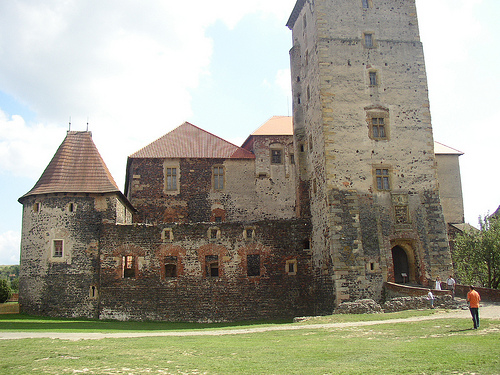
Castle, also known as a water castle, is a late Gothic fortress located
near the town of Klatovy in the Plzeň Region of West Bohemia, Czech
Republic. Situated in a shallow river valley at the confluence of the
Úhlava River and Židova strouha brook, it was designed as an artificial
island surrounded by moats, making it one of the most impressive water
fortifications in the country. Built in the late 15th century, the
castle combines defensive architecture with residential elements and has
been preserved as a national cultural monument. It gained modern fame as
a filming location for the 1973 fairy tale film "Three Wishes for
Cinderella" (Tři oříšky pro Popelku), where it served as the prince's
palace.
Early Fortifications (12th–15th Centuries)
The site's defensive
history predates the current structure. At the end of the 12th century,
a noble residence of the Držkajů family rose on a promontory above the
Úhlava River. In the first half of the 14th century, the Švihovští
branch of the powerful Rýzmberk (Rýžemberk) noble family erected a new
fortress closer to the river; it is first documented around 1375.
During the Hussite Wars, in 1425, Hussite forces under Jan Hvězda z
Vícemilic besieged this earlier fortress. The defenders surrendered only
after the attackers drained the water moats—a tactic that exposed the
castle's reliance on its hydraulic defenses. The fortress suffered
damage in the conflicts.
Construction of the Present Water Castle
(1480–Early 16th Century)
In 1480, Půta Švihovský of Rýzmberk (c.
1472–1504)—a leading figure in the Rýzmberk family, highest judge at the
court of King Vladislaus II Jagiellon, and owner of additional
strongholds such as Rabí, Horažďovice, and Prácheň—ordered a grand new
castle on the ruins of the old fortress. Půta's wealth and court
influence enabled this ambitious project.
The design created an
artificial island protected to the east by the Úhlava River and to the
north/west by a mill race. The core featured two residential palaces
(north and south ranges), a chapel, and a staircase tower enclosing a
rectangular inner courtyard. Defense relied on a concentric layout:
Inner zone: walls with four corner bastions and an inner moat.
Outer zone: a second ring of walls with bastions and an outer moat.
Both moats drew water from the Úhlava River and three nearby ponds.
The system allowed rapid flooding of the surrounding area (and
reportedly the inner courtyard) for defense—an ingenious hydraulic
feature considered among the most advanced of its era. Access involved
drawbridges and a prominent western square entrance tower (with a second
northern tower).
Construction of the core ran from 1480 to 1489 in
late Gothic style. After Půta's death in 1504, his sons Václav and
Jindřich continued work, completing the outer fortifications by around
1505–1530. The celebrated architect Benedikt Ried (Rejt/Reid) oversaw
much of the later phase. Ried introduced innovative horseshoe-shaped or
broad round bastions (some open toward the courtyard) equipped with
embrasures and a revolving drum mechanism for artillery—techniques he
also applied at Rabí Castle and Prague Castle. Renaissance elements,
including paintings and facade updates, appeared by the late 16th
century.
Ownership and 16th-Century Modifications
The castle
stayed in Rýzmberk hands until 1548, when financial troubles forced
Půta’s descendants (Václav, Jindřich, and later Jan Půta) to sell it to
Heralt Kavka of Říčany and Štěkeň. The Kavka family (1548–1598) made
minor alterations but also struggled financially and sold it in 1598 to
Humprecht Czernín (Černín) of Chudenice. The Czernín family retained
ownership for over three centuries.
Thirty Years’ War and Partial
Demolition (17th Century)
During the Thirty Years’ War, Švihov twice
repelled Swedish attacks (notably 1641–1644, when the town burned).
Post-war, however, Emperor Ferdinand III ordered its demolition, viewing
it as a potential anti-Habsburg stronghold. Thanks to Czernín
interventions and bureaucratic delays, only the eastern outer
fortifications, two bastions, and the moats were destroyed or filled.
The core palaces and chapel survived but were repurposed as granaries
and farm buildings, preserving the structure at the cost of its military
role.
Decline and Economic Use (18th–Early 20th Centuries)
In
the 18th–19th centuries the castle served purely economic purposes and
gradually decayed. By the 18th century and again in 1928 it was
officially listed as a ruin. The Czernín family continued ownership
until nationalization in 1945.
Modern Restoration and Today
Initial repairs began in the 1930s. After World War II and the 1945
nationalization of Czernín properties, the National Cultural Commission
assumed control in 1947. Major reconstruction (1949–1954) included
archaeological work in 1951 that traced the demolished eastern bastions.
The outer fortification outline was restored, and the site became a
protected monument under the National Heritage Institute.
Today,
three guided tours showcase the late Gothic and Renaissance interiors:
the armory, 18th-century kitchen, feast hall (with a magnificent wooden
coffered ceiling from Dobrovice Castle), chapel (with net vaults,
sculptured Church Fathers busts, and frescoes including St. George and
the Dragon depicting the castle at its peak), bed chambers, and the
Great Hall. Surviving 16th-century wall paintings (e.g., tournament
scenes in the Red Bastion) and original furnishings remain on display.
The castle also features in Czech cultural memory—sometimes called
“Popelka’s Palace” after its use in fairy-tale adaptations—and hosts
events.
Overall Layout and Defensive System
The castle follows a
concentric plan that merges two Bohemian architectural traditions (as
analyzed by art historian Dobroslava Menclová): an older residential
model focused on living quarters and a chapel, combined with a modern
defensive layout featuring multiple towers and bastions. The entire
complex was engineered as an artificial island, with buildings and walls
forming layered zones of defense.
Central core (inner ward) — Two
main residential palaces (north and south blocks) connected by walls
enclose a rectangular inner courtyard. The north range originally
featured a two-story hall with wooden ceilings and groin vaults added
later by Benedikt Ried; the south range includes three vaulted
ground-floor rooms and a twin-aisled upper hall with groin vaults
supported on octagonal columns. A narrow staircase wing (added during
joint maintenance) links the palaces on the western courtyard side. The
inner moat (now largely infilled and forming the visible courtyard area)
and inner wall surround this core.
Entrance — A tall, square
five-storey entrance tower stands on the west, originally accessed via a
drawbridge. A sculptured stone tablet (once bearing the owner’s arms)
frames the gateway. This tower serves as the primary vertical and
defensive element, preserving original roof-frame beams and structural
details.
Chapel — On the east curtain wall, a separate single-cell
Gothic chapel (dedicated to the Assumption of the Virgin Mary) protrudes
as a polygonal bastion-like structure, with its apse extending toward
the moat. It features broken (lancet) arches in doors and windows, net
or star vaulting with ribs on decorated consoles converging to a painted
keystone, and preserved frescoes.
Bastions and outer fortifications —
The inner wall is reinforced at the four corners by circular
(externally) or horseshoe-shaped (plan) bastions open toward the
courtyard: Red (Červená, with original tournament frescoes), White
(Bílá), Green (Zelená), and Gold (Zlatá, known mainly from 1951
foundations). These were equipped with embrasures and innovative
revolving-drum artillery features. An outer ring of walls and a second
moat completed the system. The eastern outer section was later partially
demolished.
Water Defense and Moats
The hallmark of Švihov’s
military architecture is its double-moat water system, fed directly from
the Úhlava River and adjacent ponds. Both moats could be flooded (or
drained) rapidly via ingenious sluices, creating an impassable barrier
that could even inundate the surroundings or inner areas without harming
the core structures. The outer moat survives in the west (partly as a
mill canal), while the inner moat is visible in terrain traces. This
system proved highly effective—it withstood a Swedish siege in the
Thirty Years’ War and echoes similar Ried-designed defenses at Rabí
Castle and Prague Castle.
Construction Phases, Architects, and
Style
1480–1489 — Major rebuild ordered by Půta Švihovský of Rýzmberk
(highest judge under King Vladislaus II Jagiellon). The core palaces,
chapel, inner walls, and bastions rose in pure late Gothic style.
Post-1504 to ~1520 — Půta’s sons Václav and Jindřich completed the outer
fortifications. The renowned late Gothic master Benedikt Ried (Rejt)
contributed significantly: he designed the horseshoe bastions, groin
vaults in the north range, and advanced artillery elements.
Late 16th
century — Renaissance modifications added sgraffito facades, rectangular
mullioned windows, and wall paintings.
17th–20th centuries — Partial
demolition of outer defenses after the Thirty Years’ War; conversion to
granary/farmstead (preserving the core); decay and 20th-century
restorations (1949–1954 core reconstruction, 1951 archaeology revealing
outer bastions, post-2002 flood repairs, facade work under architect
Václav Girsa).
The dominant style is late Gothic—ribbed vaults,
consoles, frescoes, and robust masonry—infused with early Renaissance
elements (sgraffito, mullioned windows). Interiors originally relied on
tiled stoves (archaeological evidence); surviving highlights include
15th–16th-century wall paintings in the Red Bastion (tournament scenes,
possibly by the Master of the Žirovnická Wall Painting), the chapel’s
original decorations, and later transferred Renaissance cassette
ceilings in halls.
Unique Architectural Highlights and
Preservation
Švihov stands out as a “last true castle” in
Bohemia—fortified yet livable, with no major post-medieval rebuilding
altering its silhouette. The protruding chapel-bastion, Ried’s open
horseshoe bastions, and floodable moats represent peak late medieval
innovation. Today, as a state-owned national cultural monument managed
by the National Heritage Institute, the castle is exceptionally
well-preserved and visitor-accessible. Guided tours reveal the tower’s
structural details (beams, defense levels), the chapel’s vaults and
frescoes, armory, historic kitchen, and great halls. Restorations have
conserved original Gothic facades and indicative period furnishings
while respecting authenticity.
Key attractions within Švihov Castle include the ceremonial rooms,
armory, banquet hall, and the castle kitchen, which have been restored
to showcase late Gothic and Renaissance furnishings. The chapel features
preserved Gothic elements, while the tower offers panoramic views of the
surrounding landscape. Exhibitions focus on the castle's history,
medieval life, and its role in film, particularly the Cinderella movie,
with displays of props and behind-the-scenes information.
The moat
and water features are notable, with bridges and pathways allowing
visitors to appreciate the defensive ingenuity. Temporary exhibitions
often highlight regional history and artifacts from the Švihovský family
era.
Švihov Castle is open to the public as a museum under the administration of the National Heritage Institute, offering guided tours of the interiors and grounds. It hosts cultural events, including medieval festivals, concerts, and film screenings. Visitors can explore the site year-round, with special programs in summer. For detailed opening hours, ticket prices, and tour information, refer to the official website at www.hrad-svihov.cz. The castle remains a popular destination for history enthusiasts and families, blending educational value with scenic beauty.