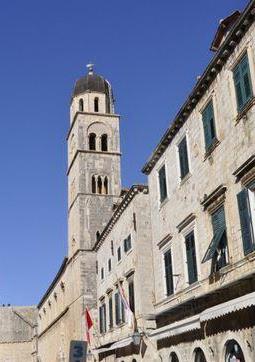
Location: Placa 2
Franciscan Monastery is a medieval Roman Catholic monastery that stands near Saint Savior church. It was constructed in 1317 and constructed in a Romanesque architectural style. Franciscan Monastery proved to be one of the richest and largest monasteries in Croatia. It faced a serious setback when Franciscan Monastery was hit by an earthquake in 1667. Today only few parts of the original Medieval structure survive including Southern portal of the main church and several living rooms. Franciscan Monastery still holds a pharmacy that was found along with the monastery itself. It is one of the oldest operating pharmacies in Europe.
Origins: Arrival of the Franciscans (13th Century)
The Franciscan
Order, founded by St. Francis of Assisi in the early 13th century,
reached Dubrovnik (then the Republic of Ragusa) shortly after. The first
documented mention of Franciscans in the city dates to 1235, referencing
a provincial of Slavonia named Fra Sixtus of Brescia. A bequest from
1234 supports an even earlier presence around 1228–1230.
Their
initial monastery, dedicated to St. Thomas (Sv. Tome), was built outside
the city walls in the Pile suburb (roughly where the Hotel Hilton
Imperial stands today). This location followed the Franciscan rule of
building monasteries “three stones’ throw” from urban centers and was
near a leprosarium at Danče, vineyards, and a road. The site was modest,
with a small church, and the friars lived among vineyards and supported
charitable work. However, its exposed position made it vulnerable to
robberies and, more critically, to potential military threats.
Relocation Inside the Walls (1317): Security and New Construction
By
the early 14th century, geopolitical tensions—particularly the threat of
war with Serbian King Uroš II Milutin (around 1317–1318) and earlier
concerns with Venice—prompted action. In 1317, the Dubrovnik Senate
ordered the demolition of the old St. Thomas monastery (except possibly
parts of the church) to prevent enemies from using it as a fortress
during a siege. With papal approval (initially from Pope Boniface VIII
and later ratified by Pope John XXII in 1318), the Franciscans relocated
inside the protective city walls near the Pile Gate.
Construction of
the new Friars Minor monastery (Mala Braća) began immediately in 1317.
Work continued for centuries, with major phases in the 14th century. The
complex was built concurrently with the church, incorporating
ground-floor areas like the sacristy and chapter house. It was designed
to house around 30 monks but expanded to serve as a studium (school),
provincial center, hospital, and more. Some recent research suggests the
core may not have been fully “moved” but rather enclosed and integrated
as the city walls expanded, though the consensus among historians is
that the old extramural site was largely cleared for security.
The
iconic lower cloister was completed around 1360 by master builder Mihoje
Brajkov (Mihajlo Brajkov) from Bar (modern Montenegro). It is a
masterpiece of late Romanesque style with Gothic elements: 120 slender
columns forming double hexaphoras (six-arched openings), each with
unique carved capitals featuring geometric, plant, human, and animal
motifs. It surrounds Dubrovnik’s oldest continuously cultivated garden.
An upper Renaissance-style cloister with semicircular arches and cross
vaults was added later. A smaller, private Gothic cloister also existed
for the friars.
The Church: Gothic Splendor and Baroque
Rebuilding
The church’s south portal (facing the Placa) is its most
famous surviving medieval feature. Carved in 1498 by local sculptors
brothers Leonard and Petar Petrović (sometimes associated with the
Andrijić workshop), it is a flamboyant Gothic masterpiece. The central
lunette features a stone Pietà; it is flanked by statues of St. Jerome
(holding a model of the pre-earthquake church) and St. John the Baptist,
with God the Father above. The iconography reflects Franciscan values
and the Republic’s concerns (e.g., resistance to Ottoman threats).
Before 1667, the church was one of Dubrovnik’s richest, with numerous
altars, paintings (including works attributed to Titian, Caravaggio, and
local masters like Lovro Dobričević and Nikola Božidarević), and
silverwork. It was divided by pillars into sections.
Major
Catastrophe: The 1667 Earthquake and Aftermath
On April 6, 1667 (Holy
Wednesday), the devastating Great Earthquake struck. The church was
almost completely destroyed, followed by a catastrophic fire that
ravaged the city. Only the south Gothic portal survived intact (it was
likely repositioned to the lateral wall during restoration). The fire
also destroyed much of the library (around 7,500 volumes and
manuscripts) and many artworks.
Reconstruction followed in the
Baroque style: a single-nave interior with a marble pulpit (which
survived the quake), a main altar by sculptor Celia from Ancona (1713)
featuring the Risen Christ, and side altars by Venetian Giuseppe Sardi
(1684–1696). Poet Ivan Gundulić is buried here. The bell tower was also
modified (its pyramidal roof replaced by a dome).
The Pharmacy:
One of Europe’s Oldest
Established in 1317 alongside the new
monastery, the Friars Minor Pharmacy (Apothecaria or Aromatica) was
originally for the friars’ care and quickly served the public. It is
widely regarded as the third-oldest pharmacy in the world and the oldest
(or one of the oldest) still-functioning in Europe. It operated
continuously using local Mediterranean herbs from the monastery garden,
generating income for the order. The original inventory from 1317
survives. Today, part functions as a museum in a Renaissance hall
displaying historic jars, scales, mortars, and equipment (relocated from
the small northern cloister in 1901).
The Library and Cultural
Significance
The library, organized in the 17th century (with an
upper-floor addition), is one of Croatia’s richest. Post-1667 rebuilding
efforts restored it to hold over 70,000 volumes, including ~20,000
manuscripts, 137–216 incunabula, rare Croatian literary works (e.g., one
of two surviving first editions of Marko Marulić’s Judita), old church
corals, and the pharmacy’s 1317 inventory. It contains vital materials
for early Croatian literature and music (over 100 unique works by
Croatian composers). The museum also displays liturgical goldwork,
paintings (e.g., “Ecce Homo” by Francesco Francia), and relics.
The
monastery served as the seat of the Observant Province of St. Francis in
Dubrovnik from 1484 to 1899 and was a center for theology, philosophy,
education, preaching, and charity.
Later History: Wars,
Occupations, and Resilience
19th–20th centuries: French (1806) and
Austrian occupations caused damage; a 1913 fire affected the west wing.
It remained a hub of faith and culture.
World War II and Yugoslav
era: Three friars were executed in 1944; activities were restricted
under communism.
Homeland War (1991–1992): The complex was heavily
shelled (over 50 grenades/missiles), damaging the library and bell
tower, especially on December 6, 1991. It still provided aid, water,
food, and shelter (including for the International Red Cross).
Reconstruction took years.
Historical Context Shaping the Architecture
Franciscans
arrived in Dubrovnik around 1235, initially building outside the
walls. The current monastery was established inside the city walls
in 1317 (after the earlier site was demolished during regional
conflicts). Construction of the main friary occurred between roughly
1317 and 1360 in late Romanesque style, with Gothic and Renaissance
additions over time. The 1667 earthquake (and subsequent fire)
destroyed much of the medieval structure, leading to Baroque
rebuilding of the church and parts of the complex while preserving
key medieval elements like the cloister and portal. Further damage
occurred during the 1991–1995 Siege of Dubrovnik (37 missiles hit
the site), but restorations preserved its character. The result is a
layered architectural palimpsest: resilient stone construction
typical of Dubrovnik (local limestone blocks) that prioritizes
harmony, proportion, and contemplative spaces aligned with
Franciscan ideals of humility and service.
The Church of St.
Francis
The church forms the spiritual core of the complex, with
a striking contrast between its exterior Gothic portal and Baroque
interior.
Exterior and Portal: The main south-facing portal
(on Stradun) is a late-Gothic masterpiece from 1498, one of the few
elements to survive the 1667 earthquake intact. Carved by local
masters Leonard and Petar Petrović in a Venetian-influenced
flamboyant Gothic style, it features a dramatic lunette relief of
the Pietà (Virgin Mary with the body of Christ). Flanking the portal
are statues of St. John the Baptist (left) and St. Jerome (right).
Above the gable stands a statue of God the Father holding a book and
blessing. The design incorporates ornate pilasters, leaf-like
capitals, and intricate tracery, creating a vertical, expressive
Gothic drama against the simpler stone facade.
Interior: Rebuilt
post-1667 in Baroque style as a single-nave hall (typical for
Franciscan churches emphasizing simplicity and preaching). It
features refined proportions without excessive ornamentation,
aligning with Franciscan theology. Highlights include a 1713 main
altar with twisted columns and a statue of the Resurrected Christ,
side altars by Giuseppe Sardi, a surviving 15th-century marble
pulpit, and the tomb of poet Ivan Gundulić. Paintings and sculptures
(some by Dubrovnik School artists) adorn the space, though many
original artworks were lost in the earthquake. The overall effect is
elegant and meditative, with high ceilings and balanced lighting.
The Cloisters: The Architectural Heart
The monastery features
two cloisters, a hallmark of monastic design providing enclosed,
contemplative walkways (ambulatories) around a central garden. They
exemplify the site’s stylistic evolution and are considered among
the finest in Dalmatia and Croatia.
Lower Cloister
(Romanesque-Gothic, primary/public one): Built in the 14th century
(completed around 1360) by local sculptor Mihoje Brajkov of Bar,
this is the standout feature—a masterpiece of late Romanesque-Gothic
architecture. It forms a rectangular quadrangle with a covered
arcade surrounding a lush central garden (symbolizing the Garden of
Eden, planted with medicinal herbs, orange/laurel/cypress trees, and
featuring a central fountain with a statue of St. Francis). The
arcade consists of semicircular arches supported by 120 slender
double-pillared columns (60 pairs of elegant, paired columns,
sometimes called hexaphoras) and 12 massive pilasters. Every capital
is uniquely carved with extraordinary variety: geometric patterns,
interwoven plant motifs, fantastic animals, expressive human
figures, and rosettes. This creates a rhythmic, harmonious gallery
with dramatic plays of light and shadow. Stone benches line the
walls for contemplation. In 1860, frescoes depicting the life of St.
Francis were added along the upper walls (some faded). The space
feels tranquil and photogenic—an oasis amid Dubrovnik’s bustle.
Upper Cloister (Renaissance): Less ornate but elegant, featuring
grand arches and semicircular vaults in a more classical Renaissance
style. It provides additional enclosed space for the monastic
community, complementing the lower cloister’s Gothic exuberance with
restrained proportion and clarity.
The cloisters together
create a meditative circulation pattern, with the lower one’s unique
capitals inviting close study and symbolizing the diversity of
creation.
Other Architectural Elements
Pharmacy and
Museum/Treasury: Integrated into the complex (pharmacy founded 1317,
one of the three oldest in Europe still functional until modern
times). The museum displays 16th–18th-century furniture, ceramic
jars from Siena/Florence, mortars, scales, and liturgical items
(reliquaries, vestments, manuscripts). The adjacent library (17th
century) holds over 20,000 volumes, including rare incunabula and
chorales.
Overall Layout and Materials: The complex is compact
yet grand, centered on the cloisters with the church adjacent. Thick
limestone walls (resistant to earthquakes and sieges) and tiled
roofs define the Dubrovnik aesthetic. No single grand dome or tower
dominates publicly (though a bell tower rises above); instead, the
design prioritizes internal harmony and functionality.
The Franciscan Monastery was a pillar of the Republic of Ragusa’s
social fabric, blending spiritual, intellectual, and humanitarian roles.
The pharmacy, one of Europe’s oldest, democratized healthcare, serving
sailors and citizens with remedies like theriac, a medieval antidote.
The library fostered scholarship, copying texts that influenced
Dalmatian humanism, while the friars’ school educated future diplomats.
The cloister, a gathering place for merchants and clergy, symbolized the
Republic’s communal ethos, balancing wealth with charity.
Today, the
monastery is a cultural linchpin. It hosts Dubrovnik Summer Festival
events (July–August), with cloister concerts drawing 5,000 attendees
annually, and serves as a venue for weddings and masses. The pharmacy’s
herbal products, sold to tourists, preserve Franciscan traditions, while
the library supports global research, with digitized manuscripts
accessible online since 2021. The Feast of St. Blaise (February 3) sees
friars join processions, linking the monastery to Dubrovnik’s
UNESCO-recognized heritage. For locals, it’s a refuge from tourism’s
bustle; for scholars, it’s a window into medieval medicine and literacy.
Environmentally, the cloister’s greenery cools the microclimate, a model
of sustainable design in Dubrovnik’s karst landscape. Current challenges
include managing tourist footfall—3 million visitors strain the Old
Town—prompting calls for timed entries to the museum and pharmacy.
As of September 17, 2025, at 11:47 AM CDT, the Franciscan Monastery
is fully operational, managed by the Franciscan Order and Dubrovnik
Museums. Open daily 9 AM–6 PM (closed during 7 AM mass), entry costs €7
(includes pharmacy and museum; free with Dubrovnik Card, €35, covering 9
sites). Post-1990s war repairs and a 2023 cloister cleaning ensure
pristine condition, with no major damage reported. Located at Placa 2,
it’s steps from the Pile Gate (bus Lines 1A/3, €8 from airport) or a
10-minute walk from the cruise port. Parking at Brsalje Square (€2/hour)
is a 3-minute walk.
Allow 45–60 minutes to explore the cloister,
pharmacy, and museum; audio guides (€2, multilingual) or guided tours
(€7, 30 minutes, book via dumus.hr) enhance understanding. Spring
(April–June) or autumn (September–October) avoids summer crowds; early
mornings offer quiet. The cloister is wheelchair-accessible, but the
church and upper library require steps—staff assist (+385 20 321 410).
TripAdvisor reviews (4.7/5) praise the “peaceful cloister” and
“fascinating pharmacy,” though some note limited signage; the app helps.
Pair with Onuphrius’ Fountain or the Pile Gate for a western Old Town
circuit, or catch a festival concert for evening serenity.