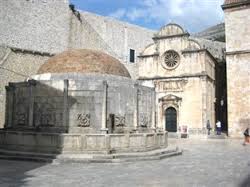
Onuphrius' Fountain, also known as Onofrio's Fountain (Velika Onofrijeva Fontana in Croatian), stands as one of Dubrovnik’s most iconic landmarks, gracing the western entrance of the Old Town near the Pile Gate. This grand, 16-sided polygonal fountain, built in 1438 by the Neapolitan architect Onofrio di Giordano della Cava, is not merely a decorative monument but a testament to the Republic of Ragusa’s engineering prowess and commitment to public welfare. Designed as the terminus of a sophisticated 12-kilometer aqueduct system, it supplied fresh water to the city’s inhabitants, ensuring survival during sieges and cementing Dubrovnik’s reputation as a self-sufficient maritime power. Adorned with intricate carvings and crowned by a domed cupola, the fountain blends Gothic and Renaissance aesthetics, serving as both a functional utility and a symbol of civic pride. Today, it remains a bustling meeting point for locals and tourists, its 16 spouts still trickling with potable water, inviting visitors to drink from history in the heart of Dubrovnik’s UNESCO World Heritage site.
Historical Context: Water Scarcity in the Republic of Ragusa
In
the 15th century, Dubrovnik (then the independent Republic of Ragusa)
was at the height of its Golden Age as a wealthy maritime trading power.
The city had grown significantly, with expanding industry (including
textiles) and a dense urban population. Fresh water was a critical
issue. For centuries, residents relied on rainwater collected in rooftop
cisterns and a few wells, which often proved insufficient during the
long, dry Mediterranean summers.
By the 1430s, the Great Council
(Senate) recognized the need for a reliable, large-scale water supply.
In 1436, they authorized the construction of a sophisticated aqueduct to
bring spring water from the Knežica spring (also called Vrelo or Šumet
spring) in Rijeka Dubrovačka, roughly 12 km (about 7.5 miles) away. The
system relied entirely on gravity, a remarkable achievement for the era,
channeling water through pipes and channels directly into the city
walls.
The Architect and Construction (1435–1442)
The project
was entrusted primarily to the Neapolitan (Italian) architect and
hydraulic engineer Onofrio di Giordano della Cava (often shortened to
Onofrio della Cava or Onofrio Giordano della Cava), a specialist in
plumbing and water systems from the Naples area. Some early documents
mention a possible collaborator, Andreucius Bulbito from Tramonte, but
Onofrio is the sole figure credited in subsequent records and is
considered the mastermind.
His contract included strict penalties for
delays, water loss, or substandard quality—yet the project was completed
flawlessly and ahead of schedule. Between approximately 1435 and 1442,
Onofrio designed and oversaw the full 12 km aqueduct, associated mills,
and two public fountains. The Large Onofrio's Fountain itself was built
from 1438 to 1440 as the main terminus of the aqueduct system. It served
as both a functional water distribution point and a grand celebratory
symbol of the engineering triumph.
The cupola (dome) atop the
fountain was crafted by master sculptor Petar Martinov (Pietro di
Martino) from Milan. The fountain also fed water to other key sites,
including the Rector's Palace.
Design and Features
The Large
Onofrio's Fountain is a large, 16-sided polygonal stone structure with a
prominent central cupola. Water flows from 16 unique carved stone masks
(known as maskerons or mascarons)—grotesque or expressive faces—through
spouts in their mouths into a surrounding drainage basin. These masks
are the fountain's most distinctive artistic element and were designed
to be both decorative and practical.
Originally, the fountain was far
more ornate. The cupola was crowned with additional sculptures (some
sources mention a dragon statue), and a symbolic statue of a dog
(locally called kučak or "fountain dog") adorned the upper walls as a
guardian figure. The entire ensemble was a harmonious blend of
functionality and Renaissance artistry, standing as a public monument to
the Republic's prosperity and ingenuity.
A smaller companion fountain
(the Small Onofrio's Fountain) was built later (1440–1442) by the same
architect at the opposite end of Stradun, in Luža Square, to serve the
marketplace. Together, they formed the core of the new public water
network.
Damage, Restoration, and Later History
The fountain
endured for centuries as the city's primary drinking water source. Its
water remained safe and drinkable, and the old aqueduct system stayed
operational until the late 19th century (when it was integrated into
modern waterworks; the connection persists today).
The greatest blow
came during the catastrophic Great Earthquake of 1667, which devastated
much of Dubrovnik, killing thousands and destroying or damaging
countless buildings. The fountain's cupola was heavily damaged, many
original sculptures and ornaments (including the dragon) were lost, and
the structure required extensive rebuilding. Later reconstructions
simplified the design and never fully restored its pre-1667 grandeur.
In the modern era, the fountain continued to serve the community. During
the 1991–1992 Siege of Dubrovnik (part of the Croatian War of
Independence), it provided essential water when the city's supply was
disrupted. A damaged kučak dog statue was replaced with a faithful
replica in 2016.
Recent archaeological work (during pavement
renovations around the fountain) uncovered the remains of a substantial
14th-century city cistern nearby—evidence of earlier medieval water
management systems that predated Onofrio's aqueduct. The cistern, once
under the jurisdiction of the St. Clare monastery, highlights the
evolution of Dubrovnik's water infrastructure.
Overall Form and Structure
The fountain takes the form of a
massive 16-sided polygonal (hexadecagonal) stone structure topped by a
prominent central dome (cupola), with a large circular basin at its
base. It rises in tiers on a stepped stone platform, creating a
monumental yet harmonious presence that evokes the polygonal
baptisteries or small temples of Italian Renaissance architecture.
The lower section forms a broad, 16-faceted container (often
described as a "sixteen-sided container") that holds and distributes
water.
A circular outer basin collects the flowing water, making the
entire composition functional for public use.
The dome crowns the
structure, adding vertical emphasis and a sense of enclosure, while the
overall proportions achieve a balanced, almost temple-like dignity in
the urban square.
Visually, the fountain resembles a freestanding
pavilion or baptistery, blending utility with civic grandeur. Its scale
is imposing yet approachable—large enough to serve as a gathering spot
and landmark while integrating seamlessly with the surrounding limestone
architecture of the Old Town.
Key Architectural and Decorative
Elements
The design emphasizes both functionality and ornamentation:
The 16 Maskerons (Mascarons): Each of the 16 facets features a unique,
intricately carved stone maskeron (a large grotesque or expressive
masked face, often blending human and animal traits such as grimacing
expressions, smiles, or hybrid features like goat-like ears). Water
originally spouted continuously from bronze pipes or faucets protruding
from each mask's mouth into the basin below. These 16 original
maskerons—surviving in worn but recognizable form after centuries—serve
as both decorative elements and functional spouts. They represent
typical Renaissance "mascherone" motifs and were likely executed or
influenced by the Milanese sculptor Pietro di Martino (Petar Martinov).
Dome and Upper Structure: The central cupola was crafted by Petar
Martinov from Milan. Originally more elaborate and richly sculpted
(possibly crowned with a dragon statue), it suffered heavy damage in the
1667 earthquake. Post-earthquake reconstructions simplified its form,
introducing some Baroque influences while preserving the core dome
shape. The upper walls or rim also once featured additional statues and
ornamentation that were lost or reduced.
Additional Sculptural
Details: A small dog statue, locally known as "Kuchak" (fountain dog),
adorns the top walls or rim; a replica was reinstalled in 2016 after
damage to the original. Other lost elements included more elaborate
Gothic-style sculptures and ornamentation that once decorated the
structure.
Base and Basin: The fountain sits on a multi-stepped stone
platform, elevating the polygonal body and allowing easy access to the
water. The circular basin collects the spouting water, creating a
refreshing, audible feature in the square.
Materials,
Construction, and Style
The fountain is constructed primarily of
local limestone (typical of Dubrovnik's durable, pale stone
architecture), carved with precision to achieve smooth polygonal facets,
detailed reliefs on the masks, and structural stability. The aqueduct
integration relied on gravity flow, showcasing advanced hydraulic
engineering for the era.
Architecturally, it represents an early
Renaissance style with lingering Gothic influences:
The polygonal
plan and dome reflect Italian Renaissance ideals of symmetry, harmony,
and classical revival (inspired by Onofrio's Neapolitan background).
Original elaborate ornamentation leaned toward Gothic verticality and
intricacy.
Post-1667 reconstructions blended these with simplified
Baroque elements.
The result is a functional public utility
transformed into a civic monument—practical for daily water collection
yet artistically refined.
Historical Changes and Current State
The 1667 Dubrovnik earthquake inflicted severe damage, destroying much
of the upper decoration, dome details, and additional sculptures. Later
repairs prioritized functionality over full restoration of the original
ornate form, resulting in the somewhat simplified appearance seen today
(with the 16 maskerons as the most intact original features).
Despite
this, the fountain has endured sieges, wars, and restorations. The
original aqueduct system operated until the late 19th century and
remains connected to the modern water supply, so the water is still
potable, cold, and refreshing—locals and tourists alike fill bottles
from the spouts. It functions 24/7 as a free public landmark and popular
meeting point.
Onuphrius’ Fountain transcends its utilitarian origins, embodying the
Republic of Ragusa’s ethos of collective survival and aesthetic
ambition. As the aqueduct’s public face, it democratized access to clean
water—a rarity in medieval Europe—underscoring the Senate’s commitment
to civic welfare over aristocratic excess. Its placement at the Pile
Gate, where merchants, pilgrims, and sailors entered, made it a first
impression of Ragusa’s sophistication, rivaling the grandeur of its
cathedral or Sponza Palace. The mascarons, with their diverse faces,
hint at Dubrovnik’s cosmopolitanism, a port welcoming traders from
Venice, the Levant, and beyond.
Culturally, the fountain is a living
artifact. It anchors festivals like the Dubrovnik Summer Festival
(July–August), where its steps host impromptu performances, and serves
as a backdrop for wedding photos or tourist selfies. Its water, still
potable, ties modern visitors to medieval residents, a continuity rare
in urban settings. For scholars, it offers insights into hydraulic
engineering and Renaissance patronage; for locals, it’s a point of
pride, dubbed “the heart of the city” in guides like Dubrovnik in Your
Pocket. Its resilience—surviving quakes, wars, and tourism’s
wear—mirrors Dubrovnik’s own defiance, from Ottoman sieges to the 1991
bombardment.
The fountain also reflects environmental foresight: the
Šumet spring, still active, underscores sustainable water management in
a karst region prone to drought. Recent conservation (e.g., 2018 flow
recalibration) ensures its functionality, while debates about limiting
tourist access highlight tensions between heritage and overcrowding in a
city of 43,000 hosting 3 million visitors annually.
As of September 17, 2025, Onuphrius’ Fountain remains fully
operational and freely accessible 24/7, nestled at Ulica od Pila, steps
from the Pile Gate bus stop (Lines 1A/3 from the airport, €8). No
tickets are required—simply approach, drink, or photograph, though signs
discourage climbing to preserve the stonework. Maintained by the City of
Dubrovnik and UNESCO-funded teams, it underwent a minor cleaning in
2023, with no major damage reported post-1990s war repairs. The water,
tested regularly, is safe, with a crisp, mineral taste from Šumet’s
limestone aquifer; bring a reusable bottle to join the ritual.
Allow
15–30 minutes to admire the mascarons and cupola, ideally at dawn or
dusk when crowds thin and the stone glows golden. Pair with nearby
sites: the Franciscan Monastery’s pharmacy (1436, €7) or Lovrijenac
Fortress (€15, panoramic views). Spring (April–June) or autumn
(September–October) avoids summer throngs; check dumus.hr for festival
overlaps. Accessibility is excellent—flat paving suits wheelchairs—but
spouts are mid-height, so assistance may help. Reviews on TripAdvisor
(4.5/5) praise its “timeless charm” and “refreshing water,” though some
note litter from tourist bottles; bins are nearby.
The fountain’s
allure lies in its simplicity: no flashy jets, just a steady flow
connecting 1438 to 2025. Sip from a mascaron, trace a carving, or linger
on its steps—you’re not just seeing history, but tasting it, in a city
where every stone tells a story of survival.