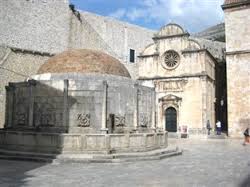
The Church of St. Saviour (Crkva Svetog Spasa), a petite yet profoundly symbolic votive church in Dubrovnik's UNESCO-listed Old Town, Croatia, stands as a testament to resilience and gratitude amid seismic calamity. Dedicated to Jesus Christ under the title of Saviour, it occupies a modest footprint of about 100 square meters in the single-nave layout, nestled between the Franciscan Monastery and the imposing city walls, just beyond Pile Gate at the western entrance to Stradun (the main thoroughfare). Commissioned in 1520 by the Dubrovnik Senate as an act of thanksgiving for the city's partial sparing from a devastating earthquake, the church was completed in 1528 and miraculously withstood the far more destructive 1667 quake that razed much of Dubrovnik. Blending Gothic and Renaissance elements, it is regarded as the first fully realized Renaissance structure in the city, serving today as an active Roman Catholic place of worship, exhibition space, and venue for classical music concerts during events like the Dubrovnik Summer Festival. Its unassuming presence—tucked away yet pivotal—invites quiet contemplation, drawing pilgrims, historians, and tourists to reflect on Dubrovnik's enduring spirit in the Republic of Ragusa's golden age.
The 1520 Earthquake and the Senate’s Decision
The church owes its
existence directly to a powerful earthquake that struck Dubrovnik on 17
May 1520—the Feast of the Ascension of Jesus Christ. The quake killed
around 20 people and damaged numerous buildings, raising fears that
Mount Srđ (the hill overlooking the city) might collapse and cause even
greater destruction. Compared to later disasters, the toll was
relatively light, and the Senate of the Republic of Ragusa (Dubrovnik)
interpreted the city’s survival as divine mercy. In immediate response,
the Senate—the republic’s highest governing body—commissioned a new
votive church dedicated to Christ the Saviour as a public expression of
gratitude.
This was a deliberate political and religious act typical
of the Renaissance-era republic: the church would stand as a permanent
memorial and thank-offering right at one of the city’s main entrances,
visible to all who entered. A monumental Latin inscription carved above
the main portal (on a rectangular plaque featuring an open scroll held
by naked winged putti) explicitly commemorates the event and the
Senate’s thanks for sparing the city from worse calamity.
Construction (1520–1528/1534): Architect, Process, and Challenges
Construction began in 1520 under the direction of Petar Markov Andrijić
(c. 1480–c. 1553), a master architect and stonemason from the nearby
island of Korčula. Andrijić belonged to a prominent family of builders;
his father, Marko Andrijić, had worked on major projects including
Korčula Cathedral. The Senate appointed noble overseers (provisores) to
supervise the works, and Petar was contracted for key elements such as
the entire facade, portal with reliefs, and decorative features.
Most
popular sources state the church was completed in 1528, but detailed
archival research (notably by historian Danko Zelić) shows the project
encountered difficulties and interruptions starting around 1522/1523.
These issues—likely involving funding, logistics, or disputes—persisted
with varying intensity until final completion around 1534. A charming
local legend claims that aristocratic women of Dubrovnik participated
enthusiastically, personally carrying stone and wooden materials to
hasten the work and show their gratitude.
In 1527, while construction
was still underway, the Senate commissioned an altarpiece of the
Ascension of Jesus Christ from the Italian painter Pierantonio Palmerini
of Urbino to furnish the interior.
Architecture: Transitional
Gothic-to-Renaissance Masterpiece
Saint Saviour is a modest
single-nave church with a semicircular apse. Its interior features a
Gothic cross-ribbed vault and slender lateral windows with pointed
arches—lingering Gothic elements common in late-medieval Dalmatia. Yet
the exterior, especially the main facade, displays confident Renaissance
characteristics: a classical portal framed by slim columns and a
triangular pediment, an entablature, and a distinctive three-lobed
(trefoil) semicircular gable at the top. The apse reinforces the
Renaissance aesthetic. Many scholars regard it as the first
comprehensive or fully cohesive Renaissance-style church in Dubrovnik,
marking the city’s architectural shift from Gothic toward the new
Italian-influenced classicism that would define the Adriatic coast.
The overall effect is elegant and restrained—perfect for a votive
monument rather than a grand cathedral.
Survival of the 1667
Great Earthquake
The church’s most famous chapter came on 6 April
1667, when the catastrophic Great Earthquake of Dubrovnik destroyed much
of the city, killing an estimated 5,000 people (roughly half the
population) and leveling or heavily damaging most buildings, including
many churches. Saint Saviour Church withstood the disaster almost
completely intact, remaining in its original Renaissance form while the
rest of Dubrovnik was largely rebuilt in the Baroque style that
dominates the Old Town today. This survival cemented its status as a
living symbol of the original 1520 vow of gratitude and divine
protection.
Later History and Modern Role
Because the 1667
quake left it untouched, there were few major structural interventions
in subsequent centuries. The church continued to serve as a minor
religious site and public landmark. During the 1991–1995 Croatian War of
Independence and the Siege of Dubrovnik, the Old Town sustained shelling
damage, but Saint Saviour (like many protected monuments) emerged with
only minor impact.
Today it remains an active Roman Catholic church
but functions primarily as a cultural venue. In summer it regularly
hosts art exhibitions and classical music concerts (chamber music and
recitals), drawing both tourists and locals. Its intimate size and
historic atmosphere make it an ideal setting for these events, allowing
visitors to experience the building as a living part of Dubrovnik’s
cultural life.
Saint Saviour Church (Crkva sv. Spasa), also known as the Church of
the Holy Saviour, is a small votive church tucked into Dubrovnik’s Old
Town on the main pedestrian street, Stradun (Placa), right beside the
Pile Gate and opposite the larger Onofrio Fountain, near the Franciscan
Monastery.
Built as an act of thanksgiving after a destructive
earthquake on 17 May 1520 (which killed about 20 people and damaged
buildings but spared the city from worse), the church was commissioned
by the Dubrovnik Republic’s Senate and dedicated to Jesus Christ (the
Saviour). Construction began immediately in 1520 and was completed in
1528. It stands today almost exactly as built—one of the very few
structures in Dubrovnik to survive the catastrophic 1667 earthquake
virtually intact, when much of the city was leveled and thousands died.
Architect and Historical Context
The architect and master
stonemason was Petar Andrijić (also spelled Petar Andrijich or Petar
Markov Andrijić) from the nearby island of Korčula, a skilled craftsman
known for work in Dalmatia. Some sources note possible influence from
the Cathedral of Šibenik (a UNESCO site), which also blends Gothic and
Renaissance elements. Legend adds that local aristocratic women
enthusiastically helped carry stone and wood during construction.
The
church is considered the first comprehensive Renaissance-style building
in Dubrovnik, marking the city’s architectural shift from late Gothic
toward the emerging Renaissance ideals of harmony, classical
proportions, and decorative restraint that were spreading across the
Adriatic from Italy.
Overall Structure and Plan
It is a
compact, single-nave (one-aisle) rectangular church with a semicircular
apse at the east end. The building is modest in scale—roughly 15 metres
long overall—designed to fit seamlessly into the dense urban fabric of
the Old Town while facing the bustling Stradun. The west façade (the
public face) is about 8.63 metres wide and rises approximately 14 metres
high (excluding the crowning cross). The structure uses local limestone,
typical of Dubrovnik’s durable, pale stone architecture.
Exterior: The Renaissance Façade
The west façade is the architectural
highlight and showcases pure early-Renaissance design with subtle
classical references:
Trefoil (three-leaf semicircular) gable:
The top of the façade curves into a distinctive three-lobed silhouette,
divided into three bays by pilasters and cornices. This creates a
graceful, rounded crown that softens the rectangular form and is a
hallmark Renaissance feature.
Central rose window: A beautifully
carved Dalmatian-style rosette window sits prominently above the portal,
allowing light into the nave while adding decorative symmetry.
Ornate
portal: The main entrance is framed by slim columns supporting a
triangular pediment in classical “all’antica” style. Intricate relief
carvings of foliage, mouldings, and ornamental details (executed by
Andrijić’s Korčula workshop) surround the doorway. Above the door runs a
wide rectangular entablature with a monumental Latin inscription on a
scroll held by winged putti (cherubs). The text records the Senate’s
1520 vow to avert “celestial wrath” after the earthquake and names the
supervisors (Daniel Resti and Damian Minuti) and the architect.
Blind
arcades and side elements: Flanking sections include narrow blind
arcades with shell motifs in relief, adding texture and depth.
The lateral (side) walls feature slender pointed Gothic arches for the
windows, providing a deliberate contrast to the Renaissance façade. The
overall effect is elegant, restrained, and perfectly
proportioned—typical of Dubrovnik’s harmonious Renaissance aesthetic.
Interior: Gothic Ribbed Vault and Simplicity
Inside, the church
feels intimate and serene (it now serves as an exhibition space and
occasional classical music venue). The single nave is covered by a
Gothic cross-ribbed vault (sometimes described as divided into bays by
smooth transverse pointed arches), which rises gracefully and creates a
sense of height despite the small footprint. The side windows repeat the
pointed Gothic arches seen on the exterior, flooding the space with
light while maintaining structural Gothic logic.
At the east end, the
semicircular apse echoes the Renaissance exterior and provides a
rounded, harmonious termination to the nave. The interior is otherwise
plain and unadorned—whitewashed walls and stone floors emphasize the
elegant vaulting and the play of light through the rose window and side
openings. No lavish Baroque additions or frescoes survive; the focus
remains on the pure architectural lines.
Stylistic Analysis:
Gothic-Renaissance Transition
Saint Saviour Church is a textbook
example of the late-Gothic-to-Renaissance transition in 16th-century
Dalmatia:
Gothic elements (interior vault, pointed arches on windows)
reflect lingering medieval traditions and structural familiarity.
Renaissance elements (façade portal, pediment, trefoil gable,
semicircular apse, classical orders, and symmetrical composition)
introduce humanist ideals of balance, clarity, and antique-inspired
decoration.
This blend is not accidental; it captures the moment
when Italian Renaissance ideas reached the Republic of Ragusa
(Dubrovnik) while local builders still employed proven Gothic
construction techniques. The result is harmonious rather than
jarring—Dubrovnik’s own elegant synthesis.
Architectural
Significance
Because it survived the 1667 earthquake unscathed
(including its delicate rose window), Saint Saviour Church offers a
rare, pristine glimpse of pre-1667 Dubrovnik architecture. It is
frequently cited as one of the finest and earliest pure examples of
Renaissance design in the city, predating many of the Baroque
reconstructions that define much of the Old Town today. Its survival and
votive purpose also make it a powerful symbol of resilience and
gratitude in Dubrovnik’s collective memory.
As a microcosm of Dubrovnik's layered identity—Roman roots, medieval
piety, Renaissance innovation, and modern resilience—St. Saviour
transcends its scale, symbolizing the republic's ethos of "Non sine Deo"
(Not without God) in navigating peril. Its votive origins and quake
survival position it as a spiritual anchor in the Old Town's sacred
ensemble, complementing grander sites like the Cathedral while
highlighting women's overlooked roles in history. Architecturally, it
pioneers Renaissance adoption in Ragusa, bridging Venetian imports with
indigenous craft and influencing later structures like the Sponza
Palace. Culturally, it enriches Dubrovnik's UNESCO status (inscribed
1979) by hosting exhibitions on local art and history, plus intimate
concerts that echo the republic's humanistic legacy, fostering ties to
contemporary Croatian identity amid tourism's pressures.
For
visitors, the church is at Ulica Placa (Stradun), 20000 Dubrovnik, a
mere 2-minute walk from Pile Gate—ideal for bundling with the Franciscan
Monastery or Onofrio's Fountain. As an active parish under the
Archdiocese of Dubrovnik, it hosts Sunday masses (typically 10:00 AM;
confirm via local parish), offering authentic glimpses of Croatian
Catholicism. However, it often closes to tourists outside services,
functioning primarily as an event space; entry is free when accessible,
though concerts may incur €10–20 fees (book via
dubrovniksummerfestival.hr). No dedicated tickets are required, but the
Dubrovnik Pass (€35–50) indirectly aids multi-site exploration. As of
September 2025, reviews note it's well-preserved but occasionally
requires external cleaning, with limited interior access—peek through
windows if locked, or inquire at the nearby Tourist Office (+385 20 427
591, tzdubrovnik.hr) for schedules. Accessibility challenges include
narrow doors and steps (no ramps), suiting able-bodied explorers; allow
10–15 minutes. Shoulder-season visits (spring/fall) evade crowds,
allowing serene appreciation—light a candle during mass for a profound,
unhurried encounter with this humble survivor.