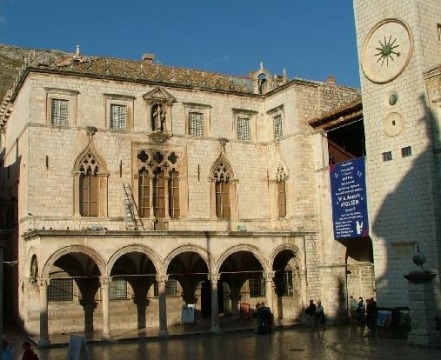
Location: Stradun street
Location: Stradun street
The Sponza Palace (Palača Sponza
in Croatian), located at the eastern end of Dubrovnik’s Stradun in
the UNESCO-listed Old Town, is a magnificent architectural gem that
encapsulates the Republic of Ragusa’s golden age (1358–1808).
Constructed between 1516 and 1522, this elegant structure blends
Gothic and Renaissance styles, serving as a testament to Dubrovnik’s
wealth, sophistication, and strategic ingenuity as a maritime power.
Originally built as a customs house and mint, it later housed the
Republic’s treasury, armory, and state archives, earning its
nickname, “Divona” (from Latin divonae, meaning customs). Today, it
functions as the State Archives of Dubrovnik, a museum, and a
cultural venue, preserving centuries of diplomatic records while
hosting exhibitions and events like the Dubrovnik Summer Festival.
With its ornate arcade, sculpted reliefs, and serene atrium, the
Sponza Palace stands as a civic jewel, offering visitors a window
into the Republic’s economic prowess and cultural resilience in a
city of 43,000 that draws millions annually.
Etymology and Pre-16th Century Site History
The palace’s name
“Sponza” derives from the Latin spongia (“sponge”), referring to a
rainwater collection cistern or “sponge-like” water-gathering spot that
existed on the site. It is also commonly called Divona, from the Italian
dogana (customs house), highlighting its primary early function.
The
location had long served commercial purposes. As early as the 13th
century (mentioned in the 1296 Statute of the Republic), a Great Customs
House (Velika carinarnica) operated here, including storages, workshops,
and the rainwater structure. Some sources note an earlier medieval
defense building on or near the site that was destroyed by fire in 1435.
The state treasury department itself dates back to 1377, though it
operated in various locations before being centralized here.
Construction and Architecture (1516–1522)
By the early 16th century,
Dubrovnik’s booming trade required a grander, more centralized facility.
Construction was decided around 1513 and took place between 1516 and
1522 (some sources cite completion in 1521). The architect and engineer
was local master Paskoje Miličević Mihov (protomagister). Stone carving,
the loggia, and sculptural details were executed by the renowned
Andrijić brothers (stonemasons from Korčula) and other local artisans. A
Renaissance relief featuring Christ’s initials, laurels, and angels is
attributed to Bertrandus Gallicus.
The palace is a rectangular
structure built around a central atrium (courtyard) with a covered
loggia (open gallery). It exemplifies a transitional Gothic-Renaissance
style:
Ground floor: Purely Gothic with pointed arches, slender
colonettes, and intricate stone tracery in the spandrels—creating a
shaded, practical trading space.
Upper floors: More Renaissance in
character, with symmetrical rectangular windows, geometric precision,
and ornate stonework.
The building uses durable pale limestone
(partly from Korčula quarries), which contributed to its earthquake
resistance. A statue of St. Blaise (Dubrovnik’s patron saint) adorns the
façade, underscoring its civic importance. The open porch (trijem) on
the ground and first floors of the courtyard allowed for efficient goods
inspection and business dealings.
One of the most famous features
is the Latin inscription carved on an arch in the atrium:
“Fallere
nostra vetant et falli pondera. Meque pondero cum merces ponderat ipse
deus.”
(Translation: “Our weights do not permit cheating and being
cheated. When I weigh the goods, God himself measures with me.”)
This
reflected the Republic’s emphasis on honest trade and official
integrity.
Functions During the Republic of Ragusa
Originally
built as the customs house and bonded warehouse, the palace was the
nerve center of Dubrovnik’s international trade. Merchants from across
Europe, the Ottoman Empire, and beyond had goods inspected, weighed,
taxed, and stored here. The atrium bustled as a trading floor and
business meeting place.
It quickly became multifunctional, housing:
The state mint (coin production).
The armoury.
The treasury and
bank (storing revenues and valuables).
Warehouses and, later, a
school (including early education for nobles and citizens, and even a
law school/printing house in some periods).
By the late 16th
century, the large hall on the first floor became the home of the
Academia dei Concordi, Dubrovnik’s first literary academy. Founded by
local poets and intellectuals, it hosted discussions on literature, art,
and scientific achievements—transforming the palace into the Republic’s
premier cultural and intellectual hub.
Survival and Resilience:
The 1667 Earthquake
One of the palace’s greatest claims to fame is
its remarkable survival of the catastrophic Great Earthquake of 1667,
which destroyed or severely damaged most of Dubrovnik, killing thousands
and triggering fires. Sponza Palace suffered minimal damage, allowing
state offices to continue operating uninterrupted. This likely helped
prevent a total collapse of the Republic’s administration. As a result,
it remains one of the best-preserved examples of pre-1667 Dubrovnik
architecture—many other palaces were later rebuilt in Baroque style.
20th and 21st Century: Archives, War, and Modern Role
After the
fall of the Republic (1797) and through the 19th–20th centuries, the
palace retained its administrative character. It has housed the
Dubrovnik State Archives (Državni arhiv u Dubrovniku) since the mid-20th
century (fully independent since 1920, moved to Sponza around 1952). The
archives are among Europe’s richest municipal collections, containing
over 7,000 manuscript volumes and approximately 100,000 individual
documents. The oldest dates to 1022, with rich holdings from the
12th–18th centuries on commerce, diplomacy, notary records, the 1272
Statute, and daily life in the Republic. They were previously kept in
the Rector’s Palace.
During the Croatian War of Independence
(Homeland War, 1991–1995), the palace was shelled in 1991–1992. The roof
and upper floors were damaged, but it was promptly restored. Bullet and
shrapnel holes were deliberately left visible as a memorial. The
ground-floor area now includes the Memorial of the Defenders of
Dubrovnik, a poignant room lined with black-and-white photographs of
those killed during the Siege of Dubrovnik.
Today, Sponza Palace
continues as a living cultural landmark. It hosts exhibitions, concerts,
and events—particularly during the Dubrovnik Summer Festival, whose
opening ceremony takes place in Luža Square with theatrical reenactments
evoking the Republic era. The atrium and halls serve as venues for
performances and public gatherings.
Historical Significance
Sponza Palace embodies the Republic of Ragusa’s democratic civic
investment: unlike private noble palaces, it was built for public
service, trade fairness, and cultural life. Its endurance through
earthquakes, wars, and centuries of change makes it a tangible link to
Dubrovnik’s 1,000+ years of history. As both an architectural gem and
guardian of the city’s documentary heritage, it remains a must-visit
site that vividly illustrates why Dubrovnik earned the nickname “Pearl
of the Adriatic.”
Sponza Palace (Palača Sponza, also known as Divona or the Customs
Palace) is a prominent 16th-century Gothic-Renaissance landmark located
in the precise geographic heart of Dubrovnik's UNESCO World
Heritage-listed Old Town (Stari Grad) in southern Croatia.
Its
coordinates are 42°38′28″N 18°06′38″E (or 42.6411°N, 18.1106°E), placing
it at an elevation of roughly 2–3 meters above sea level on the
relatively flat central spine of the historic core.
Regional and
Local Geographic Context
Dubrovnik sits on the Dalmatian coast of the
Adriatic Sea, in a Mediterranean climate zone characterized by hot, dry
summers and mild, wet winters. The city occupies a rocky limestone karst
promontory (a small peninsula-like landform) at the foot of Mount Srđ
(approximately 400 m high), which rises steeply immediately north and
west of the Old Town. The terrain is classic Dinaric karst: hard, porous
limestone with minimal soil, leading to excellent natural drainage but
also occasional sinkholes and caves. The Old Town itself is a compact,
walled enclave (roughly 1 km east-west by 500 m north-south) fully
enclosed by nearly 2 km of massive stone fortifications built between
the 12th and 17th centuries. These walls hug the irregular rocky
shoreline, with the Adriatic Sea lapping directly against the southern
and eastern edges.
The Old Town's internal topography is gently
undulating but mostly low-lying near the coast. The main east-west axis
is Stradun (or Placa), a broad, polished-limestone pedestrian boulevard
that was originally a marshy sea channel between two rocky ridges; it
was filled and paved in the medieval period, creating the city's flat
commercial spine. Sponza Palace stands at the eastern terminus of
Stradun, in Luža Square (Luža trg), a small but vital public plaza that
historically served as the civic and commercial hub.
This
location is only steps from:
The Old Port (Stara Luka) to the
southeast (via a short passage under the Bell Tower).
The Ploče Gate
(eastern city gate) leading to the outer harbor and mainland.
The
Bell Tower immediately adjacent to the north.
Orlando's Column (a
15th-century symbol of justice) in the center of the square.
The
Church of St. Blaise directly opposite.
Precise Positioning and
Micro-Geography of the Palace
The palace occupies a rectangular plot
facing directly onto Luža Square, with its open Renaissance portico and
loggias forming the square’s western and northern boundaries. The
building measures approximately 30–40 m on its long (east-west) axis and
features a spacious inner courtyard that once served practical functions
tied to its geography: rainwater collection and storage. The name
“Sponza” derives from the Latin spongia (“sponge”), referring to a
natural or engineered rainwater catchment site that existed on this spot
before or during construction—logical in a karst landscape where fresh
water was precious and the low-lying square occasionally collected
runoff from the surrounding ridges.
Because of its position just
inland from the Old Port, merchants could unload goods directly from
ships and move them a few dozen meters into the palace’s ground-floor
warehouses and customs halls. The open arcades on the ground floor (five
elegant Renaissance arches on Corinthian columns) and the first-floor
loggia allowed for ventilation, shade, and easy public access while
protecting against the strong bora winds that funnel down from Mount Srđ
in winter.
Strategic and Historical-Geographic Significance
Its placement was no accident: in the era of the independent Republic of
Ragusa (Dubrovnik), the palace functioned as the city’s customs house
(Divona), mint, treasury, and arsenal. Proximity to the protected harbor
(sheltered by the eastern walls and the breakwater) made it the nerve
center of Mediterranean trade routes connecting Venice, the Ottoman
Empire, and the Levant. The 1667 earthquake devastated much of the city,
but the palace’s robust stone construction and slightly elevated,
well-drained site allowed it to survive largely intact—another testament
to how its geography (solid limestone foundation on a stable coastal
bench) contributed to its durability.
Today the State Archives of
Dubrovnik occupy the building, preserving centuries of maritime and
diplomatic records that reflect its historic role as a trade nexus.
The Sponza Palace was the economic and intellectual nerve center of
the Republic of Ragusa, embodying its mercantile might and diplomatic
finesse. As a customs house, it processed goods fueling a GDP rivaling
larger states, taxing silk from Asia and wine from Pelješac to fund
ships and fortifications. The mint standardized currency, boosting trade
credibility, while the archives preserved treaties that kept Ragusa
neutral between East and West—a feat of “soft power” in a volatile
region. The Academy of the Learned, hosted upstairs, fostered humanism,
with poets like Ivan Gundulić shaping Dalmatian literature.
Culturally, the palace remains a living monument. Its atrium hosts
Dubrovnik Summer Festival events (July–August), from Shakespeare plays
to chamber music, drawing 80,000 attendees annually. The Memorial Room,
opened in 1995, is a poignant tribute to the 1991–1992 siege, displaying
portraits of 300 fallen defenders, a reminder of Dubrovnik’s modern
resilience. The archives, accessible to researchers by appointment,
offer a trove for studying medieval trade networks, with digitized
records launched in 2020 enhancing global access. For locals, the palace
is a point of pride, its survival through the 1667 quake and 1991 war
mirroring the city’s defiance.
Environmentally, its thick walls and
courtyard design reflect passive cooling suited to Dubrovnik’s hot
summers, a model of sustainable architecture. Current debates focus on
balancing tourism—3 million visitors strain the Stradun—with
preservation, prompting calls for capped entries to the palace’s
exhibitions.
As of September 17, 2025, the Sponza Palace is fully operational,
managed by the Dubrovnik Museums and the State Archives. Open daily 9
AM–5 PM (closed Mondays off-season), entry costs €5 (free with Dubrovnik
Card, €35, covering 9 sites). The Memorial Room and atrium are included;
archive access requires pre-booked research permits (+385 20 321 032).
Post-1990s war repairs and a 2023 facade cleaning ensure pristine
condition, with no major damage reported. Located at Luža Square, it’s a
2-minute walk from the Pile Gate (bus Lines 1A/3, €8 from airport) or 10
minutes from the cruise port. Parking at Zagrebačka Street (€2/hour) is
a 5-minute walk.
Allow 45–60 minutes to explore the portico, atrium,
and exhibitions; audio guides (€2, multilingual) or guided tours (€7, 30
minutes, book via dumus.hr) enrich the experience. Spring (April–June)
or autumn (September–October) avoids summer crowds; visit early to dodge
cruise ship surges. The palace is wheelchair-accessible on the ground
floor, though the staircase limits upper access—staff assist.
TripAdvisor reviews (4.6/5) praise its “elegant arches” and “haunting
memorial,” though some note sparse signage; the app helps. Pair with St.
Blaise’s Church or Orlando’s Column for a Luža Square trifecta, or catch
a festival concert for evening magic.