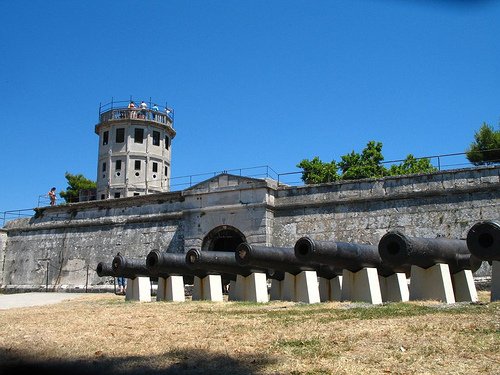
Museum of Istria
Povijesni Muzej Istre
Kastel
Tel. (052) 211 740
Open: Jun- Sep: 8am- 9pm daily
Oct- May: 9am- 5pm daily
The Castle and Historical Museum of Istria, commonly known as the Kaštel (Castle) in Pula, Croatia, is a prominent historical site that combines a 17th-century Venetian fortress with a modern museum dedicated to the region's rich heritage. Perched atop Kaštel Hill, the highest point in central Pula at approximately 34 meters above sea level, the site offers stunning panoramic views of the city, the iconic Pula Arena (Amphitheater), the harbor, and the Adriatic Sea. Officially named the Historical and Maritime Museum of Istria (Povijesni i pomorski muzej Istre, or PPMI), it serves as a specialized regional institution focused on collecting, conserving, researching, and presenting Istrian heritage from the Middle Ages to the present day. The fortress itself is a star-shaped structure with four bastions, emblematic of Venetian military architecture, and has been home to the museum since 1961. This blend of defensive history, cultural artifacts, and educational exhibits makes it a key attraction for history enthusiasts, offering insights into Istria's multifaceted past, including its maritime legacy, military conflicts, and everyday life.
Prehistoric and Roman Foundations (Pre-1st Century BC to Late
Antiquity)
The site’s history begins in prehistory. The Histri
(pre-Roman Illyrian inhabitants of Istria) constructed one of over
400 known hill-forts (gradine) here around the 1st century BC (with
evidence of even earlier Bronze Age activity, c. 1800–1000 BC, and
Neolithic presence). This was not a formal town but a defended
settlement of huts protected by dry-stone ramparts. Graves from an
associated cemetery have been found on the eastern and northeastern
slopes (along today’s Carrarina Street).
After the Roman conquest
of Istria in the Second Histro-Roman War (ending 177 BC), the Romans
likely built a military castrum (camp) on the ruins of the Histrian
hill-fort. It served as a surveillance post over the territory and
nearby sea routes. By the mid-1st century BC, this developed into
the colony Colonia Pietas Iulia Pola (Pula), with the hill
functioning as an acropolis-like military garrison. A small Roman
theater once stood at the base of the hill, and stones from Roman
structures were later reused in fortifications.
Medieval
Castrum Polae and Venetian Conquest (Middle Ages to 1331)
During
the Middle Ages, a fortress known as castrum Polae stood on the
hill. It was granted as a fief by the Istrian margraves (Patriarchs
of Aquileia) to the powerful Sergi family (allies of the
Patriarchs), who used it to control the city and earned the nickname
Castropola. Rivalries with the Iontasi family (Venetian allies)
escalated into violence, culminating in a massacre during a 1271
Good Friday procession. The Sergi held power until 1331, when Venice
seized Pula. The Venetians banished the family and demolished the
medieval fortress.
Pula then became a key transitional port for
Venetian merchant and naval ships en route to Dalmatia and the
Levant, tying its fortunes to Venice’s Adriatic dominance.
Venetian Star Fortress (1630–1633)
The current structure—a
quadrangular star fort (trace italienne style) with four bastions,
thick walls, and a central courtyard—was built between 1630 and 1633
(cornerstone laid 1630; construction 1631–1633) by the Republic of
Venice. French military engineer Antoine de Ville (1596–1656, from
Toulouse), a renowned fortification expert and author of Les
fortifications, designed and supervised it. The goal was to protect
Pula’s vital harbor and the north Adriatic maritime route amid
threats during the Thirty Years’ War era (and broader
Ottoman/Venetian conflicts). It replaced the demolished medieval
castle and was erected above the ancient Nimfeia freshwater spring.
Construction involved Venetian and local Istrian craftsmen during
one of Pula’s harshest periods (plague, famine). Stones were partly
quarried from the ruins of the large Roman theater and other local
sources. The design featured advanced artillery-resistant bastions,
making it a masterpiece of early modern military engineering.
Austro-Hungarian and 19th–20th Century Military Use
After the
fall of the Venetian Republic (1797, Treaty of Campo Formio), Pula
passed to Austria. France briefly occupied it (1805–1813), but
Austria regained control and made Pula its main naval base and
shipbuilding center in the 19th century. The fortress was reinforced
and integrated into coastal defenses; an observation tower
(sometimes described as “weird” or Austro-Hungarian) was added, and
modern guns were mounted. Pula’s population boomed tenfold.
During World War I, Austro-Hungarian dreadnoughts used Pula’s port.
Post-1918, Pula joined Italy; in World War II, it saw Nazi German
occupation (U-boat base) and Allied bombing (the fortress survived
intact). After 1947, it became part of Yugoslavia (then independent
Croatia in 1991).
Beneath the castle lie the extensive
Zerostrasse underground tunnels/shelters (Austro-Hungarian era,
expanded later), now part of the museum complex and open to visitors
since 2011.
The Museum: Founding and Evolution (1955–Present)
The site transitioned from military to cultural use after World War
II. The museum was founded on December 31, 1955, as the Museum of
the Revolution (focusing on the antifascist struggle). In 1961, it
moved into the adapted Venetian fortress and became the Historical
Museum of Istria. It is now the Historical and Maritime Museum of
Istria (PPMI), a regional public institution under Istria County.
It collects, conserves, researches, and exhibits Istrian
cultural-historical heritage from the High Middle Ages to the
present (over 100,000 objects in 18 collections: history of Pula,
medieval/modern Istria, maritime history/shipbuilding,
arms/uniforms/military equipment, old postcards/photographs, coins,
insignia, ethnography, etc.). Departments cover Pula history,
medieval/modern Istria, pedagogy/education, and more. Permanent
exhibitions include the History of Pharmacy; temporary shows and
publications cover broader themes. The museum also manages
Zerostrasse tunnels, the Herman Potočnik Noordung visitor centre
(former Austro-Hungarian water reservoir, opened 2015), and the
House of Frescoes in Draguć (since 2016).
Significance Today
The Kaštel fortress and PPMI offer panoramic views, immersive
military architecture, and a comprehensive window into Istria’s
layered past—from Histrian defenses to Roman colonization, Venetian
naval power, Austro-Hungarian imperialism, world wars, and modern
Croatian heritage. It hosts educational programs, events, concerts,
and guided tours. Opening hours vary seasonally (typically 9 AM–5 PM
or later in summer); combined tickets often include Zerostrasse.
The hill has been a fortified vantage point for over two millennia,
influencing the castle’s placement and design:
Pre-Roman (Histrian
period, ca. 1st century BC): Indigenous Histri built a hill-fort with
round dry-stone ramparts, huts, and a nearby graveyard.
Roman era
(after 177 BC): A military castrum was likely established here for
territorial control, forming the nucleus of the Roman colony Colonia
Pietas Iulia Pola.
Medieval period: A castrum Polae (fortress) stood
on the site under the control of local noble families (e.g., the
Sergi/Castropola). The Venetians demolished it after seizing Pula in
1331.
The current structure rose directly on these ruins in the
1630s, reusing the strategic high ground above the ancient Nimfeia
freshwater spring.
This palimpsest of fortifications underscores
the site’s enduring military importance for controlling the bay and
maritime routes.
Construction (1630–1633)
Venice commissioned
the fortress amid the Uskok Wars and the Thirty Years’ War to safeguard
southern Istria, the port of Pula, and Adriatic shipping lanes from
Uskok raiders, Habsburg threats, and potential Ottoman incursions.
French military engineer Antoine de Ville (also spelled Antonio De Villa
or Antoine de Ville, 1596–1656, from Toulouse) designed and supervised
the project. De Ville was a leading European fortification expert who
authored the influential treatise Les fortifications (first published
1628, with multiple reprints). Venetian and Istrian craftsmen, including
stonecutters from Rovinj and Venice plus slave oarsmen from merchant
galleys, executed the build.
Construction was rapid and monumental
for its time. Workers hauled massive stone blocks up the hill using
teams of 20 pairs of oxen. Materials included:
Spolia (reused
stone) from the nearby Roman amphitheater ruins on Monte Zaro.
Freshly quarried local limestone.
This reuse of Roman stone not
only provided durable, high-quality masonry but also symbolically linked
the new Venetian stronghold to Pula’s ancient grandeur.
Overall
Form and Style
From above, the fortress presents a distinctive
star-shaped or blossom-like plan—a hallmark of 16th–17th-century bastion
fortifications designed to eliminate blind spots and enable interlocking
fields of fire. The core is a rectangle with narrow curtain walls
(flanks or cortines) connecting four projecting pentagonal bastions at
the corners. This angular geometry allowed cannons on the bastions to
rake attackers with enfilading fire while the thick, sloped walls
deflected incoming artillery.
Key defensive elements include:
Thick, load-bearing stone walls and high ramparts.
Angular bastions
for optimal defensive coverage.
A surrounding dry moat (typical of
the era).
Elevated platforms for artillery.
Though sometimes
labeled “Baroque” due to its period and ornate naming conventions, the
architecture prioritizes functional military design over decorative
flourish—purely pragmatic yet aesthetically harmonious in its symmetry
and scale.
Detailed Layout and Named Features
The fortress
measures roughly square in its central plan (exact dimensions vary
slightly by source but emphasize compactness for defense). Its layout
centers on an open courtyard containing a well, around which the
armoury, powder magazines, and troop accommodations were originally
arranged. Four named bastions crown the corners (each designed to mount
cannons):
Southeast: Zuliano (or Canal bastion).
Northeast:
Marcello (or Priuli bastion).
Southwest: Pugliana (or Pojana
bastion).
Northwest: De Ville (named after the architect).
The
principal entrance originally sat on the south curtain wall with a
movable (draw) bridge for controlled access; it was relocated to the
west side in the early 18th century. Ramparts and bastion tops remain
walkable today, offering panoramic vistas that highlight the fortress’s
original command of the harbor and city below.
Interior and Later
Modifications
Only the curtain walls, bastions, and flanks survive
largely intact from the 17th-century Venetian phase. The interior
underwent significant transformation under later rulers:
Early
18th century: Entrance repositioned.
Austrian period (from ca. 1840
onward): Older structures were demolished to make way for new casemates
(bombproof vaulted chambers used as barracks, storage, or gun
emplacements). The fortress shifted from frontline defense to armory,
prison, and barracks use.
1861: A half-moon-shaped water cistern was
added on the outer north wall.
1876: An internal cistern completed
the water system.
These Austrian-era additions adapted the space
for prolonged garrison life while preserving the outer defensive
envelope. The result is a hybrid structure: the monumental Venetian
shell enclosing reworked, functional interiors suited to 19th-century
military needs.
Current Architectural Presentation and Museum
Integration
Today the castle functions as both a historic monument
and museum venue (since 1961, originally founded as the Museum of the
Revolution in 1955). Visitors enter through the west gate and explore:
The preserved ramparts and bastions (the star-shaped silhouette is
most evident from the walls or aerial views).
The central courtyard.
Casemate interiors now housing permanent and temporary exhibitions on
Istrian history, maritime heritage, military artifacts, and local
culture.
Panoramic terraces offering 360° views that underscore the
fortress’s original strategic purpose.
The architecture itself is
the star attraction—thick stone masonry, angular bastions, narrow
corridors, and defensive detailing vividly illustrate Venetian
engineering prowess. Combined with the underground Zerostrasse tunnels
(accessible from the site), it forms part of Pula’s broader
fortification heritage. A single ticket grants access to the fortress,
museum exhibits, and tunnels, making it one of the city’s most immersive
historical sites.
The Historical and Maritime Museum of Istria boasts an extensive
collection of over 100,000 objects, organized into 18 specialized
collections covering cultural, historical, political, military, and
ethnographic themes. Exhibits span from prehistoric artifacts to
contemporary items, with a strong emphasis on Istria's maritime
history, reflecting Pula's role as a key naval port. Key highlights
include:
Maritime Collection: Displays on shipbuilding,
navigation, fishing, and naval battles, featuring ancient naval
equipment, maritime maps, model ships, and artifacts from the
Austro-Hungarian navy, which was based in Pula. This includes items
from the oldest periods of Istrian seafaring, such as tools and
vessels from Roman and Byzantine times.
Military and Historical
Artifacts: Weapons, cannons, uniforms, and documents from various
eras, including the Venetian period, Napoleonic Wars,
Austro-Hungarian rule, and both World Wars. Special focus on Pula's
involvement in WWI and WWII, with exhibits on naval battles and the
antifascist resistance.
Archaeological and Ethnographic Items:
Inscriptions, statues, coins, pottery, and everyday objects from
Roman settlements, medieval times, and local Istrian culture.
Ethnographic displays highlight traditional life, crafts, and
folklore.
Thematic Exhibitions: Rotating shows on topics like the
antifascist struggle, local sports history (e.g., a Pula boxing
club), and broader Istrian political history. The museum also
manages off-site attractions, such as the Zerostrasse tunnels for
WWII history, the Herman Potočnik Noordung visitor center (focused
on space exploration in a restored Austro-Hungarian reservoir,
opened in 2015), and the House of Frescoes in Draguć (featuring
medieval wall paintings, managed since 2016).
The Department
of Pedagogy and Education, established in 2009, offers workshops,
lectures, and programs for all ages, collaborating with schools and
cultural organizations. A specialized library supports research,
though it's primarily for staff with limited public access.
Visiting the Kaštel and museum provides an immersive experience,
combining exploration of the fortress's moody, atmospheric interiors
with educational displays and breathtaking views. Allocate 2-3 hours for
a thorough visit, ideally in spring or autumn to avoid summer crowds and
heat. Guided tours are recommended for deeper insights into the site's
history.
Hours: Open year-round; 9 AM–5 PM (October–April) and 9
AM–9 PM (May–September).
Admission: Adults €6.00, children (5-16) and
seniors (65+) €3.00, groups (10+) €5.00 per person; free for children
under 5 and persons with disabilities. Cash and cards accepted.
Access: Reachable by a short uphill walk from central Pula via
Castrepola Street. Paid street parking is available, but limited spots
exist on the hill. Public buses serve the area, though routes may
vary—check locally.
Amenities: A gift shop sells books, postcards,
replicas (e.g., ship models, coins), apparel, and local crafts. No
on-site cafe, but nearby options in Pula abound.
Overall, the
Castle and Historical Museum of Istria encapsulates Pula's enduring
legacy as a crossroads of empires, making it an essential stop for
understanding the cultural tapestry of the Istrian peninsula.