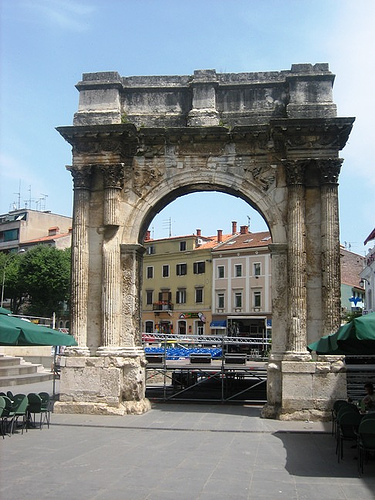
Location: Ulica Sergijevaca
Constructed: 27 BC
The arch of the Sergii (often called The Golden Gate),
an ancient Roman arch in Pula, Croatia. It was erected in memory of
three members of the Sergius family, especially Lucius Sergius Lepidus,
a Tribune who served in the Roman Legion, which took part in the Battle
of Actium, so it is assumed that the arch was built between 29. and 27.
years BC The Sergii were a powerful family in the colony, and retained
their power for centuries.
In the monument is carved the name of
salvia Postuma, who paid for the construction (de sua pecunia), and as
she was married to the family of Sergius, erected it in honor of
probably her husband, Lucia Sergius Lepidus, his father Lucia Sergius
and uncle Gnaeus Sergius. It is decorated in the late Hellenistic style,
with oriental influences. The bas-relief on the arch depicts a
horse-drawn war chariot.
The Arc de Triomphe attracted the
attention of many artists, including Michelangelo's pupil Bastiano De
Sangallo, who immortalized it with a drawing. It probably served as an
antique role model for one of his masterpieces. The drawing is today
kept in the wicar Museum of the French city of Lille.
Historical Context and the Sergii Family
Pula was a strategically
important Roman colony on the Adriatic coast of Istria, refounded or
reinforced after Octavian’s (later Augustus) decisive victory at the
Battle of Actium in 31 BC. Many veterans from the civil wars were
settled there, and the colony became known as Colonia Pietas Iulia Pola
(with additional titles like Pollentia Herculanea in later periods). The
Sergii were a prominent local patrician family that held high civic and
military offices for centuries, exemplifying the integration of Italian
elites into provincial administration.
The arch specifically honors
three male members of this family who had died by the time of its
construction:
Lucius Sergius Lepidus (son of Lucius): aedile
(local magistrate), duumvir (one of the two chief magistrates of the
colony), and military tribune (tribunus militum) of Legio XXIX, which
fought for Octavian at Actium. The legion was disbanded in 27 BC,
providing a firm terminus ante quem for the monument.
Lucius Sergius
(father of Lepidus, son of Gaius): aedile and duumvir.
Gnaeus Sergius
(uncle of Lepidus, son of Gaius): aedile, duumvir, and quinquennalis (a
higher-ranking duumvir with censorial powers).
Commission and
Purpose
The arch was commissioned and entirely funded privately by
Salvia Postuma Sergia (wife of Lucius Sergius Lepidus and from the
Salvia gens), as proudly proclaimed in the inscription. This was a rare
public display of female wealth and agency in the early Roman Empire. It
served dual purposes:
A private family monument honoring deceased
relatives (with subtle funerary symbolism in its motifs).
A public
statement of loyalty to the victorious Octavian/Augustan regime and the
prestige of the Sergii in the new colony.
It was not a
traditional tomb (the men were likely buried elsewhere) but an honorary
structure blending triumphal and commemorative elements, typical of the
transitional period from Republic to Empire.
Inscription
The main
dedication is carved across the frieze/architrave in large Latin letters
(still clearly legible today). The full text reads:
L(ucius) Sergius
C(ai) f(ilius) / aed(ilis) IIvir // Salvia Postuma Sergi // L(ucius)
Sergius L(uci) f(ilius) / Lepidus aed(ilis) / tr(ibunus) mil(itum)
leg(ionis) XXIX // Cn(aeus) Sergius C(ai) f(ilius) / aed(ilis) IIvir
quinq(uennalis) // Salvia Postuma Sergi de sua pecunia
Translation:
“Lucius Sergius, son of Gaius, aedile, duumvir // Salvia
Postuma [of the] Sergii // Lucius Sergius Lepidus, son of Lucius,
aedile, military tribune of the 29th Legion // Gnaeus Sergius, son of
Gaius, aedile, quinquennal duumvir // Salvia Postuma [of the] Sergii
[built this] from her own money.”
A shorter, highly visible version
on the frieze simply states “Salvia Postuma Sergi de sua pecunia,”
emphasizing her personal expenditure.
Later History and Survival
19th century: During urban modernization under Austrian rule (Pula was
part of the Austro-Hungarian Empire), the city walls and the Porta Aurea
were largely demolished around 1829–1830 to open up the town. The arch
survived as a standalone monument in what is now Portarata Square (at
the entrance to the pedestrian old town).
World War II: It sustained
damage but was repaired and stabilized postwar.
Today: It remains
exceptionally well preserved, free to visit 24/7, and is a focal point
of Pula’s Roman heritage alongside the Arena (amphitheater), Temple of
Augustus, and other sites. It is illuminated at night and surrounded by
cafés and shops, yet still evokes its ancient grandeur.
The Arch
of the Sergii is not only a family memorial but a microcosm of the
political, social, and artistic transformations of the Augustan
age—private wealth funding public propaganda in a newly pacified
province. Artists like Michelangelo and Piranesi later drew it, and it
continues to draw visitors as one of the most intact small Roman arches
on the Adriatic.
Overall Design and Structure
The arch is a single-bay
(single-fornix) triumphal arch, originally integrated into the inner
(western) facade of the city’s main gate in the Roman walls, known
as the Porta Aurea (Golden Gate). It was not a freestanding
structure like later imperial arches but was attached to the gate,
which explains why only the town-facing western side received full
sculptural decoration—the eastern (outer) side remained largely
plain and uncarved. The gate and walls were largely demolished in
the 19th century (around 1829), leaving the arch as a standalone
monument in what is now Portarata Square.
Height:
Approximately 8 meters (some sources note ~8–8.3 m).
Materials:
Constructed primarily from local Istrian limestone—a fine-grained,
durable stone quarried nearby that gives the monument its uniform,
pale appearance and excellent preservation.
Engineering: It
employs a true semi-circular barrel-vaulted passageway formed by
precisely cut voussoirs converging on a prominent central keystone.
This demonstrates Roman mastery of load distribution and stability.
The pylons (side supports) are solid and rise from sturdy bases,
supporting a full entablature and attic story.
The design is
compact and elegant rather than monumental in scale, condensing an
extraordinary amount of artistic detail and symbolic iconography
into a relatively small footprint. This “condensed artistry” is
characteristic of private family monuments of the Augustan era.
Architectural Order and Columns
The arch follows the
Corinthian order, the most ornate of the classical orders, which was
especially popular in the late Hellenistic and early Imperial
periods for its decorative richness.
Columns/Pilasters:
Flanking the central archway are paired or engaged (three-quarter)
fluted Corinthian columns (or pilasters with attached columns)
rising from sturdy bases. These are slender and elegant, emphasizing
verticality and refinement. The capitals are richly carved with
acanthus leaves in the classic Corinthian style.
Pilaster
Decoration (western facade): The outer faces of the pilasters
feature acanthus clusters and scrolling tendrils. The inner faces
(facing the passageway) show vine tendrils emerging from acanthus,
with lively naturalistic details such as mating birds and a bird
pecking at grapes (especially on the northern pylon). These motifs
add organic movement and symbolic fertility/victory themes.
Archway, Vault, and Spandrels
Spandrels (the triangular spaces
above the arch curve and below the entablature): Filled with
sculpted winged Victories (Victorias) floating and carrying wreaths
or tropaea (trophies). These are classic Roman triumphal symbols
representing military success and divine favor.
Intrados (soffit
/ inner vault surface): The barrel vault is richly coffered in a
diagonal pattern with rosettes and palmettes in the coffers. The
triangular spaces along the edges contain a menagerie of fantastic
creatures drawn from Hellenistic repertoire: sphinxes, eagle-headed
griffins (with lion or sea-monster bodies), cetus (sea monsters),
hippocampi (with horse or hippopotamus heads), a dog, and a panther.
At the center is a striking coffer showing an eagle seizing a
snake—a powerful symbol of heroic apotheosis and victory over chaos.
The design is framed by additional triangles with dolphins. This
coffering creates dramatic light-and-shadow effects while evoking
the celestial and triumphal sphere.
Friezes, Entablature, and
Reliefs
The western facade is covered in finely carved low-relief
sculpture:
Main frieze (above the architrave, centered on the
inscription): Features antithetical light chariots (bigae) drawn by
two horses with charioteers, interpreted by some as the celestial
goddesses Aurora (dawn) and Luna (moon) brandishing cloaks. This may
symbolize the eternal cycle of victory or the family’s divine favor.
Side panels of the pylons: Reliefs of accumulated weaponry (trophies
of war).
Smaller friezes flanking the main inscription: Erotes
(cupids) carrying festoons (garlands) and bucrania (ox skulls with
fabric tied around the horns), interspersed with rosettes. Bucrania
are traditional sacrificial symbols linked to piety and victory
rituals.
Prominent low relief on the main frieze (visible from
the town side): A war chariot drawn by horses in a triumphal
procession scene, reinforcing the military honors of the Sergii
family.
Above the entablature sits an attic story with three
pedestals (and additional inscriptions) that originally supported
statues of the honorees: Lucius Sergius Lepidus in the center,
flanked by his father Lucius Sergius and uncle Gnaeus Sergius. These
statues are now lost, but the pedestals and inscriptions remain.
Inscriptions and Dedication
The Latin inscriptions are
integral to the architecture and propaganda:
The main frieze
inscription records that Salvia Postuma Sergia funded the entire
monument “de sua pecunia” (with her own money) in honor of her
husband, son, and brother-in-law.
Four additional inscriptions on
the attic pedestals name the family members and their titles
(aedile, duumvir, military tribune of the 29th legion, participant
in the Battle of Actium).
Style, Influences, and Symbolism
The decoration is executed in the late Hellenistic style with strong
Asia Minor (eastern Mediterranean) influences—visible in the fluid,
organic scrollwork, fantastic creatures, and narrative reliefs. This
reflects the cultural exchanges of the Augustan period, when artists
and motifs from Greece and Asia Minor were imported to Roman
provinces. The overall effect is one of refined elegance, dense
symbolism (triumphal, heroic, funerary, and apotheotic), and private
family prestige rather than overt imperial propaganda.