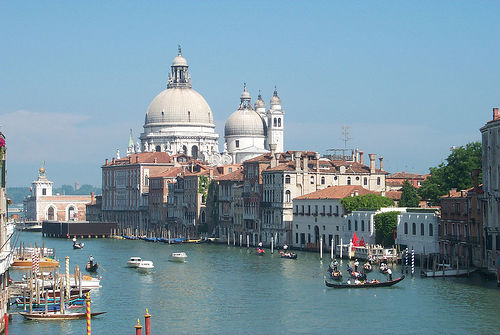
Location: Veneto
Venice (Italian: Venezia) is the capital of the
Veneto region. As a trading city and capital of a colonial empire in
the eastern Mediterranean, Venice was one of the richest cities in
the world in the Middle Ages and still has a rare concentration of
cultural treasures today. The part of the city located in the lagoon
has preserved its uniqueness, where to this day traffic flows only
on foot or by boat.
The islands of the lagoon were settled as
early as the 5th century. According to legend, mainlanders fleeing
from the Huns founded settlements on the lagoon islands.
In
the Middle Ages, Venice became the most powerful maritime republic
thanks to the wealth acquired through a monopoly on the trade of
various goods from Asia and the Orient. Through numerous conquests
in the Adriatic and Aegean areas, Venice became the most important
military power in the eastern Mediterranean. With the European
discovery of America and the sea route to India at the end of the
15th century, Venice's importance as a trading power gradually began
to wane. In the 17th century, Venice gradually lost all conquered
areas in the Aegean to the Ottoman Empire. The conquest by Napoleon
in 1797 finally ended Venice's independence. From 1815 Venice
belonged to Austria-Hungary until 1866 when it became part of the
newly founded state of Italy.
Today the historic center still
has about 55,000 inhabitants and the trend is decreasing. Since the
middle of the 20th century, the population has shifted sharply from
the historical center and the islands to the mainland: while in 1951
55% of the inhabitants still lived in the historical centre, 14% on
the offshore islands and 21% in the mainland districts In 2006 only
23% in the historic center, 11% on the offshore islands and two
thirds on the mainland. Since the 1970s, however, the total
population of Venice (including the mainland districts) has also
been declining: from 363,000 in 1971 to 261,000 in 2017.
Economically, Venice is dependent on tourism, but with 30 million
tourists a year, the city is increasingly reaching its limits.
Especially in the warmer months, congested roads, overcrowded boats
and gigantic amounts of rubbish bring Venice to its breaking point.
That is why there have been demands for years to limit mass tourism.
An entrance fee for St. Mark's Square and a ban on cruise ships are
being discussed. At least the largest ships are to be diverted in
the future (from 2019) to reduce the environmental impact.
In
addition to the "island city", other mainland towns also belong to
the municipality of Venice (Tessera, Mestre, Marghera, Campalto,
Trivignano and others). They are more industrial or have the
character of "dormitory towns" and therefore have little to offer to
tourists. Venice is also the capital of the province of Venice and
the Veneto region.
How to orient yourself
In several points of the city there are indications written in black on a yellow background which indicate the direction to follow to reach the most important places. If in doubt, it is advisable to follow the direction shown by these indications.
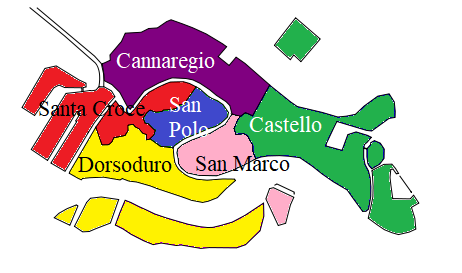
Venice (Venezia) is famously divided into six historic districts,
known as sestieri. These neighborhoods each possess their own unique
character, atmosphere, and attractions, making exploration on foot one
of the best ways to experience the city.
Here is a complete list of
Venice’s six sestieri:
Cannaregio — The
northernmost district, home to the historic Jewish Ghetto (one of the
oldest in the world, established in 1516), quiet residential canals, and
authentic local restaurants. It offers a more relaxed vibe away from the
main tourist crowds.
Castello — The largest sestiere, stretching along the eastern edge
of the city. It features the impressive Arsenale (the historic shipyard
of the Venetian Republic), the Giardini Pubblici (site of the Biennale),
and charming working-class areas with fewer tourists.
Dorsoduro — Located in the southern part of
Venice, this artistic and intellectual district is popular with students
and art lovers. Highlights include the Accademia Gallery, Peggy
Guggenheim Collection, vibrant Campo Santa Margherita, and scenic views
across the Giudecca Canal.
San
Marco — The bustling heart of Venice and the main tourist hub.
Centered around the iconic Piazza San Marco (St. Mark’s Square), it is
home to St. Mark’s Basilica, the Doge’s Palace, the Campanile, and
luxury shopping along the Mercerie.
San Polo
— A lively central district famous for the Rialto Bridge and the
colorful Rialto Market (one of the oldest markets in Europe). Narrow
streets, excellent wine bars (bacari), and historic churches make it a
favorite for foodies.
Santa Croce/ Holy Cross
— Situated in the western part of the city, it includes the main train
station (Santa Lucia) and the Piazzale Roma bus terminal. It features a
mix of historic palaces, the charming Campo San Giacomo dell’Orio, and
more everyday Venetian life.
Popular Areas and Highlights
San Marco square (Piazza San Marco):
The symbolic center of Venice and one of the most famous squares in the
world. Surrounded by elegant arcades, historic cafés (like Florian and
Quadri), and breathtaking architecture, it is the perfect starting point
for any visit.
Ghetto di Venezia: Located
in Cannaregio, this was the world’s first Jewish ghetto. Today it
remains an important cultural and historical site with synagogues,
museums, and a peaceful atmosphere that tells the story of Venice’s
Jewish community.
Islands in the Venetian Lagoon
Beyond the
historic center, the Venetian Lagoon contains numerous islands and
settlements, each with its own distinct identity. These are covered in
greater detail in the dedicated article on the Venice Lagoon, but some
of the most notable include Murano (glassmaking), Burano (colorful
houses and lace), Torcello (ancient history), and the Lido (beaches and
film festival).
Poveglia Island,
often called one of the most haunted places in Italy, lies in the
southern lagoon. Historically used as a quarantine station, a plague
burial ground, and later a mental hospital, it is currently closed to
the public but remains a fascinating (if eerie) part of lagoon lore.
The monuments of the municipality of Venice are found almost entirely
in the historic center and on the islands of the lagoon.
The most
famous place in the city is Piazza San Marco, the only one in the
historic center to be characterized by the toponym "piazza": the other
squares are in fact called "campi" or "campielli". The Basilica of San
Marco is located in the center of the square, colored with gold and
covered with mosaics that tell the story of Venice, together with the
bas-reliefs that depict the months of the year. Above the main door, the
four bronze horses from the imperial palace of Constantinople,
which were transported to Venice following the fourth crusade of 1204 on
the orders of doge Dandolo (commander of the crusade). The Greek cross
plan is dominated by five large domes. The factory is the third basilica
dedicated to San Marco that stands in this place: the first two were
destroyed. This version was inspired by the church of the Holy Apostles
of Constantinople (destroyed by the Muslims a few years after the
conquest of 1453), of which it is a sort of small-scale replica. The
interior is covered with gold background mosaics depicting biblical and
allegorical passages. Initially, it was the chapel of the Doges of the
Republic of Venice.
The Palazzo Ducale stands next to the
Basilica: to unite them, the Porta della Carta, the work of Bartolomeo
Bono, which is the exit of the Palazzo Ducale museum. The main entrance
is on the side facing the lagoon. Seat of the government of the
Serenissima, it was built in the 15th century with Istrian marble. Here
stood a castle, then set on fire to let out Pietro IV Candiano who had
found refuge there during a revolt. Now the Palazzo is a museum, with
works by the best Venetian artists: the Sansoviniana Library, which is
located inside, hosts temporary exhibitions. Worth seeing are the Sala
del Maggior Consiglio, which for centuries was the largest seat of
government in the world, the Bridge of Sighs, the prisons and the
Piombi.
Opposite the Palazzo Ducale stands the bell tower of San
Marco: built in 1173 as a lighthouse for sailors, it was restored by
Bartolomeo Bon in the 15th century. It collapsed on July 14, 1902 and
was entirely rebuilt. The loggia in red Verona marble is a work by
Jacopo Sansovino, and on it there are bas-reliefs depicting allegories
with the exploits of the Republic of Leone.
Other important
Venetian monuments are the Arsenale, the basilica of Santa Maria della
Salute, the basilica of Santa Maria gloriosa dei Frari, the synagogues
of the Ghetto.
Venice is also famous for its historic cafés.
Imported from the Ottoman Empire around 1615, from 1683 coffeehouses
sprang up throughout the city. On 29 December 1720 the famous Caffè
Florian was opened, still active in Piazza San Marco, under the
Procuratie Nuove, in 1775 it was the turn instead of the equally famous
Caffè Quadri.
The sought-after Peggy Guggenheim museum is also
located in Venice, where there are great works by artists including
Ernst, Modigliani, Picasso, Mirò, Pollock and Kandinsky. Important
tourist destinations in the lagoon are the islands of Murano, Burano and
Torcello. The island of Lido is instead a renowned seaside resort, as
well as home to the famous Venice Film Festival.
There are countless noteworthy churches that can be found in the
lagoon city, both for their architectural merits and for the artistic
treasures contained therein. Among the most important are the octagonal
Basilica of Santa Maria della Salute, with its imposing dome that stands
out at the inlet of the Grand Canal and the famous and majestic Basilica
of San Marco, the city's cathedral and seat of the Patriarch and
Patriarchate of Venice, located in the homonymous square, next to the
Doge's Palace.
Among the other important religious buildings,
there are: the basilica of Santa Maria Gloriosa dei Frari, the church of
Santa Maria dei Miracoli, the church of San Francesco della Vigna, the
church of San Zaccaria, the basilica of Santi Giovanni e Paolo, the
church of the Redeemer, the latter built on the island of Giudecca to a
design by Andrea Palladio, and the basilica of San Pietro di Castello
which includes two chapels by Veronese, as well as having been the
primitive cathedral of the city until 1807.
Venice is full of stately buildings, overlooking campi, calli, canals
and canals, ancient residences of the richest Venetian families of the
city's golden age.
Apart from the schools and institutional
buildings such as Palazzo Ducale, almost all the palaces are identified
with the name of the family who founded them or who left their mark on
them the most. Among the most famous are Palazzo Fortuny, in Gothic
style donated to the city of Venice by the widow of the Spanish artist
Mariano Fortuny, Palazzo Grassi, the work of Giorgio Massari, Palazzo
Mocenigo with its Renaissance-style facade, Palazzo Grimani, state-owned
and seat of the Court of appeal and Palazzo Loredan in gothic style.
Often two or more families are mentioned in the name such as Palazzo
Cavalli-Franchetti, or Palazzo Gritti-Badoer, or the branch of the
family is specified (eg Palazzo Morosini del Pestrin).
Many
private residences, on the other hand, maintain the traditional Ca'
denomination, which indicated the name of the lineage and the building:
for example Ca' Foscari, seat of the city university of the same name,
Ca' Corner, designed in the 16th century by Jacopo Sansovino, Ca'
Rezzonico , in the Dorsoduro district and designed by Longhena, Palazzo
Balbi, seat of the President and the Regional Council of the Veneto
Region, Ca' Pesaro, Ca' Tron, Ca' Vendramin Calergi and Ca' Dario, sadly
known for the tragic fate of some of its owners.
The use of the
Italian Casa (eg Casa Venier) is more recent. Some small buildings are
often referred to as Palazzetto (e.g. Palazzetto Stern).
In
Venice, given its ancient commercial vocation, there are also
warehouses, ancient buildings of medieval origin used as a warehouse and
shelter for foreign merchants. Along the Grand Canal you can see the
fondaco dei Tedeschi, the fondaco dei Turchi and the fondaco del Megio.
Due to its conformation, Venice has 435 public and private bridges
that connect the 118 islands on which it is built, crossing 176 canals.
Most of them are built in stone, other common materials are wood and
iron. The longest is the Ponte della Libertà which crosses the Venetian
lagoon, connecting the city with the mainland and thus allowing
vehicular traffic. The project dates back to 1931, by the engineer
Eugenio Miozzi, while its inauguration took place in 1933, with the name
of Ponte Littorio.
The main canal that cuts through the city, the
Grand Canal, is crossed by four bridges: the Rialto bridge is the oldest
(built around the 16th century); the Accademia bridge; the Scalzi
bridge, the latter built under the Habsburg domination and rebuilt in
the 20th century, and finally the Constitution bridge, erected in 2008
on a project by the architect Santiago Calatrava.
Another symbol
of the city is the Rialto bridge: the work of Antonio Da Ponte, it was
built in 1591. It was the only way to cross the Grand Canal on foot: in
fact, it remained the only bridge until 1854, when the bridge was built
dell'Accademia (to which the Scalzi bridge and the Constitution bridge
were later added). On the sides of the central body there are luxury
shops while, at the end of the bridge, in the San Polo district, there
are the fruit and vegetable market, the covered building of the fish
market and the church of San Giacomo di Rialto.
Furthermore, one
of the most famous bridges in Venice is the Bridge of Sighs. Built in
Istrian stone in the 17th century to a design by the architect Antonio
Contin, it connects the Palazzo Ducale with the New Prisons.
Venice during the era of the Serenissima Republic was a vibrant hub
of theatrical culture, boasting a remarkable number of theaters
dedicated to musical operas, dramatic plays, and lively comedies. These
venues were deeply woven into the social and cultural fabric of the
city, reflecting the Republic’s wealth, artistic patronage, and love for
spectacle. Many performances took place in elegant patrician palaces
owned by noble Venetian families, while others occupied purpose-built or
adapted structures of exceptional architectural beauty that still
enchant visitors today.
One notable example is the Teatro at Palazzo
Grassi, housed in a magnificent 18th-century palace on the Grand Canal.
Originally used for theatrical events, it was beautifully renovated in
2013 by the Pinault Collection and now serves primarily as a
contemporary art exhibition space, though it occasionally hosts cultural
events that echo its theatrical past.
Among the most prestigious
historic theaters are:
Teatro La Fenice (Phoenix Theater):
Inaugurated in 1792, this is one of the world’s most famous opera
houses. Its name reflects its history of rising from the ashes after
devastating fires (notably in 1836 and 1996). The sumptuous interior,
with its glittering gilt boxes, rich red velvet, and neoclassical
design, remains a pinnacle of Venetian elegance. It continues to host
world-class opera, ballet, and symphonic concerts.
Teatro Goldoni:
Originally opened in 1622 (one of the oldest theaters in Venice), it was
dedicated to the great Venetian playwright Carlo Goldoni, whose witty
comedies of manners still define Italian theater. The venue underwent
major renovations in the 1970s while preserving its historic charm.
Today it presents a varied program of prose theater, classical and
contemporary plays, making it a key destination for lovers of dramatic
arts.
Teatro Malibran: Dating back to 1678, this intimate theater is
named after the legendary 19th-century soprano Maria Malibran. It
occupies a historic building with excellent acoustics and has hosted
legendary performances over the centuries. It often complements La
Fenice by presenting smaller-scale operas, chamber music, and recitals.
The largest library in the city, and one of the largest in Italy, is
the Marciana National Library. It is located in Piazza San Marco,
has about 1,000,000 volumes, specializes in classical philology and
history of Venice, has one of the most valuable collections of
Greek, Latin and Oriental manuscripts in the world. The building
that houses it is the work of the architect Jacopo Sansovino. The
Marciana was officially established in 1560, although already in the
fourteenth century Francesco Petrarca had the idea of creating a
public library in this city. After the fall of the Republic, with
the transformation of the Procuratie Nuove into Palazzo Reale, the
library was moved to Palazzo Ducale, but after the First World War,
due to the limited spaces and the growth of the literary heritage,
the library found a new location in the Palazzo della Zecca.
The State Archive of Venice is located in the former Frari convent
which, with its 70 km of shelves, houses the documentation produced
over a thousand years by the Republic of Venice, from its birth to
the 20th century. Its patrimony consists of a very rich collection
of parchments, papers and drawings, preserved in the hundreds of
rooms (the ancient monks' cells) located around the cloisters, which
testify not only the history of the Serenissima, but also of the
whole world that entertained diplomatic and trade relations with it.
Established in 1815, since 1866 the archives produced by the offices
of the Italian State located in Venice have also flowed into it.
The library of the Querini Stampalia Foundation, in Campo Santa
Maria Formosa with headquarters in Palazzo Querini Stampalia,
collects mainly scientific and naturalistic material, fulfilling the
role of civic library of the city thanks to the availability of
around 350,000 volumes. The library was commissioned in 1868 by N.H.
Giovanni Querini Stampalia, who died the following year without
direct heirs. It underwent an important restoration by the architect
Carlo Scarpa between 1959 and 1963 and more recently by Mario Botta.
The Giorgio Cini Foundation manages a library on the island of
San Giorgio Maggiore, in the rooms of the former Benedictine
monastery, recently restored by Michele De Lucchi, which deals with
the history of Venice, literature, music, theater and melodrama, but
above all specializes in art history, to which a core of over
150,000 volumes and about 800 periodicals are dedicated, 200 of
which are current.
Important specialized collections are also
those of the university libraries of Ca' Foscari (over 830,000
volumes), of the IUAV (about 170,000 volumes), of the Academy of
Fine Arts (about 16,000 inventoried volumes) and of the Benedetto
Marcello Conservatory (over 50 000 volumes). Other libraries with a
significant number of works are: the Monumental Library of the
Patriarchal Seminary of Venice (163,000 volumes and other important
works of art), and the Library of the Cavanis Institute (60,000
volumes).
The Venetian Jewish community manages the "Renato
Maestro" library-archive, located in the Ghetto. Officially
established in 1981, it now offers around 12,000 titles and a
"Catalogue of ancient Jewish books" which includes 2,500 volumes
dating back to the 16th-19th centuries.
On the island of San
Lazzaro degli Armeni, the library is considered the most significant
collection of Armenian manuscripts preserved in the West. Founded in
1740, it has 170,000 volumes of which 4,500 are manuscripts.
Some civic museums also manage dedicated specialist libraries: that
of the Correr Museum (135,000 modern volumes, over 8,000 ancient and
more than 12,000 manuscripts), Ca' Pesaro (over 25,000 volumes), the
Centro Studi di Storia del Tessuto and of the Costume of Palazzo
Mocenigo (over 25,000 volumes and about 13,000 fashion sketches),
and of Casa Goldoni Theater Studies (over 30,000 volumes).
As
far as civic libraries are concerned, the "Venice Library Network"
brings together 23 public and specialist libraries, seven of which
are located in the historic centre, four on the islands and twelve
on the mainland. Since 1980, the Civic Library of Mestre VEZ has
been designated as the central library, opened to the public in 1953
and moved to Villa Erizzo since 2013, which has about 100,000
volumes and 60 periodicals in a total area of 2015 m² .
Venice boasts a rich educational heritage, with numerous secondary
schools that reflect the city's layered history—from Napoleonic
reforms to religious foundations and modern institutions. Among the
most notable historical establishments is the prestigious Liceo
Classico Marco Foscarini, the oldest secondary school in Venice and
one of the oldest in Italy. It was founded in 1807 by decree of
Eugène de Beauharnais (Eugenio di Beauharnais), who served as
Viceroy of the Napoleonic Kingdom of Italy. Originally housed in the
former convent of Santa Caterina and known as the Ginnasio Liceale
di Santa Caterina, it was later renamed in honor of Marco Foscarini,
the 117th Doge of Venice and a renowned scholar of Venetian
literature.
The school offers a classical curriculum with a
strong emphasis on humanities, European education programs, and has
grown to include multiple courses. Its historic buildings and long
tradition make it a point of pride for the city, with alumni
including notable figures in literature, academia, and public life.
Another significant institution is the Istituto d'Istruzione
Superiore Marco Polo, established in 1812. Located in the Dorsoduro
district, it combines classical, musical, and artistic high school
programs, providing a well-rounded education that aligns with
Venice’s artistic and cultural legacy.
On the mainland, in the
vibrant district of Mestre, stands the Liceo Classico Raimondo
Franchetti (part of the IIS Giordano Bruno – Raimondo Franchetti).
This classical high school has educated generations of students and
maintains a strong academic reputation, with facilities including
libraries and spaces for cultural events. It is named after Baron
Raimondo Franchetti, from a prominent Italian family known for
exploration and contributions to society.
Dating back even
earlier is the Istituto Cavanis, founded in 1804 by the Venetian
brothers Marco and Antonio Cavanis. This religious institute, part
of the Congregation of the Schools of Charity (Congregazione delle
Scuole di Carità), focuses on holistic education rooted in Christian
values. It offers both classical and scientific high school tracks
and continues to operate in Dorsoduro, near landmarks like the
Accademia Gallery. The founders dedicated their lives to educating
youth, especially the less privileged, and the institution later
included features like a meteorological observatory.
In contrast,
the Istituto Benedetti-Tommaseo represents a larger, more
contemporary educational center. It provides modern facilities and a
broad range of programs (including scientific studies), serving as a
key hub for secondary education in Venice proper, particularly in
the Castello area.
A standout addition to Venice’s educational
landscape is the prestigious Scuola Navale Militare “Francesco
Morosini” (Naval Military School). Situated on the island of
Sant’Elena, it continues the tradition of the ancient colleges for
young nobles. The current institution traces its roots to a naval
boarding school established in 1937; it was re-founded in 1961 and
granted full military status in the late 1990s. The school combines
rigorous academic secondary education with naval and military
training, preparing students for careers in the Italian Navy and
beyond. Its scenic location overlooking the lagoon offers a unique
backdrop for discipline, leadership, and maritime studies.
Venice is an important Italian university seat, in fact it has more
than one university. The most famous is the Ca' Foscari University,
which offers degree courses in economics and commerce, foreign
languages and literature, literature and philosophy, and natural
sciences. Founded in 1868 as the first Business School in Italy and
second in Europe, after that of Antwerp, it has its main office at
Ca' Foscari, a Gothic palace overlooking the Grand Canal.
For
the studies of architecture, fashion, design and urban planning,
there is the IUAV University, established in 1926, as the second
architecture school in Italy, after that of Rome, on the initiative
of Giovanni Bordiga, then president of the Academy of Fine Arts from
Venice.
The Academy of Fine Arts was founded on 24 September
1750 by the will of the Venetian Senate as the "Venetian academy of
painting, sculpture and architecture", with Gianbattista Piazzetta
as its first president. Among the artists who taught there are:
Tiepolo, Hayez, Ettore Tito, Alberto Viani, Carlo Scarpa and Emilio
Vedova. The main seat of the university is housed in the former
Ospedale degli Incurabili, at the fondamenta delle Zattere.
Also in Venice, the Benedetto Marcello Conservatory has been present
since 1876, housed in Palazzo Pisani.
In 1995 the Venice
International University was founded, an international training and
research consortium in which the Ca' Foscari University, the IUAV,
the Ludwig Maximilian University of Munich and the Autonomous
University of Barcelona participate, among others. The seat of the
institution is located on the island of San Servolo, in a building
that once housed a monastery.
Venice is also the only Italian
city to host a Faculty of Canon Law, the "San Pio X", erected by the
Congregation for Catholic Education in 2008 within the Studium
Generale Marcianum. Commissioned by the then Cardinal Patriarch
Angelo Scola, the faculty is housed in the restored palace of the
patriarchal Seminary, adjacent to the Basilica della Salute. Also
part of the academic pedagogical center of the Studium Generale
Marcianum is the Higher Institute of Religious Sciences "San Lorenzo
Giustiniani", erected in 2006, and part of the Theological Faculty
of Triveneto.
Mestre is home to the Nursing degree course of
the University of Padua, the IUAV Building Science Laboratory and
the Ca' Foscari Scientific Campus.
Mindful of the long
Venetian maritime tradition, in 1999 the Navy chose the headquarters
of the Venice Arsenal as the seat of the Institute of Maritime
Military Studies for the higher education of its officers.
Inside the monastery of San Nicolò al Lido there is the headquarters
of the European Master in Human Rights.
The Veneto Institute of Sciences, Letters and Arts is an Italian
academy. The Institute's purpose "is to increase, disseminate and
protect science, literature and the arts". For this purpose, in
addition to ordinary academic activity, it periodically promotes
scientific and humanistic events, study meetings, conventions,
seminars, international specialization schools and the organization
of art exhibitions.
The Ateneo Veneto is an institution whose
purpose is to collaborate in the dissemination of science,
literature, the arts and culture, in all their manifestations. The
activities promoted by the Ateneo Veneto involve: history, history
of art and goldsmithing, music, medicine, cinema, theatre,
economics, architecture and literature, involving all categories of
knowledge. They take place on days dedicated to various activities
throughout the year. All the activities promoted by the institute
are free to enter and free of charge.
The Giorgio Cini Foundation
is a non-profit organization established by Count Vittorio Cini. The
aim is to promote the restoration of the monumental complex on the
island of San Giorgio Maggiore and to encourage the development of
educational, social, cultural and artistic institutions in the area,
in collaboration with existing ones. In addition to its research
activities, exhibitions and conferences, shows and concerts, the
Foundation hosts congresses and conferences of scientific and
cultural organizations and hosts initiatives of absolute importance
in the field of international relations.
The Venice Biennale is a
cultural society born in 1895 with the organization of the first
Biennial Art Exhibition in the world in order to stimulate artistic
activity and the art market in the city of Venice. It aims to
promote new artistic trends and organizes international events in
the contemporary arts.
The regatta of the befanas. January 6th.
Epiphany in Sant'Erasmo
(Sant'Erasmo). January 6th. At 05:00 a "berolon" (bonfire) is
erected a few steps from the square; they offer pancakes, sweets and
mulled wine.
Carnival of Venice. In the 10 days preceding Lent
between February and March. The most famous carnival in Italy.
Up
and down the bridges. March April. Non-competitive march
Vogalonga. May. Regatta.
Feast of the violet artichoke, Torre
Massimiliana (Sant'Erasmo). second Sunday in May. Born in 2007, it
offers tasting and sale of local products and demonstrations of
different ways of cooking the artichoke.
Night Marathon. June.
Night running race.
Feast of Christ the King (Sant'Erasmo). first
Sunday in June. Patron Saint day
Feast of the Redeemer. Third
Sunday of July. Great popular festival.
The Venice Biennale,
Palazzo del Cinema di Venezia, Lido di Venezia. end of August -
beginning of September. Attend the annual film festival, the oldest
of its kind. Book in advance as the island is small and hotels fill
up. Many celebrities attend this annual event, so have your camera
ready.
Historical Regatta. First Sunday of September.
Venice
Marathon. October.
Festival of must (Sant'Erasmo). first or
second Sunday of October. It is an event dedicated to must, the
freshly pressed juice used to make wine. It is in fact "torbolino",
a wine obtained from white grapes, not totally fermented, cloudy,
slightly sparkling and sweet.
Our Lady of Health. November 21st.
Ice Skating at Campo San Polo (Winter Season)
One of the most
magical winter experiences in Venice is ice skating in the historic
Campo San Polo, the city's second-largest square after Piazza San
Marco. Every year, typically from late November through mid-February
(often aligning with the Christmas period and Carnival), a temporary
real-ice skating rink transforms this charming campo into a festive
winter wonderland.
Surrounded by elegant palazzos, historic
churches, and twinkling lights, skaters glide under the open sky
while nearby stalls offer hot glühwein, local treats, and artisan
goods. It's a family-friendly activity perfect for all ages and
skill levels—skate rentals are usually available on-site. The
atmosphere feels especially enchanting at dusk when the square
lights up. Check current dates and hours on official Venice tourism
sites, as they vary slightly each season.
Gondola Ride – The
Iconic Venetian Experience
A gondola ride remains one of the most
romantic and quintessential ways to experience Venice's intricate
network of canals. These handcrafted black boats, propelled by
skilled gondoliers in striped shirts, offer a unique perspective on
the city's hidden waterways, historic bridges, and elegant
architecture.
Current Official Prices (as of 2026):
Daytime
(8:00 AM – 7:00 PM): €90 for 30 minutes (up to 6 passengers total).
Evening/Night (7:00 PM – 8:00 AM): €110 for 35 minutes (up to 6
passengers).
The rate for additional time is approximately
€40–€50 for every 20 minutes beyond the standard duration. You can
opt for a standard route (often including quieter side canals and a
section of the Grand Canal) or request a customized route. Longer or
special itineraries typically incur an extra fee—agree on details
and price with the gondolier before boarding.
Pro Tips for the
Best Experience:
Book early morning or late evening for fewer
crowds and magical lighting.
Choose departure points slightly
away from the busiest spots (like near San Marco) for quieter, more
authentic side-canal routes.
Prices are regulated by the city and
apply to the entire gondola (not per person), so sharing with others
reduces the cost.
Cash is preferred; serenades or musicians are
extra and should be negotiated upfront.
Excursion to the
Lagoon Islands: Murano, Burano, and Torcello (Green Line)
For a
delightful half-day escape from the bustling center, take a guided
boat excursion to Venice's famous lagoon islands. The Green Line
(often operated by Alilaguna or similar services) visits Murano
(famous for its glass-blowing workshops and demonstrations), Burano
(known for its brightly colored fishermen's houses and intricate
lace-making tradition), and Torcello (a quiet, ancient island with
Byzantine mosaics in the Cathedral of Santa Maria Assunta and
atmospheric ruins).
Typical itineraries include stops of about
35–50 minutes per island, allowing time to explore, watch glass
demonstrations, shop for souvenirs, and enjoy local seafood.
Departures are available from various points in Venice, such as near
San Marco or the train station. The full round-trip duration is
around 4.5–5.5 hours depending on the starting point.
Pricing:
Around €20–€25 per person (check for current offers; prices were
lower in past years but have adjusted). Public vaporetto passes
(e.g., 24-hour ACTV ticket for ~€25) offer a flexible, self-guided
alternative if you prefer more time on each island.
By plane
The Venice-Tessera Airport "Marco Polo" (IATA: VCE) in Mestre is
located 8 km north of the lagoon city. The onward journey can be
done either by road or by boat.
By taxi: To Piazzale Roma travel
time approx. 15 minutes, approx. 30 euros. Taxis wait in front of
the terminal building.
By bus: ATVO buses run non-stop to
Piazzale Roma in 20 minutes for €8. Line 5 of the ACTV also costs €8
and has a few stops and takes a few minutes longer.
By water
taxi: If you want to take a water taxi – the journey time to St.
Mark’s Square is around 35 minutes – you can pay €120 during the day
and €150 for the service in the evenings and at night. The booking
can be made either through the hotel or directly in the arrivals
hall. Shared water taxis cost €32 per person per trip (including one
piece of luggage).
By waterbus: You can take a boat from Marco
Polo to the city (St. Mark's Square) operated by the Alilaguna
(public transport company in Venice), it takes about 70 minutes and
costs €15. In addition, you have to reckon with a 7-minute walk
(with a roof) from the airport to the pier.
A little further
is Treviso Airport (IATA: TSF) in Treviso, which is mainly served by
low-cost airlines.
By train
Venezia S.L. and Mestre are on the international railway lines
Villach-Udine-Treviso-Mestre-Venezia,
Venezia-Mestre-Padova-Bologna-Florence-Rome and others. There is a
connection to and from the Brenner Railway in Verona P.N.
The
Venezia Sta Lucia Santa Lucia city train station is connected to the
mainland via the approx. 5 km long Ponte dell'Libertà bridge and is
located directly on the Grand Canal. All long-distance and regional
trains of Italian domestic traffic arrive here, as well as night
trains from Germany and Austria. All trains to and from Venezia S.L.
also stop in Mestre.
By bus
Local and national buses stop at Piazzale Roma. Tourist buses
generally stop at the Tronchetto park island, which was specially
built for this purpose. The local bus network extends far beyond
Mestre. There was a tariff reform recently, which unfortunately puts
visitors at a serious disadvantage: the cheaper tariffs (€1.30 (bus)
/ €2.50 (boat) are only available to owners of an "Imob" card, which
are not suitable for visitors worthwhile (except as a season ticket,
see below). Without such a ticket, a single journey costs €6 (bus) /
€7 (boat).
Therefore, the best solution is to buy a season
ticket for the entire network. Prices are staggered according to
periods: €18 (12 h), €20 (24 h), €25 (36 h), €30 (48 h), €35 (72 h),
€50 (7 days) and apply from validation on the first ride.
(More
information: actv.it)
In addition, the possibility of the
VeneziaUnica value card, which can be individually combined for
museums and local public transport, should be reconsidered.
In the street
While destinations in the districts of Mestre and Lido (arrival by
ferry) can be reached by car, the old town of Venice, which is
interesting for tourists, is completely car-free. If you want to go
to the old town - like most tourists - you have to park your car
either on the mainland or in one of the (very expensive) garages on
Piazzale Roma or on Tronchetto. The parking lot at Tronchetto costs
€21.00 (as of 09/2016) for 24 hours from check-in. The parking
spaces closest to the center at Piazzale Roma (Autorimessa Comunale
and Garage San Marco) cost around €30 per day.
It is a bit
cheaper if you park your car in a garage in Mestre and then take the
train to Venice (one leaves every few minutes, the journey time is
about 10 minutes; a single ticket costs €1.40 in 2022). There is a
multi-storey car park (Parcheggio Stazione) directly opposite the
train station, where you can park for €2.50/hour with a maximum of
€14.00 per day (until midnight) (as of 09/2016). If you only stay
one or two nights, the parking garage on Tronchetto may be cheaper
because of the billing after 24 hours. Another option is to leave
the car in Punta Sabbioni for a one-off fee of up to €7 per day (as
of 2015) and then take the boat to St. Mark's Square in around 40
minutes.
For longer stays, it is advisable to park your car
in one of the numerous private parking lots near the airport (e.g.
www.alipark.it/de/ ), which are usually fenced and guarded and at
€5/day significantly cheaper than the There are car parks in Mestre
or even Venice. The operators offer a free shuttle service to the
boat docks at the airport, where you can also be picked up and taken
back to your car after making an appointment by telephone. The fare
of the ACTV vaporetto to Venice and back is included in the ACTV
Tourist Ticket, so before departure, pick up the ticket you ordered
online in advance at the ACTV airport office (an easy walk from the
jetty) and make sure that you also boarding the ACTV vaporetto to
Venice (not the Alilaguna Linea Blu boat, for which the ticket is
not valid). Line B goes to Fondamente Nove and Line A through the
Grand Canal to St. Mark's Square, but does not stop at every stop in
the Canal. consists via the Fusina terminal on the mainland. It is
particularly suitable if you want to do a day trip to Venice, as it
is very cheap for 12 hour bookings. Online bookings receive
additional discounts. The journey to Fusina from Padua along the
Brenta Canal is impressive, as it passes a series of the most
beautiful villas in Veneto, including: at the Villa Nazionale and
the Villa Malcontenta. Arriving in Venice via the Giudecca Canal,
get off at the Zattere station, located at the back of the
Accademia, just a few minutes' walk from Santa Maria Salute, the
Peggy Guggenheim Museum and the Punto della Dogana, with its
breathtaking views the Palazzo Ducale, the Doge's Palace.
Venice is the end of the European Goethestrasse, which starts in
Karlovy Vary.
Terminal Fusina Venezia (Circolare linea
Fusina, alternative arrival by car/boat to Venice), Via Moranzani,
79, 30176 Venezia VE, Italy (parking and pier directly on the
lagoon). Tel.: +39 041 547 0160, fax: +39 041 5479133, email:
fusina@terminalfusina.it. The Terminal Fusina Venezia is a guarded
car park with a pier for crossing to Venice from the mainland. It
offers space for cars and buses and can be reached via the A4
motorway and the federal road 309 “Romea”. The ferry connection runs
every hour from 8.00 a.m. to 6.00 p.m. all year round to Venice,
Zattere stop, longer in the carnival season and in summer. Open:
daily from 8 a.m. to 6.30 p.m., sometimes longer depending on the
season. Price: from €18 for 12h parking and arrival and departure
for 1 person. Accepted payment methods: online only Paypal, cash on
site, no further information.
By boat
During the day, the People Mover connects you to the bus station
from around 7.30 a.m. for €1.50. The stops are Tronchetto (small
ships) <==> Marittima (ferries, cruise ships) <==> Piazzale Roma
(bus station). Santa Lucia Venezia train station is 500m away on
foot. From Piazzale Roma there is a direct bus connection to Marco
Polo Airport.
Cruise ship
Cruise Terminal (Venezia Terminal Passeggeri).
Ferries
From/to Greece: With Anek or Minoan you can reach the new port of
Patras. There are often stops in Ancona, Igoumenitsa or on Corfu.
Connections are daily in summer and 2-3 times a week in low season.
Deck class, the cheapest offer, costs €93 for the entire route in
autumn 2020.
From/to Croatia, more precisely Istria: Poreč (It.
Parenzo. West Coast), Pula (It. Pola) and Rabac (Kvarner Bay). One
provider is VeneziaLines, whose speedboats cost € 66 p.p. in 2023.
costs.
From/to Slovenia: Piran(o).
The entrance to Porto
di Lido leads into the lagoon. The port police ("Polizia di
Frontiera Presso Scalo Marittimo ed Aereo di Venezia") is not far
from the cruise terminal.
The best and most used means of getting around the city, both by residents
and Venetians, are on foot, considering, moreover, the high cost of public
transport. The historic center is not very big, and in about an hour you can
go through it completely. To orient yourself along the most popular routes,
you can follow the appropriate yellow signs. Perhaps not everyone knows that
gondolas are used by the Venetians for the classic "tragheto" or a gondola
ride from one bank of the Grand Canal to the other.
The two banks of
the Grand Canal were connected until 2008 by only 3 bridges (scalzi, Rialto
and Accademia) and only recently the fourth was added: Constitution Bridge
called Ponte di Calatrava, from the name of the architect , which connects
piazzale Roma with the railway area.
By public transport
Vaporetti
Public transport of people is mainly carried out by the ACTV through its
fleet of water vehicles which includes, alongside the famous vaporettos,
also other types of means, such as the so-called motorboats, and the larger
motorboats. The rates are available in the appropriate rate table.
For occasional users, transport is quite expensive: the ordinary ticket
costs €7.50 (September 2021) for 75 minutes. There are also timed tourist
tickets (€20.00 - 1 DAY, €30.00 - 2 DAYS, €40.00 - 3 DAYS, €60.00 - 7 DAYS
in June 2015). The ticket must be validated upon entry.
NB: in some
stops there are turnstiles as well as priority access for season ticket
holders.
1: P.Le Roma Parisi/S.Chiara "D/G" — Railway "E" — Riva de
Biasio — S.Marcuola (Casino) — S.Stae — Ca' d'Oro — Rialto Mercato — Rialto
"B/ A" — S.Silvestro — S.Angelo — S.Tomà — Ca'Rezzonico — Academy "A/C" —
Giglio — Salute — S.Marco Vallaresso — S.Marco S.Zaccaria (Danieli) "F/E" —
Arsenale — Giardini — S.Elena — Lido Santa Maria Elisabetta (hereinafter,
SME) "D" and vice versa. Suitable for those who want to enjoy a panoramic
tour of the Grand Canal.
2: S.Marco S.Zaccaria (M.V.E.) "B" — S.Giorgio —
Zitelle — Redentore — Palanca — Zattere — S.Basilio — Sacca Fisola —
Tronchetto — Fruit and vegetable market — P.Le Roma (S.Chiara) "F /G" —
Railway "B/A" — S.Marcuola — Rialto "D/C" — S.Tomà — S.Samuele — Accademia
"A/C" — S. Marco Giardinetti and vice versa. Along the Grand Canal it makes
fewer stops than line 1, therefore it is convenient for quickly reaching the
various points.
2 /: P.Le Roma - Railway - Rialto.
3: (by 4.00 pm)
P.Le Roma "D" — Railway "D" — Murano Colonna "A" — Murano Faro — Murano
Navagero — Murano Museum — Murano Da Mula — Murano Venier — Railway "C" — P
.Roma "E". (After 16:00) P.Le Roma "D" — Railway "D" — Murano Venier —
Murano Da Mula — Murano Museum — Murano Navagero — Murano Colonna "A" —
Murano Faro — Railway "C" — P.Le Rome "E".
4.1: starts from Murano and
reaches Venice at the Fondamenta Nuove. Go around the city, take the
Cannaregio Canal, pass in front of the Railway Station, take the Santa
Chiara Canal and then the Giudecca Canal, pass the San Marco Basin, go
around Sant'Elena, skirt Venice to the north and return to Murano .
4.2:
does the reverse round of Line 4.1.
5.1: it starts from the Lido, skirts
the whole of northern Venice, takes the Cannaregio Canal, passes in front of
the railway, runs along the Giudecca Canal and returns to the Lido.
5.2:
does the reverse round of Line 5.1.
6: P.Le Roma Parisi / S.Andrea "E /
B" - S. Marta - S. Basilio - Zattere - Spirito Santo - Giardini Biennale -
S. Elena - Lido (SME) "B" and vice versa (weekdays only )
7: S.
Marco/S.Zaccaria - Murano (Navagero - Faro - Colonna) - S. Marco/S.Zaccaria
8: San Basilio - Giudecca - Giardini - Lido SME / S. Nicolò and vice versa
9: Burano - Torcello and vice versa
10: Zattere - Lido (SME) "E" and vice
versa (weekdays only, vv also stops at S. Marco (Giardinetti))
11: Lido
(SME) - Alberoni (Lighthouse Rocchetta) - S.Maria Del Mare - Pellestrina
(Cemetery) - Caroman - Chioggia and vice versa
12: Venice (F. Te Nove)
"A" - Murano (Lighthouse) - Mazzorbo - Torcello - Burano - Treporti - Punta
Sabbioni vv (Torcello can be visited when Line 9 is not in navigation)
13: Venice (F.Te Nove) "D" — Murano (Faro) — Vignole — S.Erasmo Capannone —
S.Erasmo Chiesa — S.Erasmo Punta Vela — Treporti and vice versa
14:
S.Marco-S.Zaccaria "A" — Lido (SME) "C" — Punta Sabbioni and vice versa
15: S.Marco-S.Zaccaria "A" — Punta Sabbioni and vice versa
16: Venice
(Zattere) — Fusina and vice versa
17: Tronchetto — Lido (S. Nicolò) and
vice versa
18: Murano (Navagero - Faro - Colonna) - Lido SME / S. Nicolò
and vice versa
20: S.Marco-S.Zaccaria (M.V.E.) "B" — S.Servolo —
S.Lazzaro — S.Servolo — S.Marco-S.Zaccaria (M.V.E.) "B"
22: Tre Archi —
F.Te Nove "D/C" — Hospital — Punta Sabbioni and vice versa
N: (night
line) S.Marco-S.Zaccaria (Jolanda) "D" — Zitelle — Redentore — Giudecca
Palanca — Zattere — Giudecca Palanca — S.Basilio — Sacca Fisola — Tronchetto
— Tronchetto Mercato — P.Le Roma (S .Chiara) "F/G" — Railway "B/A" — Riva De
Biasio — S.Marcuola Casino — S.Stae — Ca' D'oro — Rialto Mercato — Rialto
"D/C" — S.Tomà — S .Samuele — Academy "A/C" — S.Marco Vallaresso —
S.Marco-S.Zaccaria (Danieli) "F/E" — Giardini — S.Elena — Lido (SME) "D"
NLN: (North Lagoon Night Line) F.Te Nove "D" — Murano (Lighthouse) — Vignole
— S.Erasmo Capannone — S.Erasmo Chiesa — S.Erasmo Punta Vela — Mazzorbo —
Torcello — Burano — Treporti — Punta Sabbioni v.v.
NMU: (Murano Night
Line) F.Te Nove "B" — Murano Colonna "C" — Murano Faro — Murano Navagero —
Murano Museum — Murano Venier — Murano Serenella — Murano Colonna "A" — F.Te
Nove "B"
People mover
The People mover of Venice has been in
operation since 2010, has a length of 0.857 km with departures every 7
minutes. The route goes from Piazzale Roma (near Santa Lucia station)
through the Marittima stop (port) to the Tronchetto island in the Santa
Croce district.
Various types of cards
If you plan to return to
Venice often or for long stays, it is certainly advisable to purchase the
Venezia Unica card which, contrary to popular belief, is not reserved only
for residents, but can be requested by anyone. If enabled for navigation,
this card entitles you to rides at the reduced price of €1.30 for a time of
75 min. The cost of the Venezia Unica card varies according to the
applicant's residence: (May 2014) €10 for residents of the municipality of
Venice, €10 (card) + €10 (navigation) for residents of the Veneto Region and
€10 (card ) + €30 (navigation) for all others (Actv).
A card is
available for entry to museums and monuments, in different types. The Venice
Card exists in two versions (orange and blue), each available for 12 hours,
48 hours or 7 days.
The blue card costs €18.50, €34 or €56
respectively (€16.50, €31 and €53 respectively for those under 30) and
entitles you to unlimited rides on ACTV public transport.
In addition to
the advantages of blue card free access to the museums included in the
Museum Pass and to the churches in the Chorus Pass.
An additional €21 can
be paid to extend the validity of the blue and orange cards to Alilaguna
trips to and from the airport. The Venice Card can be ordered online a
minimum of 48h in advance to take advantage of a €2.50 discount or by
calling the toll-free number 899.909.090 (free).
Cumulative cards
There are also cumulative tickets such as the Museum Card, The Museums of
Piazza San Marco, at the price of €20 (€13 for children aged 6 to 14 and
students aged 15 to 25, European citizens over 65 and holders of Rolling
Venice) which allows entry to the Doge's Palace, the Correr Museum, the
Archaeological Museum and the Marciana Library. The Museum Pass instead
costs €24 (€18 for the discounted categories as above) and allows access to
Palazzo Ducale, Correr Museum, Archaeological Museum, Marciana Library, Ca'
Rezzonico, Casa Goldoni, Palazzo Mocenigo, Ca' Pesaro, Museum of Burano
Lace, Murano Glass Museum. Both Museum Cards are valid for six months and
for one entry to each of the museums.
It should be noted that the
museums of Piazza San Marco are accessible only with one of the two cards
Museum Card or museum Pass.
The Chorus Pass costs €8 and allows
access to the sixteen churches of the Chorus association for its entire
duration (1 year) (Frari, Gesuati, Madonna dell'Orto, Redentore, San Giacomo
dell'Orio, San Giobbe, San Giovanni Elemosinario, San Pietro di Castello,
San Polo, San Sebastiano, San Stae, Sant'Alvise, Santa Maria dei Miracoli,
Santa Maria del Giglio, Santa Maria Formosa, Santo Stefano).
Ferries
(gondolas)
Venetian pedestrians often use the ferry to cross the Grand
Canal outside its bridges: these are larger gondolas than those that offer
excursions to tourists and allow the transport of 14 people, all standing,
at a cost of 70 cents for residents and imob owners and 2 euros for other
users (May 2015).
By car
In the center of Venice there are no
cars, buses and smog, but only pedestrians, boats, gondolas and water buses.
Gondola
Once the most typical means of getting around the city, today
the gondola is no longer a means of transport, having become exclusively an
entertainment for tourists. However, the view of Venice from the water is
absolutely worthwhile. A 30-minute daytime ride (maximum 6 people) costs
€80, while a 35-minute night ride costs €100. Pay attention to the fact that
almost none of the gondoliers offers the price agreed by the gondola
institution, or they offer times lower than the canonical 40 minutes. It is
therefore advisable to obtain a copy of the official tariff at any
information office.
By water taxi
A comfortable but very expensive
alternative to the vaporetto.
The water taxis are managed by the Coop.
San Marco (☏ +39 041 5222303), Coop. Venetian (☏ +39 041 716124), Coop.
Serenissima (☏ +39 041 5221265 or ☏ +39 041 5229538), Soc. Narduzzi Solemar
(☏ +39 041 5200838), Soc. Marco Polo (☏ +39 041 966170), Soc. Sotoriva (☏
+39 041 5209586), Soc. Serenissima (☏ +39 041 5228538) and Venezia Taxis (☏
+39 041 723009).
There are water taxi stations at Ferrovia (Santa
Lucia Railway Station) (☏ +39 041716286), Piazzale Roma (S. Chiara) (☏ +39
041716922), Rialto (☏ +39 041723112), Lido (☏ +39 0414222303 ) and at Marco
Polo Airport (☏ +39 0415415084).
In the historic center of the city
there is a fixed rate for water taxis of €15 at departure plus €2 per minute
on urban routes. There are supplements of €5 for customer call and
collection services outside the taxi ranks, €10 for night services from
10.00pm to 6.00am, €3 for baggage exceeding 4 pieces and €5 o 10€ for each
person exceeding a group of 4 people. Rates are fixed by resolution of the
City Council of Venice.
Venice’s massive influx of visitors has fueled an explosion of shops
selling all sorts of “typical” souvenirs — from mass-produced trinkets
to outright kitsch. While it’s easy to get overwhelmed by the sheer
volume of generic merchandise, the city still proudly preserves genuine
artisan traditions rooted in centuries of craftsmanship. With a bit of
knowledge, you can distinguish the real treasures from the tourist
traps.
Murano Glass: A Millenary Tradition
One of Venice’s
most iconic products is Murano glass, hand-blown on the nearby island of
Murano. This ancient craft dates back over a thousand years, with
techniques passed down through generations of master glassmakers. The
island’s furnaces produce everything from delicate vases and chandeliers
to intricate beads and figurines, renowned for their vibrant colors,
controlled bubbles, and artistic innovation.
Tip for buyers: Many
shops in central Venice sell cheap imitations, often from China or
elsewhere in Italy. Always look for the official Vetro Artistico® Murano
certification sticker (a tamper-proof label with a producer code in
gold) or an engraved signature from the artist or furnace. Authentic
pieces usually come with a certificate of origin. Buying directly on
Murano is often more affordable and reliable.
Burano Lace:
Delicate Needlework from the Lagoon
Another hallmark of Venetian
craftsmanship is lace, primarily produced on the colorful island of
Burano. The tradition likely originated from fishermen’s wives mending
nets, evolving into exquisite needle lace (made entirely by hand with
needle and thread, without bobbins) around the 16th century. At its
peak, Burano lace adorned the wardrobes and homes of European royalty.
Production also occurs on nearby Pellestrina and in Chioggia.
These
delicate pieces — tablecloths, collars, shawls, and decorative items —
represent hours of painstaking work. True Burano lace is a luxurious,
heirloom-quality souvenir, though expect higher prices reflecting the
skill involved.
Venetian Masks: Carnival Icons (with a Modern
Twist)
Venetian masks are hugely popular with tourists, yet they are
not an ancient everyday tradition in the way many assume. Their
widespread production surged in the 1980s alongside the revival of the
Venice Carnival. Historically, masks date back to the 13th century for
anonymity during festivities and even plague doctors’ beak masks filled
with herbs. Carnival favorites drew from commedia dell’arte characters
like Harlequin and Colombina.
Caution: Many inexpensive masks sold in
Venice are imported from Asia and falsely presented as local
craftsmanship. Quality handmade masks start around €15–20 for simpler
designs and go much higher for ornate, decorated pieces. Reputable shops
offer certificates of authenticity and sometimes workshops where you can
paint your own.
High Fashion in San Marco
For luxury shopping,
head to the elegant streets of the San Marco district:
Le Mercerie (a
network of alleys linking St. Mark’s Square to the Rialto Bridge)
Calle Vallaresso
Calle Larga XXII Marzo (also known as Via XXII
Marzo)
These areas feature high-end Italian and international
designer boutiques, offering fashion, leather goods, accessories, and
jewelry.
The Kitsch Souvenir Market
Side by side with
authentic crafts thrives the classic tourist souvenir trade. You’ll find
plastic gondolas (complete with lights, miniature dancers, and music
boxes), striped gondolier hats, T-shirts, keychains, and miniature
replicas of landmarks like St. Mark’s Basilica or the Rialto Bridge.
Following the Carnival revival, jester-style hats have become
surprisingly popular, though they have no deep Venetian roots.
These
items are fun and inexpensive mementos, but they rarely reflect local
artistry. If you want something meaningful to take home, prioritize
certified artisan products from Murano, Burano, or dedicated workshops.
Pro Travel Tip: Venture slightly off the main tourist paths or visit the
islands themselves for better prices, fewer crowds, and a genuine
connection to the makers. Supporting authentic Venetian artisans helps
preserve these unique traditions for future generations.
Venice boasts a rich coffee culture deeply intertwined with its
glamorous history. Coffee first arrived in Europe via the Ottoman Empire
around 1615, and by 1683, the city’s first coffeehouses had begun to
appear, quickly becoming vibrant social hubs where locals and visitors
mingled, exchanged ideas, and soaked up the unique Venetian atmosphere.
Two of the most iconic and historic cafés are located right in the heart
of Piazza San Marco:
Caffè Florian (Piazza San Marco 57, under the
Procuratie Nuove)
Opened on December 29, 1720, this is one of the
oldest coffeehouses in continuous operation in the world. Its opulent
interior features elegant 18th-century décor, gilded mirrors, frescoed
ceilings, and plush seating. Over the centuries, it has welcomed famous
patrons such as Casanova, Lord Byron, Charles Dickens, and Marcel
Proust. Sitting at an outdoor table with live orchestra music playing in
the square is an unforgettable experience.
Gran Caffè Quadri (Piazza
San Marco 120)
Established in 1775, this elegant establishment offers
a similarly refined ambiance with stunning views of the basilica and the
bustling piazza. Like Florian, it combines historic charm with excellent
service and has hosted numerous notable figures throughout its long
history.
A word on prices: These legendary cafés are
significantly more expensive than typical Venetian coffee bars. For
instance, in September 2021, two coffees at Caffè Florian could easily
cost around €23 (prices have risen since then). However, many visitors
consider the experience — the ambiance, the history, and the prime
location — well worth the splurge. For a more budget-friendly option,
you can stand at the bar inside for a much lower price (the traditional
Venetian way), or simply enjoy the view from nearby.
Tips for
your visit:
Go early in the morning or late afternoon to avoid the
biggest crowds.
Check the schedule for live music performances, which
add to the magical atmosphere.
Dress smart-casually if you plan to
sit at a table — these historic venues maintain a certain elegance.
Pair your coffee with traditional Venetian pastries like zaleti or
frittelle (during Carnival season).
Venetian cuisine is characterized by its proximity to the sea. Many fish
dishes (e.g. spaghetti al vongole, with mussels), also risotto (rice
dish).
The purple artichoke is a specialty from the lagoon, the
vegetable is grown on the lagoon island of Sant'Erasmo. The very first
buds, the delicate castraure, are particularly popular. From the
beginning of April to mid-May, the Venetians snatch the artichokes out
of the hands of the traders. The delicacy hardly ever makes it onto the
national markets. On the second Sunday of May, the festival of the
Artichoke Violetto is celebrated on the island of Sant'Erasmo.
A
specialty that is offered in many places is "Fegato alla Venexiana con
Polenta" (liver in Venetian with polenta).
Many bars have
cicchetti, white bread slices with a variety of different side dishes.
When it comes to restaurants, there is a noticeable price difference
from east to west: high-priced posh restaurants in San Marco and
Castello, numerous, cheaper pizzerias in Cannaregio.
There are
also numerous self-service restaurants and fast food outlets of all
sizes throughout the island.
As has been said, Venetian cuisine
was a fusion of the cultures and customs of distant peoples. But Venice
also has an exceptional territory that offers excellent products that
over time have found an incredible synergy with the international
cuisines that are protagonists of the history of the Serenissima.
In the 16th century, merchants stopped filling the holds of their
merchant ships and the Venetians turned their interest to the mainland:
the land was reclaimed and invested in agriculture, revolutionizing the
territory and gastronomy.
The lagoon areas of Cavallino,
Malamocco, Pellestrina, Lido, the islands of Torcello and Sant'Erasmo
have been populated by vegetable gardens and vineyards basking in the
sea breeze, kissed by the warm sun, giving rise to exceptional products.
Among the best are the purple artichoke of Sant'Erasmo, from which
the castraure are obtained, the vegetable bases usually prepared in
stews that fill the counters of all Venetian markets.
Lands rich
in wild and bruscandoli asparagus, end tips of young hops, yellow
pumpkins and tasty radicchio, white and round onions to combine with
meat and fish, peas and beans.
The possibility of growing wheat
then gave birth to another exceptional product of the lagoon cuisine:
polenta. As an accompaniment to more complex dishes, it is almost always
chosen in the white version. The sea offers sardines and sardines for
saor, peverasse (mussels) for spaghetti, peoci (mussels) for soups,
scallops and oysters; those of the Lagoon, on the other hand, are
delicious shie, tiny prawns that must be eaten in one bite, goby fish,
called gò, for the excellent risotto, to moeche, small molting crabs,
fried and very expensive.
But what do you taste when you arrive
in the city? Which dishes should you try to take home a tasty culinary
postcard?
The true traditional Venetian cuisine today consists of
simple and nutritious dishes, rich in flavor and often combining sweet
with salty, sour with spicy.
Impossible not to try the creamy bacalà,
a cream of long-cooked fish served with grilled polenta slices. Please
prepare without cream or garlic. It's my favorite dish!
Sardines in
Saor, a specialty created to keep fish out of the fridge for a long
time, which combines the fish of our lands with oriental spices. A
perfect balance between sweetness and acidity.
The Venetian liver
cooked with a significant amount of onions, cooked for a long time to
make them almost creamy. You will be surprised by the sweetness of the
dish.
Risi e bisi (rice and peas), the pride of every good housewife,
is the quintessential Venetian dish: it is served during the Doge's
banquets and is now the dish of the feast of San Marco. Tasty and
tender.
Bigoli in sauce, fresh pasta prepared with anchovy and onion
cream in reduced sauce. For extremely strong palates.
Black squid
served with grilled polenta. Then smile sparingly.
Crabs cooked with
oil, salt, pepper and lemon. Light and tasty. If you are on a diet...
Polenta and Schie, tiny and tender prawns served on a creamy and soft
polenta. Absolutely typical.
If you have a sweet tooth: Venetian
pastries consist mainly of dry and savory, fragrant and tasty
preparations. Soaking baicoli, saffron zaeti, buttery and
vanilla-scented bussolà, peppery pevarini, soft and spicy pan del doge,
soft and sugary fritole.
Cheap
In bars and cafés, standing is cheaper than sitting. Many Venetians
quickly drink a coffee (approx. €1) or a glass of wine ("un ombra",
€0.80-1.60) while standing at the counter. The term "un ombra" for a
glass of wine, ombra Italian shadow, comes from the time when there was
no way to cool the wine in the warm season. The wine merchants followed
the shadows of the buildings to keep the wine as cool as possible.
Pizza is also sold in the piece ("al taglio") to take away, the
piece about 1-3.50 €. It gets cheaper the further away you are from the
tourist centers (Piazza San Marco, Rialto).
Middle
1 La Vecia Cavana, Rio Terà SS. Apostoli (Cannaregio). Popular
restaurant, not far from Campo Santi Apostoli, known for its fish
specialities.
2 Trattoria al Gazettino (San Marco. Just south of the
Church of S. Fava.). Very good cuisine, tastefully served.
3
Ristorante Malibran (down-to-earth, friendly service, good food,
affordable prices), Cannaregio 5864 - 30131 Venezia (VE) (240 m
northeast of the Rialto Bridge, northwest of the Malibran Theater).
Expensive
4 Caffè Florian, Piazza San Marco. One of the oldest cafes in Venice. In
addition to the already high prices (an espresso costs €6.50) there is a
surcharge for the musicians. It is the coffee house that the Italians
frequented when the Austrians ruled here.
5 Coffee Quadri. (An
espresso costs €6.00) Also Piazza San Marco, is the one frequented by
German speakers during Austrian rule. There is also a music surcharge
here. Feature: ★.
6 Coffee Lavena. third music café (an espresso
costs €6.20) on St. Mark's Square. According to tradition, Richard
Wagner sometimes even swung the baton here.
The two other coffee
houses on St. Mark's Square are the "Eden", situated right next to the
"Quadri", and the "Astoria" between "Florian" and Campanile; there is no
music surcharge here and the prices are only slightly below those of the
three aforementioned. The music surcharge in 2013 was between €6.00 and
€8. Music surcharge is only to be paid for the first (!!) consumption.
7 Gran Caffe Chioggia. Music café that offers slightly jazzy music.
8 Al Todaro. at the foot of the column with "St. Theodor". From here you
have a magnificent view of San Giorgio Maggiore, the Paglia (straw)
bridge, the Doge's Palace with the two slightly reddish columns between
which the death sentence was proclaimed, St. Mark's Basilica and the
clock tower. When it's hot, a pleasantly cool fan usually blows here.
The hotel prices have also been adjusted to the overall high price
level. But even in hotels of the same quality class, even in the same
street or its extension, there are big price differences. But there are
also private quarters, e.g. B. can be ordered per week.
The bed
tax of up to €5/night remains unaffected by the introduction of the
admission tax.
Especially in the main travel season (summer,
carnival) you should definitely reserve a room in advance. Those
traveling on a budget should consider booking in Mestre, especially if
driving, as the bus is a quicker and (much) cheaper way to get into the
city. A bus ride costs €1. It is also recommended to live on the Lido di
Venezia. Line 1 takes you to St. Mark's Square in 15 minutes.
And
yet one should consider whether the outlay for accommodation in Venice
is not worth it. Nothing can replace the flair of living in the city
itself. A short tour of Venice in the morning, between 6:00 and 8:00
a.m., or a short run through deserted streets to the empty St. Mark's
Square and then quickly back to the hotel for breakfast, is a real
experience. Or when you enjoy the wonderful chioccolatta con panna
outdoors in Caffé Florian in the late evening. It's not cheap, but it's
incredibly good! Or if you look in front of the Caffé Quadri with a view
of the wonderfully illuminated mosaics of St. Mark's Basilica, hear the
deep toll of the great bell of the Campanile at midnight and then stroll
or hurry through the lonely streets back to the hotel without worrying
about a vaporetto, a bus , a train or even to have to worry about the
strike of the transport companies, that certainly outweighs the high
price of the stay in the real Venice!
Camping
During the
summer months, you can also stay at the campsites in Punta Sabbioni. The
prices here are not higher than the other campsites in Italy. The
vaporetto takes you to the city in about half an hour.
youth
hostels
1 Wombats City Hostel, Via Ca' Marcello 6, Mestre.
2 Sunny
Terrace Hostel, Giudecca 392, Ramo Della Palada, Giudecca. Payment
methods accepted: debit card, credit card.
A&O, Via Ca Marcello 19.
Cheap
Even "cheap" means €50-80.
3 Al Vagon. In an ancient
Venetian building in the heart of Venice. Double room from €80 (extra
bed €20).
4 Hotel Acca, San Polo 2160, 30131 Venice. Phone: +39
041.2440126, Fax: +39 041.2440126. lies in a fascinating environment.
5 Hotel Casa Boccassini, Cannaregio 5295, 30131. Tel.: +39.041.5229892,
Fax: +39.041.5236877. 10 rooms, 1*; typical Venetian building with a
lovely garden and just a few minutes from the Rialto Bridge.
located outside:
6 Casa Villa Gardenia, Via Rizzardi 36/c, Venice
Marghera. Phone: +39.041.930207, Fax: +39.041.2528662. A beautiful Art
Nouveau villa with a garden just a few minutes from Venice. Price:
Double room from €80, 3-bed: from €105.
7 Hotel Antico Mulino &
Ristorante Perbacco, Via Moglianese 37, 30037 Scorze, Venice. Phone:
+39.041.5840700, Fax: +39.041.5840347. An old river mill in the Scorzè
countryside, not far from Venice, houses the Hotel Antico Mulino. Price:
Double room from €95.
8 B&B Faronhof, Via seriola Veneta sx, 51
Oriago di Mira. Tel.: +39 041.428 363, Fax: +39 041.563 9755. Rooms for
rent 15 minutes from Venice; Faronhof Bed and Breakfast. Price: Double
room from €40.
9 Hotel Holiday, Via dell'essicatoio, 38. Tel.:
+39.041.611088, Fax: +39.041.5347136. Hotel Holiday, just 15 minutes
from Venice, offers free parking with surveillance. Price: Double room
from €70.
10 Hotel Rivamare, Lungomare Marconi 44. Tel.: +39
041.5260352, Fax: +39 041.5260352. Hotel Rivamare is located on Venice
Lido, 20m from the beach, a few steps from the Palazzo del Cinema and 20
minutes from St. Mark's Square, the heart of Venice. Price: Double room
from €99.
11 Hotel Villa Albertina, Via Vallaresso 1a. Tel.: +39-041
5260879, Fax: +39-041 5260883. Aristocratic building, family run with a
cozy atmosphere. Only 20 minutes to St. Mark's Square. Price: Double
room from €60.
12 A&O Venice Mestre, Via Ca Marcello 19 (near Mestre
train station). Tel: +39 041 884 0990, email: booking@aohostels.com.
Feature: 300 rooms.
Middle
13 Ca' del Pozzo, S. Marco 2612,
30124 Venice. Phone: +39.041.2413875. Bed and Breakfast in Venice
located in the characteristic Campo San Maurizio: a few steps from the
famous La Fenice Theater and a few minutes from St. Mark's Square.
14
Alloggi al Mercante, San Polo, 1770, 30123. Tel.: +39 041.2750158, Fax:
+39 041.723284. Right in the heart of the Levantine Venice with its
markets and shops, just five minutes walk from the Rialto Bridge and
fifteen minutes from St. Mark's Square, the facilities and atmosphere
evoke the memory of the rich patrician houses of the old merchants.
15 Antica Locanda Sturion, Calle del Sturion - San Polo 679 - 30125.
Tel.: +39 041.5236243, Fax: +39 041.5228378. The Hotel Antica Locanda
Sturion, an ancient tradition of hospitality on the Grand Canal, very
close to the Rialto Bridge.
16 Ca' del Nobile, San Marco, 987, 30124
Venice. Phone: +39 041.5283473, Fax: +39.041.722345, Email:
info@cadelnobile.com. Just two steps from St. Mark's Square, elegant
rooms and spaces with modern comforts and services.
17 Cà della
Corte, Dorsoduro, 3560, Corte Surian, 30123. Tel.: +39.041.715877, Fax:
+39.041.5283473. In an important artistic area about 5 minutes from the
Frari Church and the San Rocco School.
18 Hotel Al Sole, Santa Croce
134/136, 30124. Tel.: +39 041.2440328, Fax: +39 041.722287. In a palazzo
from the early 15th century, not far from Piazzale Roma.
19 Hotel
Alla Salute da Cici, Salute 222, Fondamenta Ca' Balà, Venice. Phone: +39
041.5235404, Fax: +39 041.5222271. A 16th-century palazzo, an oasis of
peace just a few steps from St. Mark's Square and easily reachable from
the train station and from Piazzale Roma. Double room from €90.
20
Hotel Antica Locanda al Gambero, Calle dei Fabbri - San Marco 4687,
30124 Venice. Phone: +39 041.5224384, Fax: +39 041.5200431. Typical
Venetian ambience combined with modern comfort. Friendly atmosphere and
excellent restaurant. Single rooms from €90, double rooms from €110.
21 Hotel Becher, San Marco 1857, 30010. Tel.: +39.041.5221253, Fax:
+39.041.5212685. Refined eighteenth-century elegance characterized by
avant-garde comfort, fascinating atmospheres and impeccable service.
Double room from €110.Edit info
22 Hotel Bridge, Campo San Filippo e
Giacomo 4498. Tel.: +39 041 5205287, Fax: +39 041 5202297, Email:
info@hotelbridge.com.
23 Hotel Ca' d'Oro, Cannaregio 4604, 30121.
Tel.: +39 041.2411212, Fax: +39 041.2414385. The hotel is located on a
quiet corner in the Cannaregio district, far from the tourist hustle and
bustle and close to many old pubs, where the atmosphere of the old days
has been preserved. The most interesting places are easily reachable on
foot, 5 minutes from the Rialto Bridge and 10 minutes from St. Mark's
Square. Double room from €80.
24 Hotel Canal, Santa Croce 553, 30135.
Tel.: +39 041.5238480, Fax: +39 041.5239106. The Hotel Canal on the
Grand Canal, in the heart of Venice, creates a romantic atmosphere with
its 18th-century-style furniture.
25 Hotel Capri, Santa Croce 595,
30135. Tel.: +39.041.2752300, Fax: +39.041.2752350. In a quiet zone
close to the terminals.
26 Hotel Castello, Campo SS. Filippo e
Giacomo, Castello 4365. Tel.: +39 041.5234545, Fax: +39 041.5211023. A
stone's throw from St. Mark's Square and the Rialto, Hotel Castello
welcomes its guests in spaces inspired by Venetian tradition. Single
room €80-185, double room €80-240, triple room €120-270, quadruple room
€140-300.
27 Hotel Commercio e Pellegrino, Calle delle Rasse,
Castello 4551/A, 30124 Venice. Phone: +39 041.5207922, Fax: +39
041.5225016. Behind the Doge's Palace, where the San Marco district, the
heart of the "Serenissima Repubblica" (Maritime Republic of Venice),
meets the Castello district and where you can still experience the
living and real Venice.
28 Hotel La Forcola, Cannaregio 2353, 30121.
Tel.: +39 041 5241484, Fax: +39 041 5245380.
29 Hotel Gardena, Santa
Croce 239. Tel.: +39 041.2205000, Fax: +39 041.2205020.
30 Hotel
Gorizia A La Valigia, Calle dei Fabbri, San Marco 4696/A - 4697/A.
Phone: +39 041.5223737, Fax: +39 041.5212789.
31 Hotel Palazzo
Guardi, Dorsoduro 995 - 30123 Venice. Tel.: +39 041 2960725, Fax: +39
041 7241067. A few steps from the Accademia, in an elegant Venetian
palazzo, rooms with every comfort. Double room from €80.
32 Hotel
Palazzo Schiavoni, Castello 3288 - 30123. Tel.: +39 041.2411275, Fax:
+39 041.2414490.
33 Hotel San Giorgio, Rio Terà della Mandola, San
Marco 3781, 30124. Tel.: +39 041.5235835, Fax: +39 041.5228072.
34
Hotel Violino D'Oro, Via XXII Marzo 2091, San Marco, 30124 Venice.
Phone: +39 041.2770841, Fax: +39 041.2771001.
35 Locanda Ca' San
Marcuola, Cannaregio 1763, 30100. Tel.: +39.041.716048, Fax:
+39.041.2759217. Near the church of San Marcuola and the vaporetto stop,
in the heart of the Cannaregio district.
36 Locanda Gaffaro,
Dorsoduro 3589 30123. Tel: +39 041 2750897, Fax: +39 041 2750375.
Located just off Piazzale Roma in the picturesque central Corte, or
courtyard, in Venice.
37 Locanda del Ghetto, Cannaregio 2892 - 2893,
30121. Tel.: +39 041 2759292, Fax: +39 041 2757987. 5 minutes by
vaporetto to San Marco and the Rialto Bridge.
38 Pension Casa La
Corte, Castello 6317, 30122. Tel.: +39.041.2411300, Fax:
+39.041.2415982. Bed & Breakfast hotel in the city center with spacious
rooms.
39 Hotel Ca'Zusto. Tel.: +39 041 524 29 91, Fax: +39 041 244
00 63. Feature: ★★★★.
40 Hotel Giudecca, Corte Ferrando, 409/C -
30133 Venice (VE) Italy. Phone: +39 041 296 01 68, Fax: +39 041 528 95
20.
located outside
Hotel Trieste, Via Trento 2 - 30171.
Phone: +39 041.929462, Fax: +39 041.922221. The Hotel Trieste is located
directly opposite the Venezia-Mestre train station.
Hotel Villa
Beatrice, Via dei Villini 4, 30011 Venice LIDO. Phone: +39 041.731072,
Fax: +39 041.5266101. The Hotel Villa Beatrice, one of the most
exceptional charming hotels on Lido di Venezia, is suitable for those
who want to treat themselves to a holiday in a relaxing hotel in Venice,
between nature, art and culture.
Hotel Villa Dori, Via Colombara 213,
Malcontenta, 30030. Tel.: +39 041.930926, Fax: +39 041.930421. Just a
few minutes from Venice and the Brenta Riviera, the Venice Hotel Villa
Dori welcomes its guests in spaces of exceptional elegance that evoke
the atmosphere of Venetian villas.
Hotel Villa Gasparini, Riviera
Martiri della Liberta' 37 Dolo. Phone: +39 041 5608156, Fax: +39 041
4265047, Email: info@villagasparini.it.
Hotel Garibaldi, V.le
Garibaldi, 24 30124 MESTRE Venice. Phone: +39 041.5349362, Fax: +39
041.5347565. Located in the historic center of modern and functional
Mestre, Hotel Garibaldi is just 10 minutes from the motorway exits and
15 minutes from Venice and the airport, also in a strategic position.
Upscale
41 Al Canal Regio, Corte dei Fiori 3632 / A. Tel.: +39
041.2960220, Fax: +39 041.81064345. Boutique hotel located in the
historic center of Venice.
42 Ca' dei Conti, Castello 4429 30122.
Tel.: +39.041.2770500, Fax: +39.041.2770727. Luxurious 18th-century
palazzo just two steps from St. Mark's Square. Double room from €200.
Feature: ★★★★.
43 Hotel Amadeus, Lista di Spagna, Cannaregio 227.
Tel.: +39 041.2206000, Fax: +39 041.2206020.
44 Hotel Bonvecchiati,
San Marco 4488, 30124 Venice. Phone: +39 041.5285017, Fax: +39
041.5285230. It was founded in 1790 as a hotel in the heart of Venice.
45 Hotel Ca' Vendramin, Cannaregio 2400, 30100 Venice. Phone:
+39.041.2750125, Fax: +39.041.2750543. Original frescoes, Murano glass
chandeliers give this hotel a very special character, in pure Venetian
style. Double room from €160.
46 Ca' dei Dogi, Castello 4242. Tel.:
+39.041.2413751, Fax: +39.041.5285403. 15th century palace very close to
the Bridge of Sighs of San Marco. Double room from €130.
47 Hotel
Gabrielli Sandwirth, Riva Degli Schiavoni 4110, Riva degli Schiavoni,
Castello, 4110, 30122 Venezia. Tel.: +39 041.5231580, Fax: +39
041.5209455 wikipediacommons. Reopening after renovation in 2021.
48
Hotel Giorgione, Calle Larga dei Proverbi, Cannaregio 4587, 30131
Venice. Phone: +39 041.5225810, Fax: +39 041.5239092. Family business,
double room from €150.
49 Hotel Palazzo Paruta, San Marco 3824. Tel.:
+39 041 2410835, Fax: +39 041 2414944, Email: info@palazzoparuta.com.
Feature: ★★★★.
50 Hotel Palazzo Priuli, Castello 4979/B - Fondamenta
de L'Osmarin. Phone: +39 041.2770834, Fax: +39 041.2411215.
51 Hotel
Principe, Lista di Spagna, Cannaregio 146 30121, Lista di Spagna, 146,
Cannaregio, 30121 Venice, Italy. Phone: +39 041.2204000, Fax: +39
041.220402079 commons. Elegant ambience.
52 Hotel Relais di Piazza
San Marco, San Marco 312, 30124. Tel.: +39 041.2960804, Fax: +39
041.7241079.
53 Palazzo del Giglio, Campo Santa Maria del Giglio, San
Marco 2462, 30124. Tel.: +39.041.2719111, Fax: +39.041.5205158. Elegant,
double room from €170. Feature: ★★★★.
located outside:
Hotel
Alexander, Via Forte Marghera 193/c, 30173 Mestre. Tel: +39.041.5318288,
Fax: +39.041.5318283, Email: alexander@hotelalexander.com. Hotel
Alexander is easily reachable from both Venice Airport and Mestre Train
Station.
Hotel Grande Italia, Rione S.Andrea, 597 (P.tta Vigo) 30015
CHIOGGIA. Phone: +39.041.400515, Fax: +39.041.400185. The Hotel Grande
Italia, housed in a twentieth-century palace, is located in one of the
most beautiful corners of Chioggia, on the Venice Lagoon. Double room
from €110.
Venice is a safe city. However, there are many pickpockets in action on
public transport and on the related "imbarcaderi" (which are the places
with the greatest crowds). It also happens to come across self-styled
"entertainers" who offer a well-known "three-card game" scam. The trade
in fake designer items (handbags, watches, etc.) in public places is a
plague that is difficult to eradicate.
We must also pay attention
to some degeneration of the tourist offer. In particular, on the island
of Tronchetto, it will easily happen to come across several illegal
invaders (called, locally, beaters), who will offer tourists passages in
water vehicles (often without a licence), at considerably higher prices
than public transport: to be avoided absolutely.
There is a
widespread bad habit on the part of certain merchants (both bars and
restaurants) of proposing increased bills to tourists. Therefore, pay
attention to the price lists and if necessary protest with the
operators, perhaps using the classic phrase said by the residents "look,
I'm not a tourist".
Gondoliers do not escape this bad habit: it
is difficult for the "stazi" to comply with the obligation to display
the official "freight" prices, and it frequently happens that higher
prices are offered, or shorter times than the norm (40 min.). In case of
problems, you can report the matter to the traffic police. If they say
that "I can't do anything about it" (it happens!) write down the name on
the card: so you can bring them back to their command. Also beware of
illegal water taxis, which are not entitled to carry passengers.
Authorized taxis have the typical yellow band on the side with the word
taxi. Even with official taxis, it is advisable to find out about the
official rates before the ride: you will avoid nasty surprises.
Near the headquarters of the Venice Casino gravitates the criminal
undergrowth of the "cambisti", who lend money to players in difficulty
for usury. Do not be scruple to report any kind of irregularity to the
Guardia di Finanza.
Although unlikely, it is not impossible to
fall into the gully, especially if you have raised your elbow. Drinking
judiciously is valid everywhere, but perhaps it is worth more in Venice.
In the evening and at night in campo Bella Vienna (near Rialto) and
campo Santa Margherita, there are sometimes episodes of violence,
therefore it is advisable to pay attention to them in case of
frequentation or transit.
Emergency and Security Services
Venice, like the rest of Italy, has a
reliable emergency response system. Here are the key numbers to save in
your phone before your trip:
General Emergency (Ambulance / Medical
Emergency): ☎ 118
Carabinieri (Military Police): ☎ 112 – They handle
serious crimes, public safety, and can assist tourists in many
situations.
Municipal Police (Polizia Municipale): ☎ +39 041 2747277
– Responsible for local traffic, minor incidents, lost property, and
tourist-related matters in the city.
Hospital and Medical Care
Ospedale SS Giovanni e Paolo (also known as Ospedale Civile)
Location: Campo SS Giovanni e Paolo (near Fondamente Nove).
Vaporetto
stop: Ospedale (Hospital).
Phone: ☎ +39 041 5294111
Email:
urp@ulss12.ve.it
This is one of the main public hospitals in
Venice, with a 24-hour emergency room (Pronto Soccorso). Staff are
generally experienced with international patients, but bringing a copy
of your European Health Insurance Card (EHIC) or travel insurance
details is strongly recommended.
Pharmacies (Farmacie)
Several
pharmacies in Venice operate 24/7 on a rotating basis. Look for the
green cross sign and the notice “Farmacia di Turno” for the current
night/weekend service. Major ones are often located near Piazza San
Marco, Rialto, and Piazzale Roma. Pharmacists can provide advice on
minor ailments and basic medications.
Public Restrooms (Bagni
Pubblici / Toilette)
Public toilets in Venice can be limited and
often charge a small fee (€1–2), so knowing reliable free or clean
options is very useful. Here are some well-located facilities:
Calle Cossetti 456A – Piazzale Roma (convenient upon arrival by bus or
parking garage).
Cannaregio 1586 – Campo San Leonardo (handy for
those exploring the northern districts).
San Marco Daytime Service
(Comunal baths) – San Marco 1265-1266, located in the Napoleonic wing of
Piazza San Marco (civic numbers 1265-66). Open approximately 9:00 to
19:00–20:30.
Royal Gardens of San Marco (Giardini Reali) – Another
convenient option near San Marco, open 9:00 to 19:00–20:30.
Ponte
dell’Accademia – Located under the Accademia Bridge on the Dorsoduro
side. A practical stop when visiting the Accademia Gallery or crossing
to the Dorsoduro district.
Practical Tips:
Most public
bathrooms are clean but can get crowded during peak tourist hours.
Consider using facilities in cafés or museums (after purchasing
something) as alternatives.
Download the official Venice app or check
the Comune di Venezia website for the latest opening hours and
additional locations, as they can change seasonally.
Always carry
some small change or a card for paid toilets.
Postal Services in Venice
Venice maintains several convenient Poste
Italiane offices across its historic sestieri, ideal for sending
postcards, packages, or letters home. Here are some of the most useful
locations:
Calle Larga de l'Ascension (San Marco 1241, near Piazza
San Marco): ☎ +39 041 2446711. This central branch is perfect for
tourists exploring St. Mark's Square.
Sestiere Santa Croce (Santa
Croce 511, Fondamenta Santa Chiara area, near Piazzale Roma): ☎ +39 041
2446811. Handy for arrivals by bus, train, or car park.
San Polo
(Campo San Polo area): ☎ +39 041 787111. Located in the lively San Polo
district, close to the Rialto Bridge and market.
Tip: Check
current opening hours (typically mornings, with some afternoon service
at major branches) on the Poste Italiane website or app, as they can
vary. Stamps for international mail are available here, and services
include tracked shipping.
Mobile Telephony
Since September
2021, Venice has enjoyed solid mobile coverage. Expect reliable 4G from
providers like Iliad and TIM, along with 5G from Vodafone and Wind Tre.
Coverage is generally strong across the historic center, islands like
Murano and Burano, and along vaporetto routes, though narrow alleys
(calli) and dense buildings may cause occasional signal dips.
Practical Advice: Purchase a local SIM card upon arrival for the best
rates and data. Major operators have kiosks at the airport, train
station, and Piazzale Roma. eSIM options from providers like Airalo work
well for short stays.
Internet Access
The City of Venice
participates in the Free ItaliaWifi national network and continues
expanding its municipal Wi-Fi. It now blankets much of the Grand Canal
area and major central squares. Guests can buy day passes for around €5
at Venezia Unica ticket offices (which also sell transport and museum
passes).
Internet Cafes and Alternatives:
Traditional internet
cafes are fewer and pricier than in much of Europe (around €6 per hour),
with Wi-Fi not always available. Italian law requires photo ID (passport
or national ID) for computer use.
Café Blue in Dorsoduro offers free
Wi-Fi (password-protected). Grab a spritz and a sandwich, connect, and
enjoy the vibrant atmosphere.
Calle Delle Botteghe (San Marco 2970):
A charming art-gallery-style internet café with a bookshop. Rates are
about €3 for 15 minutes, but it's a lovely spot to sip wine and play
chess.
Telecom Italia Future Center in Campo San Salvatore (San
Marco): Free 1-hour surfing after registering with your ID card. A great
budget option in a central, historic setting.
Pro Tip: Many
cafés, hotels, and restaurants now offer guest Wi-Fi. For reliable
access, consider a local SIM with data or the Venezia Unica pass add-on.
Tourist Information Offices (I.A.T.)
Stay informed with Venice's
official tourist information points (I.A.T. – Informazione e Accoglienza
Turistica). Staff provide maps, advice on attractions, transport,
events, and more:
Piazzale Roma (adjacent to Agenzia Venezia Unica):
☎ +39 041 2722283, info@veneziaunica.it. Excellent for arrivals by land.
Tronchetto (car parking island).
Santa Lucia Railway Station
(Platform 1).
Marco Polo International Airport (arrivals area).
Piazza San Marco 71/f — the most central spot near St. Mark's Basilica.
These offices are your go-to for real-time updates on opening hours,
reservations (essential for sites like the Doge's Palace), and the
Venice Access Fee. Visit veneziaunica.it for tickets, passes, and the
latest visitor info.
Post: There are several post offices on the island where you can get
stamps. It's a matter of luck whether you can get them in tobacco shops.
There are two different boxes for posting letters: blue for domestic
mail, red for international mail.
Orientation: Venice consists of a
tangle of alleys, squares and canals and the system of house numbers is
also not accessible to the visitor.
An impressive first overview of
the city and the neighboring islands of the lagoon is available from the
Campanile on San Giorgio Maggiore, the island opposite St. Mark's
Square, which can be reached by vaporetto from e.g. B. can be reached
from St. Mark's Square. It is almost as high as the Campanile of St.
Mark's Square, not nearly as crowded as this one, and you can take the
elevator up to the viewing platform without long waiting times.
A
simple and effective orientation results from the signposts, which are
usually attached as a sign on every corner. From the train station just
follow "PER RIALTO", then continue "PER S.MARCO" and back go in the
direction of "ALLA FERROVIA" (train station) or "PIAZZALE ROMA" (where
most buses depart). It's really amazingly easy - and helps a lot for a
rough orientation.
A navigation app (such as OpenStreetmap) or a
good city map are helpful to get to the desired destination. Most hotels
have a free city map. In the plans, all the streets are often drawn in
with the same width, no matter how wide they actually are. It is
therefore advisable to always be alert so as not to walk past small
alleys or passageways. Incidentally, if you don't get lost in Venice,
you're doing something wrong - you can't really get lost in the city
anyway.
Language: In Venice, of course, the main language spoken
is Italian. But since Venice lives almost exclusively from tourism,
several foreign languages are often spoken. In many tourist restaurants
the menus are multilingual. The frequently encountered carabinieri and
auxiliary police officers also speak at least English, often also
German, and despite the many questions they are consistently friendly
and helpful.
Clothing: The high temperatures and humidity in the
summer months call for light, airy clothing. However, it can still be
very drafty in the shady alleys. Some will be happy about that, but if
you are very sensitive, you should at least have a light shawl with you.
This is also recommended for visiting churches. In Venice people are no
longer so strict in this regard, but if you wear clothes that are too
revealing, or even in bathing suits, you can be rejected. In most
churches there are chiffon towels to borrow if a lady is wearing a
sleeveless top.
luggage storage
Luggage storage in Italy is
not usually done in lockers, but in privately run shops with limited
opening hours (rarely longer than 7:00 a.m. to 8:00 p.m.), where billing
by the hour is often not cheap.
Inside the Santa Lucia train
station, platform 1.
In Mestre train station, platform 1.
Marco
Polo Airport, outside the terminal near entrance 1.
Piazzale Roma:
Depot Cooperativa Trasbagagli in the Autorimessa Comunale car park.
The Golden Luggage, Santa Croce 516. Between Piazzale Roma and Santa
Lucia Station.
Company Vaise. With machines: Terminal bus, Rio Terà
Sant’Andrea 460. Second branch San Marco - Fenice, Calle de Piscina de
Frezzaria 1657.
Near People Mover Terminal: Cooperativa Trasbagagli
in Tronchetto.
In the port of Marittima, Fabbr. 103
Territory
From a geographical point of view, the municipality of Venice is divided
into two parts: the island area and the mainland area. As far as seismic
risk is concerned, Venice is classified in zone 4, i.e. very low
seismicity.
Climate
July and August may be the worst time to visit.
Summer months are very hot and often humid, there are mosquitoes
flies. Additionally there are crowds of tourists and large crowds
anywhere you go. Late spring and early autumn are probably best, a
compromise between temperature (expect 5-15°C in March) and the
tourist load. Between November and January, you may manage to feel
you have Venice all to yourself, an interesting and quiet
experience. Beware of the weather during the winter months: it can
be quite cold, windy, and damp. Fog is an additional hazard if you
are driving in or out, doubly so in the unlikely chance that you
will pilot a boat. But if you've never been to Venice, it's better
to go in summer than not to go. You won't regret it. Many cities are
far worse in summer, and Venice has no cars, hence no smog.
Acqua alta (high water) has become a fact of life in Venice. The
lagoon water level occasionally rises above the level of the squares
and streets, flooding them. This can happen several times a year, at
irregular intervals, usually in the colder months. Acqua alta
usually lasts a few hours and coincides with high tide. You'll see
raised walkways in side alleys ready to be pulled out when acqua
alta hits. When the city begins to flood, sirens will sound to warn
residents and businesses. If you speak fluent Italian, tune into
news programs since their predictions of the times the flood begins
and ends are usually accurate. Normally, the tide rises and falls in
six-hour cycles.
You can get an acqua alta map at the tourist
offices either at the railway station or St Mark's Square. This will
show you the higher, dry routes and the ones with walkways set up
during the various flood alerts. There is a tide measuring station
at the Rialto vaporetto piers, and a noticeboard at the base of the
Campanile in the Piazza San Marco that shows a live tide reading and
predictions for the next few days.
The tides
The tide observed in Venice can be thought of as the
sum of two components: the astronomical tide, correlated to the motion
of celestial bodies, mainly the Moon and the Sun, and the meteorological
contribution due to the state of the atmosphere. Under normal conditions
the meteorological contribution is small and the observed level
coincides approximately with the astronomical tide. In some cases the
sum of the effects of atmospheric pressure and wind can determine an
important meteorological contribution which leads to significant low
tides or, on the contrary, produce the phenomenon of high water.
High water phenomenon
he term high water indicates particularly pronounced
tidal peaks in the Venice lagoon, such as to cause flooding in the urban
area. The phenomenon is frequent above all in the period between autumn
and spring, when the high tide floods a large part of the city, making
it difficult to move around the alleys and fields. The tide that exceeds
the +80 cm threshold in Venice is commonly referred to as "high water";
at this altitude there are transport and pedestrian traffic problems in
the lower parts of the city. When the tide exceeds 100 cm (5% of public
land flooded), the phenomenon begins to affect more substantial sections
of city routes. At an altitude of +110 cm, about 12% of the city is
affected by flooding. On the other hand, when +140 cm is reached, 59% of
the city is flooded.
The phenomenon of high water is generated by
the combination of two main factors: the regular alternation of the
tides combined with a meteorological cause made up of the combination of
rain, wind and atmospheric pressure on the sea mass; high tide alone
does not generate high water: it is the superimposition of these factors
which, combined with the astronomical tide, brings the water level to
reach higher altitudes in a less predictable way. The rise of the water
above the tide level is a normal phenomenon in a closed basin such as
the Adriatic Sea and the wind that favors it is not so much the bora,
common in Venice, but the sirocco which acts longitudinally over the
whole mass of water from the Adriatic.
Eustatism (rising of the
sea level) and subsidence (lowering of the ground due to natural or
anthropic causes) contribute to the variation in the frequency of high
water events in Venice. It was once thought that the excavation of the
Canale dei Petroli and the deepening of the port inlets (which increased
the water exchange section between the lagoon and the sea) had amplified
the phenomenon, given that in the past it was an extraordinary event for
the city. It was then demonstrated that this specific contribution
exists but is completely negligible when compared with the others.
In order to protect the Venice lagoon from exceptional high waters,
the MOSE project has been underway since 2003, which consists of a
series of mobile barriers made up of a variable number of sluice gates
anchored to the bottom of the lagoon inlets, which they rise when the
predefined tide level is exceeded, blocking the inflow of water from the
sea.
Origins of the name
The toponym "Venezia" (and its ancient variants:
Venédia, Venétia, Venésia, Venéxia, Vinegia) was initially used to
indicate all the land of the pre-Roman Venetian populations.
Thus
Venetia appears in the Augustan administrative subdivision of Italy (6
AD) and, alongside ancient Istria, was part of the X Regio. The toponym
continued to be used under the Byzantines who called Venetikà, or
Venetia maritima in Latin, the coastal strip from Chioggia to Grado.
Consequently, the name then passed to indicate the Duchy of Venice and
only later its capital: it is in fact known that the center arose in the
late period by bringing together the settlements that arose on its
islands.
A peculiarity of the Latin name of Venice is that it is
a pluralia tantum, that is, it is declined in the plural Venetiae and
not Venetia; this perhaps because the city was conceived as the union of
several centers which arose on the various islets and then merged
together, or in any case constituted by a plurality of elements. In
ancient documents, therefore, the region appeared in the singular
Venetia (Venetia et Histria, Venetia Maritima), but when referring to
the city, the plural was used instead: Venetiarum Civitas, Venetiarum
Respublica, Venetiarum Patriarcha.
Ancient times and the Middle Ages
The Venetian lagoon was formed in the 8th century BC.
from a previous fluvial-marshy environment; it is assumed that there
were human settlements since prehistoric times, allowed by the wealth of
resources that could favor hunting and fishing. In the pre-Roman age,
i.e. in the Paleo-Veneto period, civilization was well rooted in the
area, with populations dedicated to fishing, salt production, maritime
transport and other connected mercantile activities. A junction of
intense commercial traffic that connected the Adriatic with central and
northern Europe, in this period some settlements developed in the area,
among which the center of Altino stood out, by now with a proto-urban
physiognomy.
The coming of the Romans strengthened this
situation: the system of ports was strengthened (Chioggia dates back to
this period), while the hinterland was reclaimed and centuriated, as is
still visible in the arrangement of roads and ditches. The lagoon
probably became a holiday resort for the nobility, as evidenced by some
finds.
According to the Chronicon Altinate of the 11th century,
the first mythical settlement in Venice on the Riva Alta (Rialto) dates
back to 25 March 421, with the consecration of the church of San
Giacometo on the banks of the Grand Canal: although recent studies have
however shown that San Giacomo di Rialto is much later, dating back to
the mid-twelfth century, the fifth century is however the probable
period of stable urbanization on the lagoon and, therefore, of the
foundation of the future city of Venice, since at that time the
inhabitants of the mainland sought refuge in the lagoons following the
various waves of barbarian invasions, in particular that of the Huns
(452) and the Lombards (568). At the same time, the major religious
institutions moved to the lagoon, such as the bishop of Altino in
Torcello. However, the lagoon area was then presented as a still very
heterogeneous set of small distinct settlements, while some neighboring
centers such as Torcello, Ammiana and Metamauco had greater importance.
United together with all of Italy to the Eastern Roman Empire with
the pragmatic sanction of Justinian I in 554, the Triveneto was again
overwhelmed by the invasion of the Lombards in 568. The Byzantines lost
most of the area, keeping only the coastal strip: it is from this moment
that the term Venetia, once referring to the whole of Veneto, comes to
indicate only the area of the lagoons.
Venetia maritima was
erected in 697 as a duchy dependent on the Exarchate of Ravenna, with
its capital first at Eracliana and then at Metamauco. Following the
attempted invasion of the Franks by Pepin (Carloman), in 821 the safer
Rialto became the capital of the Duchy of Venice, over time assuming the
name of the territory and the State and becoming definitively Venice.
The proximity to the Holy Roman Empire of the Franks, the privileged
relationship with the Byzantine East and at the same time the distance
from Constantinople made it one of the main ports of exchange between
the West and the East, allowing the development of a dynamic and
enterprising who, over the course of about four centuries, transformed
the city from a remote settlement and imperial outpost to a completely
independent master power of the seas.
During the Late Middle
Ages, Venice was counted among the Maritime Republics and, in memory of
this, the lion of San Marco, emblem of the Serenissima, appears in the
marine insignia of the Italian flag together with the symbols of Genoa,
Pisa and Amalfi. The head of the government was the Doge (from the Latin
dux), who saw, over time, his power increasingly constrained by new
institutional bodies. Many Doges, especially before the year one
thousand, were forced to take the vows because the citizens considered
them too greedy for power: some were even killed or dazzled.
At
the height of its power, in the thirteenth century, Venice dominated
most of the Adriatic coasts, regions such as Dalmatia, Istria, many of
the Aegean islands, Crete, Cyprus, Corfu, and was the most important
military power and among the main mercantile forces in the Middle East.
In the 15th century the territory of the Republic extended from the Adda
to Istria, and part of the province of Belluno, to the Venetian
Polesine. From the fifteenth century the Venetian primacy began to
decline following historical events such as the increase in Ottoman
power and the shift of trade towards the Americas, which severely
affected the maritime vocation of the city, which ended up turning its
economic interests towards the hinterland.
Modern and contemporary age
The progressive growth of settled commercial interests on the
mainland, i.e. the growth in importance of agriculture and the relative
construction of numerous villa-farms such as those of Palladio, also
changed the economic condition and lifestyle of the Venetian ruling
class. In the 18th century Venice was among the most important cities in
Europe, with a strong influence on the art, architecture and literature
of the time.
After more than 1,000 years of independence, on 12
May 1797 Doge Ludovico Manin and the Great Council were forced by
Napoleon I to abdicate in order to proclaim the "Provisional Government
of the Municipality of Venice". During the first decade after the loss
of the sovereignty of the Republic of Venice, many interventions were
carried out on the city, such as the silting of the Rio di Sant'Anna,
which became Via Garibaldi, the demolitions to build the Gardens of
Castello and the destruction of the granaries of Terranova to build the
Royal Gardens in the Procuratie Nuove.
With the treaty of
Campoformio between the French and the Austrians, on 17 October 1797 the
"Municipality of Venice" ceased to exist and Veneto, Istria, Dalmatia
and the Mouths of Cattaro were ceded to Austria, which went to form the
" Venetian Province" of the Austrian Empire. Returned to the French with
the peace of Pressburg of 26 December 1805, it was then again Austrian
until the unification of Italy. In 1848 the city took an active part in
the revolutionary uprisings and, under the initiative of Daniele Manin,
was, albeit briefly, independent with the establishment of the Republic
of San Marco. After a year of siege by the Austrians, the Republic had
to surrender on 22 August 1849. In 1866 it became part of the Kingdom of
Italy and the annexation was sanctioned by the plebiscite of 21 and 22
October 1866, which saw the victory of the with 99.9% of the votes in
favor of the active electorate. In 1883 the municipality of Malamocco,
including the entire Lido of Venice, was suppressed and incorporated
into Venice.
On May 24, 1915, Italy entered the First World War
on the side of the Entente powers. With the retreat of Caporetto, in a
desperate attempt to defend Venice and its precious naval base, the
Italian army took up positions on the Piave and repulsed two
Austro-Hungarian offensives (one at the end of the year, the second in
June 1918). Venice therefore found itself close to the front. In this
context it suffered numerous air attacks by Austria-Hungary, which
caused various damages to the city.
In 1917 the Bottenigo area
(whose name was changed to Marghera) was integrated into the
municipality of Venice, and the construction of the new port facilities
of Porto Marghera began there. In the 1920s the city saw its territory
increase considerably, thanks to the unification of the municipalities
of Burano, Murano, Pellestrina (1923), Chirignago, Zelarino, Mestre and
Favaro Veneto (1926). The annexation of the mainland, in particular, was
linked to the birth of the industrial center of Marghera, wanted by the
economic policies of those years. Venice, due to its urban conformation
on the sea, proved in fact incapable of having its own complete
industrial area: expansion onto the mainland became the necessary
solution to give new development to the lagoon city and to work for the
workforce.
In 1933 the road bridge between Venice and the
mainland was built (alongside the previous railway bridge built in
1846). During the Second World War the centers of Marghera and Mestre
suffered heavy air raids. On 21 March 1945, the lagoon city suffered its
only air attack of the conflict: up to that moment, in fact, the Allies
had concentrated on port installations and communication routes on the
mainland, avoiding hitting a city of such great cultural and
architectural value. The bombardment was very specific, hitting the port
and its warehouses and sinking three merchant ships. Overall, Venice
survived the war almost unscathed, thanks to the precautions taken by
the warring powers as well as to its isolated position, easily
recognizable by bomber pilots.
The post-war period saw the great
building expansion of the Venetian mainland, which attracted immigrants
from all over the Veneto hinterland and from the historic center itself.
In parallel with this expansion, the majority of its population
abandoned the historical centre. As a result of these phenomena, the
Venetian mainland now has more than twice as many inhabitants as insular
Venice.
The demographic growth of Mestre became dizzying starting
from the sixties, when the disastrous effects of the 1966 flood added to
the housing and labor policies, which did not favor the residents of the
lagoon, which showed the vulnerability of low-rise houses in Venice .
The incredible rapidity of development meant that this happened in a
rather disorderly way and outside of a master plan (it is the so-called
building sack of Mestre). On the evening of 11 September 1970, the
historic center was hit by a whirlwind of intensity estimated at F4 on
the Fujita scale, which caused serious damage including the sinking of
an ACNIL motorboat which caused the death of 21 people. In the mid-1970s
there was a decline in the chemical, industrial and shipbuilding sectors
with a consequent major re-employment of human and economic capital in
the tourism sector.
During the years of lead, even Venice was
repeatedly the object of criminal acts such as the Veneto fire nights,
the bombing of the headquarters of Il Gazzettino and various murders,
including those of Giuseppe Taliercio, Alfredo Albanese and Lino
Sabbadin. In the city there were cells of the Red Brigades, Prima Linea
and Ordine Nuovo.