Location: Novgorod Oblast Map
Established: 1190
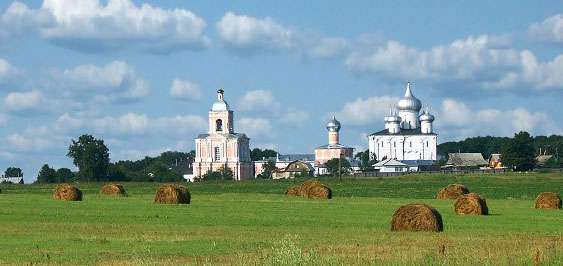
Khutyn Monastery of Saviour's Transfiguration and of Saint Varlaam (Хутынский Спасо-Преображенский Варлаамиев монастырь) is located in Novgorod Oblast of Russia. Khutyn Monastery of Saviour's Transfiguration and of Saint Varlaam was founded in 1190 in the isolated region of the country. Despite years of development and city growth this beautiful Eastern Orthodox monastery is still surrounded by pristine meadows and forests.
Founding and 12th-Century Origins (1192)
The
monastery was founded in 1192 by the monk Varlaam of Khutyn (secular
name: Oleksa/Aleksei/Alexei Mikhailovich, also spelled Aleksa
Mikhalevich), a prominent Novgorodian boyar who left secular life for
asceticism. According to tradition and his vita (life), the site—known
as “Khutyn” (from “khudoe mesto,” or “bad/evil place”)—was reputedly
haunted by unclean spirits and pagan influences in a forested, isolated
hill area. Varlaam settled there as a hermit, built a cell, purified the
site through fervent prayer, and overcame the demonic forces.
He
first constructed a wooden church dedicated to the Transfiguration of
the Saviour (Spas Preobrazheniya). This was soon replaced by a stone
church, consecrated on August 6, 1192 (the feast of the Transfiguration)
by Archbishop Gavril (or Gregory) of Novgorod, who formally established
the monastery at that time. Varlaam became its first hegumen (abbot). He
died shortly afterward, on November 6, 1192 (or possibly 1193 by Old
Style), and was buried in the main church to the right of the altar. His
relics became the central shrine.
Even in his lifetime, Varlaam was
renowned for clairvoyance and miracle-working. A famous early legend
(ca. 1190) recounts Prince Yaroslav Vladimirovich of Novgorod visiting
him; Varlaam prophesied the birth of the prince’s son (saying, “Be
healthy, prince, and with your noble son”), astonishing the prince who
had not yet known of the pregnancy. Other miracles attributed to him
include healings and control over natural elements. Varlaam quickly
attracted followers, turning the hermitage into a full monastery. He is
venerated as a patron saint of Novgorod and is considered an ancestor of
several noble families, including the Chelyadnins and the Pushkins
(Alexander Pushkin was a distant descendant).
The original
12th-century church no longer survives (archaeological traces were found
in the 1980s), but the monastery rapidly grew into one of the premier
Christian shrines of the medieval Novgorod Republic, drawing pilgrims
and receiving donations from boyars and princes.
Medieval Period:
Miracles, Pilgrimage, and Influence (13th–15th Centuries)
The
monastery flourished as a spiritual and cultural hub. Varlaam’s relics
and ongoing miracles sustained its fame. Posthumous miracles included a
vision in 1505 to a sexton named Tarasius, in which St. Varlaam warned
Novgorod of impending disasters (flood on Lake Ilmen, pestilence, and
fire), which reportedly came to pass.
A pivotal event occurred in
1471, shortly after Ivan III of Moscow’s conquest of Novgorod. The Grand
Prince visited the monastery to venerate the relics. According to
legend, he questioned the hegumen why the tomb was not opened for public
veneration and ordered it excavated. A fiery pillar or smoke and flames
erupted from the grave, scorching the southern wall and iconostasis
door. Terrified, Ivan III fled the church and monastery, striking his
staff on the ground (causing more fire to appear). He abandoned the
staff, which—along with the scorched door—was preserved for centuries in
the monastery’s sacristy (riznitsa) as a relic. This miracle was widely
interpreted as divine displeasure at Moscow’s interference in Novgorod
affairs.
16th–18th Centuries: Muscovite Rebuilding and Expansion
Under Muscovite rule, the monastery gained further prominence and
underwent major architectural transformation, symbolizing the shift from
Novgorod to centralized Russian styles.
In the early 16th
century, Vasily III (son of Ivan III) ordered the demolition of the old
main church and the construction of a new six-pillared Transfiguration
Cathedral (Spaso-Preobrazhensky Sobor), completed around 1511–1515. It
was consecrated by Metropolitan Varlaam (during a vacancy in the
Novgorod see). Modeled on the Assumption Cathedral in Rostov, it was the
first example of Muscovite architecture in the Russian North-West and
served as a prototype for later regional churches.
In 1552, under
Ivan IV (the Terrible), a refectory with a dedicated Church of St.
Varlaam was added.
In 1646, an annex dedicated to St. Gabriel was
built onto the cathedral (later associated with the poet Gavriil
Derzhavin).
A neoclassical belltower was erected during the reign of
Catherine the Great (late 18th century).
The monastery was
elevated to archimandry status in the early 17th century (around 1608).
During the Time of Troubles, in 1611, it served as a residence or
headquarters for Swedish forces during their occupation of Novgorod.
From the mid-18th century, its abbots often served as vicars (assistant
bishops) of the Novgorod diocese, holding titles such as Archbishop of
Khutyn, Starorussky, or others.
Notable 16th-century figure: Abbot
Markell Bezborody (or Bezborodiy, 1553–1557), a prominent hagiographer
and leader of the Novgorod school of znamenny chant (liturgical
singing).
19th–Early 20th Centuries: Cultural Significance and
Burials
The monastery remained a place of pilgrimage and monastic
life. In 1816, the celebrated Russian poet and statesman Gavriil
Romanovich Derzhavin (and his wife Daria) was buried in the St. Gabriel
annex of the cathedral after his death at the nearby estate Zvanka; his
body was transported by barge along the Volkhov. Other notable burials
include several Novgorod archbishops and bishops (e.g., Antony
Znamensky, Silvester Tsvetkov, Arseny Ivashchenko).
Soviet Era,
WWII, and Closure (1920s–1980s)
The monastery was closed by Soviet
authorities in 1925. Services continued in the cathedral until 1932. It
was repurposed first as a lunatic asylum and later as a vacation home or
hostel for visitors. Future Patriarch Alexy I (Simansky, then Archbishop
Aleksei) held the title Archbishop of Khutyn from 1926–1932 while
administering the Novgorod diocese under difficult conditions.
During
World War II (the Great Patriotic War), the monastery was heavily
damaged or largely destroyed and left in ruins for over 40 years.
Derzhavin’s grave was disturbed; his remains were reburied in the
Novgorod Kremlin (Detinets) in 1959.
Revival and Modern Status
(1990s–Present)
In 1993, the monastery was returned to the Russian
Orthodox Church (Novgorod Eparchy) and designated a federally protected
cultural heritage site. It was revived in 1994 as a women’s convent
(previously male for most of its history). As of the early 2010s, it
housed over 100 nuns under Igumenia (Abbess) Alexia (Simdyankina); it
includes a metochion (dependent house) in the village of Bykovo,
Valdaysky District. Daily services are held, and it remains an active
pilgrimage center focused on the relics of St. Varlaam (kept under the
cathedral). The poet Derzhavin’s remains were returned to the monastery
in 1993 for the 250th anniversary of his birth.
The main surviving
structures include the 1515 Transfiguration Cathedral (with its
annexes), the 1552 Varlaam refectory church, the neoclassical belltower,
monastic cells, and a cemetery. Restoration work has focused on
preserving its architectural and spiritual heritage.
The Khutyn Monastery of the Saviour's Transfiguration and of St.
Varlaam (Russian: Хутынский Спасо-Преображенский Варлаамиев монастырь,
also known as Varlaamo-Khutynsky Monastery) is a historic Russian
Orthodox monastery complex on the right bank of the Volkhov River,
roughly 10 km north-northeast of Veliky Novgorod in the village of
Khutyn. Founded in 1192 by St. Varlaam of Khutyn (a Novgorodian
boyar-turned-monk named Oleksa Mikhailovich), it became one of the
premier Christian shrines of the medieval Novgorod Republic. Its
architecture reflects a fascinating evolution: early Novgorodian
medieval styles (late 12th century) gave way to Muscovite influences
after Novgorod's annexation by Moscow in 1478, with later Baroque,
Neoclassical, and 17th–19th-century modifications. The ensemble suffered
damage during World War II but has undergone significant restoration.
The complex centers on a core group of stone structures arranged around
the main cathedral, enclosed by walls (with gates featuring smaller
churches in earlier periods). Key surviving or reconstructed elements
include the Spaso-Preobrazhensky Cathedral (the dominant central
building), the Church of St. Varlaam with refectory to its northwest, a
prominent bell tower, monastic residential and service buildings, and
later chapels/galleries. It blends robust, fortress-like forms with
ornate detailing typical of Russian Orthodox architecture—onion domes,
pilasters, keeled arches, and frescoed interiors—while illustrating the
shift from regional Novgorodian simplicity to centralized Muscovite
grandeur.
Spaso-Preobrazhensky Cathedral (Church of the
Transfiguration of the Saviour)
This is the monastery's principal and
most architecturally significant structure, serving as the burial site
for St. Varlaam (to the right of the altar) and later figures like poet
Gavrila Derzhavin and his wife.
Original 12th-century church
(demolished c. 1515): A classic late-Novgorodian cross-domed
temple—three-apsed, four-pillared in plan, single-domed, with choirs
(khorami) accessed by an intramural staircase. Walls (about 1 m thick)
used mixed masonry of local brown boulders and brick on lime mortar.
Foundations rested on boulders; interiors featured vibrant frescoes with
geometric/stream ornaments, garment patterns, and acanthus motifs.
Eastern sub-dome supports were uniquely L-shaped (echoing 1160s Ladoga
churches and Pskov influences), while western ones were square. A
western porch was added in the 14th century. This modest, intimate scale
was typical of pre-Muscovite Novgorod architecture.
Current cathedral
(completed 1515): Commissioned under Vasily III (replacing the
dilapidated original), this was the first major example of Muscovite
architectural style in northwest Russia. It was explicitly modeled on
the Assumption Cathedral in Rostov (and indirectly on Aristotle
Fioravanti's 1475–1479 Kremlin Assumption Cathedral in Moscow). The
design symbolized Moscow's political and cultural dominance over former
Novgorod territories and became a prototype for later regional
churches.It is a three-aisled (three-nave), six-pillared, five-domed
cruciform church with a robust interior layout. The central dome rises
on stepped, raised pendentive arches (with eight windows); the four side
domes each have five windows. The three large semicircular apses face
east. Facades are divided by pilasters and arches (four bays on
north/south sides, three on west), with three portals and ornate
horizontal moldings (tyagi), multi-beveled plinths, and "runner"
(begunets) decorative bands on the drums. Originally covered in zakomary
(curved gables/komary), it later received a four-slope iron roof. Low
closed galleries (added 17th century) surround it on three sides,
creating a more enclosed, monumental presence.Interiors feature cross
vaults (in corners), cross-shaped sub-dome supports, semi-circular
vaults between them, and no choirs (a Muscovite trait). The altar is
divided into three interconnected rooms (main sanctuary,
prothesis/sacrificial area on the left, diakonikon on the right), lit by
windows of varying heights. A southern altar staircase leads to the dome
area. 17th-century additions include side chapels: south (Protection of
the Theotokos/Pokrov) and north (St. John the Theologian). Baroque
elements (e.g., iconostasis) were introduced later but largely lost. The
cathedral's scale, five domes, and pilastered facades convey imperial
grandeur while retaining some Novgorodian restraint in proportions.
Church of St. Varlaam (with Refectory), 1550–1552
Built by order
of Ivan IV (the Terrible) northwest of the cathedral, this complex
addressed the shift to a communal monastic charter (monks eating
together rather than in cells). It is one of the largest and
best-preserved refectory churches in the Novgorod tradition.
Refectory: A massive two-story, nearly square block (approx. 22.75–25 ×
23.4 m)—the largest of its kind in Novgorod. Lower floor housed
storerooms and a cell (four rooms total). Upper floor contained the
spacious refectory hall, another cell, and storeroom (kitchen in a
separate building). Access: intramural staircase from below; southern
"red" porch from outside. Vaults are varied (cross, trough, with
functional and decorative squinches/raspaloobki). Brick construction on
lime-sand mortar.
Church proper (adjoining east): Taller, pillarless
(column-free/besstolpny) single-domed volume (9.3–9.8 × 14 m) with three
internal apses and a sub-church (podtserkovye/crypt). As of early
restorations, the upper section likely featured a tented (shatrovaya)
roof with 1–2 rows of kokoshniks at the drum base. Roofs used shingles
(tess) and lemekh (wooden scales); the drum is deaf (blind). Vaults: box
in crypt, trough in church proper, both with squinches.
Decoration is moderate yet dynamic: series of pilasters (lopatki)
tapering upward for slenderness, profiled horizontal divisions, friezes
of keeled (kilevidnye) niches, eyebrows (brovki) over upper windows, and
keeled niches on pilasters. This echoes the cathedral's detailing and a
lost nearby Church of St. Gregory the Illuminator. The overall effect is
tall, streamlined, and harmonious—combining Novgorodian refectory
practicality with 16th-century Muscovite influences.
Later changes:
1797 four-slope iron roof and interior alterations; 1839 Neoclassical
four-column portico replacing the porch; side chapels (Sts. Constantine
& Helena; St. Isidore of Pelusium) added late 19th/early 20th century.
WWII damage was severe (lost vaults, drum, walls); restorations
(1970s–2000s under architects like G.M. Shtender) aimed to recover
16th-century forms.
Bell Tower and Other Structures
The
prominent bell tower (kolokolnya) dates to the late 18th century
(construction 1768–1774, during Catherine the Great's reign), replacing
earlier iterations (one over a 15th-century St. Gregory church; another
rebuilt 1535 as a multi-tiered "tower-church" with bell cage). It is
Neoclassical in style, featuring a three-span triumphal-arch base with
chambers, columns, pilasters, stucco cartouches, masks, parapets,
triangular pediments, and oval windows. Earlier versions blended
Moscow-style tiers (octagonal forms, galleries, loggias) with bell
chambers. One 17th-century description (by Paul of Aleppo) praised its
grandeur, with balconies, a small upper church (St. Gregory), and iron
clocks.
Other elements include:
17th-century closed galleries
around the cathedral.
Monastic corps (residential cells,
abbess/brethren quarters—two-story, functional).
Gate churches (e.g.,
over main gates: Prophet Elijah; others dedicated to St. Nicholas, St.
Anthony).
A hospital church (All Saints) and domestic chapels (e.g.,
St. John the Theologian).
White-stone enclosure walls, gardens, and
cemetery.
The overall layout forms a cohesive ensemble: the
five-domed cathedral as focal point, refectory church providing communal
space to the side, and bell tower adding vertical accent. Post-1478
Muscovite elements (multi-domed scale, pilasters) overlay earlier
Novgorodian roots, with 18th–19th-century classicism/Baroque accents.
WWII inflicted heavy damage (collapsed upper cathedral sections, ruined
refectory), but restorations (1990s onward) have revived its
whitewashed, dome-crowned silhouette against the Volkhov landscape.
Varlaam Khutynsky (1192);
Anthony Dymsky (1193);
Varlaam (1207);
Arseny (1230);
Isidore (1243);
Xenophon (1262);
John (1388);
Zacchaeus;
Joseph;
Tarasius (1440);
Leonty
(1460);
Nathanael (1471, 1476);
Herman (1479);
Sergei
(1508-1516);
Nicephorus (1517-1524);
Alexander;
Theodosius
(1531-1542);
Paisiy Kozlyatev (1551);
Theognost;
Gury Korovin
(1552);
Martyrius (1555);
Markell the Beardless (1555);
Philotheus (1556-1560, 1567);
Varlaam (1571, 1572);
Dionysius
(1577-1581);
Sylvester (1584-1591);
Arkady (1595-1598);
Joel;
Tryphon (1601-1609);
Ioanniky Maltsov (1890, 1891)
Paphnutius;
Cyprian (Starorusennikov) (1609-1620);
Varlaam (1621, 1624);
Theodosius (1624);
Theodoret (1629, 1635);
Raphael (1636, 1637);
Pachomius (1638-1641);
Evfimy (1642, 1646);
Varlaam (1648-1652);
Sophronius (1652, 1653);
Evfimy (1653-1657);
Tikhon (1658-1660);
Dionysius (1661, 1662);
Cornelius (1662-1664);
Joseph (1664-1672);
Pachomius (1673, 1674);
Macarius (1674-1678);
Gelasius (1679-1682);
Evfimy (1683-1689);
Macarius (1690-1695);
Job (1698);
Tikhon (1699-1704);
Theodosius (Yanovsky) (1704-1712);
Benjamin (1712-1737);
Gabriel (Voronov) (1738-1740);
Benedict;
Ephraim;
Triphilius (1747);
Damaskin (Ascaron) (1747-1751);
Sylvester (1755);
Joasaph (Mitkevich) (1756-1758);
John (Nikitin)
(1763-1764);
Anthony (Feofanov) (1764-1767);
Lavrenty (Baranovich)
(1767-1774);
Tarasy (Verbitsky) (1774-1775);
Arseny (Buzanovsky)
(1775-1782);
Theophilus (Raev) (1782-1788).
Parthenius (Sopkovsky) (1759-1761);
Tikhon Zadonsky
(1761-1763);
Innokenty (Nechaev) (1763);
Athanasius (Volkhovsky)
(1788-1795);
Dosifey (Ilyin) (1795-1798);
Arseny (Moskvin, Vasily)
(1798-1799);
Anthony (Znamensky) (1799-1802);
Mikhail (Desnitsky)
(1802-1803);
Eugene (Bolkhovitinov) (1804-1808);
Anthony (Sokolov)
(1808-1810);
Joasaph (Sretensky) (1810-1813);
Methodius
(Pishnyachevsky) (1813-1816);
Ambrose (Ornatsky) (1816-1819);
Damaskin (Rossov) (1819-1821);
Sylvester (Tsvetkov) (1821-1823);
Moses (Bogdanov-Platonov-Antipov) (1824-1827);
Ignatius (Semenov)
(1828);
Timofey (Kotlerov-Veshchezerov) (1828-1834);
Anastasy
(Klyucharev) (1834-1837);
Feodoty (Ozerov) (1837-1842);
Justin
(Mikhailov) (1842);
Leonid (Zaretsky) (1843-1850);
Nathanael
(Savchenko) (1850);
Anthony (Shokotov) (1850-1853);
Anthony
(Pavlinsky) (1853-1854);
Ioanniky (Gorsky) (1855-1856);
Plato
(Thebes) (1856);
Evfimy (Belikov) (1856-1860);
Feofilakt (Gubin)
(1860-1862);
Gerasim (Dobroserdov) (1863-1864);
Apollos (Belyaev)
(1864-1866);
Seraphim (Protopopov) (1866-1869);
Feoktist (Popov)
(1869-1874);
Nikodim (Belokurov) (1875-1876);
Varsonofy (Okhotin)
(1876-1882);
Anastasy (Dobradin) (1882-1888);
Vladimir
(Bogoyavlensky) (1888-1891);
Anthony (Sokolov) (1891-1892);
Nazariy (Kirillov) (1893);
Arseny (Ivashchenko) (1893-1903);
Theodosius (Feodosiev) (1903-1907);
Andronik (Nikolsky) (1908-1913);
Alexy (Simansky) (1913-1920).