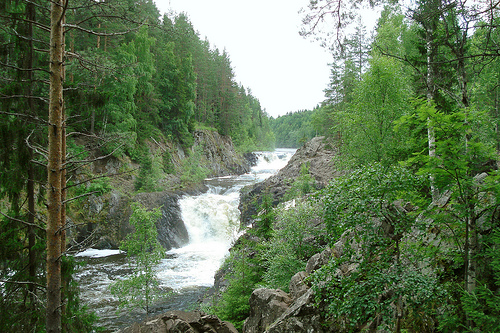
Location: 60 km from Petrozavodsk, Kondopoga District, Republic of Karelia
Height: 11 meter cascade
Visitors: 40,000 a year
Kivach Waterfall (Водопад Кивач) is one of the most famous
natural attractions in the Republic of Karelia, Russia, and a
highlight for visitors to the region. Located in the Kivach State
Nature Reserve (one of Russia's oldest reserves, founded in 1931),
it ranks as the second-largest plain (lowland) waterfall in Europe
after the Rhine Falls, though its power has diminished since a
hydroelectric dam was built upstream at Girvas in the 1930s.
The
waterfall drops about 10.7 meters over four steps on the Suna River
(one of Karelia’s major rivers). It sits amid ancient taiga forests,
with viewing platforms on the rocky right bank offering safe,
excellent vantage points. The name "Kivach" likely derives from the
Finnish/Karelian word for "stone" (kivi) or "snow mountain" (kiwas),
evoking the white cascade against dark rocks and greenery.
It has
inspired poets like Gavrila Derzhavin (his 1791 poem "Waterfall"
describes it vividly) and was visited by Russian emperors Peter I
and Alexander II. Today, it draws tourists for its scenic beauty,
accessible trails, and role as "Karelia in miniature."
Geologically, Kivach Waterfall formed as the Suna River flows over a resistant layer of ancient diabase bedrock, creating a sharp drop. This Precambrian rock ridge causes the water to cascade in stages: the stream first crashes onto one rocky platform, then slides to a second, before continuing as a turbulent river. Waterfalls like Kivach generally develop where rivers encounter irregularities in their bed, with erosion over softer underlying rock leading to the vertical drop— a process common in river systems worldwide. In terms of volume, Kivach is noted as the third-largest plain waterfall in Europe by water discharge, though its flow has been reduced since the 1930s. The surrounding area features three main terrain types: rocky ridges, forested hills, and wetland depressions, shaped by glacial activity from the last Ice Age.
The waterfall has a rich history tied to Russian culture and exploration. It gained fame in the 18th century when Russian poet Gavrila Derzhavin visited and was inspired to write his poem "Waterfall," describing its "unruly stream" and establishing it as a symbol of natural power in Russian literature. This drew other notable visitors, including Emperor Alexander II in the 19th century, who ordered the construction of a road to the site, a viewing pavilion on the right bank, and a bridge downstream to improve access. In 1931, the area was designated as a strict nature reserve (zapovednik) by the Council of People's Commissars of the Karelian ASSR, making it one of Russia's oldest protected areas and the first in Karelia. However, in 1929-1936, the construction of the Kondopoga hydroelectric power station upstream diverted part of the Suna River, damming Lake Girvas and significantly diminishing the waterfall's flow. This human intervention nearly destroyed the site, reducing its spectacle compared to historical accounts, while nearby waterfalls like Girvas (14.8 m) and Por-Porog (16.8 m) were completely lost.
As part of the Kivach Nature Reserve, the waterfall is embedded in a pristine taiga forest ecosystem, which the reserve was established to study and protect. The area preserves primeval Karelian nature, including coniferous forests dominated by pine, spruce, and birch, along with diverse undergrowth. It's home to a variety of wildlife, such as moose, bears, wolves, and numerous bird species, reflecting the boreal forest's biodiversity. The reserve also features unique flora, including rare orchids and mosses adapted to the humid, rocky environment around the falls. Ecologically, waterfalls like Kivach create microhabitats with high moisture levels, supporting specialized plant and animal communities, though human alterations have impacted local hydrology. Conservation efforts focus on maintaining the taiga's integrity, with restricted access to core zones to minimize disturbance.
Best Time to Visit
Summer (May–September): Peak season with the
longest opening hours, lush greenery, and easiest access. Water flow is
decent, though highest in spring (May–early June) after snowmelt or
after heavy rains. Expect more crowds on weekends/holidays.
Spring:
Best for powerful water volume and dramatic photos, but trails may be
muddier.
Winter: Magical with snow/ice formations (the falls rarely
fully freeze). Fewer crowds, but shorter hours and colder conditions.
New Year programs with fairy-tale characters are sometimes offered.
Autumn: Stunning foliage colors with fewer people.
Photography
tips: Visit early morning or late afternoon for softer light and fewer
crowds. Overcast days or post-rain provide even lighting and fuller
flow. Use longer exposures for silky water effects (tripod helpful).
Avoid harsh midday sun.
How to Get There
The reserve lies
about 80 km (50 miles) from Petrozavodsk and 27 km from Kondopoga.
Coordinates: approx. 62.16126° N, 33.58969° E.
By Car
(recommended for flexibility): Take the R-21 (M-18) "Kola" highway (St.
Petersburg–Murmansk) toward Murmansk. Look for the "Kivach 8" sign near
kilometer 493/912, turn off, and drive 8 km on a good local road to the
checkpoint. Parking is available (small fee). Drive carefully—speed
limit 50 km/h in the reserve, no stopping off-road.
By Bus/Tour:
Buses from Petrozavodsk bus station (about 1.5 hours) go toward Sopokha
or Kondopoga; you may need to walk or arrange pickup for the last
stretch. Organized day tours from Petrozavodsk (3–5 hours total) are
convenient and often include transport, guide, and entry.
Public
transport caveats: Less reliable for the final leg; taxis or
pre-arranged transfers work better from nearby towns.
Tip: Use
Yandex Maps or similar for real-time navigation. The access road was
upgraded in 2019.
Opening Hours and Tickets (as of recent info)
May–September: Excursion zone 07:00–23:00; Nature Museum 09:00–21:00.
October–April: Excursion zone 08:00–17:00; Museum 10:00–17:00.
Entry is paid at the checkpoint (adults around 200–300 RUB historically;
check current prices on-site or via official channels, as they vary).
Schoolchildren often free or discounted. Guided tours require advance
booking.
What to See and Do
Kivach Waterfall: Main attraction.
Spend time on the equipped platforms and paths along the right bank.
Stay behind railings—rocks are slippery.
Arboretum (Dendrological
Collection): Established 1948, features local taiga species plus
exotics. Highlights include rare Karelian birch. Short guided or
self-guided walks.
Museum of Nature: Dioramas, stuffed animals/birds,
insect collections, and info on the reserve. Renovated and informative
(30–40 min tour).
Eco-Trails:
"1500 Steps to Nature" (short ~600m
loop, ~40 min, year-round).
Longer options like Sopokha Pine Wood
(2–6 km, 2–3 hours) through forests, bogs, and springs. Guided walks
recommended for deeper insight.
Other: Souvenir shop with
Karelian items, small cafe (tea, pastries), WWII memorial.
The
reserve spans ~110 km² of protected taiga with rich biodiversity
(old-growth pines/spruces, berries, wildlife like bears/moose—observe
from afar).
In-Depth Visiting Tips
Safety First: Slippery
rocks and fast water—do not climb fences or approach too closely for
photos. Follow signs and staff instructions.
Clothing and Gear:
Comfortable, weather-appropriate layers and sturdy waterproof shoes
(trails can be wet/muddy). Insect repellent essential in summer
(mosquitoes in taiga). Binoculars for wildlife/birds.
Duration: 1–3
hours for the main sights; half-day or more with trails. Combine with
nearby sites like Marcial Waters (old resort with springs) or
Petrozavodsk.
Crowds and Timing: Weekdays/early mornings best. Summer
weekends busier.
Food/Facilities: Limited on-site cafe—bring
snacks/water. Toilets available.
Respect the Reserve: No littering,
no off-trail walking, no picking plants, stay on paths. It's a strict
nature reserve focused on conservation.
Accessibility: Mostly
flat/equipped paths suitable for many, but check for mobility needs
(some trails more challenging).
Photography/Drone: Drones likely
restricted in reserve—confirm rules. Golden hour and rainy days enhance
shots.
Winter Specifics: Ice/snow traction aids helpful; shorter
daylight.
Health/Weather: Karelia’s weather changes quickly—check
forecasts. Prepare for bugs, rain, or cold.
Nearby Attractions
for a Combined Trip
Marcial Waters (first Russian resort, mineral
springs, Peter the Great church).
Petrozavodsk (lakeside city,
starting point).
Kizhi Island (UNESCO wooden architecture, by
hydrofoil).
Ruskeala Mountain Park (marble canyon, further afield).