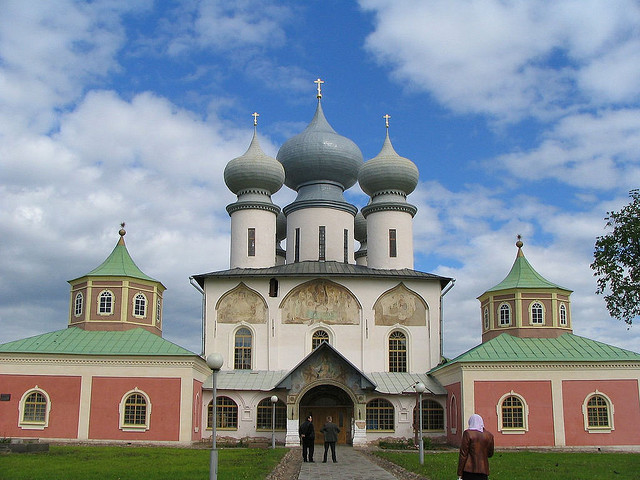
Location: Tichvin
Found: 11th February, 1570 by Pimen
The Tikhvin Uspensky Monastery, more formally known as the Tikhvin Monastery of the Dormition (or Assumption) of the Mother of God, is a historic Russian Orthodox monastery located in the town of Tikhvin, Leningrad Oblast, Russia, on the left bank of the Tikhvinka River. Established in 1560, it stands as one of Russia's most revered spiritual sites, primarily due to its association with the miraculous Icon of the Theotokos of Tikhvin, which has drawn pilgrims for centuries and played a pivotal role in Russian religious and cultural history.
Origins and the Miraculous Icon (1383–1560)
The monastery’s story
begins with the Tikhvin Icon, traditionally attributed to the Apostle
Luke. According to Orthodox tradition, the icon—originally housed in
Constantinople’s Blachernae Church—miraculously disappeared in 1383 and
reappeared in a radiant light over Lake Ladoga in northern Russia. It
moved miraculously through the air several times before settling near
the Tikhvinka River. Locals built a wooden church dedicated to the
Dormition (Uspenie) of the Theotokos on the site of its appearance.
Wooden churches burned down three times (in 1390, 1395, and 1500), but
the icon was always saved. In 1507, Grand Prince Vasily III of Moscow
ordered the construction of a stone Uspensky (Dormition) Cathedral to
house the icon permanently. Completed in 1515 (modeled after Moscow’s
cathedrals and possibly built by the same team as the Khutyn Monastery,
under Italian architect influence), it became the first stone building
in the area and the monastery’s architectural core. A smaller wooden
church to St. Nicholas was also built nearby, later evolving into the
Nikolsky Besedny Monastery (which existed until 1859).
Tsar Ivan IV
(the Terrible) visited the site in 1547 before his Kazan campaign,
accompanied by Metropolitan Macarius. This pilgrimage underscored the
icon’s growing national importance.
Founding as a
Fortress-Monastery (1560)
On February 10, 1560 (7068 in the old
Russian calendar), Ivan the Terrible issued a decree founding the men’s
monastery around the existing cathedral. Novgorod Archbishop Pimen
oversaw the project, with wealthy Novgorod merchant and devout patron
Fyodor Syrkov (later executed during Ivan’s oprichnina terror in 1570)
directing construction. Peasants from 20 volosts were mobilized to speed
up the work. The monastery was deliberately built as a fortress with
strong walls and towers to defend Russia’s northwestern frontier against
Swedish incursions.
The original enclosure was wooden at first but
soon upgraded. Key early structures included the Pokrovskaya
(Intercession) Church with a large refectory (1581) and a distinctive
belfry (1600).
17th Century: Time of Troubles and Swedish Sieges
During the Time of Troubles (early 1600s), the monastery faced severe
trials. In 1610, Polish troops looted it. Swedish forces under Jacob De
la Gardie then occupied the region after seizing Novgorod. In 1613–1614,
the Swedes repeatedly assaulted the monastery, which had become a key
defensive outpost.
A famous miracle occurred during one siege: the
monks and defenders, led by Prince Semyon Prozorovsky, prepared to flee
with the icon but found it immovable. They stayed and, with a small
garrison, repelled a vastly superior Swedish army. The invaders fled in
panic, believing they faced a huge Russian force or heavenly hosts. The
monastery held until reinforcements arrived. This defense is
commemorated in the all-Russian feast of the Tikhvin Icon (June 26 /
July 9).
Fires damaged the cathedral in 1623–1624, but it was quickly
restored with a new iconostasis. The monastery prospered in the later
17th century, gaining new frescoes (including preserved Apocalypse
scenes in the galleries) and monastic buildings.
Imperial Era:
Expansion and Patronage (18th–19th Centuries)
Under the Romanovs, the
monastery received lavish support. Empress Elizabeth Petrovna initiated
a massive stone wall (construction began 1766; completed in phases
through 1795 with funding from Paul I and Alexander I). Over 450 sazhens
long, it featured towers and gate churches (one to the Tikhvin Icon,
another to St. Nicholas).
Tsars and empresses frequently visited:
Peter the Great, Elizabeth, Paul I, Alexander I, and Alexander II all
prayed before the icon. Architectural updates blended ancient Russian
forms with 18th-century classicism (e.g., rebuilding the belfry and
cells). The 19th century saw further refinements, including a new
gallery around the cathedral and crosses from master silversmiths.
20th Century: Revolution, Soviet Closure, and WWII Exile of the Icon
After the 1917 Revolution, the monastery was gradually closed. In the
1920s, churches passed to the “renovationist” (обновленцы) faction; by
the 1930s, they were shut entirely, and the icon became a museum exhibit
in Tikhvin.
During World War II, Tikhvin played a critical strategic
role in the Siege of Leningrad. German forces occupied the town from
November 8 to December 9, 1941. They looted the monastery, heavily
damaging buildings (the belfry was destroyed). The icon was taken to
Pskov, then Riga, and eventually to the German-occupied zone. Bishop
John (Garklavs) of Riga safeguarded it, smuggling it out of the Soviet
sphere after the war. It reached Chicago’s Holy Trinity Orthodox
Cathedral in 1950, where it remained under the condition (per the
bishop’s will) that it return only when the monastery was fully revived
and Russia free of state atheism.
Tikhvin’s liberation in December
1941 helped reopen supply routes to besieged Leningrad via the “Road of
Life” across Lake Ladoga. The town later earned the title “City of
Military Glory” (2010).
Post-Soviet Revival (1995–Present)
In
1995, the monastery was returned to the Russian Orthodox Church. The
Dormition Cathedral was restored and reconsecrated. Major restoration
work (guided by 17th–18th-century illustrations) recreated ancient
forms: the belfry, towers (including Omytnaya and Taynichnaya), and
cells.
The icon’s triumphant return occurred on June 9, 2004,
traveling via Riga, Moscow, and St. Petersburg amid national
celebrations. It remains the monastery’s chief relic. Additional
treasures include the relics of St. Anthony of Dymsk (temporarily housed
2001–2008).
Today, the monastery belongs to the St. Petersburg and
Ladoga Diocese. It is open to the public and continues as an active
monastic community, cultural heritage site, and pilgrimage center.
Overall Layout and Fortifications
The monastery occupies a
compact, roughly rectangular site. Early defenses consisted of stout
wooden log walls and towers from the 1560s, designed for military
purposes during regional conflicts. These were replaced in the
mid-to-late 18th century (construction began around 1766–1788 under
Empress Elizabeth Petrovna’s decree of 1747, with completion in the
1790s funded partly by Emperors Paul I and Alexander I) by brick/stone
enclosure walls approximately 450 sazhens (about 960 meters) long. The
walls feature covered walkways, arrow slits (in earlier phases), and
towers (including restored examples like the Omytnaya and Taynichnaya).
Later walls serve a more decorative than purely military role.
Holy
Gates and over-gate churches punctuate the perimeter, including:
The Church of the Tikhvin Icon of the Mother of God (over the gate
tower, consecrated 1791; one variant known as “Krylechko” or “Porch” was
rebuilt in 1863 by architect Nikolai Benois).
The Church of St.
Nicholas the Wonderworker (consecrated 1798).
These elements
integrate religious and entrance functions typical of Russian monastic
design.
Uspensky Sobor (Assumption/Dormition Cathedral) – The
Architectural Core
The oldest and most significant building is the
Uspensky Sobor (katholikon), constructed 1507–1515 before the
monastery’s official founding. Commissioned by Grand Prince Vasily III
to enshrine the Tikhvin Icon, it replaced earlier wooden churches
destroyed by fire. It was built under the supervision of Novgorod
masters (likely Dmitry or Fyodor Syrkov) with possible involvement of an
Italian (“Fryazin”) architect, modeled after the Assumption Cathedral in
the Moscow Kremlin but incorporating Novgorod influences.
Key
original features (16th-century Muscovite style with innovations):
Six-pillar structure with five domes and three apses (the apses
nearly as tall as the interior space).
Arches between pillars and
walls support vaults and unusually tall drums: eastern drums are blind
(solid) for solemnity, while western ones admit light.
Asymmetric
drum placement due to a raised northwest St. Nicholas side-chapel.
Covered galleries (papert’) on three sides, creating a spacious
ambulatory.
Pozakomarnoye (stepped arched) roofing (later modified to
a four-sloped metal roof).
Monumental scale with whitewashed facades,
high drums, and onion domes.
The interior features frescoes
(originally 17th century; repainted in the 18th century under
icon-painter Loggin Shustov) and a large iconostasis. The cathedral’s
design fuses Moscow’s five-domed symmetry with Novgorod’s six-pillar
traditions (e.g., echoes of Yuriev and Antoniev Monasteries), resulting
in a distinctive asymmetric, visually dynamic composition with
oversized, dispersed drums.
Later modifications:
1623 fire
damage led to repairs.
18th century: Nicholas side-chapel dismantled;
narrow windows consolidated into larger ones; floors changed from
cast-iron to slate; granite ambo added.
19th century: Galleries
expanded with massive cubic side-chapels; iconostasis gilded.
20th–21st centuries: Major post-Soviet restorations returned it to early
17th-century appearance; it survived WWII relatively intact but was used
for secular purposes (prison, warehouse) during the Soviet era.
Pokrovskaya Church and Refectory (1581)
South of the cathedral stands
this massive two-storey refectory complex with an integrated
Intercession (Pokrov) Church. The ground level housed the refectory
hall; the upper level the church. In the 18th century, it received a
large octagonal (vos’merik) superstructure with semicircular windows,
introducing Baroque/Classical elements. Post-WWII restorations (under
V.V. Eck) reinstated 17th-century decorative rows of kokoshniki,
restoring its ancient Russian character.
Belfry (Zvonitsa, 1600)
The belfry, built in Novgorod style, is a four-storey, five-tiered
(“pyatignyezdnaya”) structure with an unusual multi-domed or tiered
silhouette. It originally held about 20 bells (the largest weighing 650
puds). It suffered damage in 1623 (powder explosion) and was restored in
1631 by masons sent by Prince Dmitry Pozharsky. A 1777 rebuild
introduced provincial Classicism; it was destroyed in WWII and
reconstructed in the 1960s by architect K.A. Stepanov to approximate its
ancient Russian forms (with further repairs in 2020).
Monastic
Cells and Domestic Buildings
Residential quarters date mainly to the
late 17th century and reflect practical monastic architecture:
Archimandrite’s cells (1682–1684).
Kelar’s (cellarer’s) cells
(1684–1685).
Euphemian (Patriarchal) chambers (1699–1700).
Official/Treasury (Archiereiskiy) corps (1699).
Late-16th-century
kitchen (povarnia).
These brick buildings form part of the
enclosed perimeter and have been restored to their historic appearance
in the 20th–21st centuries.
Architectural Styles and Evolution
16th–17th centuries: Core in traditional Russian Orthodox style—brick
construction, whitewashed walls, multiple onion domes, kokoshniki, and
galleries. Strong Muscovite influence with Novgorod elements;
engineering possibly aided by Italian expertise.
18th–19th centuries:
Baroque and provincial Classicism overlays (octagons, enlarged windows,
Classicist belfry rebuilds).
20th–21st centuries: Extensive
restorations prioritize 17th–18th-century historicism, guided by period
miniatures and archaeological data, emphasizing the ensemble’s
pre-Soviet character. The monastery suffered Soviet-era secularization
and WWII damage but was revived as an active male monastery in the 1990s
(icon returned in 2004).
Beyond its architectural grandeur, the Tikhvin Uspensky Monastery holds profound spiritual and historical importance in Russia. It has served as a "spiritual center of defense" against foreign threats, with the icon invoked during conflicts like the Time of Troubles and World War II. The icon's veneration extends to Russian royalty—Mikhail Romanov was blessed with a copy upon ascending the throne—and it consoled Russian exiles during the 20th century. Today, as an active monastery open to the public, it attracts pilgrims and tourists alike, symbolizing resilience and faith. Its return to Orthodox hands in 1995 and the icon's repatriation in 2004 marked a revival of Russian spiritual traditions post-Soviet era, underscoring its enduring role in national identity.