Open: 10am- 5pm
Mon, Wed: 10am- 4pm
Closed: Mondays and last Friday of the Month
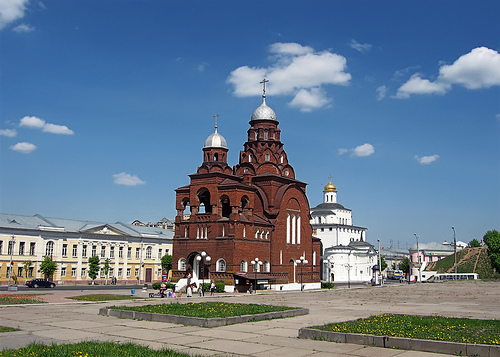
The Holy Trinity Church, often simply referred to as Trinity Church or the "Red Church" due to its distinctive red brick construction, is a prominent historical and architectural landmark in Vladimir, Russia. Situated in the heart of the city at 2 Dvoryanskaya Street (now known as Museum Street), it stands in close proximity to the iconic Golden Gate, a 12th-century UNESCO World Heritage site. This location places it amid Vladimir's ancient monuments, creating a striking contrast between medieval white-stone architecture and early 20th-century neo-Russian design. The church serves as a testament to the city's rich religious heritage and its evolution through the centuries.
Construction of the Holy Trinity Church began in 1913 and was
completed in 1916, making it one of the last religious buildings erected
in Vladimir before the Russian Revolution. It was built specifically for
the Old Believers community—a schismatic group within Russian Orthodoxy
that adhered to pre-17th-century liturgical practices and resisted
reforms introduced by Patriarch Nikon. The project was funded primarily
by wealthy local merchants who were part of this community, reflecting
their economic influence in pre-revolutionary Vladimir. The church was
dedicated to commemorate the 300th anniversary of the Romanov dynasty,
symbolizing loyalty to the imperial family during a period of political
turbulence.
The architect behind the design was Sergei Mikhailovich
Zharov (sometimes spelled S. Zhavor), a Moscow-trained professional and
disciple of the renowned architect Leonty Benoit. Zharov was recommended
for the role by Benoit himself and served as Vladimir's city architect
at the time. The construction was carried out under the auspices of the
Old Believers' Edinoverie branch, which sought reconciliation with the
official Russian Orthodox Church while maintaining traditional rites.
Post-revolution, the church's fate mirrored that of many religious sites
in Soviet Russia. Divine services ceased in 1928 when the Old Believer
community was disbanded by authorities. During the Soviet era, the
building was repurposed for secular uses, including as a storage
facility. In the 1960s, it faced the threat of demolition to make way
for urban expansion around the Golden Gate area. However, a public
campaign led by prominent figures, including the writer Vladimir
Aleksandrovich Soloukhin, successfully advocated for its preservation.
Restoration efforts culminated in 1976, when the church was transformed
into a cultural institution.
The Holy Trinity Church exemplifies the pseudo-Russian (or
neo-Russian) architectural style, which drew inspiration from medieval
Russian forms while incorporating modern elements. This style was
popular in the early 20th century as a means of reviving national
identity through architecture. The structure is built entirely from red
brick, giving it a vibrant, warm appearance that stands out against the
white limestone of nearby ancient churches like the Assumption
Cathedral.
Key architectural features include:
Overall
Composition: The church and its bell tower are seamlessly integrated
into a single, harmonious unit, rather than being separate structures.
This creates a unified silhouette with two prominent domes— a larger
central one and a smaller companion—both crowned in a silver helmet
shape.
Decorative Elements: The facade is adorned with intricate
brickwork, including elegant straps, curbs, and x-pattern bricklaying. A
distinctive stair-step arrangement of keeled kokoshniks (semi-circular
or pointed decorative arches) frames the drum supporting the main dome,
echoing the design of the 15th-century Assumption Cathedral in the
nearby Princess' Monastery.
Proportions and Scale: The building's
design emphasizes verticality and symmetry, with octagonal elements and
arched windows that enhance its elegant profile. Its relatively modest
size allows it to blend into the urban landscape without overpowering
the surrounding historical sites.
The architecture not only pays
homage to Russia's Orthodox traditions but also incorporates subtle
modern influences, making it a bridge between eras.
Originally, the interior was lavishly decorated to reflect the Old
Believers' devotion. It featured an oak iconostasis housing antique
icons donated by affluent merchants, along with opulent church utensils
and liturgical books. These elements created a space of profound
spiritual ambiance, enhanced by the building's excellent acoustic
properties, which made it ideal for choral performances and services.
Today, much of the original religious decor has been repurposed or
removed, but the space retains its grandeur. Since its restoration, the
church has housed the Museum of Crystal, Lacquer Miniatures, and
Embroidery, showcasing decorative arts from the Vladimir region.
Highlights include:
Crystal glassware from the historic Maltsovs’
plant in Gus-Khrustalny, known for its intricate designs and historical
significance in Russian craftsmanship.
Mstera lacquer miniatures, a
traditional folk art form featuring painted scenes on wooden boxes.
Vladimir embroidery, renowned for its colorful patterns and cultural
heritage.
The basement has served as an art salon since 1994,
hosting exhibitions and sales of local artworks. The acoustics continue
to be utilized for occasional concerts and cultural events, adding to
the site's multifaceted appeal.
As of recent reports, the Holy Trinity Church remains primarily a
museum and cultural venue rather than an active place of worship, though
it holds symbolic importance for Russia's Orthodox history. It attracts
tourists interested in Vladimir's Golden Ring heritage, offering
insights into pre-revolutionary religious life and Soviet-era
preservation efforts. Visitor reviews often praise its unique red brick
aesthetics and the quality of the museum exhibits, with ratings
averaging around 4.6 out of 5 on platforms like Tripadvisor. The
church's survival and adaptation underscore themes of cultural
resilience in Russia, blending religious, artistic, and historical
narratives.
In a broader context, the Holy Trinity Church contributes
to Vladimir's status as a key destination on Russia's Golden Ring
tourist route, where it complements older sites like the Dmitrievsky and
Assumption Cathedrals. Its neo-Russian style provides a fresh
perspective on Russian architecture, making it an essential stop for
those exploring the evolution of Orthodox church design.