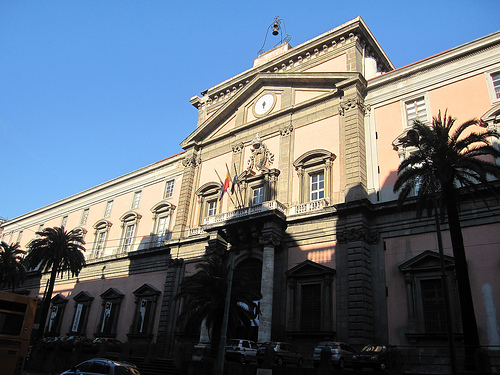
Piazza Museo Nazionale 19
Tel. 081- 564 89 41
Subway: Piazza
Cavour
Open: Wed- Mon
Closed: Jan 1, Dec 25
The National
Archaeological Museum of Naples (Museo Archeologico Nazionale di Napoli,
or MANN) is one of the world's premier institutions dedicated to
classical antiquity, renowned for its unparalleled collection of
artifacts from ancient Greco-Roman civilizations, particularly those
excavated from the Vesuvian sites of
Pompeii, Herculaneum,
Oplontis, and Stabiae. Housed
in a grand 16th-century palace in central Naples, Italy, the museum
spans approximately 12,000 square meters of exhibition space across
multiple floors, including basements, ground level, and upper stories.
Established in the late 18th century, it serves as a vital repository
for understanding Roman daily life, art, and engineering, drawing over
700,000 visitors annually as of recent reports. The collection, which
includes sculptures, mosaics, frescoes, gems, and everyday objects,
bridges the gap between myth and history, with highlights like the
Farnese sculptures and the Alexander Mosaic. As of August 25, 2025, the
museum continues to evolve through conservation efforts, digital
enhancements, and temporary exhibitions that address contemporary issues
like artifact repatriation and cultural heritage protection. Its
location at Piazza Museo 19, near the historic center and accessible via
Naples' metro (Museo stop on Line 1), makes it a cornerstone of the
city's UNESCO-listed cultural landscape.
The Building: From Cavalry Barracks to University to Museum
(1585–1777)
The structure that now houses the museum began life in
1585 as the royal cavalry barracks (cavallerizza reale) during Spanish
viceregal rule in Naples. Architect Giovanni Vincenzo Casale (or
similar) designed it for the Spanish viceroy. Around 1610–1616,
architect Giulio Cesare Fontana transformed it into the Palazzo degli
Studi, serving as the seat of the University of Naples until 1777. Some
ancient statues from the Campi Flegrei area had already found their way
there by 1613.
In 1777, after the university relocated, the Bourbons
repurposed the building specifically for a museum. Architects Ferdinando
Fuga (who died in 1782) and Pompeo Schiantarelli oversaw major
expansions and refurbishments to accommodate growing collections. This
marked the physical birth of the institution, though full public use
came later.
Founding Under the Bourbons: Charles III and
Ferdinand IV (1734–1815)
The museum’s creation ties directly to
Charles of Bourbon (Charles III, King of Naples and Sicily from 1734).
He championed systematic excavations at sites buried by the 79 AD
eruption of Mount Vesuvius—Herculaneum (starting 1738), Pompeii (1748),
and Stabiae. He also inherited the vast Farnese Collection through his
mother, Elisabetta Farnese. This Renaissance-era hoard, assembled by the
Farnese family from Roman excavations (including the Farnese Marbles
like the Farnese Hercules, Farnese Bull, and Atlas statues, plus gems
such as the Tazza Farnese), formed a cornerstone of the holdings.
Charles planned a Museo Farnesiano and initially displayed Vesuvian
finds at the Reggia di Portici as the Museo Ercolanense.
His son,
Ferdinand IV (later Ferdinand I of the Two Sicilies), decided to unite
the Farnese treasures with the Vesuvian relics under one roof in Naples.
The Palazzo degli Studi became the chosen site. Statues from Rome’s
Palazzo Farnese and gardens transferred to Naples in 1787, despite some
opposition.
During the French Decade (1806–1815), under Joseph
Bonaparte and Joachim Murat, the first galleries took shape. Michele
Arditi became the first director in 1807. Vesuvian artifacts moved from
Portici (starting 1805), paintings arrived from Capodimonte (1806), and
mosaics were installed as floors. The museum took on an encyclopedic
character, incorporating the Royal Library, Drawing Academy, Officina
dei Papiri Ercolanesi (for unrolling Herculaneum papyri from the Villa
of the Papyri, discovered 1752), and plans for an astronomical
observatory (the grand Salone della Meridiana hall).
Official
Opening and Royal Bourbon Museum (1816–1860)
The Bourbon Restoration
in 1816 led to the official public opening on February 22 as the Real
Museo Borbonico (Royal Bourbon Museum). A statue of Ferdinand I by
Antonio Canova graced the grand staircase. Further acquisitions enriched
it, including the Borgia Egyptian collection (1821, assembled by
Cardinal Stefano Borgia in the late 18th century; a second Picchianti
collection followed in the early 19th century, forming the basis of the
~2,500-object Egyptian section).
The Secret Cabinet (Gabinetto
Segreto), housing erotic and sexual artifacts mostly from Pompeii and
Herculaneum, was created around 1819 under Arditi. Access was severely
restricted—to “persons of mature age and known morals”—and became a
flashpoint for censorship.
Italian Unification and National
Museum Era (1860–1957)
After Garibaldi’s forces occupied Naples in
September 1860, the collection opened more broadly to the public
(briefly including the Secret Cabinet). With Italian unification in
1860–1861, it was renamed the Museo Nazionale (National Museum).
Collections expanded rapidly through ongoing excavations across Campania
and southern Italy, plus private acquisitions.
Notable directors
included Giuseppe Fiorelli (1863–1873), who advanced organization and
Pompeian studies. Later figures like Ettore Pais and Amedeo Maiuri (from
1924) expanded sections and moved the library. Alfonso De Franciscis
oversaw rearrangements in the 1960s–1970s. Architectural modifications
continued throughout the 19th century.
Censorship of the Secret
Cabinet persisted: post-1848 revolution, authorities proposed destroying
“lascivious” items; in 1851, even nude Venus statues were locked away
and the entrance walled up. Restrictions eased gradually after 1971,
with full public reopening (with age limits for minors) in April 2000
after a complete rebuild.
Shift to Purely Archaeological Identity
(1957–Present)
In 1957, all paintings transferred to the Capodimonte
Museum, solidifying the institution’s identity as the Museo Archeologico
Nazionale di Napoli (MANN). It focused exclusively on antiquities.
Key modern milestones:
2005: Opening of the Stazione Neapolis section
with artifacts from Naples metro excavations.
2014: Greater autonomy,
leading to major section reopenings and reorganizations (e.g., Egyptian
collection, Magna Graecia).
Ongoing restorations and exhibitions,
including work on the famous Alexander Mosaic (visible to visitors via
observation points during conservation).
Plans for MANN 2 in the
historic Real Albergo dei Poveri (Palazzo Fuga), funded at €148 million
and slated for opening around 2026. It will showcase stored artifacts,
with a focus on Vesuvian history and rediscovery, as part of broader
urban regeneration.
Today, the museum’s core remains the Farnese
Collection (sculptures, gems), Vesuvian artifacts (frescoes, mosaics,
bronzes, papyri, everyday objects), Egyptian holdings, and Greek/Roman
antiquities. It attracts hundreds of thousands of visitors annually and
continues evolving through renovations, digital initiatives, and
temporary exhibitions.
Origins as Cavalry Barracks (1585–1586)
Construction began in
1585–1586 under Viceroy Don Pedro Girón, Duke of Osuna, to house royal
cavalry stables (scuderie vicereali). The initial architect was Giovan
Vincenzo Casale. The project was abandoned unfinished due to
insufficient water supply. Only fragments survive from this phase,
notably the western portal in dark piperno stone (a local volcanic tuff)
along what is now Via Santa Teresa. The early design echoed the
monumental style of the nearby Royal Palace (Palazzo Reale), with a
planned large rectangular block.
Transformation into Palazzo
degli Studi (1610–1616)
In 1610–1616, Viceroy Pedro Fernández de
Castro repurposed the incomplete barracks as the new seat of the
University of Naples (Palazzo degli Studi). Architect Giulio Cesare
Fontana (son of the famous Domenico Fontana, designer of the Royal
Palace) led the redesign. His vision was ambitious and symmetrical:
A
central two-story block rising above single-story lateral wings (though
only the central section and western wing were fully realized at first).
A grand south-facing entrance leading into a central atrium.
At the
rear, a vast apsidal hall (Sala dei Concorsi, later the Salone della
Meridiana) lit by large windows.
Upper floor featuring a library
above the atrium, flanked by lateral gardens with porticoes and
classrooms overlooking them.
Facade richly articulated in late
Renaissance/early Baroque style: alternating windows and niches intended
for statues of illustrious figures, interrupted by the main portal and
two secondary doors. The overall effect was ornate, with pediments,
medallions, vases, and busts—designed as a visual homage to the Royal
Palace.
The palace was inaugurated (incomplete) around 1615–1617.
Further work occurred under Bartolomeo Picchiatti, but progress slowed.
In the 18th century, the building saw intermittent use as a tribunal and
military quarters. In 1735, architect Giovanni Medrano stabilized the
enormous Salone ceiling with a double wooden roof structure (beams
supporting the vault plus upper trusses).
Conversion to Royal
Bourbon Museum (1777–early 19th century)
In 1777, King Ferdinand IV
(later Ferdinand I of the Two Sicilies) decided to repurpose the
building as a universal museum to house the Farnese Collection
(inherited via his mother) and the rapidly growing finds from
Herculaneum, Pompeii, and Stabiae. The University relocated, freeing the
structure.
Major architects Ferdinando Fuga (until his death in 1782)
and Pompeo Schiantarelli oversaw a profound transformation and
enlargement:
Addition of a full upper story for greater
uniformity and capacity.
Construction of the monumental principal
staircase.
Extension of the right (eastern) wing.
Closure of some
ground-floor arcades in the vestibule; creation of a semicircular
staircase element.
Refacing and embellishment of the facades
(completed c. 1791): The main facade was simplified and given a more
severe, imposing Neoclassical character—eliminating many original
statues, niches, and ornate window decorations. Dark piperno pilasters
now contrasted dramatically against the Pompeian-red stucco background
of the walls, creating a striking chromatic effect typical of Neapolitan
architecture. Lateral facades retained more decorative rhythm with
windows alternating niches (some still containing statues), pediments
topped by vases, and bust medallions.
The building was officially
inaugurated as the Real Museo Borbonico on 22 February 1816. Antonio
Canova sculpted a statue of the king (later removed after Italian
unification and replaced in 1997), which stood prominently on the
staircase. Further refinements came from architects Francesco Maresca
(c. 1801) and Pietro Bianchi (1831, completing the right wing and
vestibule decorations with Antonio Niccolini).
Key Interior
Architectural Features
The layout is organized around a central axis
with symmetrical wings, optimized for displaying vast collections
(sculpture on ground floor, smaller artifacts and frescoes above).
Notable spaces include:
Monumental Staircase: Grand, double-ramp
design (refashioned in the late 18th century) leading to upper floors.
It serves as the dramatic focal point, originally dominated by Canova’s
royal statue and now framed by ancient sculptures.
Salone della
Meridiana (formerly Sala dei Concorsi, first floor, central hall): A
colossal 16th/17th-century space measuring approximately 54 m long × 20
m wide × 27 m high. Three tiers of windows illuminate it—lower ones
opening onto courtyards and the main facade (with balconies), middle
tier square openings, upper tier at vault level. The vault was frescoed
in 1781 by Pietro Bardellino with allegorical figures celebrating
Ferdinand IV and Maria Carolina as patrons of the arts. A meridian line
and wind rose inlay the floor (installed 1791 for a planned astronomical
observatory). The hall once housed the colossal Farnese Atlas and
remains one of the most imposing interiors in Naples.
Vestibule and
Atrium: Originally open arcades (later partially closed); decorated in
the 19th century. Leads into the central axis.
Garden and Courtyards:
Lateral gardens (partially preserved) and a right-side garden created in
the 1790s; the western ground-floor area now includes a large sculpture
garden/gallery (c. 2,000 m²) with 19th-century decorations by Giuseppe
Abbate and Fausto Niccolini.
Overall Layout: Ground floor
(large-scale marble sculptures, Farnese Bull, Hercules, etc., in airy
halls); mezzanine and upper floors (mosaics, frescoes, smaller bronzes,
papyri). Basement (seminterrato) has low, vaulted rooms evoking ancient
tombs, housing Egyptian and epigraphic collections. The design
prioritizes symmetry, high ceilings, and abundant natural light for
exhibition purposes.
Architectural Style and Character
The
building’s final appearance is predominantly Neoclassical in its
monumentality, symmetry, and restrained grandeur—especially after the
18th–19th-century interventions—but retains underlying late
Renaissance/Baroque DNA from Fontana’s era (ornate facades, dramatic
scale). The piperno-and-red stucco palette is quintessentially
Neapolitan. Interiors emphasize vast, processional spaces suited to a
“universal museum,” with frescoed ceilings and inlaid floors adding
theatrical Bourbon-era opulence. 19th-century changes made it more
austere and functional while preserving its palatial dignity.
Subsequent 20th- and 21st-century work (post-WWII reorganization, 1970s
rearrangements under Alfonso De Franciscis, modern accessibility
upgrades, and new sections like the Roman Campania galleries) has
focused on interiors and displays rather than major structural
alterations. The building remains a landmark on Piazza Museo Nazionale,
its imposing red-and-gray facade a fitting prelude to the ancient
treasures inside.
The MANN's holdings exceed 3 million items, with about 20,000 on
permanent display, divided into thematic sections that span from
prehistory to the late Roman Empire. Key collections include:
Farnese Collection (Ground Floor): Inherited from the Farnese family,
this assemblage of over 200 marble sculptures from ancient Rome includes
Hellenistic originals and Roman copies. Highlights encompass monumental
works excavated from sites like the Baths of Caracalla in Rome,
reflecting Renaissance collecting practices.
Pompeii and Herculaneum
Artifacts (First and Second Floors): The museum's crown jewel,
comprising frescoes, mosaics, bronzes, and household items from the
Vesuvian cities. This includes over 100 mosaics from Pompeian villas,
such as those depicting theatrical scenes or marine life, and fresco
panels illustrating myths like Theseus and the Minotaur. The collection
provides unparalleled insights into Roman domestic life, cuisine, and
sexuality.
Gabinetto Segreto (Secret Cabinet, Restricted Access): A
notorious section of erotic art from Pompeii, including phallic amulets,
frescoes of priapic figures, and sculptures like the Pan and Goat group.
Opened to the public in 2000 after centuries of censorship, it requires
separate booking and is limited to adults, offering context on ancient
attitudes toward sexuality.
Egyptian and Epigraphic Collections
(Basement): One of Europe's oldest Egyptian assemblages, with over 2,500
items including mummies, sarcophagi, and papyri from the 3rd millennium
BC to the Ptolemaic era. The epigraphic section features inscriptions in
Latin, Greek, and Oscan, documenting ancient administration and
religion.
Magna Graecia and Prehistoric Sections: Artifacts from
southern Italy's Greek colonies, including vases, terracottas, and
bronzes, alongside prehistoric tools from Campania.
Numismatic and
Gem Collections (Second Floor): Over 200,000 coins from antiquity to the
Bourbon era, and the Farnese Gems, engraved cameos like the Tazza
Farnese (a Hellenistic sardonyx cup).
Standout pieces include:
Alexander Mosaic (First Floor): A
2nd-century BC floor mosaic from Pompeii's House of the Faun, depicting
Alexander the Great battling Darius III, measuring 5.82 x 3.13 meters
and composed of over 1.5 million tesserae.
Farnese Hercules (Ground
Floor): A colossal 3.17-meter marble statue of the hero, a Roman copy of
a Greek original by Lysippos, symbolizing strength and endurance.
Farnese Bull (Ground Floor): The largest surviving ancient sculpture
group (3.7 meters high), carved from a single marble block, showing the
myth of Dirce's punishment.
Portrait of Terentius Neo and His Wife
(First Floor): A Pompeian fresco portraying a baker and his literate
wife, highlighting social mobility in Roman society.
As of August 25, 2025, the MANN is open Wednesday through Monday from 9:00 AM to 7:30 PM, with last entry at 6:30 PM; galleries begin clearing at 7:00 PM. It is closed on Tuesdays, December 25, and January 1, but open on most other public holidays. Standard tickets cost €22 for adults, €6 for EU citizens aged 18–24, and €4 for those under 18 (free for under 18s from non-EU countries with ID). Reduced rates apply for teachers, journalists, and disabled visitors (free entry for the latter plus one companion). An annual pass (€35) offers unlimited access, including temporary exhibitions. Skip-the-line tickets and audio guides (€5) are available online via the official website or apps like Tiqets and Viator. Guided tours start at €44, and group bookings for schools are encouraged. Amenities include a cafeteria, bookstore, cloakroom, and wheelchair accessibility (with reserved parking for disabled visitors upon presentation of documentation). Audio guides and apps provide multilingual support, and family-friendly activities are offered on weekends.
In 2025, the MANN has hosted several high-profile events. From
April 14, a major exhibition titled "Stories of Crime and Stolen
Artefacts" showcases over 600 recovered Italian artifacts (dating
from the Archaic period to the Middle Ages), seized from black
market traffickers by the Carabinieri. Items include Greek vases,
Roman statues, and Etruscan bronzes, some once owned by celebrities
like Maria Callas, displayed in the basement to highlight
repatriation efforts. Opened on June 30, "Domus. The Furnishings of
Pompeii" on the second floor explores Pompeian household items, from
furniture to lamps, reconstructing ancient domestic environments
through 3D models and artifacts. In June, controversy arose over a
photography open call for young creatives to reinterpret the
collection, criticized for offering exposure without compensation.
Upcoming collaborations include loans for international shows, such
as the "Art and Life in Imperial Rome: Trajan and His Times" at the
Museum of Fine Arts, Houston, featuring MANN's Trajan statue. These
initiatives underscore the museum's role in contemporary dialogues
on heritage preservation.
In summary, the National
Archaeological Museum of Naples stands as an indispensable gateway
to the ancient world, blending historical depth with modern
engagement. Its collections not only preserve the past but also
inspire ongoing research and public education, making it essential
for scholars and tourists alike. For the latest updates, visitors
are encouraged to check the official website or app.