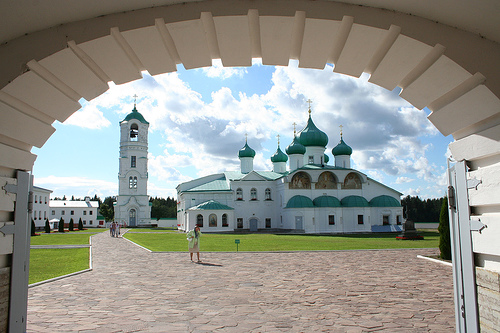
Location: 20 km (12.5 mi) East of Lake Ladoga, Leningrad Oblast Map
Found: 1487 by monk Alexander
The Holy Trinity Alexander-Svirsky Monastery (Свято-Троицкий
Александро-Свирский монастырь) is one of Russia's most significant and
architecturally distinctive Orthodox monasteries. Located in the dense
forests of Leningrad Oblast, about 260 km northeast of St. Petersburg,
21 km from Lodeynoye Pole, and 6 km from the Svir River near
Roshchinskoye (Holy) and Roshchinsky Lakes, it sits in a historically
remote area once inhabited by pagan Karelian, Veps, and Chud peoples.
Founded in the late 15th century, the monastery consists of two
interconnected but originally semi-independent complexes—the Trinity
Cloister (eastern, with brotherly cells) and the Transfiguration
Cloister (western, near the cemetery)—linked by a road along the
lakeshore. It is renowned for its role in Russian monasticism, its
unique 17th-century architecture (including one of Russia's few
surviving three-tented belfries), and its deep ties to Saint Alexander
of Svir, whose incorrupt relics remain its central holy relic.
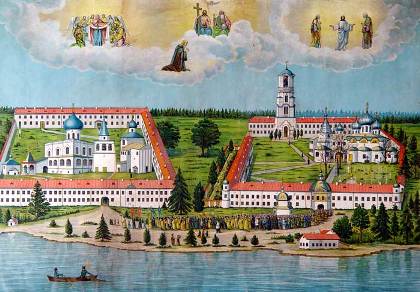
Founding and the Life of Saint Alexander of Svir (Late
15th–Early 16th Century)
The monastery's origins trace to
1487 (or the late 1480s/early 1490s per some accounts), when the
monk Alexander (born Amos in 1448 to peasant parents Stefan and
Vassa in the village of Manevo near the Oyat River in the
Novgorod Republic) settled in the wilderness. At age 19, he left
home for the Valaam Monastery
on Lake Ladoga, where he took monastic vows and lived as a
hermit in a cave on Holy Island. After about 13 years at Valaam,
a divine vision—a great light and a voice—directed him to return
to the Svir River area to establish a new monastery. An angel
(appearing as a traveler) guided him to the exact site between
the lakes.
Alexander built a simple hut and lived in extreme
asceticism, surviving on forest berries, roots, and prayer amid
hunger, cold, and illness. His solitude ended when local
nobleman Andrei Zavalishin, while hunting, saw a mysterious
light over the hermit's cell and discovered him. Despite
Alexander's plea for secrecy, word spread, attracting disciples
and seekers of healing and counsel. The community grew rapidly.
A pivotal event was Alexander's vision of the Holy Trinity
around 1510–1520 (23 years after his arrival). While praying, he
beheld three radiant men (the Trinity) who instructed him to
build a church dedicated to the Holy Trinity and gather monks.
This rare vision—Alexander is one of the few saints to converse
directly with the Trinity—led to the construction of wooden
chapels: one to the Trinity and one to the Transfiguration of
the Savior. These gave rise to the twin cloisters. In 1506,
Archbishop Serapion of Novgorod appointed him hegumen. He was
later ordained a priest.
In his final years, the Virgin Mary
appeared to him with the Christ Child, promising the monastery
would never lack. Alexander died on August 30 (September 12 New
Style), 1533, at age 85 and was buried in the Transfiguration
Cloister, which remains the monks' burial ground. During his
lifetime, the oldest surviving building—the small stone Church
of the Intercession of the Holy Virgin (Pokrovskaya) with a
refectory—was constructed (1533–1536) with donations from Tsar
Vasily III; Alexander himself participated. A wooden Trinity
Church had been built and consecrated by him in 1509.
Early Growth and Canonization (Mid-16th Century)
Alexander's
disciples compiled his Life in 1545. In 1547—remarkably soon
after his death—the Russian Orthodox Church canonized him as a
saint during the reign of Ivan the Terrible (a synod under
Metropolitan Macarius). His relics were later found incorrupt in
1641. The monastery quickly became a beacon of Orthodoxy in a
pagan-leaning frontier region, drawing monks and pilgrims.
Golden Age: 17th Century Prosperity and Construction
The
17th century marked the monastery's "golden age." Despite being
sacked and burned three times by Swedish forces during the Time
of Troubles (early 1600s), it recovered strongly. Tsars granted
privileges, including tax collection rights from the annual Svir
Fair held at its walls, which boosted its economy as trade
routes shifted after the Russian-Swedish border stabilized west
of the Svir.
Major constructions included:
The
five-domed Transfiguration Cathedral (1641–1644), with a side
chapel to Saint Alexander; Tsar Mikhail Feodorovich gifted a
golden ark for the relics.
The Church of Saints Zachariah and
Elizabeth (completed 1668).
A three-tiered, three-tented
belfry in the Trinity Cloister (1646–1649)—one of Russia's rare
preserved medieval examples, along with a clock tower.
Most
monastic cells (1670s).
The spacious Trinity Cathedral
(completed 1695–1697).
The monastery received donations
from tsars, boyars, and merchants, amassing a rich library,
vestry, and icons. It oversaw regional spiritual life and was
later called the "Northern Lavra" for its influence (supervising
up to 27 smaller monasteries at its peak).
18th–19th
Centuries: Reforms, Education, and Stability
Catherine the
Great's 1764 ecclesiastical reforms secularized the monastery's
vast lands. The Transfiguration Cloister briefly served as the
residence for Olonets archbishops and a seminary (1764–1786).
Additional buildings included the Church of St. John of Damascus
(1718, hospital chapel) and the Gate Church of St. Nicholas
(1791).
In the 19th century, it hosted the Svir (Olonets)
two-class spiritual school (1802–1870) for clergy children. It
regained independence in 1890. A chapel was added in 1900
commemorating the imperial family's survival of a train crash.
By the early 20th century, it featured eight churches, a brick
factory, sawmill, and thriving monastic life.
Soviet Era:
Persecution, Closure, and Repurposing (1918–1990s)
The 1917
Revolution brought catastrophe. In autumn 1918, Chekists
(Bolshevik secret police) seized and looted the monastery. Abbot
Archimandrite Evgeny (Trofimov) was executed. On December 20,
1918, Saint Alexander's relics were removed and taken to
Leningrad; authorities falsely claimed they contained a wax doll
(later disproven by commissions confirming a human body). Monks
were dispersed, imprisoned, or killed.
The site became part
of the Svirlag Gulag labor camp (1931–1937), then housed
children's homes, disability facilities, a sovkhoz (state farm),
and— from 1953 to 2009—the Trinity Cloister served as the
Svirskaya Psychiatric Hospital. Churches were boarded up or
damaged; WWII added further harm. The Transfiguration Cloister
retained some monastic use initially but overall declined
severely.
Revival and Modern Era (1990s–Present)
Restoration began in 1997 with new monastic inhabitants. On July
30, 1998, Saint Alexander's relics were triumphantly returned to
the Transfiguration Cathedral after decades hidden as an
"unknown man" in a St. Petersburg medical academy. This event,
along with the saint's intercession, fueled the revival.
Liturgical life resumed, buildings were restored, and the
territory was cleared.
Today, it operates as a male monastery
in the Tikhvin and Lodeynoye Pole Diocese of the Russian
Orthodox Church (abbot: Bishop Mstislav (Dyachina) since
2011/2012). The Transfiguration Cloister houses the active
monastic community; the Trinity Cloister was vacated by the
psychiatric hospital in 2009 and is undergoing full restoration.
It maintains a courtyard chapel in St. Petersburg and a festive
hierarchical choir (established 2012) performing ancient chants.
Key relics include Saint Alexander's incorrupt body (in a golden
ark), particles of other saints, a copy of the Turin Shroud, and
a holy spring. It remains a major pilgrimage site and federal
cultural heritage monument.
The monastery exemplifies Russian
northern monastic resilience: from wilderness hermitage to
imperial "Northern Lavra," through Soviet desecration, to active
spiritual center. Its preserved 16th–19th-century
ensemble—frescoed cathedrals, unique belfry, and lakeside
setting—continues to inspire, with Saint Alexander's legacy of
Trinity devotion and asceticism at its heart.
The Alexander-Svirsky Monastery (full name: Holy Trinity
Alexander-Svirsky Monastery, or Свято-Троицкий Александро-Свирский
монастырь) is one of the most architecturally distinctive Russian
Orthodox monastic ensembles in northwestern Russia. Located in the
village of Staraya Sloboda, Leningrad Oblast (about 20 km east of Lake
Ladoga and 260 km northeast of St. Petersburg), it sits on the
picturesque shore of Roshchinsky Lake amid dense northern forests.
Founded in 1487 by St. Alexander of Svir (a monk from Valaam Monastery),
the site originated from two wooden chapels built after his vision of
the Holy Trinity in 1508—one dedicated to the Trinity and one to the
Transfiguration of the Savior. This dual dedication gave rise to its
unique structure: two separate but interconnected architectural
complexes (cloisters) about 250–300 meters apart, linked by a lakeside
road and enclosed within fortified stone walls with towers.
The
monastery exemplifies northern Russian Orthodox monastic architecture
from the 16th to early 20th centuries. It features whitewashed stone and
brick structures, onion domes (often turquoise or green), tented roofs
(shatry), integrated refectories, covered galleries (gulybishche), and
defensive elements adapted to the harsh forested climate. Early
buildings show Novgorod influences (simple, robust forms), while the
17th-century “golden age” (under the early Romanovs) brought more
elaborate multi-domed cathedrals and rare tented belfries. Later
additions incorporate Baroque, neoclassical, and Byzantine revival
elements. Interiors typically include rich frescoes, iconostases, and
functional monastic spaces (cells, hospitals). The ensemble survived
Swedish raids (1581, Time of Troubles), Soviet repurposing (including as
a gulag and psychiatric hospital), and WWII damage, with ongoing
restorations preserving its status as a major architectural monument.
Trinity Complex (Troitsky / Eastern Cloister)
This is the older,
more compact historic nucleus, centered on communal and liturgical life
with brother cells. It served briefly as a bishops’ residence
(1764–1786) and later housed a psychiatric hospital (1953–2009). Its
architecture emphasizes austere functionality with picturesque
silhouettes against the forest.
Church of the Intercession of the
Most Holy Theotokos (Pokrovskaya Church) with refectory (1533–1536): The
oldest surviving stone building, constructed during St. Alexander’s
lifetime (he participated directly) with funding from Tsar Vasily III.
Built in the Novgorod style by Moscow master Ignatiy, it is a small,
single-domed winter church with elegant proportions. A large adjoining
refectory chamber includes a ground-floor kitchen, creating a
self-sufficient communal space. It features a subterranean cell linked
to the founder’s prayers. This structure anchors the complex and
demonstrates early 16th-century northern simplicity—robust stone walls,
minimal decoration, and practical integration of worship and daily life.
Three-tiered Belfry (Zvonitsa) (1646, sometimes dated 1649): One of the
monastery’s most iconic and rare features—one of the few preserved
three-tented belfries in Russia (crowned with three shater tent roofs).
Built in three tiers for acoustic projection across the forest, it was
originally linked to the cathedral by a suspended passage and included
medieval clock-tower elements. Its striking, multi-roofed silhouette is
a highlight of 17th-century prosperity under Tsar Mikhail Feodorovich.
Holy Trinity Cathedral (Troitsky Sobor) (1695–1697): The main, spacious
cathedral, replacing earlier wooden structures. A large stone basilica
(often described as four-pillar) with onion domes and a covered gallery
(gulybishche) encircling three sides for processions. The vaults feature
impressive early 18th-century frescoes (1709) by a Novgorod-Kostroma
artel led by icon painter Leontiy Markov, including detailed biblical
scenes and the Last Judgment. It exemplifies late-17th-century northern
grandeur with harmonious proportions and rich interior decoration.
Supporting structures: Monastic cells (mostly 1670s), the hospital
chapel of St. John of Damascus (1716–1718, a modest late addition beside
medical cells), and the igumen’s quarters (1789, funded by Catherine the
Great). The compact layout prioritizes enclosed monastic routine within
high walls.
Transfiguration Complex (Preobrazhensky / Western
Cloister)
Located near the monastic cemetery (where St. Alexander was
buried), this complex is slightly more open and focused on relic
veneration and entry points. It evolved from the founder’s original cell
and vision site.
Transfiguration Cathedral (Spaso-Preobrazhensky
Sobor) (1641–1644): The centerpiece—a five-domed (pyatiglavy) stone
cathedral built as a four-pillar, three-apsed basilica with gabled
facades during the monastery’s 17th-century revival. It includes a
northern chapel dedicated to St. Alexander Svirsky (expanded 1716 to
house his relics in a golden ark gifted by Tsar Mikhail Feodorovich).
Later modifications (1873–1874) extended it westward into a six-pillar
form with Baroque choir elements; interiors feature 1903–1904 frescoes
and restored iconostases. Adjoining it (north) is the single-apsed
Church of Sts. Zacharias and Elizabeth (1668, by master Maxim Semyonov),
linked by a vaulted gallery—its facades feature pilasters, decorative
“shirinki” friezes, and keel-arched portals. This ensemble represents
peak 17th-century Russian Orthodox cathedral design with later Baroque
influences.
Gate Church of St. Nicholas the Wonderworker (1791): A
later over-the-gate church marking the main entrance, introducing
neoclassical elements typical of late-18th/early-19th-century monastic
architecture.
Bell tower (1903–1904): Erected in Byzantine-revival
style with an open belfry tier—adding vertical emphasis and stylistic
variety to the complex.
Chapels: A small chapel marks the exact site
of the Holy Trinity’s apparition to St. Alexander (on the foundations of
an earlier wooden church); another commemorates the founder’s well.
These modest structures tie directly to the monastery’s spiritual
origins.
Additional Features and Significance
High stone walls
(17th century) enclose both complexes, reflecting defensive northern
monastic design. The overall color scheme—white walls contrasting with
colorful domes and tents—creates a harmonious, luminous effect in the
lakeside forest setting. Some 19th–20th-century elements show European
or revivalist influences, unusual in traditional Russian monasteries.
As a center of Orthodox monasticism, the monastery embodies themes of
divine revelation, asceticism, and missionary zeal. Saint Alexander's
vision of the Trinity is a cornerstone, making it a site of profound
spiritual importance—pilgrims visit to venerate his relics, believed to
possess healing properties. It played a pivotal role in Christianizing
the northern regions, converting local pagan communities through
Alexander's example. Culturally, it preserves Russian ecclesiastical
art, music, and traditions; for instance, the monastery's choir is noted
for its resonant Orthodox chants, with recordings circulating online.
In modern times, it attracts tourists and believers alike for its
historical authenticity and tranquil setting. Reviews highlight its
"unique atmosphere" and worth as a stop during travels through Karelia.
It is listed among Russia's national landmarks and continues to host
religious services, feasts, and events, underscoring its enduring legacy
in Russian history and Orthodoxy.