Location: North of lake Ladoga Map
Constructed: 1407
Valaam Monastery, also known as the Valaam Monastery of the
Transfiguration of the Savior, is a stauropegic Orthodox monastery under
the direct jurisdiction of the Russian Orthodox Church. It is situated
on Valaam Island, the largest island in Lake Ladoga—Europe's largest
freshwater lake—in the Republic of Karelia, northwestern Russia. The
archipelago consists of over 50 islands, covering about 36 square
kilometers, characterized by rocky terrain, dense coniferous forests,
and a milder microclimate compared to the surrounding mainland. This
remote, scenic location has long symbolized spiritual seclusion and
resilience, serving as a northern outpost of Eastern Orthodoxy.
The monastery's setting enhances its mystical appeal: surrounded by
crystal-clear waters teeming with fish, including rare Ladoga ringed
seals, and featuring inner lakes connected by canals, arch bridges, and
winding paths through silver fir and larch groves. These natural
elements not only provide a serene environment for monastic life but
also attract pilgrims and tourists, with the island's farms, orchards,
and even a trout farm and cheese dairy demonstrating the monks'
self-sufficiency. Historically, the monks cultivated exotic produce like
melons (up to 3 kg) and watermelons (up to 8 kg) in greenhouses, a
testament to their ingenuity in this northern climate.
The Valaam Monastery, also known as the Valaam Transfiguration
Monastery, is a renowned stauropegic Orthodox monastery located on
Valaam Island in Lake Ladoga, the largest lake in Europe, within the
Republic of Karelia, Russia. It stands as one of the most
spiritually significant sites in Russian Orthodoxy, often called the
"Northern Athos" due to its monastic traditions and seclusion. The
monastery complex includes a central estate with cathedrals, cells,
and administrative buildings, as well as numerous sketes (smaller
hermitages) scattered across the archipelago's islands. Its history
spans over a millennium, marked by periods of founding legends,
prosperity, destruction from wars, suppression under Soviet rule,
and a robust revival in the post-Soviet era.
Founding Legends
and Early History
The exact founding date of Valaam Monastery
remains debated among historians, with no primary documents
referencing it before the 16th century. Church tradition attributes
its establishment to two 10th-century missionaries: the Greek monk
Sergius of Valaam and his Karelian companion, Herman of Valaam, who
are venerated as saints and considered the monastery's patrons.
According to this legend, they arrived in the region as evangelists
from Novgorod, establishing a monastic community on the island to
spread Orthodoxy among local pagan tribes. However, scholarly
consensus leans toward a later date, with some sources, including
the 16th-century manuscript "Tale of the Valamo Monastery,"
suggesting the late 14th century—specifically between 1389 and
1393—during the archiepiscopate of Ioann II of Novgorod. Other
theories propose the 12th century, but these are considered too
early by modern historians. A colorful legend from the medieval
period claims that Magnus II Eriksson Smek, King of Sweden (r.
1319–1364), converted to Orthodoxy, became a monk named Gregory, and
was buried on the island, with his grave still marked in the old
cemetery.
In its early years, Valaam served as a northern outpost
for the Eastern Orthodox Church, evangelizing pagan populations and
later acting as a bulwark against Catholic influences from
Swedish-controlled regions like Tavastia, Savonia, and Karelia. By
the 15th century, notable figures like Reverend Alexander Svirsky
joined as a monk, living in a rock cave on what is now Holy Island
before founding his own monastery on the Svir River. The monastery
grew modestly, but its remote location made it vulnerable to raids.
Medieval Period and Conflicts (16th–17th Centuries)
The 16th
century brought intense border struggles between Russia and Sweden,
transforming Karelia into a contested frontier. In 1578, Lutheran
Swedish forces attacked Valaam, beating numerous monks and novices
to death. Another devastating assault in 1611 led to the burning of
buildings and the monastery's depopulation, leaving it desolate
until 1715, when the Karelian border was redrawn through Lake
Ladoga. These repeated attacks highlight Valaam's precarious
position amid geopolitical tensions, with the monastery often
ravaged due to its strategic lakeside location near Swedish
territory.
18th–19th Century Prosperity and Expansion
Recovery began in the early 18th century under Russian imperial
patronage. In 1715, Emperor Peter I issued a decree for the
monastery's reconstruction, initiating a period of magnificent
restoration. New buildings were erected, and the complex expanded
significantly. By 1793, under Abbot Nazarius and at the behest of
Empress Catherine II, Valaam sent a missionary group of eight monks
to Alaska, including Saints Herman and Juvenaly, who traveled
through Siberia and arrived in Kodiak in 1794 to evangelize
indigenous populations. This mission underscored Valaam's role in
global Orthodox outreach.
In 1809, following Sweden's cession of
Finland to Russia, Valaam fell under the autonomous Grand Duchy of
Finland. Emperor Alexander I visited in 1819 and elevated it to
first-class status, granting benefits that fueled growth. Under
Father Superior Damaskin (1839–1881), the monastery reached a peak
of prosperity: the stone Transfiguration Cathedral with its bell
tower was constructed, and the community became self-sufficient
through sawmills, farms, fisheries, and gardens. By the early 20th
century, it controlled about 20 sketes and housed around 600 monks,
making it one of Russia's wealthiest monasteries. Architectural
developments included canals with arch bridges, alleys of fir and
larch trees, and a mix of stone structures blending Russian and
Finnish influences.
20th Century: Wars, Revolution, and
Soviet Suppression
The Bolshevik Revolution of 1917 shifted
Valaam's fate when Finland gained independence, placing the
monastery under the Finnish Orthodox Church, which became autonomous
under the Ecumenical Patriarchate of Constantinople. This shielded
it from Soviet anti-religious campaigns but sparked internal
divisions: the switch from Church Slavonic to Finnish liturgy and
from the Julian to Gregorian calendar led to expulsions of
dissenting monks. In the 1920s and 1930s, it became a pilgrimage
haven for Russian emigrants, preserving a slice of "old Russia."
World War II brought further upheaval. During the Winter War
(1939–1940) between Finland and the Soviet Union, the monastery was
evacuated, with 150 monks relocating to Heinävesi, Finland, where
they founded the New Valaam Monastery (still active today as the
Finnish Orthodox Church's sole monastery). The island fell under
Soviet control, and during the Continuation War (1941–1944), Finns
briefly occupied it, establishing a military base with artillery on
nearby Oboronny Island. Post-war, the entire Lake Ladoga region
became Soviet territory, and Valaam was repurposed as a military
base, then as a state farm, tourist site, hospital for disabled
veterans, and nature reserve. Monastic life ceased, buildings
deteriorated, and in 1979, it was designated a
historical-architectural-natural museum-reserve.
Post-Soviet
Revival and Modern Era
With the easing of Soviet restrictions on
religion in the 1980s, Valaam was returned to the Russian Orthodox
Church in 1989, marking the start of its revival. Under the personal
patronage of Patriarch Alexy II (who had visited as a child),
extensive restorations began, including repairs to the
Transfiguration Cathedral's interiors and murals. In the late 1990s,
the monastery gained legal authority over the island to enforce
spiritual seclusion, leading to the eviction of many secular
residents through court proceedings. Today, it sustains itself via a
trout farm, cheese dairy, orchards, and tourism, with a professional
male-voice choir touring internationally to fund projects. The
current abbot is Bishop Pankraty (Zherdev) of Troitsk.
A notable
setback occurred on May 1, 2016 (Orthodox Easter), when a fire
destroyed the 1850s-era "Winter Hotel," a national heritage site
adjacent to the main chapel, though no casualties were reported.
Despite this, Valaam remains a vibrant center of Orthodox
monasticism, with 12 active sketes (such as Nikolsky, Voskresensky,
and Gethsemane) open to pilgrims, and it continues to attract
visitors for its natural beauty and spiritual heritage. The
monastery's history reflects broader themes in Russian Orthodoxy:
resilience amid persecution, cultural preservation, and adaptation
to changing political landscapes.
The monastery's architecture blends Russian Orthodox traditions with
neoclassical and revivalist elements, much of it rebuilt in the
18th–19th centuries. The central estate revolves around the
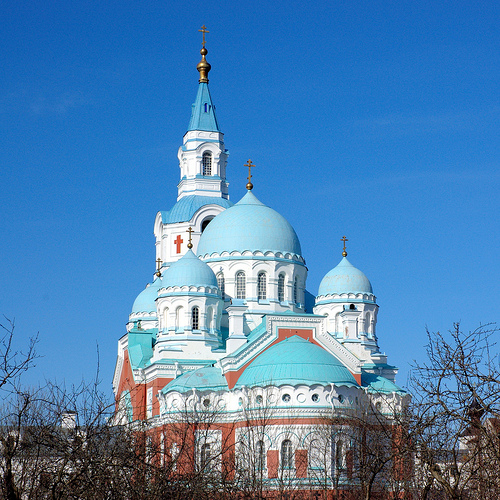
Transfiguration Cathedral, a grand structure with blue domes, white
walls, and intricate frescoes depicting biblical scenes and saints'
lives. Designed by architect Aleksey Gornostayev in the mid-19th
century, it features a multi-tiered iconostasis adorned with gold leaf
and precious stones, serving as the spiritual core where daily services
and chants occur.
Surrounding the cathedral are monks' cells, a
refectory, administrative buildings, and the Father Superior's
residence. The complex includes bell towers and chapels, with pathways
leading to 12 sketes (hermitages) scattered across the islands—smaller
monastic communities for contemplative life. Publicly accessible sketes
include Nikolsky (on a rocky outcrop with views of Ladoga), Voskresensky
(Resurrection), and Gethsemane, each with distinct chapels in varying
styles, from wooden to stone. Others, like the Holy Island skete,
feature caves used by early ascetics, such as Reverend Alexander Svirsky
in the 15th century.
Defensive elements, like fortifications on
Oboronny Island (including WWII-era Finnish artillery), reflect the
site's military history. The overall design emphasizes harmony with
nature, with gardens, alleys, and bridges enhancing the meditative
atmosphere.
Valaam holds profound religious importance as a center of Russian
Orthodoxy, often called the "Northern Athos" for its ascetic traditions
and influence on northern monasticism. It has produced numerous saints
and spiritual leaders, with monastic life centered on prayer, labor, and
hospitality. The unique Valaam chant—a diatonic, two-part style blending
Byzantine and ancient Znamenny elements—features simplified melodies and
ison (drone) accompaniment, distinguishing it from other Orthodox
traditions. This chant has been experimentally adopted in Russian
parishes since the late 20th century.
Culturally, Valaam is a
regional heritage site, symbolizing resilience amid geopolitical shifts.
Its library and archives preserve rare manuscripts, and it has inspired
artists, writers, and composers. The monastery operates under Patriarch
Kirill's patronage, with Bishop Pankratius (Zherdev) as the current
hegumen, emphasizing spiritual purity over tourism.
Today, Valaam thrives with around 200 monks, focusing on restoration
and seclusion. It gained legal control over much of the island in the
2000s, leading to resident relocations and controversies over land
rights. The site attracts thousands of pilgrims and tourists annually,
though access is seasonal (mid-May to late October) and
weather-dependent.
Visitors arrive by boat from Sortavala (50 minutes
by hydrofoil), Priozersk, St. Petersburg, or Petrozavodsk, or by
helicopter. On-site accommodations include the Pilgrim House "Valaam"
(renovated 19th-century building with modern amenities) and "Igumenskiy"
(simpler dormitory-style). Guided tours cover the central estate,
sketes, and nature trails, with summer concerts of Valaam chants. Strict
dress codes and behavioral rules apply, reflecting its active monastic
status.
In summary, Valaam Monastery embodies centuries of faith,
endurance, and natural beauty, remaining a vital spiritual beacon in the
Orthodox world.