Location: Yalta municipality Map
Elevation: 1234 meters (4049 feet)
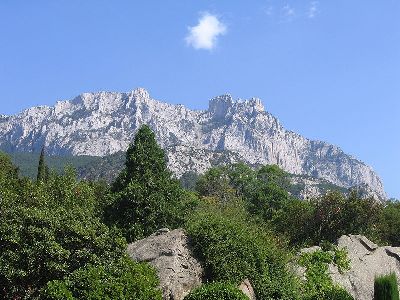
Ai-Petri is located in the Crimean Mountains, Crimea. Ai-Petri is a peak and a mountain range with an area of more than 300 km2, one of the table massifs (they are also called yayls), stretched along the southern coast of Crimea and making up the main mountain range. The Ai-Petri massif extends from east to west for 25 km.
Location and Topography
Coordinates: Approximately 44°27′04″N
34°3′10″E.
Elevation: The main peak reaches 1,234 m (4,049 ft) above
sea level. The broader Ai-Petrinskaya Yayla (plateau/massif) includes
higher points, such as Bedene-Kyr (Quail Mountain) at around 1,334–1,346
m.
It sits above the resort towns of Alupka and Koreiz on the
southern coast of Crimea, offering dramatic views over the Black Sea,
Yalta, and the coastal strip. The southern slopes drop steeply toward
the sea, while the northern side transitions into a flatter plateau.
The massif forms part of the main ridge of the Crimean Mountains and
is one side of the Grand Canyon of Crimea (the other being the Boyka
massif). The Ai-Petrinskaya Yayla is a large, somewhat plateau-like
highland area spanning roughly 300 km² and extending about 25 km
east-west. It features a characteristic karst landscape with extensive
limestone dissolution.
A defining visual feature is the jagged
"teeth" or rocky pinnacles (sometimes called "dragon's teeth") along the
crest—sharp limestone formations rising 60–80 meters, shaped by
differential weathering and erosion over millions of years.
Geology
Ai-Petri is primarily composed of Upper Jurassic reef
limestones, which originated as fossil coral reefs in a shallow marine
environment. Around 200 million years ago, the area was submerged under
an ancient ocean; tectonic uplift later exposed these formations.
The
plateau is a classic karst region:
Numerous caves, tunnels (totaling
~1,800 m in some counts), chasms, sinkholes, and underground wells.
Limestone dissolution creates features like the famous Trekhglazka Cave
(Three-Eyes Cave) and others.
The "teeth" result from long-term
erosion of inhomogeneous reef rock.
Volcanic influences are noted in
the broader Crimean context, with remnants visible nearby.
This karst
system is hydrologically important, supplying water via underground
sources to nearby populations.
Climate
Ai-Petri has a distinct
highland climate that contrasts sharply with the subtropical
Mediterranean-like conditions on the nearby southern coast:
Windy:
One of the windiest spots in Crimea — winds blow ~125 days per year,
with gusts up to 50 m/s (110 mph / ~180 km/h).
Foggy: Extremely foggy
(one of the foggiest places on the peninsula, with reports of 215 foggy
days annually in some sources), creating a mysterious atmosphere.
Temperature: Cooler and more variable than the coast. Snow is common in
winter, sometimes creating Arctic-like conditions at the top while the
coast remains milder. Summers are relatively mild but can be dry.
Precipitation supports meadows and forests but contributes to the karst
hydrology.
Flora (Vegetation)
Ai-Petri and its surrounding reserve host
exceptional plant diversity, with over 600 vascular plant species across
its ecosystems (some sources note up to 1,363 species for the broader
Yalta reserve). About 75% of the Yalta Mountain-Forest Nature Reserve is
forested, with vegetation changing markedly by altitude.
Altitudinal
Zones:
Lower slopes (up to ~400 m): Dominated by pubescent oak
(Quercus pubescens) forests mixed with Greek juniper (Juniperus
excelsa), pistachio (Pistacia mutica), and shrub communities including
hornbeam, hold-tree (derzhiderevo), strawberry tree (Arbutus
andrachne—with distinctive smooth reddish bark), jasmine, and other
Mediterranean-style shrubs.
Mid-elevations (400–900/1,000 m): Mixed
broadleaf-conifer forests with Crimean pine (Pinus nigra subsp.
pallasiana), sessile oak (Quercus petraea), ash, hornbeam (Carpinus
betulus), and maples. Beech begins appearing. Crimean pine is a key
species, forming beautiful stands.
Higher elevations (900–1,200+ m,
including the plateau): Oriental beech (Fagus orientalis) forests
dominate on flatter areas (beech makes up a large portion of reserve
forests, around 59% in some descriptions), with pines on slopes. The
open Ai-Petri Yayla plateau features subalpine meadows, mountain
steppes, and grasslands with feather grasses (Stipa spp.), fescues
(Festuca spp.), sedges, and herbaceous plants adapted to wind, thin
soils, and karst conditions.
Notable and Endemic Species:
Early spring bloomers: Snowdrops (Galanthus spp.), crocuses (including
the Crimean endemic Crocus pallasii), lilies-of-the-valley (Convallaria
majalis), violets.
Endemics/relicts: Crimean peony (Paeonia daurica
subsp. taurica), low carnation (Dianthus juniperinus subsp. hypovanus),
Crimean bindweed (Convolvulus tauricus), yayla dubrovnik (Teucrium
montanum subsp. yaylensis), Crimean androsace (Androsace taurica), and
others. Many are Tertiary relicts preserved in these isolated habitats.
Fruit/berry trees and shrubs are common in forests, supporting wildlife.
The plateau's open meadows and rocky outcrops create colorful
seasonal displays, though the area faces pressures from tourism,
potential overgrazing (historically), and invasive alien plants (78
documented in the reserve).
Fauna (Wildlife)
The region
supports diverse wildlife adapted to forests, meadows, cliffs, and
varying altitudes, with over 200 vertebrate species recorded in the
broader Crimean reserves. Protection within the nature reserve helps
maintain populations.
Mammals:
Ungulates: Crimean red deer
(Cervus elaphus brauneri—a subspecies, with populations around 500 in
reserves), roe deer (Capreolus capreolus).
Smaller mammals: Caucasian
squirrel (Sciurus anomalus), various rodents, hares.
Predators:
Wolves, foxes, and others typical of Crimean mountain forests (though
larger carnivores like bears are more associated with other parts of
Crimea).
Birds:
Over 150 species, including raptors like the
golden eagle (Aquila chrysaetos) nesting on cliffs.
Woodland and
meadow species: Coal tit (Crimean subspecies), black grouse (Tetrao
tetrix—populations have declined), various passerines.
The area is
important for breeding and migration.
Reptiles and Amphibians:
Lizards: Crimean lizard (Darevskia lindholmi, endemic).
Snakes:
Aesculapian snake (Zamenis longissimus) and others.
Limited
amphibians due to the terrain/climate.
Invertebrates:
High
endemism, including butterflies (e.g., Parnassius spp.) in alpine zones.
Cave fauna includes specialized spiders and other arachnids in the many
karst caves.
The fauna benefits from the mosaic of habitats:
dense forests for cover and food, open plateaus for grazing/breeding,
and cliffs/caves for nesting and refuge. Conservation focuses on
anti-poaching and habitat protection, though challenges like habitat
fragmentation and invasive species (e.g., American mink) exist.
By cable car
The upper station of the cable car (Miskhor -
Ai-Petri).
By minibus
From the bus station of
Yalta or from the lower station of the cable
car. The price is on average equivalent to the fare on the cable car.
By car
The 65-kilometer Bakhchisaray highway TO117 passes through
Ai-Petri, starting in Yalta and going to the village of Zheleznodorozhny
in the suburbs of
Bakhchisaray.
From Yalta, the
road is a thin winding serpentine.
From the north, the road is more gentle and crosses the villages of
Tankovoe, Kuibyshevo and Sokolinoe. Under difficult weather conditions
and during the fire hazard period (July-August), the road is often
blocked by the traffic police for safety reasons. Sometimes only light
vehicles pass.
On foot
Walk along one of the trails described
below.
Contributions and passes
No. They may ask for an
entrance fee for climbing to the highest point of Ai-Petri.
A number of climbing routes of 1-5 category of difficulty have been
laid to the top of the mountain, including through the teeth of
Ai-Petri.
Also in the immediate vicinity of the summit are the
beginnings of several freeride trails.
From about the end of November
until the end of March, snow lies on the mountain. There are six tracks
for skiing and snowboarding, with a length of 120 to 1030 m and a height
difference of 20 to 170 m. With two lifts and eight towing devices. Ski
rental - about 400 rubles, sled - 200 rubles. (2015). But before going
to the mountain, it is advisable to call the KSS station on Ai-Petri and
clarify what is the snow layer and whether it is sufficient for skiing;
you can also check it yourself by looking at the webcams installed on
the mountain.
Two suspension bridges were stretched to the teeth of
Ai-Petri, connecting the teeth and the main plateau. There was a
"bungee" and jumping. Removed in 2014 due to security concerns.
Ai-Petri trails for descent
Taraktashskaya (goes to the Uchan-Su
waterfall, from there along the Shtangeevskaya and Botkinskaya trails
you can get to the Glade of Fairy Tales in Yalta);
Koreizskaya or
Miskhorskaya (located under the cable car and leads to Koreiz, Miskhor);
Malay-Bogaz (on the western side of Ai-Petri, closer to Alupka);
Shanghai Eastern and Western (both lead to Alupka, the western one is
more difficult);
"Jew" (will also lead to Alupka).
The most
convenient way to get to the high mountain plateau of Ai-Petri is by
climbing the Iograf. Iograph is a ridge, a narrow path along which
gradually gains height and leads you to the very top. Such a smooth
climb makes climbing the mountains accessible to middle-aged people and
people without special training. Route: Yalta city - Temiar spring -
Iograf ridge - Yerakh-Hul rock - Yalta city. Range: 13 kilometers.
Shopping
There are no ATMs, bank branches, or currency exchange
offices on the Ai-Petri plateau. However, souvenir shopping is very well
represented. You’ll find multiple rows of stalls and shops offering a
wide variety of local souvenirs, including products made from natural
juniper wood, genuine fur items (hats, vests, slippers), handmade
crafts, and fragrant Crimean herbal tea sets with mountain herbs.
Restaurants & Cafes
Right near the upper cable car station (exit
point), there is a good selection of cafes, restaurants, and food
stalls. They operate year-round and are quite numerous. The cuisine is
mainly Crimean Tatar (lagman, shurpa, chebureki, pilaf) mixed with
classic Russian-Ukrainian dishes (borscht, dumplings, okroshka, grilled
meats).
A second cluster of restaurants and guesthouses is located in
the small mountain village of Okhotnichye, a few hundred meters from the
cable car top station.
Recommended Spot:
Cafe "Baron
Munchausen" – located about 300 meters from the upper cable car station.
☎ +7 (978) 018-6182, +7 (978) 018-6175
Prices (approximate, from
2014):
250g BBQ — 200 rubles
Borscht, okroshka, pilaf, lagman,
shurpa — 150 rubles
The cafe enjoys mostly positive reviews for
tasty, hearty food and friendly atmosphere, though some visitors find it
a bit pricey. The owner, Viktor, is known for his hospitality — he
sometimes offers free overnight stays in the common room of the cafe (no
private rooms). Free Wi-Fi is available.
Where to Stay
The
highest mountain settlement in Crimea is the small village of
Okhotnichye, situated on the Ai-Petri plateau near the famous Shishko
Rock observation deck. The central part of the village lies at 1,160
meters above sea level, offering stunning views and a true highland
atmosphere.
Near the upper cable car station, several cafes and small
guesthouses provide basic overnight accommodation. In 2014, a separate
room for two people typically cost around 1,000 rubles per night.
Accommodations
Tourist shelter "Ai-Petri"
Location:
Okhotnichye village, Bakhchisarai highway, 9
☎ +7 (978) 806-10-82
Camping
Camping with tents is prohibited within the Ai-Petri
reserve.
The only exception is the area near the Ai-Petri cordon
(forest ranger station), and even then, you must obtain official
permission from the foresters beforehand.
Precautionary measures
If you decide to climb the mountain in any known way, it is strongly
recommended to bring warm clothes (sweater or windbreaker) with you. If
it is hot at the foot of the mountain, this does not mean at all that it
will also be hot at the top - most likely it will be very cool there,
and if fog comes up (and this is an ordinary cloud), it can become quite
uncomfortable and you stop your walk very quickly.
The
importunity of local barkers and taxi drivers pretty much spoils the
overall impression. Moreover, they are often aggressive. But it is worth
pushing through their crowd - and everything changes dramatically, only
nature and, maybe, some rare tourists remain around. They are
concentrated near the lower and upper stations of the cable car (and
within a radius of 500 meters from them), they are also present in small
numbers in the village of Okhotnichy, but they are already more
good-natured there.