Hotels, motels and where to sleep
Restaurant, taverns and where to eat
Izborsk is located in the western part of the
Pskov region, 30 km west of Pskov. The official name of the
historical Izborsk - Old Izborsk. The village of New Izborsk is
quite far from the Old, and is of no interest to the traveler.
In The Tale of Bygone Years, Izborsk is mentioned along with
Novgorod, Ladoga, and Kiev, and thus is one of the oldest
settlements of northwestern Russia. According to legend, in 862,
Izborsk went to Truvor, Rurik's younger brother, who became his
first prince and was buried in Izborsk. In the XIV century, a
powerful fortress was built, which for hundreds of years never
succumbed to the constant attacks of the Livonian Order.
To
our time, Izborsk turned into a village, which preserved, however,
remarkable monuments: the Izborsk fortress (walls and towers are
preserved), as well as natural attractions - Slovenian Keys and
Truvorovo Mound.
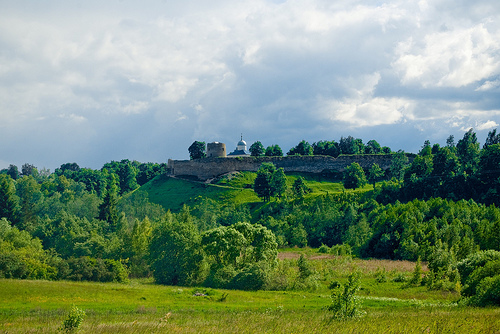
1 Izborsk Castle.
Open: around the clock. 20 rubles (2013). It is one of the oldest
fortresses of the North-West of Russia. Its first chronicle mention
refers to the year 862 and it is this date that is considered the
year of its foundation, although, most likely, the fortification
existed at this place much earlier. The fortress that reached us was
built in the XIV century on a limestone hill of gray untreated stone
- all the same limestone. The outlines of the fortress are not the
result of a well-thought-out project, but were determined by the
natural outlines of the natural elevation. During the
Russian-Lithuanian wars, the fortress withstood many sieges, but it
was well preserved to this day and, uncharacteristically, was not
rebuilt at a later time. The length of the walls of the fortress is
850 meters with 7 towers. It is necessary to climb the Lukovka tower
(daily, 10.00–19.00, 40 rubles) - the oldest tower of the fortress -
and enjoy the beautiful landscapes of the Izborsk-Malsky valley. In
the basement of Lukovka there is a small exposition of historical
weapons.
On the territory of the fortress stands Nikolsky
Cathedral (XIV century; rebuilt, but retained elements of Pskov
architecture) and a couple of small, unremarkable buildings. From
the fortress begins the trail leading along the lake to the north,
and then branching out: one path leads down to the Slovenian
springs, and the other goes up to the settlement.
2 Slovenian
springs (or springs of the Twelve Apostles). Powerful groundwater
exits from the steep coastal terraces of Lake Horodyshche, forming
small waterfalls. Springs are located a little to the north of the
fortress, at the Gorodishchensky lake. The legend says that each
spring has its own miraculous power: one gives wisdom, the other
health, and together they form the river of life. On the springs are
the ruins of a water mill and a manor house, which stood here at the
beginning of the 20th century.
3 Truvorovo Settlement. The hill
on which, according to legend, settled in 862, the Truvor. Now here
is a cemetery with a stone Truvorovy cross, which dates from the XV
century and, of course, has nothing to do with Truvor himself.
However, the main attraction of the settlement is not the cross or
even the Nikolskaya Church (see below), but stunning views of the
Gorodishchenskoye Lake and the Izborsky-Malsky Valley. Truvorovo
Settlement - one of the most delightful places in the North-West of
Russia.
4 St. Nicholas Church at Truvorovoy Mound (1650). Located
in the southeastern part of the settlement and is the only surviving
building of the ancient Nikolsky Gorodishchensky monastery. No
documentary evidence of the date the church was built has been
discovered so far; it is only known that at the end of the
seventeenth century the stone Nikolskaya already existed. The upper
part of the church, apparently, was rebuilt in the XVIII century.
The church has a rare form of a small cupola and an unusual decor
with an abundance of almost Kabbalistic symbols that are not typical
for Orthodoxy.
Along with the main attractions, several unusual
chapels of the XVIII century are scattered around Izborsk.
Truvor
Cross at the Gorodishchenskoye Cemetery
For the celebration of
the 1150th anniversary of Izborsk, large-scale restoration work was
carried out: the fortress walls, all the towers, the battle
procession on the eastern fence, the green cellar in the Lukovka
tower, the secret passage to the water were restored. All restored
objects are available for visiting.
5
Church of St. Sergius of Radonezh. At the entrance to the fortress -
the small church of Sergius of Radonezh (the beginning of the XVIII
century).
6 Church of the Nativity of the Virgin. 17th century
7 Chapel of Our Lady of Korsun. Early 20th century
8 Chapel
Troitskaya. XVIII century
9 Chapel of Flora and Laurel. Early
eighteenth century
10 Slovenian springs. They are located not far from the Izborsk fortress on the shore terrace of the Gorodishchenskoye Lake, sometimes they were called the springs of the Twelve Apostles. The first written mention of these sources dates back to the seventeenth century. In the "Book of the Big Drawing" (the first geographical description of the Russian land) it is said that: "from Pskov, thirty miles to the west, the city of Izborsk stands on the Slovenian springs." Sources of karst-fissure type. Water intake is carried out on the territory of three to four kilometers. Passing through limestone and clay layers, the water is filtered and purified, but it still contains a lot of calcium and mineral salts. The mineralization of water is quite high, as is the power of the springs, which emit up to four liters of water every second. Slovenian keys are an Orthodox shrine. They are annually consecrated on Bright Week, on the day of the celebration by the Orthodox Church of the icon of the Mother of God "Life-Giving Spring".
11 State Museum-Reserve "Izborsk". The museum in Izborsk was founded in 1964 on the initiative of local residents. Worked on a voluntary basis. The local historian Sergey Alekseevich Shcherbakov became the first director. From the first days, the museum began to receive archaeological artifacts - finds of selected trees, household items, documentary materials. The name of Professor of the Russian Academy of Sciences, Academician Valentin Vasilievich Sedov is closely associated with the museum, under whose leadership since 1971 systematic archaeological research of the ancient Russian urban settlement began in Izborsk and a unique collection of archaeological objects was collected, which became the basis of the museum's stock collection. Since 1979, the museum has become known as the Museum of Defense Architecture, which was headed by Leonid Nikolaevich Panov in 1982. Through his efforts, in 1993 the museum became independent and received the status of a legal entity. In 1996, in accordance with Decree of the Government of the Russian Federation No. 43 “On measures to preserve the historical, cultural and natural heritage of the Izborsk-Malskaya Valley in the Pskov Region”, the State Historical, Architectural and Natural Landscape Museum-Reserve “Izborsk” was created with an area of 7734 hectares. On its territory there are 181 monuments of history, archeology, religious and civil architecture, nature, 12 are of federal significance. The Izborsk Museum-Reserve includes a branch of the Museum of the History of the City of Pechora and a museum-estate of the Seto people in the village of Sigovo.
Horse riding, organized by the museum-reserve "Izborsk". ☎
8-81148-96-696. 500 rub / hour Routes have a different duration from
half an hour to 4, 5 hours.
The path of health. It starts from
Truvorov settlement. The length of 6km round-trip.
Museums
1 Manor of the merchant Anisimov, Pechora, 41 a. Open from 10.00 to
18.00 daily. The exhibition "Chronicle of the Slavic-Russian
princely city of Izborsk: from the beginning of Russia to the
Poltava battle." The exposition will tell you about the birth,
history and development of one of the first cities in Russia -
Izborsk, which for more than six centuries defended Russian land
from enemies.
2 Outhouse of the estate of merchant Anisimov,
Pechora, 41 b. Open from 10.00 to 18.00 daily. The exposition “The
Izborsk Chamber of Russian Literature and the Orthodox Faith” is the
author’s exposition of murals by the People’s Artist of the USSR
Peter Ossovsky.
3 The estate of the merchant Shvedova,
Pechorskaya, 32. Open from 10.00 to 18.00 daily. The exhibition
"Russian and Seto. One land is a common story.” Presents a real
Russian stove, a collection of samovars, authentic furniture of the
time, the characteristic items of merchant life, old photographs.
1. Visa and Entry Requirements (Critical for International Travelers)
Russia requires a visa for most nationalities, including US citizens
(your location in Waukegan, Illinois, suggests you’re likely American or
traveling from the US). As of 2026:
US citizens are generally
issued 3-year multiple-entry tourist visas (under a bilateral
agreement). You can stay up to 6 months per visit (with 90 days in any
180-day period in some cases).
You need a visa support/invitation
letter (from a hotel, tour agency, or service like iVisa). Apply via the
Russian consulate or visa center in the US (Washington DC, New York,
Houston, etc.) with passport, photos, insurance, and the invitation.
E-visa is available for citizens of ~64 countries for short stays (up to
16 days), but US citizens are typically not eligible and must use the
standard process.
Processing takes 2–4 weeks (or longer). Costs are
around $300+ for the multi-entry visa.
Travel advisory note: The US
State Department currently advises against travel to Russia (Level 4: Do
Not Travel) due to security and limited consular support. Borders are
open, but check the latest official guidance. Have proof of onward
travel and funds.
If entering from Estonia (possible but less
common for first-time Russia entry), you’ll still need the Russian visa
and handle border formalities at points like Koidula. Always confirm
current rules via the Russian Embassy site.
2. International
Flights to Russia
Best hub: St. Petersburg (LED / Pulkovo Airport) —
Closest and most convenient (~260–325 km / 160–200 miles from Pskov).
Direct flights from many European cities, some Middle Eastern hubs, and
connections from the US (e.g., via Istanbul, Doha, or European
capitals).
Alternative: Moscow (SVO, DME, or VKO) — Farther (~760 km
/ 470 miles from Izborsk). More international options but adds
significant travel time to Pskov.
Pskov Airport (PKV) has no
international flights—only domestic routes to Moscow, Sochi, Mineralnye
Vody, and Kaliningrad on airlines like Rossiya or others. Useful only if
you’re already in Russia.
3. Getting from Major Hubs to Pskov
From St. Petersburg (recommended route, 3.5–5 hours total):
High-speed train (Lastochka): Fastest and most comfortable. Multiple
daily departures from Baltiysky Railway Terminal (or Ladozhsky).
Examples (2026 schedules; check tutu.ru or rzd.ru for exact times):
~06:55 → 10:25 (3h 30m)
~13:40 → 17:10 (3h 30m)
~20:20 → 23:50 (3h
30m)
Tickets: ~700–2,000 RUB (~$8–22) depending on class.
Comfortable, Wi-Fi, food available.
Bus: 4–5 daily (e.g., Sov
Avto, ECOLines) from St. Petersburg bus terminals. ~4–5 hours, cheaper
(~500–1,500 RUB). Slower but direct to Pskov Bus Station.
Taxi/rideshare (BlaBlaCar): Possible but not recommended for long
distance.
From Moscow (overnight option, 11–13 hours):
Overnight train: One daily (~20:00 departure, ~08:00 arrival in Pskov).
Comfortable sleeper cars available.
Bus: Longer (11–13+ hours) and
less convenient.
Pskov Railway Station and Bus Station are
adjacent (a 3-minute walk apart) on Vokzalnaya Street—very convenient
for transfers.
4. From Pskov to Izborsk (30–45 minutes, the final
leg)
This is easy and frequent. No need to stay in Pskov unless you
want to explore it first.
Bus (cheapest and most
straightforward):
Departs from Pskov Bus Station (Vokzalnaya st.,
right by the train station—turn left out of the station and walk down
the street).
Frequency: Every 30–60 minutes.
Duration: Express
buses ~30 minutes; regular ~45–60 minutes.
Cost: ~80 RUB (~$1).
Buy tickets at the station ticket office (left wing of the building;
waiting room on right). Online via pskovavtotrans.ru (print confirmation
and exchange for a physical ticket for ~5 RUB). Arrive 20–30 minutes
early due to possible queues.
Key tip: Request Stary Izborsk (Old
Izborsk) or Izborsk Fortress area—not Novy Izborsk (a different stop).
Specific routes include bus 126 or 207 (times like 08:00, 12:00, etc.,
but check current timetable).
Train + taxi: Commuter train from
Pskov-1 to Novoizborsk (~20–30 min), then short taxi ride to central
Izborsk. Less direct than the bus.
Taxi or private transfer: 31
minutes, ~200–300 RUB (~$2–3). Use Yandex Go app (works well in Russia)
or arrange via hotel. Reliable and door-to-door.
Car
rental/self-drive: Feasible if you have an International Driving Permit,
Russian insurance, and a car from Pskov or St. Petersburg. The highway
is good. Fuel is cheap.
From Pechory (alternative if you’re
coming from the south or monastery area): Buses every 30–60 minutes (~30
min ride, ~60 RUB) from Pechory bus station on Victory Square.
5.
Practical Tips Once You Arrive
In Izborsk: Everything (fortress,
springs, museum-reserve) is within walking distance or a short uphill
stroll. No public transport needed inside the village.
Money &
payments: RUB cash is useful; cards accepted in some spots but have
small bills. ATMs in Pskov.
Language: Russian dominant; download
offline translation apps or use Google Translate.
Time zone: Moscow
Time (UTC+3).
Accommodations: Limited guesthouses or homestays in
Izborsk; easier to base in Pskov or do a day trip.
Tours: Organized
day tours from St. Petersburg often combine Pskov + Izborsk + Pechory
Monastery—convenient if you don’t want to self-navigate.
Border note:
Izborsk is very close to Estonia. Do not attempt informal crossings; use
official points only with proper visas for both countries.
Schedules
& booking: Always double-check on:
Trains: tutu.ru or rzd.ru
Buses: pskovavtotrans.ru
Rome2Rio for overviews (great for
maps/routes).
Total example journey from St. Petersburg:
International arrival at LED → Lastochka train (3.5h) → immediate bus
from Pskov station (30–45 min) → arrive Izborsk. Feasible as a long day
trip or overnight.
1 Guest
House of the State Historical-Architectural and Natural-Landscape
Museum-Reserve "Izborsk", st. School, 3 (the road from the
fortress to the Slovenian springs and fortification).
izborsk@yandex.ru ☎ + 7- (81148) -96-612 (round-the-clock), 96-696
(from Monday to Friday, from 9.00 to 17.00 h.). Double room: 1500
rub .; triple room: 2000 rub .; luxury: 3500 rub. (2013). A small
new hotel with several double and triple rooms which are quite nice
with no amenities, as well as two suites with private facilities.
The house has a fully equipped kitchen - in this case, an absolutely
necessary element, since there are no cafes in the evening working
in Izborsk. The hotel offers a beautiful view of the fortress. There
is no Internet.
2 Hotel
"Izborsk-Park", st. Pechorskaya, 43. ☎ +7 (911) 370 4219, +7
(921) 509 1127, +7 (931) 902 2067. Double room without conveniences
990 rubles, 2-person guest house 2500 rubles. Mini-hotel,
restaurant. There are double rooms of the main building (shower and
toilet are located on the second floor of the main building, next to
the rooms), as well as a guest house (there is a shower and toilet).
The reviews are very mixed: someone really liked it, someone
complained about the discrepancy between price and quality.
3
Hotel Complex "Izborsk", st.
Pechora, 13. ☎ +7 (8112) 60 703 1, +7 (921) 703 703 1. Single 1900
rub., Double from 2500 rub. Hotel with 40 rooms, restaurant, free
parking
1 Museum cafe "Pancake" (near the fortress). Open 10.00-19.00.
seven days a week. The bill per person is 150 - 200 rubles (2013).
Cafe in the hut with a small cozy room (there is even a working
Russian stove). The menu includes salads, first, second courses,
pancakes with various fillings, dumplings, as well as a stew of
broth and herbal tea prepared according to the original recipe. Very
tasty cooked. A lot of positive feedback. In addition, they sell
chips, chocolates, juices, beer; brewed espresso. Taking into
account the color (the hall with the Russian stove is especially
good in winter) is quite a suitable place for a snack. The only
problem is the lack of space, which is especially felt in winter (in
summer, open terraces save).
2 Cafe Izborsk Sloboda, the village
of Old Izborsk, Pskov ul. (Turn to the town of Pechora, 500 meters
from the old fortress.). ☎ +7 (981) 351-24-51. Open 11:00 - 1:30.
pancakes, chowder, tea.
In addition, there are restaurants in
hotels Izborsk-Park and Izborsk Hotel Complex.
Festival
International festival of military historical reconstruction "Iron City". Beginning in 2007, a festival of military-historical reconstruction was held in Izborsk fortress in August. In the framework of the festival: fights, dances, rites of fraternization, torchlight processions, reconstruction of the storming of the fortress, equestrian tournament, craft workshops, medieval theater and much more.
Legendary and Early Origins (7th–9th Centuries)
Archaeological
evidence shows the area was settled by the Slavic Krivich tribe as
early as the late 7th or early 8th century. The first fortified
settlement, known as Truvorovo Gorodishche (Truvor’s Hillfort), sat
on a hill about 500–700 meters north of the present fortress. It
began as a modest Krivich center with wooden defenses that were
later upgraded to stone walls (roughly 3 m high and wide) in the
12th century.
According to the Russian Primary Chronicle (Tale of
Bygone Years), Izborsk enters written history in 862 AD. The
chronicle states that the divided East Slavic tribes invited
Varangian (Viking) princes from overseas to rule and bring order.
Rurik went to Novgorod, Sineus to Beloozero, and their brother
Truvor took Izborsk, where he ruled until his death around 864. A
burial mound (Truvor’s Grave) marked by a stone cross still stands
near the old site and is shown to visitors, though 21st-century
historians (such as Valentin Yanin) doubt the literal existence of
the “Rurik brothers,” citing a lack of Scandinavian archaeological
traces from the 9th century and linguistic arguments. Regardless,
Izborsk was clearly an important early Krivich political and
defensive center.
Later folk chronicles (17th century) add a
deeper legendary layer: the original name was supposedly Slovensk,
after the mythical Prince Sloven (ancestor of the Slavs), and was
renamed Izborsk after his son Izbor. The nearby Slovenian Springs
(Slavyanskie Klyuchi, or “Twelve Apostles Springs”)—sacred karst
springs that gush from a cliff into a lake—are tied to this legend
and remain a site of Orthodox pilgrimage.
Medieval Fortress
and Frontier Role (10th–13th Centuries)
By the 10th century a
more permanent wooden fortress existed; it was replaced by a stone
one in the second half of the 11th century, making Izborsk the key
western outpost of the Novgorod Republic.
The town saw repeated
conflict with the Catholic military orders expanding from the
Baltic:
1233: Captured by the Livonian Brothers of the Sword
(allied with a Pskov prince trying to seize power).
1240: Taken
again by the Livonian Knights (Teutonic Order branch).
Liberated
in 1242 during the campaign that culminated in Alexander Nevsky’s
famous Battle on the Ice (Lake Peipus/Chudskoe).
Burned by the
Livonians in 1269.
These raids highlighted Izborsk’s
vulnerability on its original hillfort site.
The “New” Stone
Fortress on Zheravya Hill (14th–15th Centuries)
In 1302–1303, the
Pskov authorities moved the fortress about 700 m south to the
higher, more defensible Zheravya (“Crane”) Hill. A wooden fortress
was built first; then, in 1330, Pskov posadnik (mayor) Sheloga
oversaw the construction of the first major stone structures,
including the iconic Lukovka (Onion) Tower—the oldest surviving
building west of Pskov (13 m high, 9.5 m diameter). Stone walls soon
replaced the wooden ones.
The fortress was expanded in the
15th–16th centuries to counter artillery: walls were thickened (up
to 5 m on the most exposed side), additional towers added (seven in
total), and gates strengthened with barbicans and portcullises.
Narrow arrow-slits and corridors made it extremely difficult for
attackers to penetrate. The Livonians nicknamed it the “Iron City”
because even battering rams barely dented it.
Between the
mid-14th and mid-15th centuries, Izborsk withstood eight major
sieges by the Livonian Order; the longest lasted 18 days. It became
the linchpin of Pskov’s (and later Moscow’s) northwestern defenses.
In 1348 the Pskov Republic formally separated from Novgorod; Izborsk
remained part of it until Pskov’s absorption into the Grand
Principality of Moscow by the late 15th/early 16th century.
Inside the fortress stands the Nativity of the Theotokos Church
(parts from the 16th century); nearby on the old Truvor site is the
17th-century St. Nicholas Church on Truvor’s Settlement.
Late
Medieval and Early Modern Period (16th–18th Centuries)
In the
late 16th century Izborsk was still a vital border stronghold. In
1569 a tiny Lithuanian detachment (led by a Russian turncoat,
Teterin, who posed as an oprichnik) seized the supposedly
impregnable fortress by betrayal. Ivan the Terrible was so shocked
that, after retaking it, he ordered the execution of many local
officials to deter further treason—especially amid his paranoia
about Novgorod and Pskov.
During the Siege of Pskov (1581),
Izborsk was briefly taken by Polish-Lithuanian forces under King
Stefan Batory but was returned to Russia under the 1582 Truce of
Yam-Zapolsky.
After the Great Northern War (early 18th century)
and Peter the Great’s founding of St. Petersburg, the western border
moved far westward. Izborsk lost its strategic importance, became a
quiet provincial town, and was gradually abandoned as a military
site. It deteriorated rapidly until repairs began under Nicholas I
in 1842.
19th–21st Centuries: Decline, Border Shifts, and
Revival
1920: Under the Treaty of Tartu, the Russian-Estonian
border shifted east, placing Izborsk inside independent Estonia (and
later the Estonian SSR 1940–1941 and 1944–1945).
1941–1944:
Occupied by Nazi Germany during WWII.
1945: The Soviet border was
redrawn to pre-1918 lines; Izborsk returned to the Russian SFSR (now
Russian Federation).
In the Soviet period and after 1991 it
remained a quiet village. Since the 1990s it has become the State
Museum-Reserve “Izborsk”, preserving the fortress, churches,
Truvor’s mound, and the scenic Izborsk-Maly Valley with its lakes
and springs. The fortress was nominated for UNESCO World Heritage
status in 2002. A major (and controversial) restoration in the early
2010s involved some embezzlement scandals but stabilized the ruins.
Today visitors explore the massive limestone walls and towers
(including the restored Lukovka Tower), the sacred Slovenian
Springs, and the open-air museum. The site symbolizes the birth of
the Russian state, the defense of Orthodoxy against Western
crusaders, and the rugged beauty of ancient Rus’.
Location and Regional Context
Izborsk lies approximately 30 km (19
mi) west of the city of Pskov and immediately east of the
Russian-Estonian border. Its coordinates are roughly 57°42′37″N
27°51′33″E (or 57.7103°N 27.8593°E). The village occupies part of the
broader East European (Russian) Plain in the lowland basins of rivers
like the Velikaya, within a region dotted with thousands of lakes,
morainic uplands, peat bogs, and mixed forests. Nearby is the massive
Lake Peipus (Pskovsko-Chudskoye Lake), one of Europe's largest, whose
southern shores the Devonian cuesta (a ridge-like landform) abruptly
meets to the north.
The area forms part of a historic trade and
defensive corridor along ancient water routes (e.g., "from the
Varangians to the Greeks"), with portages linking river systems to the
Baltic and beyond. The State Architectural and Natural Landscape
Museum-Reserve "Izborsk" protects about 7,734 hectares here, integrating
the village, fortress, and surrounding natural monuments.
Topography and Relief
The terrain is gently undulating but highly
dissected in the Izborsk-Malskaya Valley—a deep (up to 40–50 m), narrow
(~800 m wide) glacial and karst-influenced feature with steep slopes,
flat terraces, floodplains, and ravines. Average elevation is around 86
m above sea level, though local hills and the fortress site rise higher.
Zheravya (Crane) Hill: The current Izborsk Fortress
(built/reconstructed 1303–1330) crowns this prominent hill, offering
commanding views over the valley. Its eastern and northern slopes are
steep to near-vertical, while western and southern sides feature deep
defensive moats. The fortress itself forms an irregular triangle (area
~2.4 hectares) with stone walls up to 3–5 m thick.
Old Izborsk
(Truvor's Gorodishche): About 400–500 m north, the earlier settlement
occupied a high cape (~48 m above the lake) on a Devonian ledge
overlooking Gorodishchenskoye Lake.
Valleys and Ravines: Key features
include Snake Ravine, Mill Ravine, Through Valley, and Cold
Narrow—narrow, incised channels shaped by erosion and karst processes. A
glaciolacustrine terrace and buried valleys reflect Pleistocene glacial
activity (subglacial formation with moraine loams overlying bedrock).
The landscape features a Devonian cuesta base: a resistant carbonate
platform that creates abrupt breaks and elevated plains. Quaternary
glacial deposits (thin moraines) mantle much of it, creating a mosaic of
uplands, depressions, and wetlands.
Geology and Geomorphology
Bedrock consists of Middle and Upper Devonian carbonate-terrigenous
rocks (~400 million years old): limestones, dolomites, and marls
deposited in ancient shallow seas, plus underlying red sandstones and
siltstones. These form the foundation for karst processes—dissolution
creating sinkholes, depressions, caves, and tufa (porous limestone)
deposits, especially on the western valley slope near villages like
Konechki and Maly.
Preglacial karst landforms and post-glacial
modification (glacial erosion, lake terraces) define the valley.
Outcrops of cavernous dolomites and tufa are federally protected natural
monuments. The area shows evidence of Ice Age influences, including
relict glacial features.
Hydrology
Izborsk is famously the
"Town on Springs." The Slovenian Springs (Slovenskiye Klyuchi, or
Springs of the Twelve Apostles) are the standout feature: powerful karst
outflows from Devonian limestone terraces that cascade dramatically into
Gorodishchenskoye Lake. These springs (some named evocatively like Love,
Happiness, Health) surge strongest in spring, forming waterfalls, and
are considered holy/healing. They emerge at the base of a beach terrace
and have been landmarks since at least the 17th century.
Other
hydrological monuments:
Gorodishchenskoye Lake (small, scenic,
adjacent to the old settlement) and nearby Malskoye Lake.
Dry Bog and
various ravines/channels that drain the valley.
The system ties
into the larger Lake Peipus basin, with underground karst flow
contributing to clear, mineral-rich waters.
Climate
Izborsk
has a humid continental climate (Dfb), typical of northwestern Russia:
cold, snowy winters and mild, humid summers. Annual precipitation
averages ~744 mm, with June the wettest (~94 mm) and March the driest.
Rain falls on many days from late winter through early winter.
Temperatures: July highs average ~24°C (comfortable but with ~33% chance
of rain); January/February lows around -8°C to -1°C daytime (nights
colder). Snow cover persists through winter.
Overall: Moderate
seasonal contrast, with frequent overcast skies, fog in valleys, and
influence from Baltic moisture. The dissected terrain creates
microclimates—sheltered valleys retain more humidity, while uplands are
windier.
Flora, Fauna, and Ecology
The Izborsk hills host a
biodiversity hotspot where northern taiga meets northwestern plain
species. Forests of spruce, pine, oak, and birch dominate, with patches
of atypical flora for the region. Relict Ice Age ferns grow in moist,
shaded spots. Karst springs and varied topography support diverse plant
communities, including those on limestone outcrops and wetlands. Fauna
is correspondingly rich (birds, mammals, amphibians tied to lakes and
forests), though specific listings emphasize overall diversity rather
than rarities.
Federally protected natural monuments (Izborsk-Maly
Valley, Slovenian Springs, ravines, bogs, dolomite outcrops) preserve
these tracts. The mosaic of forests, meadows, lakes, and karst features
creates high ecological value amid the broader Pskov region's bogs and
morainic landscapes.
In 1903-1904, Nicholas Roerich and his wife made a trip to the
ancient Russian cities, studying architectural monuments, frescoes and
icons. Having visited Izborsk, the artist was fascinated by the beauty
of these places. In his diary he wrote:
The most beautiful place near
Izborsk, on the shore of the lake…
Here he painted several
paintings, including "Towers" and "Cross on the Truvorov Settlement".
The main place was occupied by Izborsk in the work of the local artist
Pavel Dmitrievich Melnikov. More than 200 works dedicated to his native
city remained after his death.
Izborsk is mentioned in Vladimir
Sverzhin's book The Homeward Crusade.
A native of Izborsk (in the
distant future) is Master Captain Alex Romanov, the protagonist of the
novel "Genome" of the trilogy of the same name by Sergei Lukyanenko.
In 2016, the artist Maksimov E. N. painted the painting of the same name
“Izborsk”.
On September 8-10, 2012, the celebration of the anniversary of Izborsk took place on the basis of the Decree of the President of the Russian Federation "On the celebration of the 1150th anniversary of the founding of Izborsk" dated June 7, 2010. For the celebration of the 1150th anniversary of the founding of Izborsk, the ensemble of the Izborsk fortress of the 14th century was restored, merchant houses were restored, in which museum expositions were created: “The Izborsk Chamber of Russian Literature and the Orthodox Faith”, “The Chronicle of the Ancient City of Izborsk: from the Beginning of Russia to the Battle of Poltava”, “Izborsk Land – Holy Places for Russian Culture”, Exposition “Russians and Setos. One land, common history.
During the celebration of the 1150th anniversary of Izborsk on September 8, 2012, an expert "Izborsk Club" was opened in the Pskov Kremlin's Order Chambers. The club brought together political scientists, philosophers, public figures, journalists, and clergy who share the idea of strengthening Russian statehood. Alexander Prokhanov, Alexander Dugin, Leonid Ivashov, Archimandrite Tikhon Shevkunov, Sergey Chernyakhovsky, Andrey Fursov, Mikhail Delyagin, Natalya Narochnitskaya, Vladimir Medinsky, Governor of the Pskov region Andrey Turchak took part in the work of the club.