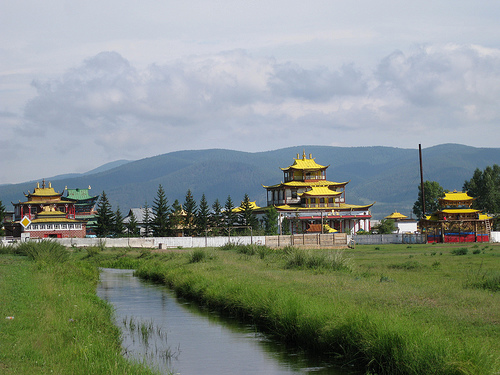
Location: 23 km (14 mi) South-west from Ulan Ude along highway A165, Buryatia Map
Open: daily
Admission: free (25 rubles- $0.80 for camera)
Official site
Ivolginsky Datsan (Russian: Иволгинский Дацан; also known as Gandan
Dashi Choinkhorlin, meaning something like "The Joyful Land of the
Wheel of Dharma") is the most important Buddhist monastery in Russia
and the center of the Buddhist Traditional Sangha of Russia (BTSR).
It is located in the Republic of Buryatia, about 23–36 km from
Ulan-Ude, near the village of Verkhnyaya Ivolga.
As a Gelug
(Yellow Hat) tradition Tibetan Buddhist monastery, it serves as a
hub for temple rites, traditional education, medical practice, and
cultural preservation for Buryat Buddhists. While relatively modern
(founded in 1945), its history is deeply intertwined with the
survival of Buddhism under Soviet rule, Buryat cultural resilience,
and the extraordinary story of the 12th Pandito Khambo Lama
Dashi-Dorzho Itigelov.
Buddhism reached the Buryat people (a Mongolic ethnic group in
Siberia) in the 17th–18th centuries, primarily via Mongolian and Tibetan
influences. Stationary datsans (monasteries) began appearing in the
mid-18th century, marking a shift from nomadic practices. The title of
Pandito Khambo Lama was officially recognized by the Russian state in
1764 as the head of Eastern Siberian (mainly Buryat) Buddhists. By the
early 20th century, there was a flourishing network of datsans with
printing houses, arts and crafts centers producing thangkas, statues,
and ritual items, and strong ties to Tibet, Mongolia, and China.
The
Russian Empire period saw relative tolerance, with Buddhism integrated
into state structures. However, the 1917 October Revolution and Soviet
era brought severe persecution. In the 1920s–1930s, under Stalin's
antireligious campaigns, nearly all datsans were destroyed, monks were
arrested, defrocked, sent to gulags, or executed, and religious
artifacts were confiscated or destroyed. By the early 1940s, no active
Buddhist monasteries remained in Transbaikalia.
Foundation in
1945: Survival Under Soviet Rule
Ivolginsky Datsan was established in
1945 as the only officially permitted Buddhist spiritual center in the
entire USSR. This was an extraordinary concession amid ongoing
repression. A group of Buryat monks and lay Buddhists petitioned
authorities (reportedly collecting signatures from surviving lamas), and
permission was granted by the Council of People’s Commissars of the
Buryat-Mongolian ASSR on May 3, 1945.
Reasons for approval are
debated:
A propaganda gesture to demonstrate "freedom of
conscience."
Gratitude for Buryat Buddhists' patriotic contributions
during WWII (fundraising for the Defense Fund).
A controlled outlet
for religious activity under state oversight.
It initially
operated as Khambin Sume (or Khambinskoe Sume) in the Srednyaya Ivolga
area (also called Monastic Centre). Early buildings were modest and
repurposed—often assembled from donated structures like a former prayer
house ("Mani"). In 1947, it moved to the Mangazhin-dobo site. The first
Sogchen dugan (main assembly hall) was built with local donations and
labor. External features like a gilded ganjir (spire) and Dharma wheel
with deer statues were added.
From 1946, it housed the Central
Spiritual Board of Buddhists of the USSR (later evolving into the BTSR),
making it the administrative and spiritual headquarters. It served a
"Potemkin" role as a showcase for limited religious tolerance while
remaining under strict surveillance.
Growth and Development
During the Soviet Era (1940s–1980s)
Despite repression, the datsan
expanded gradually through community donations, returned artifacts from
museums, and international gifts:
Buildings: A new three-story
wooden Sogchen dugan was built in the early 1970s (rebuilt after a 1976
fire). Other temples included Maidari (Maitreya), Devazhin, and
Sakhyusan dugans. A guesthouse and suburgans (stupas) were added.
Artifacts: Thousands of items (thangkas, statues, Kanjur volumes on
lacquered paper, ritual objects) were returned from the Antireligious
Museum in Ulan-Ude or donated by laity who had hidden them. Foreign
Buddhist delegations (from Mongolia, India, Sri Lanka, etc.) brought
gifts, especially via participation in organizations like the World
Fellowship of Buddhists.
Education and Role: It preserved Buddhist
education and practices on a limited scale. The Dashi Choinkhorling
Buddhist University opened in 1991.
The Dalai Lama visited multiple
times starting in 1979, highlighting its international significance.
The Itigelov Phenomenon: A Central Relic and Symbol
The datsan's
fame is inseparable from Dashi-Dorzho Itigelov (1852–1927), the 12th
Pandito Khambo Lama:
Born in Buryatia, orphaned young, he studied
extensively, became a teacher and abbot, and was elected Khambo Lama in
1911.
He supported Russia's war efforts (Russo-Japanese War and WWI),
fundraising and earning the Order of Saint Anna.
He wrote over 50
works on philosophy (emphasizing śūnyatā/emptiness), medicine, and
teachings.
In 1927, at age 75, he meditated in the lotus position,
chanted a death prayer, and passed away. He instructed disciples to
exhume his body after 30 years.
His body was secretly exhumed in
1955 and 1972 (showing no decay) and reburied to avoid Soviet
persecution. In 2002, following a dream vision, it was exhumed publicly
in the presence of experts. The body remains remarkably preserved—soft
skin, flexible joints, in lotus position—without traditional embalming.
It is housed in a glass case in a dedicated temple (Etigel Khambin or
similar) at the datsan, a major pilgrimage site believed to have
miraculous powers (healing, wish fulfillment, karma correction).
Scientists note possible natural preservation factors (salt packing,
genetics), but Buddhists attribute it to advanced meditation and
realization of emptiness. Itigelov's story symbolizes resilience and the
enduring power of Buddhist practice.
Post-Soviet Era and Modern
Significance
After 1991, with greater religious freedom, the datsan
expanded further (e.g., Green Tara temple in 2010, additional dugans).
It lost some exclusivity as other monasteries reopened, but remains the
premier center. A museum of the history of Russian Buddhism opened in
2019.
Today, the complex includes multiple temples (Tsogchen-dugan,
etc.), a university, library, museum of Buryat art, hotel, greenhouse
with a Bodhi tree, and residential buildings. It attracts pilgrims,
tourists, and scholars. Russian leaders like Putin and Medvedev have
visited.
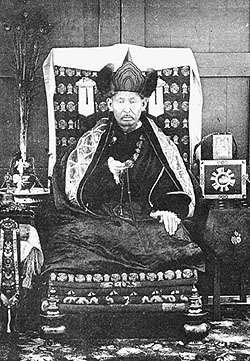
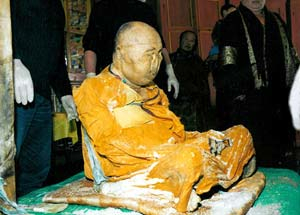
Dasha-Dorzho Itigilov
Overall Layout and Setting
The datsan occupies about 3 hectares
and includes multiple temples (dugans or sumes), stupas (suburgans),
residential buildings for lamas, a Buddhist university (Dashi
Choinkhorlin, opened 1991), a museum of Buddhist art, a library, a
greenhouse with a sacred Bodhi tree, a hotel/guest house, and service
buildings. Prayer wheels (khurde) line the perimeter; visitors
traditionally walk clockwise around the complex while spinning them.
The architecture features vibrant colors, multi-tiered roofs (often with
golden or gilded elements like ganjir finials and dharmachakra wheels
flanked by deer), ornate carvings, and symbolic elements drawn from
Tibetan, Mongolian, and Buryat traditions. Buildings are arranged in a
somewhat mandala-inspired layout, with the main temple central. The
steppe setting makes the colorful roofs and stupas stand out
dramatically, especially against snow in winter.
Main Temple:
Tsogchen Dugan (Sogchen / Tsogchen-dugan)
This is the largest and
central cathedral temple, rebuilt in its current form in 1976 after a
fire (a wooden three-storey structure on a stone basement). It serves as
the primary assembly hall.
Exterior: Three stories with traditional
proportions and ornamentation, despite using light-colored brick or wood
in earlier iterations. It has a prominent roof with Buddhist symbols,
protected symbolically by twelve stone lions at the base. The design
follows mandala principles.
Interior: Highly ornate with vibrant
murals, thangkas, columns, and a riot of colors. The main altar features
a large statue of Buddha Shakyamuni (central figure), surrounded by a
pantheon of a thousand Buddhas. There is also a throne and portrait of
the Dalai Lama XIV (not to be sat upon). The first level supports study
and prayer, the second preserves sacred texts, and the third (gonkan) is
an inner sanctum for guardian deities, encircled by an open gallery for
ceremonial processions.
Daily morning ceremonies (around 9 AM) are
often open to visitors.
Other Key Temples and Structures
Choyra Dugan (Faculty of Philosophy): The original main temple
(1947–1948), later repurposed. Built with extensions, a second floor,
and balcony; features traditional elements added over time.
Devazhin
Sume (Sukhavati, Pure Land of Buddha Amitabha): A mud-walled (adobe)
eight-sided two-storey building from 1970, one of the earlier
post-foundation structures.
Maidari Sume (Maitreya Temple): Small
wooden temple (1970–1973) housing statues of the future Buddha Maitreya
and bodhisattvas, gifted from Mongolia.
Sakhyusan Sume (Protector
Deities Temple): Wooden square building (1986) dedicated to dharmapalas
(guardians of the teaching), such as Lhamo and Zhamsaran.
Palace-Temple of Khambo Lama Itigelov (Etigel Khambin Temple): A special
wooden temple in Korean style, built to house the imperishable body of
Dashi-Dorzho Itigelov (exhumed and enshrined in 2002/2008). The project
drew from an earlier design by Itigelov himself. This is a major
pilgrimage site; the body is displayed on limited occasions.
Other
dugans: Green Tara Temple (Nogoон Dara Ekhyn sume, completed around
2010, impressive structure), Zhud Dugan (tantric), Maani Dugan
(Avalokiteshvara), Gunrig Dugan (Vairochana).
Stupas (suburgans) dot
the complex, adding vertical and symbolic elements.
Architectural
Style and Materials
Datsans in Buryatia adapt Tibetan models to local
conditions and materials. Early buildings used wood, brick, and adobe
due to Soviet constraints and local resources; later ones incorporate
more traditional craftsmanship. Key features include:
Multi-level
structures with galleries and balconies.
Ornate interiors with
painted beams, dragon motifs, lotuses, and symbolic colors.
Symbolic
guardians (lions, deities) and roof finials.
Integration of Buryat
artistic traditions (e.g., specific thangka styles and statuary by local
masters like Sanzhi-Tsybik Tsybikov).
The complex evolved
organically: starting from a modest donated wooden house in 1945,
expanding in the 1940s–1970s despite restrictions, and growing further
post-Soviet with new temples and the university.
Additional
Elements
Buddhist University (Dashi Choinkhorlin): Educational
buildings for philosophy, medicine, iconography, etc.
Museum and
Library: House rare manuscripts (including Kanjur on special paper),
thangkas, sculptures, and artifacts returned from Soviet museums or
donated internationally.
Greenhouse: Contains a sacred Bodhi tree.
Residential and Practical Buildings: Lamas' houses, guesthouse,
administrative offices, souvenir area, and even a small enclosure for
Siberian roe deer.
Ivolginsky Datsan represents
resilience—founded in 1945 as the sole official Buddhist center in the
USSR—and serves as a vibrant hub of Tibetan Buddhism (Gelug tradition)
in Russia, blending spiritual, educational, and cultural roles. Its
architecture, while constrained by history, authentically embodies
Buryat Buddhist identity through vibrant, symbolic design in a stark
Siberian landscape.
How to Get There
From Ulan-Ude: The journey takes 40–60 minutes by
road.
Public transport (budget option): Take marshrutka (minibus)
№130 or №125 from Banzarov Square (near Odigitrievsky Cathedral or
updated stops) to Ivolginsk village (about 40 minutes, ~40 RUB). Then
transfer to a local marshrutka to the datsan (another 10 minutes, ~25–30
RUB). The last return services run until around 9:30 PM—check current
schedules as they can change. Suburban bus №108 goes more directly but
less frequently.
Taxi or private car: Most convenient (RUB 550–850 or
more). GPS coordinates: approx. 51°45’32″N, 107°12’12″E. Roads are
generally good across rolling plains.
Organized tours: Many from
Ulan-Ude include transport, a guide, and sometimes entry to special
sites (500 RUB/person or less for groups).
Tip: Public transport
is straightforward but confirm times locally or via apps/Yandex. Renting
a car gives flexibility for combining with nearby sites like other
datsans or Old Believer villages.
Best Time to Visit
Year-round accessibility, but summer (June–August) offers pleasant
weather, longer days, and full temple access, though it can be busier
with tourists.
Shoulder seasons (May, September) provide milder
crowds and comfortable temperatures.
Winter brings a serene, snowy
atmosphere with fewer visitors—striking for photography and spiritual
reflection, but cold (prepare for sub-zero temps).
Major events:
Sagaalgan (Buryat Lunar New Year, usually Feb/March) or other Buddhist
holidays when Itigelov’s body may be more accessible for viewing and
special ceremonies. Prayers (khurals) often start around 9 AM.
Plan
for 2–4 hours on-site; it can be done as a half-day trip from Ulan-Ude.
Opening Hours and Fees
Generally open 9:00 AM – 6:00 PM (or until
5:00–6:00 PM; confirm on-site or via phone +7 30140 23377).
Entrance
to the grounds: Free.
Special access: Viewing Khambo Lama Itigelov’s
body (in Tsogchen-dugan or dedicated palace) may require a
donation/ticket (around 350 RUB) and is sometimes limited to festivals
or specific times. Guided tours: ~500 RUB/person.
What to See and
Do
Perform Goroo (clockwise circumambulation): At the entrance, walk
clockwise around the complex and sacred sites (odd number of times,
e.g., 3, 7, 21), spinning prayer wheels (khurde/hurde). This is a key
Buddhist practice—follow marked paths.
Main temples (dugans):
Tsogchen-dugan (main cathedral, 1970s), Sockshin-dugan, Maidarin-sume,
Devazhin, Sakhiusan-sume, and others. Many are open for visitors;
interiors feature vibrant murals, statues, and altars. Attend a khural
(prayer service) if timings align—non-Buddhists are welcome but observe
quietly.
Itigelov’s Temple-Palace: The highlight for many. The
preserved body is in a glass case; pilgrims believe it has miraculous
properties. Access may be restricted—follow signs and staff
instructions.
Other highlights: Buddhist University (Dashi
Choinhorlin), museum of Buddhist art, stupas (suburgans), library, and
surrounding grounds with prayer wheels and monuments. Souvenir shops
sell incense, prayer flags, beads, and local crafts.
Nearby: Combine
with visits to other Buryat sites or nature spots in the Ivolga Valley.
Visiting Etiquette and Rules (Very Important)
Datsans are active
holy places—respect is essential:
Walk clockwise around temples,
stupas, and the complex (never counterclockwise).
Do not turn your
back on Buddha statues, point at them with fingers, or sit on
thrones/altars (e.g., Dalai Lama’s throne).
Speak quietly; no
shouting, swearing, smoking, or loud behavior.
Photography: Allowed
outdoors and on grounds. Prohibited inside temples (no photos/video of
interiors, statues, or services). Look for signs.
Remove shoes before
entering temples; cover shoulders and knees (modest dress: long
pants/skirts, sleeves). Remove hats. Women and men follow similar rules.
Do not step on thresholds (considered sacred).
Donations: Use
designated spots; avoid random coin offerings.
Be mindful during
services—stand or sit as appropriate without disturbing.
Monks are
generally hospitable; you may receive tea or blessings, but follow their
lead.
Practical Tips
What to bring: Modest clothing layers
(weather can change), comfortable walking shoes (grounds are walkable,
accessible for wheelchairs/strollers), water/snacks (limited cafe
options with local fare like buuz), cash for
donations/souvenirs/transport, and insect repellent in summer.
Health/Safety: Altitude is low; standard precautions. Respectful
behavior ensures a positive experience.
Accommodations: Basic hotel
on-site or stay in Ulan-Ude. Day trip is sufficient for most.
For
your website: Emphasize the blend of Tibetan-Buryat traditions, Soviet
history (Stalin-era tolerance), and living spiritual center. Include
practical logistics, cultural context, and high-quality photos
(exteriors).
Language: Russian/Buryat dominant; some English at
visitor areas. Guided tours help.